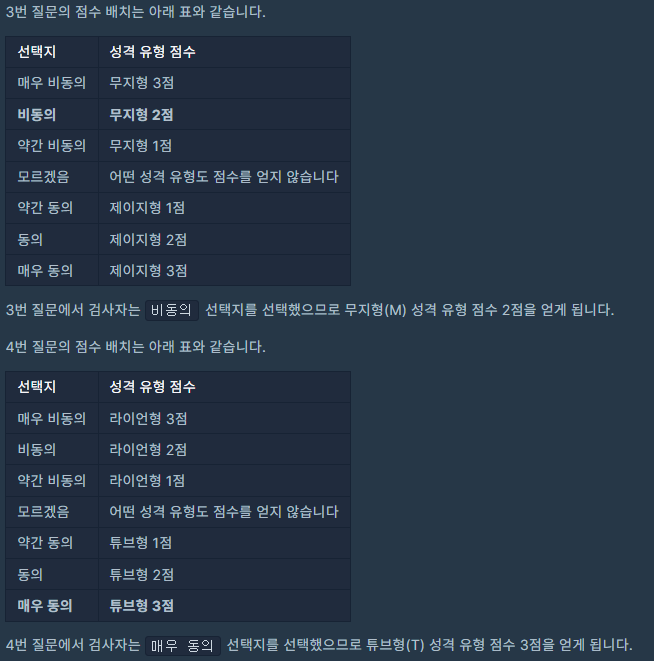
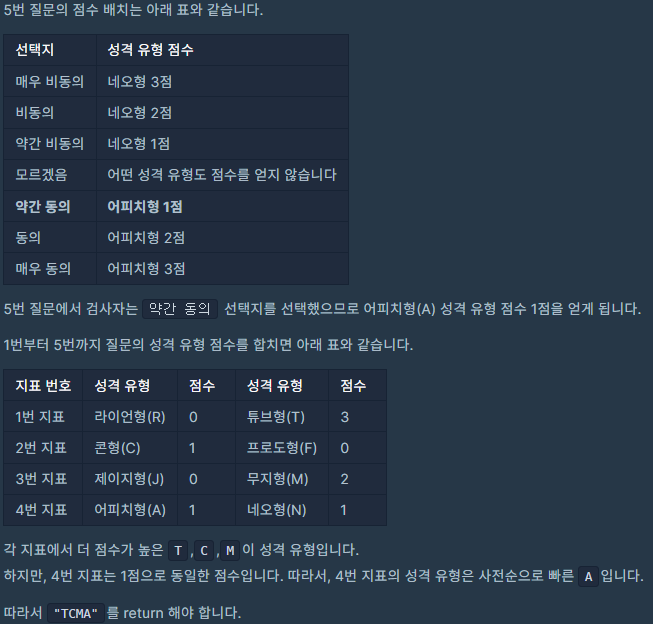
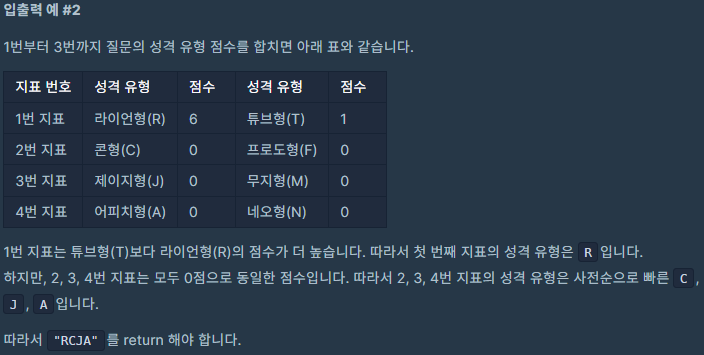
나의 풀이
import java.util.*;

class Solution {
    public String solution(String[] survey, int[] choices) {
        String answer = "";
        HashMap<Character, Integer> map = new HashMap<>();

        for (int i = 0; i < 26; i++) { // 1
            map.put((char)(i + 65), 0);
        }

        for (int i = 0; i < survey.length; i++) { // 2
            if (choices[i] < 4)
                map.put(survey[i].charAt(0), map.get(survey[i].charAt(0)) + 4 - choices[i]);
            else if (choices[i] > 4)
                map.put(survey[i].charAt(1), map.get(survey[i].charAt(1)) + choices[i] - 4);
        }

        if (map.get('T') > map.get('R')) answer += "T"; // 3
        else answer += "R";

        if (map.get('F') > map.get('C')) answer += "F";
        else answer += "C";

        if (map.get('M') > map.get('J')) answer += "M";
        else answer += "J";

        if (map.get('N') > map.get('A')) answer += "N";
        else answer += "A";

        return answer;
    }
}
과정
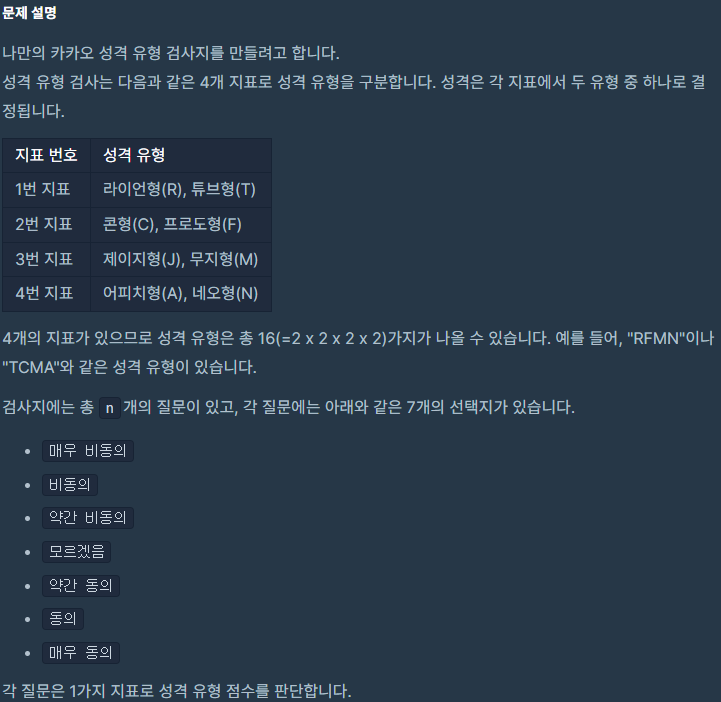
- map에 알파벳 대문자를 key값으로 넣어준다. 밸류는 0으로 모두 초기화
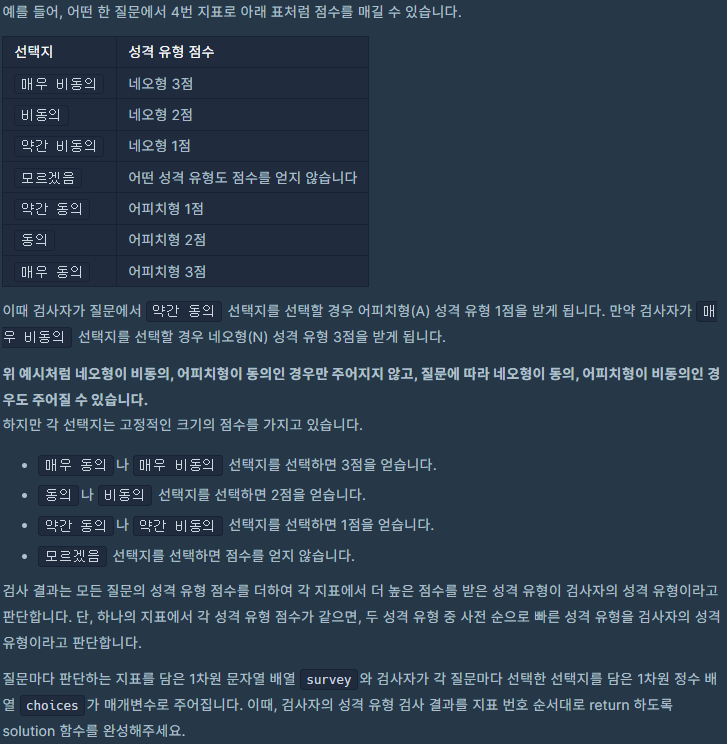
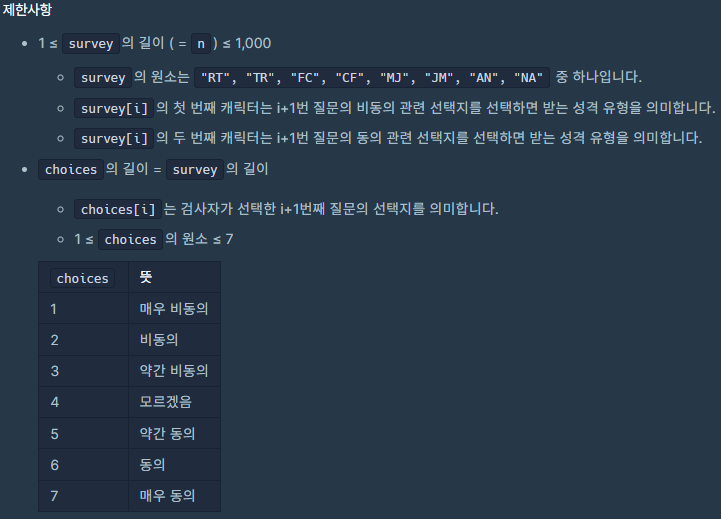
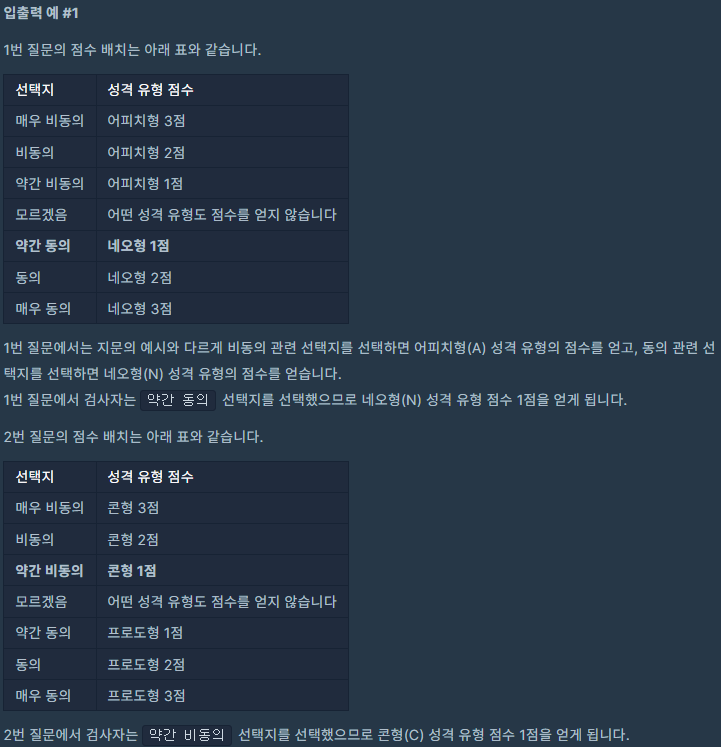
- survey를 순회하며 choices[i]와 survey[i]를 비교하여 map에 넣어준다(survey와 choices는 길이가 같다)
- 점수가 같으면 사전 순으로 빠른 성격 유형을 넣어주면 되니 더 늦은 유형이 크다면 늦은 유형을 넣어주고, 그 외에는 빠른 유형을 넣어주면 된다
다른 사람 풀이
import java.util.HashMap;

class Solution {
    public String solution(String[] survey, int[] choices) {
        String answer = "";
        char [][] type = {{'R', 'T'}, {'C', 'F'}, {'J', 'M'}, {'A', 'N'}};
        int [] score = {0, 3, 2, 1, 0, 1, 2, 3};
        HashMap<Character, Integer> point = new HashMap<Character, Integer>();

        // 점수 기록할 배열 초기화
        for (char[] t : type) {
            point.put(t[0], 0);
            point.put(t[1], 0);
        }

        // 점수 기록
        for (int idx = 0; idx < choices.length; idx++){
            if(choices[idx] > 4){
                point.put(survey[idx].charAt(1), point.get(survey[idx].charAt(1)) + score[choices[idx]]);
            } else {
                point.put(survey[idx].charAt(0), point.get(survey[idx].charAt(0)) + score[choices[idx]]);
            }
        }

        // 지표 별 점수 비교 후 유형 기입
        for (char[] t : type) {
            answer += (point.get(t[1]) <= point.get(t[0])) ? t[0] : t[1];
        }

        return answer;
    }
}
study