Django URLs
- 요청과 응답에서 Django URLs의 역할
- 요청 URL에 따라 실행될 view 함수가 달라진다.
- URL dispatcher
- URL 패턴을 정의하고 해당 패턴이 일치하는 요청을 처리할 view 함수를 연결(매핑)
Variable Routing
<path_converter:variable_name>- 템플릿의 많은 부분이 중복되고, URL의 일부만 변경되는 상황이라면
urlpatterns = [ path('articles/1/', ...), path('articles/2/', ...), path('articles/3/', ...), ..., ] - Variable Routing이란, URL 일부에 변수를 포함시키는 것
- 변수는 view 함수의 인자로 전달할 수 있음
urlpatterns = [ path('articles/<int:num>/', ...), ] - 요청 URL의
<int:num>,<str:name>의 위치에 들어있는 값이 변수처럼 취급됨- 정수 num 변수가
views.detail에, 문자열 name 변수가views.greeting에 키워드 인자로 전달됨 - 예) 요청 URL이
/articles/10/이면,views.detail(request, num=10)의 형태로 호출
- 정수 num 변수가
- Path Converter
- URL 변수의 타입을 지정
- str, int 등 5가지 타입 지원
- Path Converter의 변수명과 View 함수의 파라미터 이름은 같아야 함
- 변수는 view 함수의 인자로 전달할 수 있음
- Variable Routing 실습
- urls.py
urlpatterns = [ path('articles/<int:num>/', views.detail), ] - views.py
def detail(request, num): context = { 'num': num, } return render(request, 'articles/detail.html', context) - articles/detail.html
{% extends 'articles/base.html' %}

{% block content}
	<h1>Detail</h1>
	<h3>{{ num }}번 글 입니다.</h3>
{% endblock content %}
- urls.py
App URL mapping
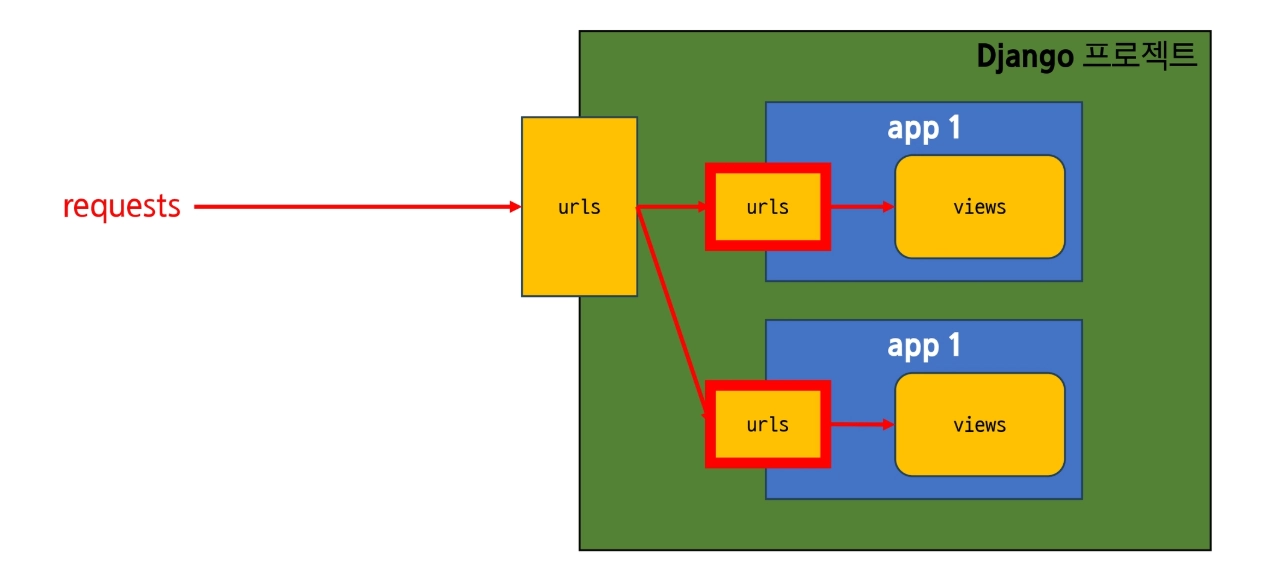
-
각 앱의
urls.py에서 각자의 URL 관리 -
App URL mapping이란, 각 앱에 URL을 정의하는 것
- 프로젝트와 각 앱이 URL을 나누어 관리를 편하게 하기 위함
- 서로 다른 앱의 URL들이 섞이지 않도록 나누어 관리하는 방법
-
include 함수
include('app.urls')- 프로젝트 내부 앱들의 URL을 참조할 수 있도록 매핑하는 함수
- URL의 일치하는 부분까지 잘라내고, 남은 문자열 부분은 후속 처리를 위해 include된 URL로 전달
- 각 앱에서 urls.py를 만들고
from django.urls import path from . import views urlpatterns = [ path('index/', views.index), ] - 프로젝트 urls.py에서
include()로 추가from django.urls import path, include urlpatterns = [ path('articles/', include('articles.urls')), ]
URL 이름 지정
Naming URL patterns
- URL에 이름을 지정하는 것
- path 함수에 name 인자를 키워드 인자로 정의해서 사용
- URL 표기 변화
- 해당 url을 사용했던 곳의 링크 변경
- articles/urls.py
from django.urls import path from . import views urlpatterns = [ path('index/', views.index, name='index'), ] - articles/index.html 변화
# 전
{% extends 'articles/base.html' %}

{% block content}
	<h1>Hello, {{ name }}</h1>
	<a href="/dinner/">dinner</a>
	<a href="/search/">search</a>
	<a href="/throw/">throw</a>
{% endblock content %}
# 후 {% extends 'articles/base.html' %} {% block content} <h1>Hello, {{ name }}</h1> <a href="{% url 'dinner' %}">dinner</a> <a href="{% url 'search' %}">search</a> <a href="{% url 'throw' %}">throw</a> {% endblock content %}
- articles/urls.py
- 해당 url을 사용했던 곳의 링크 변경
DTL URL tag
{% url 'url_name' arg1 arg2 %}urltag- 주어진 URL 패턴의 이름과 일치하는 절대 경로 주소를 반환
- URL에 이름을 붙였을 경우 url 태그와 이름을 이용해 템플릿 상에서 이름으로 실제 주소를 작성할 수 있게 해준다.
- URL 패턴에 변수가 포함되어 있으면, ‘url_name’ 이후 추가
- aricles/index.html
{% extends 'articles/base.html' %}

{% block content}
	<h1>Articles</h1>
	<a href="{% url 'detail' 1 %}">Article 1</a>
	<a href="{% url 'detail' 2 %}">Article 2</a>
	<a href="{% url 'detail' 3 %}">Article 3</a>
{% endblock content %}
- aricles/index.html
- DTL의 for 태그에서 사용한 변수 이름 사용 가능
- aricles/index.html
{% for num in nums %}
	<a href="{% url 'detail' num %}">Article {{ num }}</a>
{% endfor %}
- aricles/index.html
- 주어진 URL 패턴의 이름과 일치하는 절대 경로 주소를 반환
URL 이름 공간
app_name 속성
- urls.py에 app_name 변수 설정
- articles/urls.py
app_name = 'articles' urlpatterns = [ path('index/', views.index, name='index'), ] - pages/urls.py
app_name = 'pages'
urlpatterns = [
		path('index/', views.index, name='index'),
]
- articles/urls.py
- app_name이 추가 또는 수정되면 url 태그에도 해당 내용이 반영되어야 함
{% url 'app_name:path_name' arg1 arg2 %}

🌱 🐜