논문 리뷰 - Attention Is All You Need
Abstract, introduction
1. 기존 모델의 한계
- 주로 사용되는 sequence transduction 모델들은 Encoder와 Decoder를 포함하는 복잡한 Recurrent 혹은 Convolutional Neural Networks 기반
2. 새로 제안하는 모델 new simple network architecture, the Transformer
-
전적으로 Attention 메커니즘에 기반하고, Recurrence와 Convolution을 완전히 제거
-
성능
- parallelizable(병렬) -> 학습 시간 단축
- WMT 2014 English-to-German translation task: 28.4 BLEU (ensemble 보다도 우위)
- WMT 2014 English-to-French translation task: 41.4 BLEU (single model SOTA)
3. Sequential computation 의 단점
- RNN, LSTM, gated RNN
- sequential nature: 병렬 불가
- memory constraints
4. Recent works achieved
- Computional efficiency (계산 효율성: factorization tricks, conditional computation)
- Improving model performance
-> 그러나, Sequential computation의 근본적인 제약 여전히 존재
5. Transformer
- Recurrence를 배제하고 전적으로 Attention 메커니즘에 의존하는 모델 아키텍처
- draw global depencies between input and output(입력과 출력 간의 전역적인 종속성을 도출)
- more parallelization, train faster, reach SOTA
Model Architecture
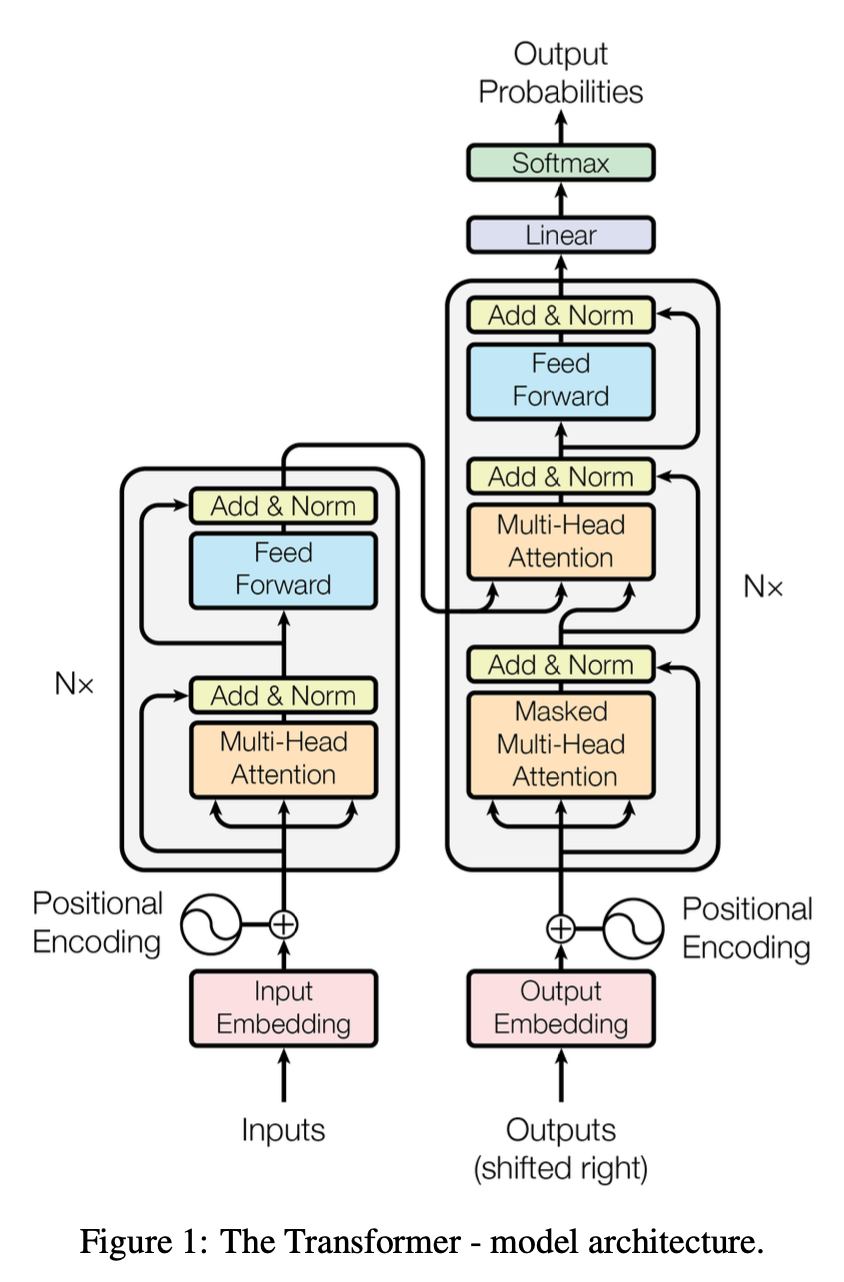
- Encoder-Decoder 구조
- Encoder: 입력 시퀀스의 symbol 표현을 연속적인 표현(z)의 시퀀스로 mapping
- Decoder: z -> 한 번에 하나씩 출력 시퀀스의 symbol 생성
- each step: auto-regressive 방식으로, 이전에 생성된 symbol들을 추가적인 입력으로 사용
- encoder, decoder both: stacked Self-Attention 및 point-wise, fully connected layers로 구성
Encoder and Decoder Stacks
Encoder
-
stack of N=6 identical layers
-
each layer has 2 sub-layers
- multi-head attention
- position-wise fully connected feed-forward network
-
각 sub-layer 주위에 residual connection을 추가하여
LayerNorm(x + Sublayer(x))형식으로 layer normalization 적용 -
출력 차원: 512 (embedding layer, sub-layers 모두)
Decoder
-
encoder와 동일, N=6 identical layers
-
3 sub-layers
- encoder 와 동일한 sublayer에 하나의 sublayer 추가: Encoder stack의 출력에 대해 Multi-Head Attention 수행
Attention
-
Query와 Key-Value pair 집합을 입력으로 받아 출력(벡터)을 생성
-
Output: weighted sum of the values(V)
- Weight: Query와 해당하는 Key 간의 유사도 함수(compatibility function)로 계산
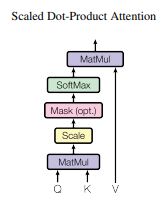
Scaled Dot-Product Attention
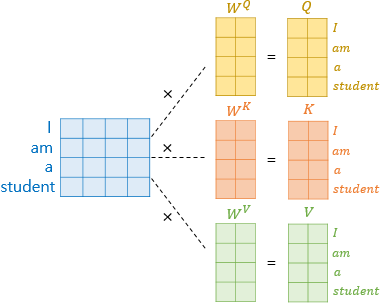 | 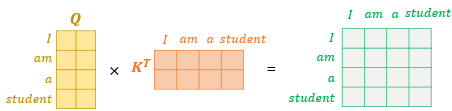 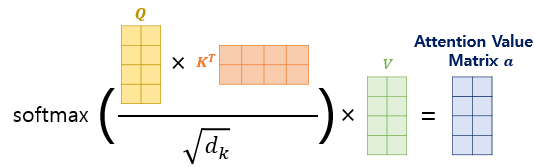 |
|---|
input: Query와 Key는 차원이 , Value는 차원이 인 벡터들로 구성
- : Query 행렬
- : Key 행렬
- : Value 행렬
- : Key의 차원
- Query와 Key의 내적 수행 -> 그 값을 Key의 차원의 제곱근으로 나눔 -> softmax 함수 적용하여 Attention Weight 계산 -> Weight를 Value 행렬에 곱해 최종 Attention 출력 생성
cf. Attention functions
-
Additive Attention
- Query와 Key를 합하여 비선형 변환을 거친 후, softmax를 적용하여 Attention Weight 계산
- 계산량 많음
-
Dot-Product (Multiplicative) Attention
- Query와 Key의 내적 통해 유사도를 계산
- 비교적 계산이 간단하지만, 차원이 큰 경우 값이 커져 학습이 어려워질 수 있음
-
Scaled Dot-Product Attention
- Dot-Product Attention에 scaling 추가
- 차원이 큰 경우 발생할 수 있는 문제 해결
Multi-Head Attention
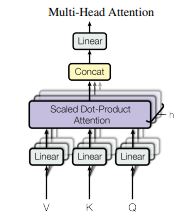
- 여러 개(h개)의 attention head 병렬로 사용
- 각 head 에서 독립적으로 Q, W, V 계산(scaled dot-product attention)
- 병렬 수행 결과 concatenate -> linear -> final values
- 수행 이유: 다양한 시점에서의 정보를 보다 풍부하게 학습하기 위해
각 Attention head:
- , , : Query, Key, Value 행렬
- , , : Query, Key, Value 행렬에 각각 적용되는 학습 가능한 가중치 행렬
- : 각 헤드의 출력을 결합한 후 적용되는 출력 가중치 행렬
- : 번째 Attention 헤드의 출력
- : 여러 Attention 헤드 결합
- : Attention 헤드의 수
Multi-head
- Query, Key, Value 행렬을 각각의 Attention 헤드에 대해 다른 가중치 행렬(, , )로 변환하여, 병렬로 여러 Attention 연산 수행
Scaled Dot-Product Attention
- 각 헤드에서 변환된 Query, Key, Value를 사용하여 Scaled Dot-Product Attention을 계산
- 이때 각 헤드는 다른 가중치 행렬을 사용하므로, 서로 다른 특성을 학습할 수 있음
Concatenate
- 여러 Attention 헤드의 출력 concatenate 하나의 큰 벡터로 만듭니다. 이는 서로 다른 정보가 함께 합쳐진 상태를 의미합니다.
Linear layer
- 최종 출력 생성
Applications of Attention in our Model
Transfor가 multi-head attention을 사용하는 세 가지 방법
Encoder-decoder attention layer:
- Encoder와 Decoder 사이의 정보 연결
- Decoder의 Query가 Encoder에서 생성된 Key, Value와 상호작용하여 Decoder가 입력 시퀀스에서 중요한 정보에 집중할 수 있게 함
- 이를 통해 번역 작업이나 sequence-to-sequence 문제에서 이전에 입력된 단어들과 관련된 정보를 잘 포착하는 데에 도움 줌
Self attention layer in encoder:
- Encoder 내부에서 Self-Attention 사용
- 입력 시퀀스 내에서 각 단어가 다른 단어들과 어떻게 연관되어 있는지를 계산하여 문맥 정보 포착
Self attention layer in decoder:
- 이전에 생성된 단어들 간의 관계를 학습하고, 이를 바탕으로 다음 단어 예측
- Masked Self-Attention을 사용하여, 현재 단어 이후의 정보는 참조하지 않음
Position-wise Feed-Forward Networks
- 각 위치에서 독립적으로, 동일한 Fully Connected Layer 적용
- 두 개의 Linear Layer와 ReLU 활성화 함수
- 입력 벡터 -> linear layer -> ReLU(비선형성 추가) -> linear layer -> 출력 벡터
- 각 위치에서 병렬적으로 수행
Embeddings and Softmax
- 단어의 정수 인덱스를 실수 벡터로 매핑
- 출력층: softmax 함수 적용하여 각 단어가 다음에 나올 확률 계산
Positional Encoding
- Transformer는 순서를 고려하지 않는 Self-Attention 메커니즘을 사용하기 때문에, positional encoding 통해 입력 시퀀스의 위치 정보를 추가적으로 인코딩
- sin, cos
- 학습x, 고정된 방식으로 계산
- 각 입력 벡터에 더해져 위치정보 반영
Why Self-Attention
- 각 요소가 다른 모든 요소와 상호작용: global dependency
- sequential computation 한계 극복
- 병렬 -> 학습 속도 향상
- 긴 의존성 효과적으로 처리: 긴 sequence에서 우수한 성능
Training
- optimizer: adam
- regularization(과적합 방지): dropout, label smoothing
Results
- model variations: layer 수, attention head 수, hidden layer 크기 변경 통해 최적화 가능
- 영어 구문 분석(constisuency parsing)에서 우수한 성능