
Dynamic Array
크기가 가변적인 배열, 필요에 따라 크기가 자동으로 조정되는 자료구조Implementation
#include <iostream>
using namespace std;

class DynamicArray {
private:
    int* arr;       // 동적 배열을 가리키는 포인터
    int capacity;   // 배열의 전체 용량
    int size;       // 현재 요소 개수

public:
    // 생성자: 초기 용량 설정
    DynamicArray(int initial_capacity = 2) {
        capacity = initial_capacity;
        size = 0;
        arr = new int[capacity]; // 초기 배열 할당
    }

    // 소멸자: 메모리 해제
    ~DynamicArray() {
        delete[] arr;
    }

    // 배열에 요소 추가 (끝에 추가)
    void push_back(int value) {
        if (size == capacity) {
            resize(); // 배열 확장
        }
        arr[size] = value; // 요소 추가
        size++;
    }

    // 특정 인덱스의 요소 가져오기
    int get(int index) const {
        if (index >= 0 && index < size) {
            return arr[index];
        }
        throw out_of_range("Index out of range");
    }

    // 배열 크기 반환
    int get_size() const {
        return size;
    }

    // 배열 전체 용량 반환
    int get_capacity() const {
        return capacity;
    }

    // 배열 요소 출력
    void print() const {
        for (int i = 0; i < size; i++) {
            cout << arr[i] << " ";
        }
        cout << endl;
    }

private:
    // 배열의 크기를 두 배로 늘리는 메서드
    void resize() {
        int new_capacity = capacity * 2;
        int* new_arr = new int[new_capacity];

        // 기존 배열의 요소들을 새 배열로 복사
        for (int i = 0; i < size; i++) {
            new_arr[i] = arr[i];
        }

        // 기존 메모리 해제하고 새 배열로 교체
        delete[] arr;
        arr = new_arr;
        capacity = new_capacity;
    }
};

int main() {
    DynamicArray darray;

    // 배열에 요소 추가
    darray.push_back(10);
    darray.push_back(20);
    darray.push_back(30);
    darray.push_back(40);

    // 배열 출력
    cout << "Array elements: ";
    darray.print();

    // 배열 크기와 용량 확인
    cout << "Array size: " << darray.get_size() << endl;
    cout << "Array capacity: " << darray.get_capacity() << endl;

    // 특정 인덱스의 요소 접근
    cout << "Element at index 2: " << darray.get(2) << endl;

    return 0;
}
Output
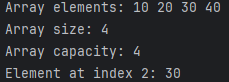
Efficiency
| Time Complexity | Explaination | |
|---|---|---|
| Search | O(1) | 연속된 메모리 공간을 사용하므로 특정 인덱스를 빠르게 접근 가능. |
| Insertion | O(1)(평균), O(n)(재할당시) | 끝에 요소를 추가할 때 평균적으로 O(1), 용량이 초과하면 크기를 두 배로 재할당하여 O(n). |
| Deletion | O(n) | z중간 요소를 삭제할 경우, 이후 요소들을 모두 이동해야 함. O(n) |
| 재할당 복사 | O(n) | 크기가 초과할 경우, 두 배 용량의 새로운 메모리를 할당하고 기존 데이터 복사하는 작업 발생. |
| Space Complexity | O(n) | n개의 요소를 저장하는 O(n)의 공간이 필요. |
Efficiency Summary
크기가 불확실하거나 자주 변하는 데이터를 저장할 때 유리
랜덤 접근이 빈번히 필요한 경우 - 배열처럼 특정 인덱스의 데이터에 상수 시간으로 빠르게 접근 가능

중간에서 빈번한 삽입/삭제가 필요한 경우 부적합
쓰레드 지원 안함
STL
std::vector
메모리 관리가 자동화된 형태로 구현 됨
크기 조절, 메모리 관리 수월
Festina Lente, Slow and steady wins the game