Top 10 DevOps Tools You Must Know in 2025
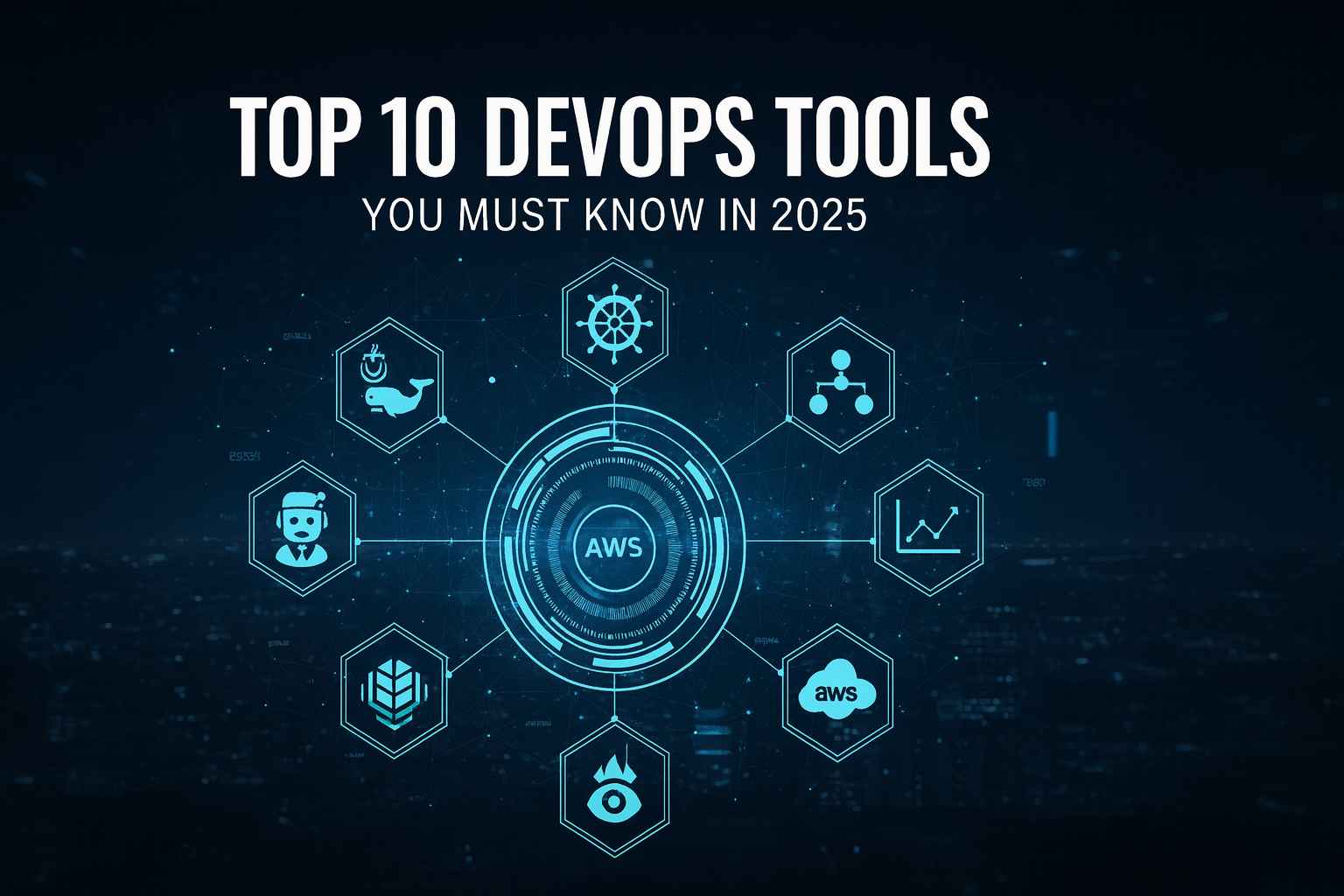
The demand for DevOps Engineers continues to rise as companies rapidly adopt automation, cloud computing, and continuous integration/continuous delivery (CI/CD). DevOps is no longer just a trend—it is the backbone of modern software development. As we move into 2025, mastering the right tools is essential for staying ahead in the tech industry.링크텍스트
DevOps tools help streamline workflows, improve collaboration, automate repetitive tasks, enhance system reliability, and accelerate deployments. In this guide, we explore the Top 10 DevOps Tools You Must Know in 2025, covering version control, CI/CD, configuration management, containerization, orchestration, infrastructure as code, and monitoring.
- Git & GitHub
Git is the most widely used version control system, allowing teams to collaborate seamlessly on code. GitHub enhances Git with cloud repositories, pull requests, workflows, and DevOps automation.
Key Features
Distributed version control
Branching & merging
GitHub Actions for CI/CD
Repository management
Code collaboration tools
Why It Matters in 2025
Version control is the foundation of all DevOps workflows. Git and GitHub remain industry standards.
- Jenkins
Jenkins is one of the most popular CI/CD automation servers. It automates building, testing, and deploying applications.
Key Features
Hundreds of plugins
Pipeline-as-code
Supports multiple programming languages
Easily integrates with Git, Docker, Kubernetes
Why It Matters in 2025
Companies still rely heavily on Jenkins due to its flexibility and large ecosystem.
- Docker
Docker revolutionized application deployment using containerization, allowing software to run consistently across environments.
Key Features
Lightweight containers
Portable and reproducible builds
Docker Compose for multi-container apps
Huge Docker Hub image library
Why It Matters in 2025
Docker is essential for microservices, cloud-native applications, DevOps pipelines, and scalable deployments.
- Kubernetes (K8s)
Kubernetes is the leading container orchestration platform, widely used to manage containerized applications at scale.
Key Features
Automatic scaling
Load balancing
Self-healing
Rolling updates
Multi-cloud support
Why It Matters in 2025
Companies require scalable, resilient architectures—Kubernetes is the backbone of modern cloud-native systems.
- Terraform
Terraform is the most popular Infrastructure as Code (IaC) tool for provisioning cloud resources.
Key Features
Cloud-agnostic (AWS, Azure, GCP)
Declarative configuration
Version-controlled infrastructure
Automated provisioning
Why It Matters in 2025
IaC is critical for scalable, repeatable, and automated cloud deployments. Terraform remains the leader.
- Ansible
Ansible is an easy-to-learn configuration management and automation tool.
Key Features
Agentless architecture
YAML-based playbooks
Application orchestration
Automated configuration enforcement
Why It Matters in 2025
Its simplicity, reliability, and agentless model make Ansible a top choice for DevOps teams.
- Prometheus
Prometheus is a leading monitoring and alerting tool used widely with Kubernetes and cloud-native systems.
Key Features
Time-series metrics storage
AlertManager
Grafana integration
Scalable monitoring for microservices
Why It Matters in 2025
As systems grow more complex, monitoring becomes essential. Prometheus is the industry standard.
- Grafana
Grafana is a powerful data visualization and analytics platform used for building dashboards.
Key Features
Custom visual dashboards
Integrations with Prometheus, Loki, InfluxDB
Real-time monitoring
Alerts and insights
Why It Matters in 2025
Grafana provides deep observability into system performance—critical for DevOps success.
- GitLab CI/CD
GitLab is an all-in-one DevOps platform that supports version control, CI/CD, security, and DevSecOps workflows.
Key Features
Built-in CI/CD pipelines
Code scanning and security features
Kubernetes integration
Automated deployments
Why It Matters in 2025
DevOps teams prefer unified platforms. GitLab offers everything in a single environment.
- AWS DevOps Tools
AWS provides an entire suite of DevOps services for cloud-native automation.
Popular Tools
AWS CodePipeline
AWS CodeBuild
AWS CodeDeploy
CloudFormation
CloudWatch
Why It Matters in 2025
Cloud DevOps continues to grow, and AWS remains the top cloud provider.
Bonus Tools Worth Learning
11. Argo CD
A GitOps tool for Kubernetes deployments.
- Helm
Package manager for Kubernetes applications.
- ELK Stack (Elasticsearch, Logstash, Kibana)
A powerful log aggregation and analytics suite.
These tools complement the DevOps ecosystem and enhance automation, monitoring, and workflow efficiency.
How to Choose the Right DevOps Tools
When selecting DevOps tools, consider:
The project’s size and architecture
Cloud vs on-premise hosting
Need for automation and scalability
Skill level of your team
Integration with existing tools
Every DevOps engineer should understand the entire toolchain, even if not mastering all of them.
Why DevOps Tools Matter in 2025
As organizations continue digital transformation, DevOps tools will power:
Faster releases
Fewer failures
Automated workflows
Scalable cloud-native systems
Enhanced developer productivity
Stronger security & compliance
Companies increasingly expect engineers to be familiar with DevOps methodologies and tools.
Conclusion
The DevOps landscape continues to evolve, but the core tools—Git, Jenkins, Docker, Kubernetes, Terraform, Ansible, Prometheus, Grafana, GitLab, and AWS DevOps services—remain essential for 2025 and beyond. Mastering these tools will make you highly competitive in the job market and enable you to build efficient, scalable, automated, and reliable systems.
Whether you're beginning your DevOps journey or advancing your skills, learning these tools will help you grow into a strong and future-ready DevOps Engineer.