This paper explores how to evolve artificial intelligence into artificial wisdom, drawing parallels with human wisdom to address complex challenges like loneliness. It proposes a framework for AI that not only processes information but also applies it with judgment and understanding.
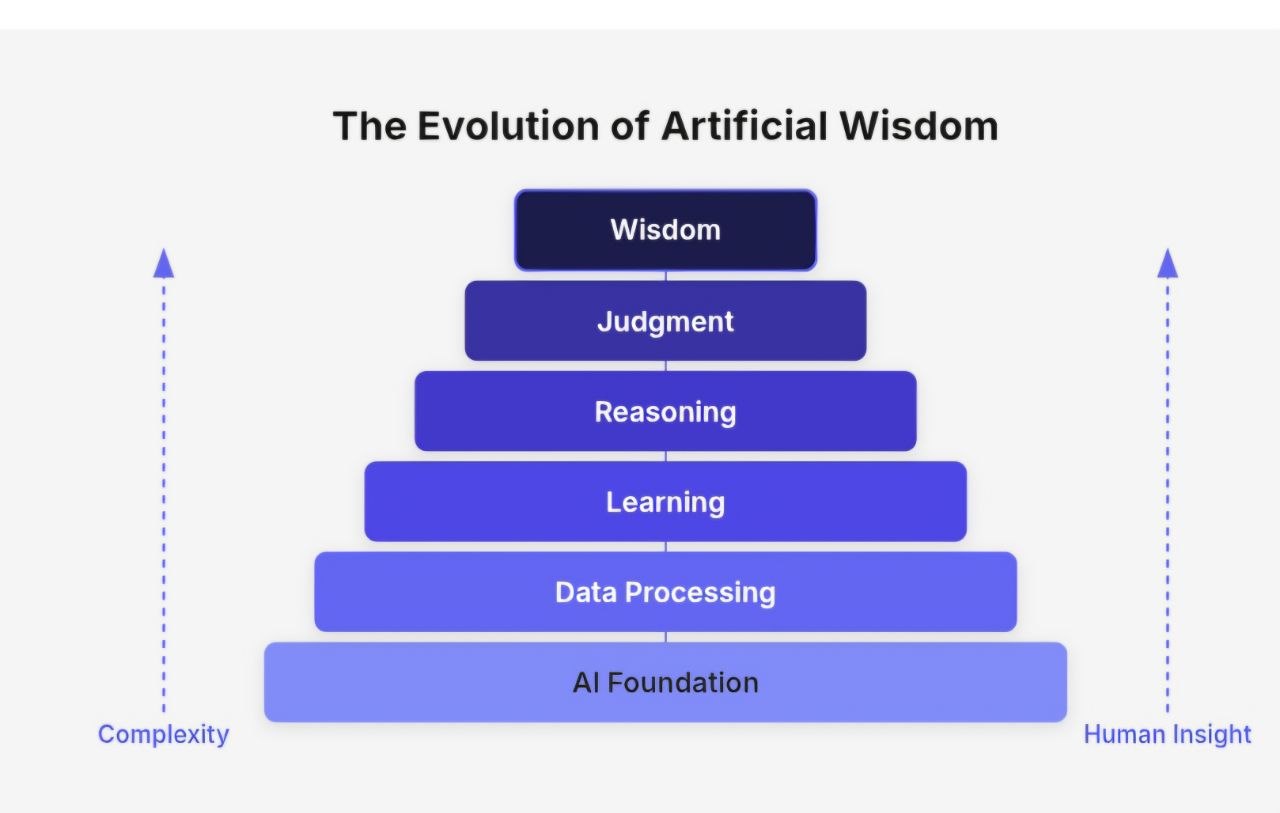
1. Transforming Artificial Intelligence into Artificial Wisdom
This section outlines the conceptual shift from artificial intelligence to artificial wisdom, drawing parallels with human wisdom to address complex societal challenges.
1.1. The Need for Artificial Wisdom
- Loneliness as a Public Health Concern
- The World Health Organization (WHO) has declared loneliness a global public health concern.
- Loneliness and social isolation are recognized as significant risk factors for mortality and various health issues, including cardiovascular disease.
- Limitations of Current AI
- Current AI excels at processing information but often lacks the nuanced understanding, judgment, and ethical considerations characteristic of human wisdom.
- This gap limits AI's ability to address complex, human-centric problems like loneliness effectively.
- Defining Artificial Wisdom
- Artificial wisdom aims to imbue AI with capabilities beyond mere data processing, incorporating judgment, understanding, and ethical reasoning.
- This evolution is crucial for AI to contribute meaningfully to solving multifaceted societal issues.
1.2. Framework for Artificial Wisdom
- Core Components of Wisdom
- Research on wisdom identifies key characteristics such as cognitive, emotional, and social regulation, as well as prosocial behaviors.
- These components include aspects like empathy, self-compassion, and the ability to navigate complex life situations.
- Bridging AI and Human Wisdom
- The goal is to develop AI that not only learns from data but also applies that knowledge with a level of judgment and understanding akin to human wisdom.
- This involves integrating ethical considerations and a deeper comprehension of human experience into AI systems.
- Potential Applications
- AI systems could be developed to offer more nuanced support in areas like mental health, addressing issues such as loneliness.
- This requires a shift from purely data-driven AI to systems that exhibit characteristics of wisdom.
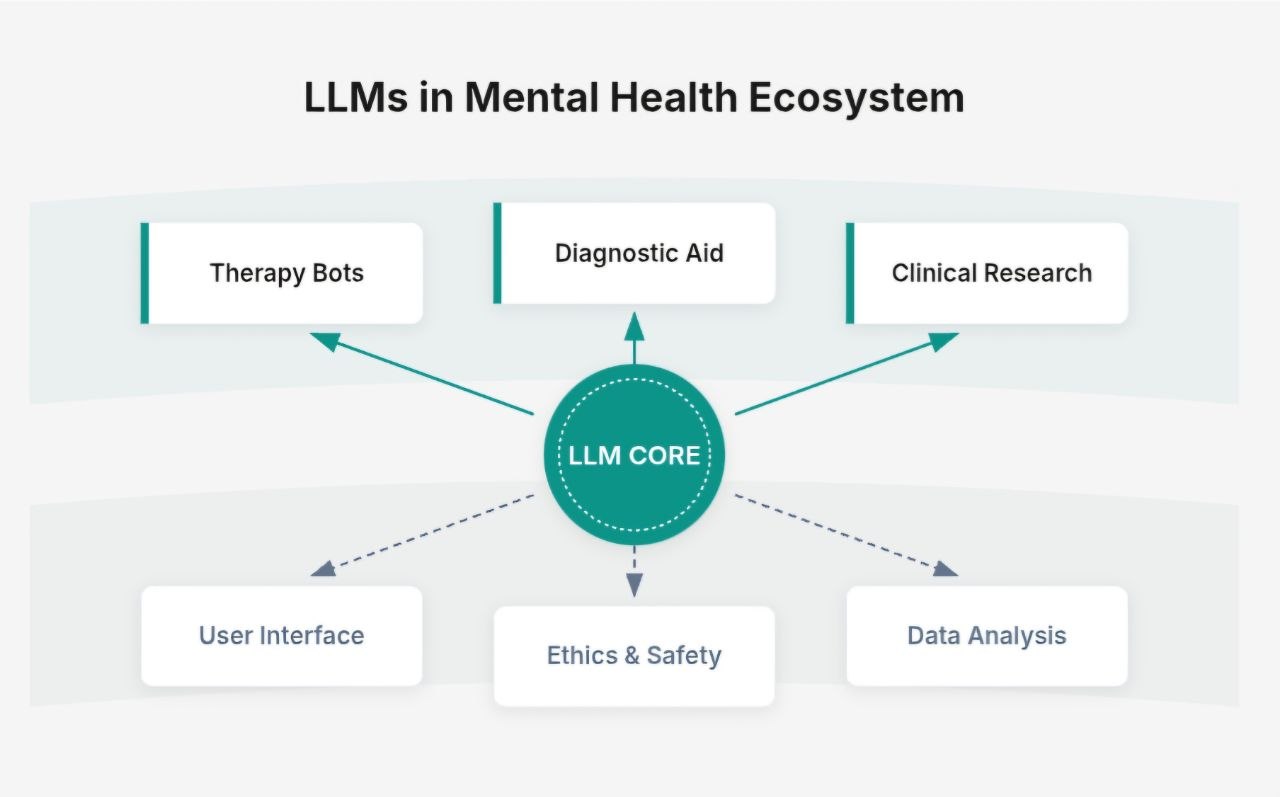
2. The Role of Large Language Models (LLMs) in Mental Health
This section explores the current and potential applications of Large Language Models (LLMs) in mental health, highlighting their capabilities, limitations, and ethical considerations.
2.1. LLMs in Mental Healthcare Applications
- Therapeutic Chatbots
- LLMs are being used to develop conversational agents for delivering cognitive behavioral therapy (CBT) and other therapeutic interventions.
- Examples include systems designed to help young adults with symptoms of depression and anxiety.
- Research is ongoing to compare the efficacy of different LLM-based chatbots in mental healthcare.
- Research and Analysis
- LLMs are employed in psychiatric research for tasks ranging from statistical analysis to deep learning applications.
- They facilitate the translation of research findings into practical care.
- Ethical Considerations
- The use of generative AI in mental healthcare raises ethical questions that require careful evaluation.
- Ensuring patient privacy and data security is paramount when using these technologies.
2.2. Advancements and Challenges in LLM Development
- Architectural Innovations
- Key advancements include the "Attention is All You Need" model, which introduced the Transformer architecture, and the development of few-shot learners.
- Mixture-of-Experts (MoE) architectures, such as GLaM and DeepSpeed-MoE, enable scaling to trillion-parameter models by efficiently distributing computation.
- Techniques like GShard and Switch Transformers facilitate the training and deployment of massive models through techniques like conditional computation and automatic sharding.
- Training and Alignment
- Methods like Direct Preference Optimization (DPO) and supervised fine-tuning are used to align LLMs with human preferences and values.
- Techniques such as "Supervising Strong Learners by Amplifying Weak Experts" and "Annotator in the Loop" aim to improve model performance and safety through expert feedback.
- Research also focuses on concrete problems in AI safety and the ethical implications of AI development.
- Current Capabilities and Limitations
- LLMs like GPT-4 demonstrate impressive capabilities in various tasks, including understanding human emotions and generating text for medical contexts.
- However, challenges remain in areas such as theory of mind, empathy, and the potential for deceptive patterns in AI interactions.
- Ongoing research evaluates LLMs for their performance in specific domains, such as mental health treatment and psychiatric diagnosis interpretation.
'인공지능(AI)을 넘어 인공지혜(Artificial Wisdom)로의 진화'와 '정신 건강 분야에서의 거대언어모델(LLM) 활용'에 관한 논문 요약입니다.
1. 인공지능(AI)이 '지혜'를 가져야 하는 이유
지금의 AI는 정보를 처리하는 능력은 뛰어나지만, 사람처럼 상황을 깊이 이해하거나 윤리적인 판단을 내리는 '지혜'는 부족합니다.
- 외로움 문제 해결: 세계보건기구(WHO)는 '외로움'을 심각한 건강 문제로 규정했습니다. 하지만 현재의 AI는 데이터만 처리할 뿐, 사람의 복잡한 감정을 진심으로 이해하고 위로하는 데 한계가 있습니다.
- 인공지혜(Artificial Wisdom)란? 단순히 지식을 전달하는 것을 넘어, 공감, 윤리적 판단, 상황에 맞는 조언을 할 수 있는 능력을 말합니다. AI가 우리 사회의 복잡한 문제(정신 건강 등)를 해결하려면 반드시 이 '지혜'의 단계로 진화해야 한다는 것이 핵심입니다.
2. 정신 건강을 돕는 AI (거대언어모델, LLM)
우리가 흔히 아는 챗GPT 같은 모델들이 정신 건강 분야에서 어떻게 쓰이고 있는지 설명합니다.
- 치료사 역할을 하는 챗봇: 우울증이나 불안감을 느끼는 사람들에게 인지행동치료(CBT) 같은 상담 서비스를 제공합니다.
- 연구와 분석: 방대한 정신의학 데이터를 분석해서 환자에게 더 나은 치료법을 찾는 데 도움을 줍니다.
- 해결해야 할 숙제: 환자의 개인정보를 보호해야 하는 윤리적 문제와, AI가 정말로 사람의 마음을 이해하는지(공감 능력)에 대한 의문은 여전히 남아 있습니다.
3. 기술적인 발전과 한계
AI가 더 똑똑해지기 위해 어떤 노력을 하고 있는지 보여줍니다.
- 더 거대하고 정교하게: '트랜스포머'라는 기술과 '전문가 혼합(MoE)' 같은 방식을 통해 AI는 점점 더 방대한 지식을 배우고 있습니다.
- 사람의 가치관 배우기: AI가 사람의 선호도와 가치관에 맞게 행동하도록 길들이는 과정(DPO 등)을 거치고 있습니다.
- 여전한 한계: GPT-4 같은 최신 모델도 감정을 이해하는 척은 잘하지만, 실제로 타인의 마음을 추론하는 능력(마음 이론)이나 진정한 공감 능력은 아직 완벽하지 않습니다.
요약하자면
이 글은 "단순히 똑똑한 AI를 만드는 것을 넘어, 사람의 마음을 이해하고 올바른 판단을 내릴 수 있는 '지혜로운 AI'를 만들어야 하며, 이를 통해 현대인의 외로움과 정신 건강 문제를 해결해야 한다"는 내용을 담고 있습니다.
유퀴즈 나종호 교수 간절한 호소... 대통령 나서달라
https://youtu.be/bNRTQYb2liU?si=aHlOfwtm3DeBX3Fn