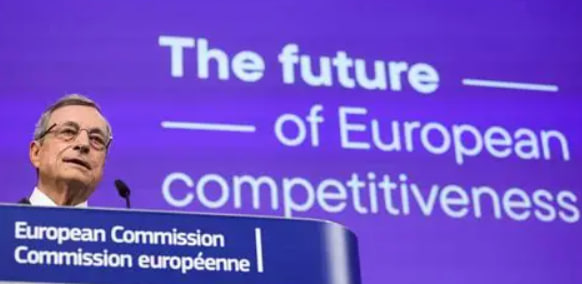
마리오 드라기(Mario Draghi) 전 ECB 총재가 유럽연합(EU)을 위해 작성한 《미래의 유럽 경쟁력 보고서(The Future of European Competitiveness) 즉, 드라기 리포트의 핵심 요약과, 이를 바탕으로 정부가 나아갈 정책적·전략적 대응 방향 제안한다.
드라기 보고서 발표 시기: 2024년 9월, 약 400페이지 규모의 방대한 문서
주요 진단: 유럽은 미·중 대비 기술혁신·생산성에서 뒤처지고 있으며, 빠른 국가 차원의 정책 대응이 필요하다
Summary and Analysis of Mario Draghi’s The Future of European Competitiveness Report
Background and Context
Mario Draghi, former President of the European Central Bank (ECB), was commissioned by European Commission President Ursula von der Leyen in September 2023 to prepare a report addressing the European Union’s (EU) declining competitiveness. Released on September 9, 2024, the 400-page The Future of European Competitiveness report serves as a critical assessment of the EU’s economic challenges and proposes bold strategies to restore its global standing. The report has garnered significant attention globally, with outlets like the BBC describing it as addressing “existential challenges” and the Financial Times noting its call to “save Europe from itself.”
The report diagnoses structural issues in the EU’s economy, particularly its lag behind the United States and China in technological innovation, productivity, and industrial competitiveness. It emphasizes the need for urgent, large-scale investments and policy reforms to prevent further economic decline and ensure the EU’s strategic autonomy in a rapidly changing global landscape.
Key Diagnoses of the Draghi Report
The report identifies several critical challenges facing the EU, summarized as follows:
Innovation and Technological Lag:
The EU trails the US and China in advanced technology sectors, including digitalization, artificial intelligence (AI), and clean technology.
Europe struggles with commercializing innovations, with many startups relocating to the US for better funding and less restrictive regulations.
The report highlights a “middle technology trap,” where the EU excels in basic research but lacks the innovation clusters and commercialization ecosystems to compete globally.
For instance, no European company has achieved a market capitalization above €100 billion in the past 50 years, compared to six US companies exceeding €1 trillion.
Low Productivity and Economic Growth:
The EU’s productivity growth has stagnated, contributing to a widening GDP gap with the US. Since 2000, US per capita disposable income has grown at twice the rate of Europe’s.
Persistent low growth risks lowering living standards, with the EU’s GDP (approximately $19.4 trillion in 2024) significantly trailing the US ($27.36 trillion).
The report attributes this to insufficient investment in research and development (R&D), with EU R&D spending at 2.2% of GDP compared to a target of 3%.
High Energy Costs:
European industries face electricity costs 158% higher and natural gas costs 345% higher than in the US, undermining competitiveness.
High energy prices exacerbate challenges in energy-intensive industries and hinder the transition to clean energy.
External Dependencies and Economic Security:
The EU relies heavily on external sources for critical technologies (e.g., 75–90% of semiconductor wafer production is in Asia) and raw materials, posing risks to supply chains and economic security.
Defense and security sectors are fragmented, with 15% of EU weapons orders from non-EU countries (including South Korea), reducing strategic autonomy.
Decarbonization and Clean Technology:
While the EU has prioritized decarbonization, it risks losing leadership in clean technology due to insufficient investment and slow adoption.
The Carbon Border Adjustment Mechanism (CBAM) is a tool to protect EU industries but requires careful monitoring to ensure effectiveness.
Fragmented Governance and Regulatory Burden:
The EU’s decision-making process, often requiring unanimous agreement among 27 member states, is slow and inefficient, hindering rapid policy responses.
Overregulation, particularly in competition policy, stifles the growth of European firms, preventing them from achieving the scale needed to compete with US and Chinese giants.
Key Recommendations of the Draghi Report
To address these challenges, Draghi proposes a comprehensive strategy centered on three pillars: innovation, decarbonization, and strategic autonomy. Key recommendations include:
Massive Investment:
Annual investments of €750–800 billion (4.4–4.7% of EU GDP) are needed to close the innovation gap, decarbonize industries, and strengthen security. This scale is compared to twice the post-World War II Marshall Plan.
Funding should combine public and private investments, including joint EU borrowing (e.g., Eurobonds) and increased venture capital (VC) through a Capital Markets Union (CMU).
Regulatory Reform:
Simplify and reduce regulatory burdens, particularly in competition policy, to allow European firms to scale up and compete with global “superstar” firms.
Streamline the European Innovation Council (EIC) to support high-risk, high-reward projects, modeled after the US ARPA.
Accelerate digitalization and AI adoption through legislation like the Digital Markets Act (DMA), Digital Services Act (DSA), and AI Act.
Decarbonization Leadership:
Strengthen the EU Emissions Trading System (ETS) to fund decarbonization technologies and maintain leadership in clean tech.
Enhance CBAM to protect EU industries from competitors with lower carbon standards while ensuring its effectiveness.
Strengthening Strategic Autonomy:
Reduce dependency on foreign semiconductors, raw materials, and defense equipment by fostering domestic production and innovation clusters.
Promote intra-EU defense procurement to reduce reliance on non-EU suppliers, including South Korea.
Governance and Integration:
Reform EU decision-making to allow “like-minded” countries to pursue joint projects without requiring unanimous consent.
Deepen EU integration through initiatives like the CMU to mobilize private capital for innovation.
Research and Innovation Funding:
Double the EU’s research and innovation budget to €200 billion for the 2028–2034 Framework Programme (FP10) to address the innovation gap.
Analysis of the Report
The Draghi Report is a stark wake-up call for the EU, framing its economic challenges as an “existential crisis” that threatens its global relevance and living standards. Its strengths lie in its comprehensive diagnosis and bold proposals, leveraging Draghi’s credibility as the “Super Mario” who stabilized the Eurozone during the 2010s debt crisis. However, the report faces challenges:
Implementation Hurdles: Proposals like Eurobonds and regulatory reform require consensus among 27 member states, which is complicated by differing national priorities.
Mixed Reactions: While businesses welcome deregulation, labor unions (e.g., ETUC) and environmental groups (e.g., EEB) criticize the report for potentially undermining worker protections and ecological goals.
Geopolitical Context: The report’s focus on reducing external dependencies (e.g., in defense and semiconductors) could impact trade partners like South Korea, particularly in the defense sector.
The report’s emphasis on massive investment and integration aligns with historical moments of EU progress, as noted by Draghi’s reference to Jean Monnet’s idea of “quantum leaps” in integration during crises. However, its ambitious scope raises questions about political will and fiscal capacity, especially in a politically fragmented EU following the 2024 European Parliament elections, where far-right parties gained ground.
Policy and Strategic Recommendations for the Korean Government
Drawing on the Draghi Report’s insights, South Korea can adopt proactive strategies to enhance its competitiveness, particularly in technology, trade, and industrial policy. The report’s warnings about technological lag, external dependencies, and the need for innovation-driven growth are highly relevant to Korea, given its export-driven economy and competition with global powers like the US and China. Below are tailored recommendations:
Strengthen Technological Innovation and R&D:
Increase R&D Investment: Korea should aim to maintain or exceed its R&D spending (currently ~4.9% of GDP) and target emerging fields like AI, quantum computing, and clean tech to stay ahead of global competitors. The EU’s struggle with commercialization highlights the need for Korea to strengthen industry-academia collaboration and innovation clusters, such as those in Pangyo Techno Valley.
Support Startups and Scale-Ups: Emulate the EU’s proposed CMU by creating a robust venture capital ecosystem. Korea could expand tax incentives and public-private funds (e.g., K-Growth Fund) to support late-stage startups, preventing talent and IP loss to the US or China, as seen in Europe.
Streamline Regulations: Learn from the EU’s overregulation critique by simplifying bureaucratic processes for tech firms, particularly in AI and biotech, to accelerate market entry and scaling.
Enhance Energy Competitiveness:
Address Energy Costs: The EU’s high energy costs underscore the importance of affordable energy for industrial competitiveness. Korea should accelerate investments in renewable energy (e.g., offshore wind, solar) and nuclear power to reduce reliance on imported fossil fuels, which account for ~85% of its energy mix.
Green Technology Leadership: Leverage Korea’s strengths in batteries (e.g., LG Chem, Samsung SDI) and hydrogen technology to capture global clean tech markets, aligning with the EU’s decarbonization goals and CBAM requirements.
Mitigate Risks from EU’s Strategic Autonomy Push:
Diversify Defense Markets: The report’s call for intra-EU defense procurement threatens Korea’s arms exports (e.g., K9 howitzers to Poland). Korea should diversify defense markets to Asia, the Middle East, and Latin America while deepening technical cooperation with EU nations to maintain access.
Strengthen Supply Chain Resilience: The EU’s focus on reducing semiconductor and raw material dependencies highlights global supply chain vulnerabilities. Korea should bolster domestic production of critical components (e.g., legacy semiconductors) and secure alternative raw material sources (e.g., lithium, cobalt) through partnerships in Australia, Canada, and Africa.
Align with EU’s Decarbonization Policies:
Adapt to CBAM: The EU’s Carbon Border Adjustment Mechanism will impact Korean exports like steel and electronics. Korea should accelerate carbon-neutral production (e.g., green steel via hydrogen reduction) and align with EU standards to avoid tariffs.
Expand ESG Compliance: Strengthen corporate ESG (Environmental, Social, Governance) frameworks to meet EU regulations, enhancing market access for Korean firms in Europe.
Deepen Korea-EU Strategic Cooperation:
Leverage Trade Agreements: Utilize the Korea-EU Free Trade Agreement (FTA) to deepen collaboration in clean tech, digitalization, and R&D. Joint projects, such as the planned CATL-Stellantis battery plant in Spain, offer models for co-investment.
Engage in Policy Dialogue: Establish regular high-level dialogues with the EU to align on innovation and decarbonization goals, ensuring Korean firms benefit from EU’s €200 billion FP10 research budget.
Foster Agile Policy Frameworks:
Learn from EU Governance Challenges: The EU’s slow decision-making underscores the need for agile policymaking. Korea should maintain its centralized, rapid-response policy framework to outpace competitors in adopting new technologies and standards.
Invest in Workforce Upskilling: Address potential skill shortages in AI and clean tech by expanding retraining programs, drawing on the EU’s struggle with technological adoption.
Conclusion
The Draghi Report underscores the urgency of addressing competitiveness through investment, innovation, and strategic autonomy, offering valuable lessons for South Korea. By prioritizing R&D, energy competitiveness, supply chain resilience, and alignment with EU policies, Korea can strengthen its position in a global economy increasingly shaped by technological and environmental imperatives. The report’s call for bold action serves as a reminder for Korea to act decisively to maintain its edge in innovation and trade, particularly in the face of rising protectionism and global competition.
각 시리즈는 3~5편 단위로 구성
① 노동의 눈으로 본 한국 사회
"2030세대의 감정노동: 사회적 허락과 착취 사이"
"청년 불안정 고용의 구조적 기원"
"공공부문 정규직화는 실패했는가"
"플랫폼 노동자와 건강위험: 보이지 않는 질병들"
② 평화와 안보, 진보의 딜레마
"주한미군, 기후위기, 전쟁경제"
"촛불 이후, 왜 실패했는가"
"진보는 왜 기지 문제, 방산 문제에 침묵하는가?"
③ 경제 읽기의 재구성
"GDP, 고용률, 임금: 수치 뒤의 정치"
"한국형 산업 전략은 존재하는가"
"드라기 보고서가 주는 교훈"
"국가자본주의와 진보의 분열"
④ 보건과 정치
"역학자의 역할"
"백신 접종과 정보 불평등"
"건강 격차의 구조: 계층, 노동, 정책"
"정책과 데이터 사이에 사람이 있다"
⑤ 정책을 말하는 사람들
"시민이 쓰는 정책, 관료는 읽을까?"
"현장이 먼저다"
"기획재정부의 권력 구조"
"공무원은 혁신의 주체가 될 수 있을까?"
👉 모든 시리즈 첫머리에 ‘시리즈 소개글’을 넣고 링크 연결
📬 뉴스레터/메일링 플랜 (격주 또는 월간 발송용)
🎯 타이틀 예시:
《정책하는 사람의 구조 진단》
《노동-건강-정치, 잇는 글쓰기》
📆 발행 주기:격주 1회
목차 구성:
1. ✍️ 주요 칼럼 요약 (링크 포함)
2. 🧠 이번 주 구조 진단 (한 문단 요약 또는 숫자 중심 비판)
3. 📎 논문/정책 문서 요약 (1-pager 스타일)
4. 🧭 “다음 주제가 궁금하면?”