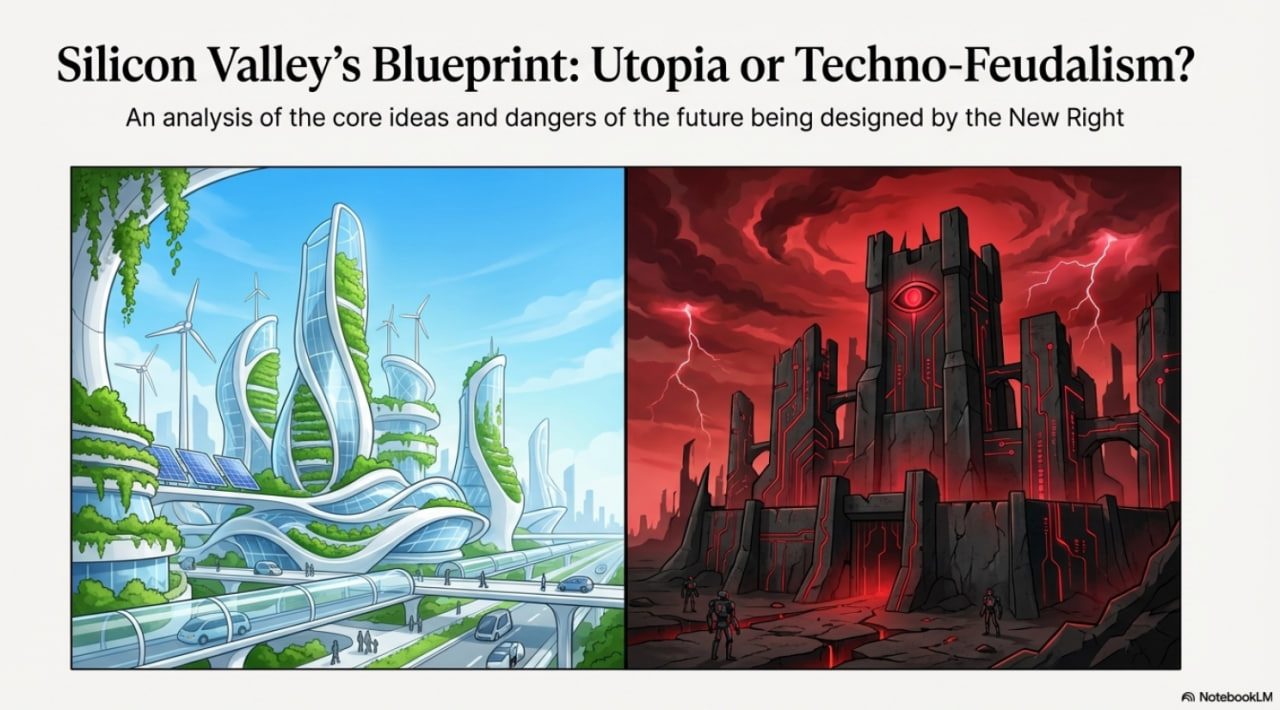
야니스 바루파키스(Yanis Varoufakis)의 기술 봉건주의(Techno-feudalism) 관점을 중심으로 알렉스 카프 등이 포함된 실리콘 밸리 신우파 이념을 비판하고, 그 내용을 정리한 슬라이드 덱을 한국어로 제공합니다.
1. 기술 봉건주의(Techno-feudalism) 관점에서의 비판
알렉스 카프 등의 실리콘 밸리 신우파 이념은 민주주의를 비효율적인 '대성당(The Cathedral)'으로 규정하고 파괴를 목표로 삼으며, 국가 통제에서 벗어난 초엘리트 개인('주권적 개인')의 자유를 극대화하려 합니다. 그러나 야니스 바루파키스가 경고한 기술 봉건주의의 관점에서 볼 때, 이들의 비전은 진정한 자유 국가를 건설하는 대신, 기술 독점 기업이 새로운 봉건 영주로 군림하는 시스템을 초래한다는 점에서 비판받을 수 있습니다.
핵심 비판 논리
-
민주적 주권의 사유화:
- 신우파 이념은 국가 기능을 '리셋'하고 '기업형 군주제'나 '네트워크 국가'로 대체하려 하지만, 이는 국가의 핵심 기능(국방, 치안, 의료)이 팔란티어(Palantir)와 같은 민간 기술 독점 기업에 종속되는 결과를 낳습니다.
- 기술 봉건주의 하에서는, 선출된 권력인 정부가 선출되지 않은 거대 기술 기업의 힘에 전적으로 의존하게 되면서 민주적 주권이 서서히 잠식됩니다. 기술 기업은 데이터와 플랫폼이라는 새로운 '영토'를 독점함으로써, 통제권을 가진 새로운 영주가 되는 것입니다.
-
이중 계급 사회의 심화:
- 신우파 이념이 추구하는 미래는 필연적으로 두 개의 계급으로 분열됩니다: 국가의 통제를 벗어나 자율성과 국경 초월을 누리는 '선택된 소수(주권적 개인)'와, 감시, 예측, 통제를 받는 '나머지 대중'입니다.
- 이러한 이중 구조는 봉건주의의 지배 구조(영주 vs. 농노)와 본질적으로 유사하며, 거대 감시 시스템은 '서구 가치 수호'라는 명분으로 구축되지만 실제로는 소수 인종이나 정치적 반대자를 억압하는 도구로 사용됩니다.
-
효율성을 가장한 반민주주의:
- 신우파는 민주주의의 기본 원리인 타협과 공존을 '비효율'로 규정하고 파괴하려 합니다. 대신 그들은 기술 개발의 무제한적 가속(e/acc)을 도덕적 의무로 간주하며, 규제를 죄악시합니다.
- 이러한 반민주적, 반인본주의적 사상(NRx, TESCREAL)이 막대한 자본과 기술력을 통해 주류 담론으로 침투하는 현상 자체가, 봉건 영주들이 자본을 통해 정치적 영향력을 무한대로 확장하는 기술 봉건주의의 확산을 의미합니다.
결론적으로, 알렉스 카프 등의 '기술 공화국 선언'은 비효율적인 국가 시스템을 개선하려는 것처럼 보이지만, 그 결과는 바루파키스의 주장대로 국가 권력을 완전히 해체하고 그 권력을 영구히 비선출된 기술 엘리트에게 이양하는 기술 봉건주의 청사진에 불과한 것으로 비판할 수 있습니다.
2. 테크노-봉건주의 청사진 (Techno-feudal Blueprint) 슬라이드 덱
다음은 알렉스 카프 등의 실리콘 밸리 신우파 이념을 비판적으로 정리한 슬라이드 덱입니다.
Slide 1: 제목 및 핵심 문제 제기
실리콘 밸리의 유토피아인가, 청사진: 기술 봉건주의인가?
- 부제: 신우파가 설계하는 미래의 핵심 사상과 그 위험성에 대한 분석
- 핵심 진단: 실리콘 밸리의 이념적 흐름은 이제 혁신의 요람이 아니라, 민주주의의 가장 강력한 내부 위협으로 변모하였다.
- 문제 제기: 막대한 자본과 기술력을 가진 일부 테크 리더들이 민주주의의 기본 원리를 부정하고 소수 엘리트 중심의 미래를 꿈꾸는 '신우파' 이념을 확산시키며 새로운 내부 위협으로 변모하고 있다.
- 배경: 최근 실리콘 밸리에서 쏟아지는 복잡한 용어들(가속주의, 네트워크 국가, 주권적 개인)은 단순한 기술 트렌드가 아닙니다. 이것들은 세계 질서를 근본적으로 바꾸려는 일관된 정치적 '청사진'을 구성하는 요소들입니다.
Slide 2: 청사진의 핵심 개념 (The Core Blueprint)
기술의 언어 뒤에 숨은, 세상을 재편하려는 거대한 이념
| 핵심 용어 (Key Term) | 정의 (Definition) |
|---|---|
| 주권적 개인 (Sovereign Individual) | 국가의 통제를 벗어나 국경 없는 초엘리트 개인으로 살아가는 존재로, 기존의 사회 계약에서 벗어나 자신만의 규칙을 따른다. |
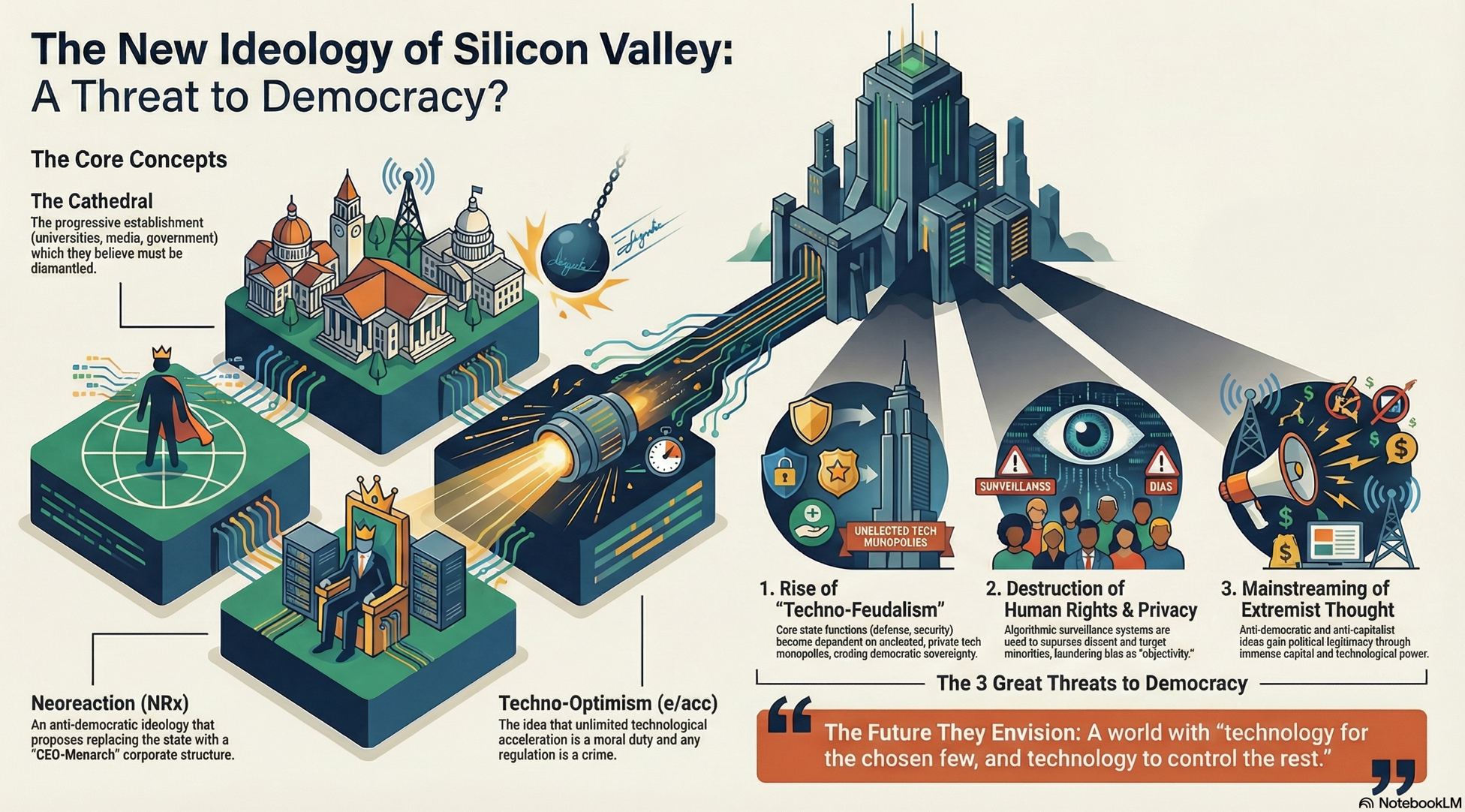
| 대성당 (The Cathedral) | 대학, 언론, 정부 관료제가 연합하여 형성한 진보적 이데올로기 합의 기구이다. 이들은 개인의 자유와 진정한 기술 발전을 억압하는 낡은 권력으로 규정되어 타도의 대상이 된다. |
| 기술-낙관주의 (e/acc) | 기술 개발의 '무제한적 가속(effective acceleration)'을 인류의 도덕적 의무로 간주하는 사상이다. 이들에게 기술 발전 속도를 늦추는 모든 규제는 인류에 대한 죄악으로 간주된다. |
Slide 3: 철학적 기반 및 행동 강령
기술 신우파 이념의 작동 원리
-
철학적 기반: TESCREAL 묶음
- 실리콘 밸리의 지배적 이념을 구성하는 7가지 사상의 약어이다.
- 핵심 논리: 장기주의 (Long-termism) 논리로, 먼 미래의 가치를 위해 현재 세대의 희생을 정당화한다.
- 구성 요소: 트랜스휴머니즘, 엑스트로피안주의, 특이점주의, 우주주의, 합리주의, 효율적 이타주의, 장기주의를 포함한다.
-
파괴의 계획: RAGE (Retire All Government Employees)
- '모든 공무원을 해고하라'는 급진적인 구상이다.
- 현 정부를 비효율적인 '대성당'의 하수인으로 보고, 모든 공무원을 해고하여 국가를 완전히 '리셋'하려는 계획이다.
Slide 4: 건설의 비전 (새로운 국가 형태)
비전 1: 네트워크 국가 (The Network State)
- 온라인 이념 공동체로 시작하여 크라우드펀딩으로 영토를 확보하고, 최종적으로 외교적 승인을 통해 주권을 가진 새로운 국가로 발전하는 개념이다.
- 물리적 영토보다 온라인 커뮤니티가 우선시되는 새로운 형태의 국가이다.
비전 2: 신반동주의 (Neoreaction, NRx)
- 민주주의를 근본적인 실패로 규정하는 반동적 사상이다.
- 국가를 주식회사처럼 운영하는 '기업형 군주제 (CEO-Monarch)'로 대체해야 한다고 주장한다.
- 효율성을 최고의 가치로 삼으며, 계몽주의와 민주주의의 유산을 거부한다.
Slide 5: 민주주의에 가하는 3가지 위협
위협 1: 민주적 주권의 침식과 '기술 봉건주의'
- 국가의 핵심 기능(국방, 치안, 의료)이 팔란티어 같은 민간 기술 독점 기업에 종속되고 있다.
- 선출된 권력(정부)이 선출되지 않은 거대 기술 기업의 힘에 의존하게 되면서, 민주적 주권은 서서히 잠식된다.
- Key Term: 야니스 바루파키스(Yanis Varoufakis)가 경고한 기술 봉건주의(Techno-feudalism)의 도래.
위협 2: 알고리즘 뒤에 숨은 인권과 프라이버시의 파괴
- '서구 가치 수호'를 명분으로 구축된 거대 감시 시스템은 실제로는 이민자, 소수 인종, 정치적 반대자를 억압하는 도구로 사용된다.
- 알고리즘은 인간의 편향을 '객관성'이라는 외피로 세탁하고, 그로 인한 차별과 인권 침해의 책임 소재를 불분명하게 만든다.
위협 3: 자본의 힘으로 주류가 되는 극단적 사상
- 과거에는 소수의 담론이었던 NRx나 TESCREAL 같은 반민주적, 반인본주의적 사상이 막대한 자본과 기술력을 얻고 주류 정치 담론으로 빠르게 침투하고 있다.
- 이들은 타협과 공존이라는 민주주의의 기본 원리를 '비효율'로 규정하고 파괴하려 한다.
Slide 6: 그들이 꿈꾸는 미래: 선택된 소수와 통제되는 대중
이들의 비전은 결코 '모두를 위한 기술'이 아닙니다.
| Side A: 선택된 소수 (주권적 개인)를 위한 기술 | Side B: 나머지 대중을 통제하기 위한 기술 |
|---|---|
| 가치: 자유, 자율성, 국경 초월 | 가치: 감시, 예측, 통제 |
- 결론: 이들이 꿈꾸는 미래는 '선택된 소수를 위한 기술'과 '나머지 대중을 통제하기 위한 기술'로 양분된 세상이다.
Slide 7: 결론 및 비판적 시사점
그러나 이 완벽해 보이는 청사진에는 치명적인 균열이 존재한다.
This collection of images, primarily in Korean, presents an analysis of a powerful ideological current within Silicon Valley, which is described as a growing internal threat to democracy. The sources outline a "blueprint" for a future driven by a technologically-focused elite, contrasting this utopian vision with the potential for "Techno-feudalism". Key concepts of this ideology are explained, including the "Sovereign Individual," the push for "Techno-Optimism (e/acc)," and the desire to dismantle established progressive institutions known as "The Cathedral." The sources identify three major threats posed by this shift: the erosion of democratic sovereignty as government functions rely on private tech monopolies, the destruction of privacy and human rights by unchecked algorithms, and the mainstreaming of anti-democratic, anti-capitalist fringe ideologies powered by immense capital. Ultimately, the text argues that this ideological movement is not about innovation for all, but about creating a future for a "selected minority" while controlling the masses.
Techno-Utopia or a New Dark Age? 5 Radical Ideas Driving Silicon Valley's Political Blueprint
1.0 Introduction: Beyond the Garage Myth
For decades, Silicon Valley has been celebrated as the world's cradle of innovation, a place where bold ideas promised a better future. But behind the veneer of progress, a coherent and radical political 'blueprint' is emerging, designed not merely to create new products, but to fundamentally re-engineer society itself. The endgame is not a shared utopia, but a system that some critics, like economist Yanis Varoufakis, have branded a new form of "Techno-feudalism."
This ideological shift has prompted observers to argue that Silicon Valley has transformed from a hub of innovation into what they now consider "the most powerful internal threat to democracy." The complex, often arcane terms that bubble up from this world—acceleration, network states, sovereign individuals—are not fleeting buzzwords. They are the interlocking components of an ambitious political project that views democratic principles as bugs to be fixed or, more often, as obstacles to be demolished.
This article decodes five of the most impactful concepts from this new ideology. By understanding them as a cohesive system, we can begin to see the future they are actively building—one that challenges the very foundations of our social and political order.
2.0 Takeaway 1: They Have a Defined Enemy — “The Cathedral”
1. The Target of Disruption Is Not an Industry, but Society Itself
At the core of this new ideology lies a clearly defined enemy: “The Cathedral.” This term refers to what its proponents perceive as an entrenched alliance of universities, mainstream media, and government bureaucracy—together forming a dominant progressive ideological consensus. From this perspective, the Cathedral represents an outdated power structure that actively suppresses individual liberty and constrains genuine technological progress.
This reframing constitutes a declaration of war. Business competition is no longer merely economic; it is recast as a political crusade against institutions of knowledge production, governance, and public discourse. The objective is not simply to disrupt markets, but to dismantle the enemy itself. This is not rhetorical exaggeration. One of the most literal expressions of this mindset is the proposal known as “RAGE” (Retire All Government Employees)—a radical plan to “reset” the state by mass-terminating public servants. Prominent figures associated with this worldview include technology investors such as Peter Thiel and Elon Musk, as well as political theorist Curtis Yarvin, who popularized the term “The Cathedral.”
3.0 Takeaway 2: The Ideal Citizen Is the “Sovereign Individual”
2. The Goal Is to Create a New Class of Borderless Super-Elites
If the Cathedral is cast as the villain to be destroyed, the protagonist of this ideology is the “Sovereign Individual.” This figure represents a person who has transcended the authority of the nation-state and operates as part of a borderless, global elite. Living by self-defined rules, the Sovereign Individual rejects the traditional social contract that binds citizens to governments—and to one another.
To enable this escape from social obligation, the blueprint requires a fundamentally new moral code. Promoted by thinkers such as Peter Thiel and James Dale Davidson, this concept represents a profound rejection of collective responsibility and democratic governance. The aim is not to reform existing systems, but to abandon them entirely—constructing a future governed not by popular will, but by a hyper-individualized elite operating beyond the reach of national laws and social obligations.
4.0 Takeaway 3: Their Moral Code Is Unrestricted Acceleration (e/acc)
3. Their Guiding Philosophy: Technology Must Advance at Any Cost
To legitimize the Sovereign Individual’s withdrawal from the social contract, this ideology adopts a moral framework that sanctifies power and unrestrained development. This framework is known as “Techno-Optimism,” or more recently, “e/acc” (effective accelerationism). Its central claim is that the unlimited acceleration of technological development is a moral imperative for humanity. Advocates such as venture capitalists Marc Andreessen and Garry Tan argue that technological progress alone is the engine of human prosperity and salvation.
The most extreme—and revealing—aspect of this belief lies in its rejection of oversight. Within the e/acc worldview, regulation, ethical review, or any attempt to slow technological progress is framed not merely as inefficient, but as a “sin against humanity.” Concerns about safety, ethics, and democratic accountability are dismissed as intolerable obstacles to progress. Raw technological advancement is prioritized above all other social, political, and human considerations.
5.0 Takeaway 4: Their Endgame Is to Replace the State
4. They Are Not Just Building Apps—They Are Building New Kinds of Countries
With the Cathedral designated for destruction, this ideology advances concrete proposals to fill the resulting power vacuum. These efforts are rooted in a broader philosophical foundation often referred to as the “TESCREAL bundle”—an acronym encompassing Transhumanism, Extropianism, Singularity, Cosmism, Rationalism, Effective Altruism, and Long-termism. Together, these ideas justify immense present-day sacrifice in pursuit of a hypothetical, distant future.
From this foundation emerge two major visions for a new political order:
First, Neoreaction (NRx). This ideology views democracy as a fundamental failure and proposes replacing it with a “CEO-Monarch” who governs the state as a for-profit corporation. In this model, efficiency is the supreme value, while Enlightenment principles—liberty, equality, and popular sovereignty—are explicitly rejected as obsolete.
Second, the Network State. Popularized by Balaji Srinivasan, this concept offers a more operational pathway. A Network State begins as an online community united by a shared ideology, then crowdsources the acquisition of physical territory across the globe, and ultimately seeks diplomatic recognition as a sovereign entity. These are not abstract thought experiments; they are active projects aimed at constructing political systems entirely outside existing democratic norms.
6.0 Takeaway 5: The Vision Is a Deliberately Divided Future
5. The Future They Envision Is Not for Everyone—and That Is Intentional
When viewed together, these ideas reveal a stark and deeply unequal vision of the future. The logical endpoint of this blueprint is not a universal utopia, but a deliberately bifurcated world—one in which humanity is divided into two distinct classes, each governed by different technologies.
-
Side A: Technology for the “chosen few.”
Designed for Sovereign Individuals, this technology enables freedom, autonomy, and borderless mobility, unconstrained by nation-states or social obligations. -
Side B: Technology for “the rest of the masses.”
Designed for everyone else, this technology serves not to liberate but to surveil, predict, and control.
The source material articulates this vision with chilling clarity:
“Their vision is by no means ‘technology for all.’ The future they imagine is a world divided between ‘technology for a select few’ and ‘technology to control the rest of the masses.’”
7.0 Conclusion: A Blueprint with a Fatal Flaw
The terminology emerging from Silicon Valley is not a collection of isolated trends, but a tightly interwoven and profoundly anti-democratic political project. This blueprint is not a plan for shared progress, but a design for a new form of techno-feudalism. It seeks to replace the imperfect, deliberative processes of democracy with the cold efficiency of code. Yet in its pursuit of a flawless system, it exposes its own fatal flaw: a deep and unsettling indifference to the value of our shared humanity.