1. JSON이란?
-
(1) 개념
JSON : JavaScript Object Notation
자바스크립트 객체 문법에 토대를 둔, 문자 기반의 데이터 교환 형식 -
(2) 구조
일반적인 JSON 구조는 자바스크립트 객체 리터럴 작성법을 따릅니다. 자바스크립트의 원시 자료형인 문자열, 숫자, 불리언을 가질 수 있고 중첩된 계층 구조 또한 가질 수 있습니다.
(자료출처 : MDN 공식문서)
{
  "squadName": "Super hero squad",
  "homeTown": "Metro City",
  "formed": 2016,
  "secretBase": "Super tower",
  "active": true,
  "members": [
    {
      "name": "Molecule Man",
      "age": 29,
      "secretIdentity": "Dan Jukes",
      "powers": [
        "Radiation resistance",
        "Turning tiny",
        "Radiation blast"
      ]
    },
    {
      "name": "Madame Uppercut",
      "age": 39,
      "secretIdentity": "Jane Wilson",
      "powers": [
        "Million tonne punch",
        "Damage resistance",
        "Superhuman reflexes"
      ]
    },
    {
      "name": "Eternal Flame",
      "age": 1000000,
      "secretIdentity": "Unknown",
      "powers": [
        "Immortality",
        "Heat Immunity",
        "Inferno",
        "Teleportation",
        "Interdimensional travel"
      ]
    }
  ]
}
자바스크립트 객체 형태와 완전히 같지는 않아요. 비슷한 것 뿐입니다. 작은 따옴포(’’)가 아닌 끝 따옴표(””)만이 허용됩니다
- (3) 메서드
JSON → 문자열 형태 → 서버 - 클라이언트 간 데이터 전송 시 사용해요.
하지만, 다음 두 경우를 위해 파싱(parsing) 과정이 필요합니다.
- JS 객체를 JSON 형태로 전송
- JSON 형태를 JS 객체 형태로 사용
# stringify()
: 자바스크립트 객체 → JSON 문자열 변환. 네트워크를 통해 객체를 JSON 문자열로 변환할 때 주로 사용합니다.
console.log(JSON.stringify({ x: 5, y: 6 }));
// Expected output: "{"x":5,"y":6}"

console.log(JSON.stringify([new Number(3), new String('false'), new Boolean(false)]));
// Expected output: "[3,"false",false]"

console.log(JSON.stringify({ x: [10, undefined, function(){}, Symbol('')] }));
// Expected output: "{"x":[10,null,null,null]}"

console.log(JSON.stringify(new Date(2006, 0, 2, 15, 4, 5)));
// Expected output: ""2006-01-02T15:04:05.000Z""
# parse()
: JSON 문자열 → 자바스크립트 객체 변환. 네트워크 통신의 결과를 통해 받아온 JSON 문자열을 프로그램 내부에서 사용하기 위해 JS 객체로 변환할 때 사용.
const json = '{"result":true, "count":42}';
const obj = JSON.parse(json);

console.log(obj.count);
// Expected output: 42

console.log(obj.result);
// Expected output: true- (4) JSONPlaceholder
가짜 서버(= fake server, mock API server)아래 API를 통해 JSON 기반 DB 통신을 일으켜봅시다.
 fetch('https://jsonplaceholder.typicode.com/posts')
  .then((response) => response.json())
  .then((json) => console.log(json));
App.jsx
import "./App.css";
import { useEffect, useState } from "react";

function App() {
  const [data, setData] = useState([]);

  useEffect(() => {
    fetch("https://jsonplaceholder.typicode.com/posts")
      .then((response) => {
        console.log();
        console.log("response.json()", response);
        return response.json();
      })
      .then((json) => {
        console.log("json", json);
        setData([...json]);
      });
  }, []);

  return (
    <div>
      {data.map((item) => {
        return (
          <div
            style={{
              border: "1px solid black",
              margin: "3px",
            }}
            key={item.id}
          >
            <ul>
              <li>userId : {item.userId}</li>
              <li>id : {item.id}</li>
              <li>title : {item.title}</li>
              <li>body : {item.body}</li>
            </ul>
          </div>
        );
      })}
    </div>
  );
}

export default App;
다음과 같은 결과를 얻을 수 있습니다.
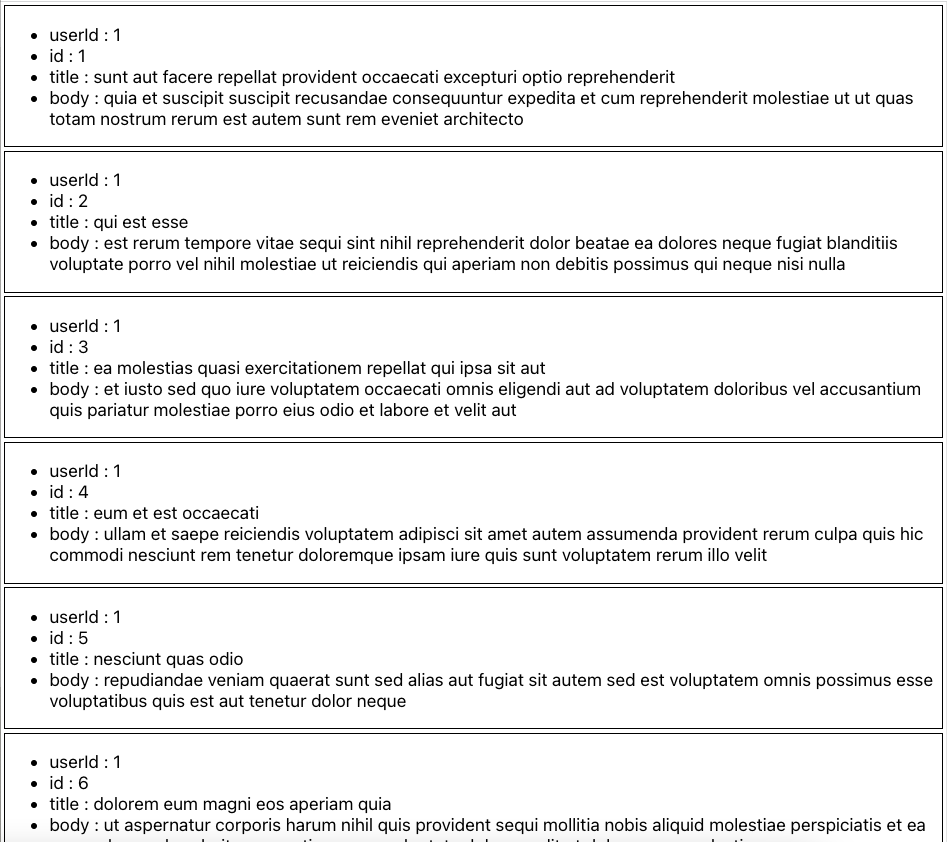
출처 : 스파르타코딩클럽 2023 강의자료

....