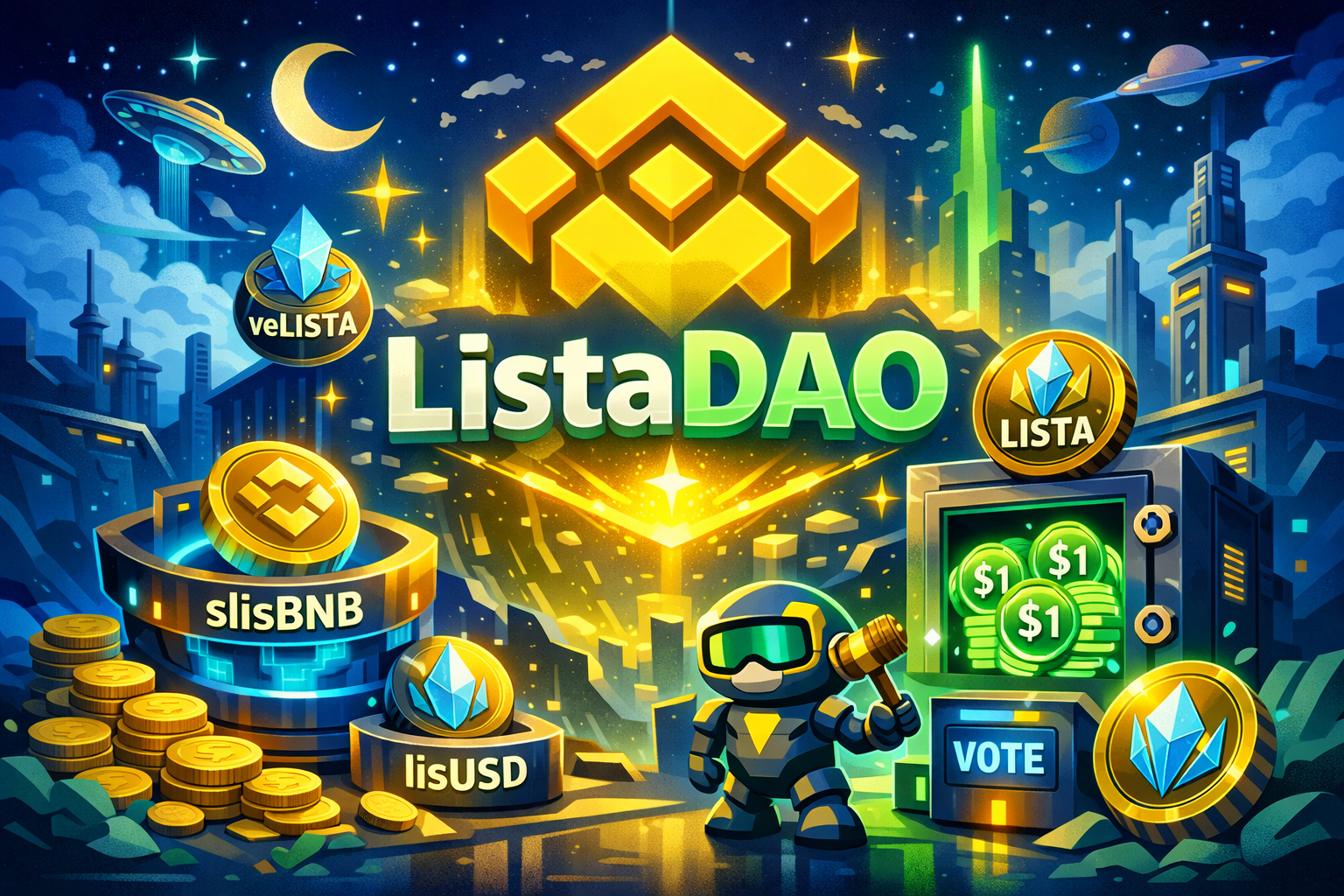
As decentralized finance matures, protocols are shifting from isolated features toward integrated financial systems. Users want more than yield — they want flexibility, transparency, and ownership. ListaDAO is built around these principles, offering a DeFi framework that combines liquid staking, decentralized stable liquidity, and DAO-based governance into a single, coherent protocol.
This article presents a new, clean overview of ListaDAO for readers on dev-focused platforms, with an emphasis on structure, usability, and long-term value.
Introduction to ListaDAO
ListaDAO is a decentralized autonomous organization focused on improving how digital assets are used on-chain. Instead of forcing users to lock assets in one place or give up control for yield, the protocol allows assets to remain productive across multiple functions simultaneously.
The core philosophy of ListaDAO is simple:
- Liquidity should not be sacrificed for yield
- Stable value should be decentralized and collateral-backed
- Governance should be transparent and community-owned
All protocol rules are enforced by smart contracts and managed through on-chain voting.
Blockchain Infrastructure
ListaDAO is deployed on BNB Chain, a blockchain chosen for its efficiency and accessibility.
BNB Chain provides:
- Low transaction costs
- Fast confirmation times
- Compatibility with a broad DeFi ecosystem
This infrastructure allows ListaDAO to support frequent user interactions without the high fees commonly associated with other networks.
Key Protocol Modules
Liquid Staking
Liquid staking is one of the foundational components of ListaDAO.
When users stake BNB, they receive slisBNB, a liquid token that represents their staked position. Unlike traditional staking models, this approach allows users to:
- Earn staking rewards continuously
- Maintain liquidity
- Use staked value across DeFi applications
This design improves capital efficiency while keeping the user experience straightforward.
Decentralized Stablecoin System
ListaDAO enables the minting of lisUSD, a decentralized stablecoin designed to maintain a stable value.
The system operates through over-collateralization:
- Users deposit approved assets as collateral
- lisUSD is minted against that collateral
- Ownership of the collateral remains with the user
This mechanism provides stable liquidity without reliance on centralized issuers or custodians.
Governance Framework
Governance in ListaDAO is handled through the LISTA token.
LISTA holders can:
- Propose protocol changes
- Vote on upgrades and parameters
- Influence the long-term direction of the ecosystem
To encourage long-term alignment, users may lock LISTA tokens to increase their voting power, reinforcing responsible governance participation.
Token Model
The protocol uses a minimal and clearly defined token structure:
| Token | Role |
|---|---|
| LISTA | Governance and protocol control |
| slisBNB | Liquid staking representation of BNB |
| lisUSD | Decentralized, collateral-backed stablecoin |
Each token serves a distinct function, reducing overlap and complexity.
Benefits of the ListaDAO Approach
ListaDAO addresses several persistent challenges in DeFi:
Improved Capital Efficiency
Users can stake assets, access liquidity, and remain flexible at the same time.
Decentralized Financial Primitives
Stablecoin issuance and governance are fully on-chain and community-controlled.
Composability
Liquid staking and stablecoin tokens can integrate with external DeFi protocols.
Accessibility
Low network fees make participation practical for a wide range of users.
Intended Users
ListaDAO is designed for multiple audiences:
- BNB holders seeking yield without lockups
- DeFi users requiring decentralized stable liquidity
- DAO participants who value transparent governance
- Developers building composable applications on BNB Chain
The protocol supports both simple and advanced strategies.
Typical Interaction Flow
A common user journey looks like this:
- Connect a wallet compatible with BNB Chain
- Stake BNB and receive slisBNB
- Mint lisUSD if stable liquidity is required
- Hold or lock LISTA to participate in governance
This flow ensures users remain in control of their assets at all times.
FAQ
What is ListaDAO designed to solve?
It improves capital efficiency by combining liquid staking, decentralized stablecoins, and DAO governance.
Which blockchain supports ListaDAO?
ListaDAO runs on BNB Chain.
What advantage does slisBNB provide?
It allows users to earn staking rewards while keeping assets liquid.
Is lisUSD centralized?
No. It is backed by on-chain collateral and governed by the DAO.
How do users participate in governance?
By holding and voting with LISTA tokens.
Is ListaDAO suitable for developers?
Yes. Its modular design and clear primitives make it developer-friendly.
Conclusion
ListaDAO represents a structured and practical evolution of decentralized finance. By aligning liquid staking, decentralized stable liquidity, and community governance on an efficient blockchain, it creates a system where users do not have to choose between control and opportunity.
For those looking to build, earn, or participate in a transparent DeFi ecosystem, ListaDAO offers a solid and forward-looking foundation.
