Growth of Functions

James·2023년 2월 5일
post-thumbnail

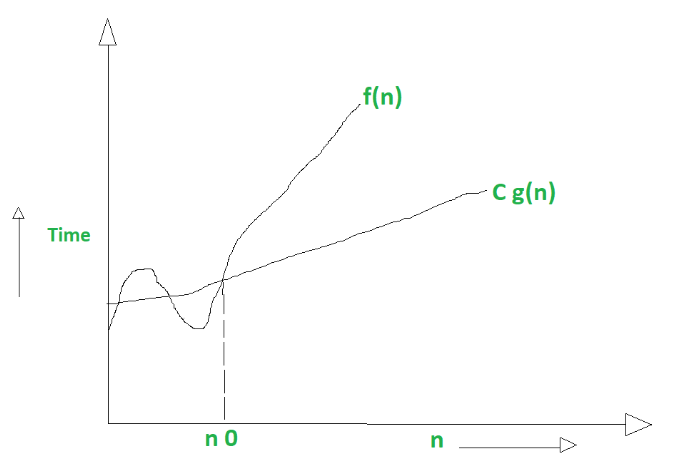
OO-notaion

O(g(n))= {f(n):0f(n)cg(n) for all nn00}for any c>0O (g(n))=\ \{f(n): 0\leq f(n) \leq cg(n)\ for\ all\ n \geq n_0 \geq 0 \} for\ any\ c>0

g(n)g(n)f(n)f(n)의 asymptotic upper bound.
가령, 2n2=O(n3), with c=1 & n0=22n^2 = O(n^3),\ with\ c=1\ \&\ n_0 = 2.

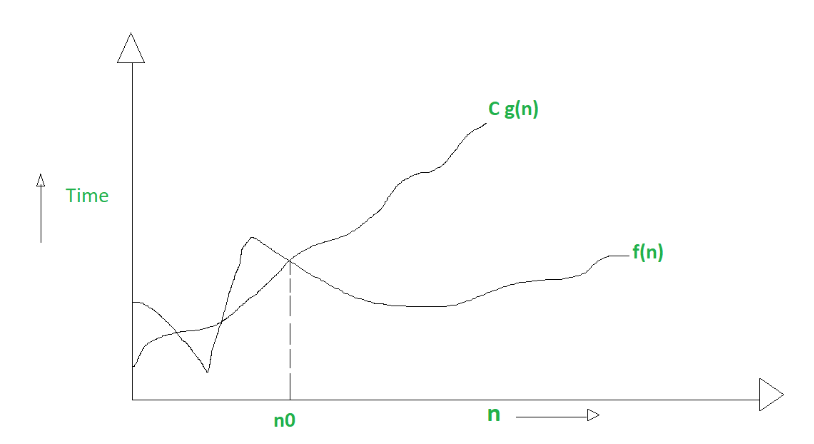
Ω\Omega-notation

Ω(g(n))={f(n):0cg(n)f(n) for all nn00}for any c>0\Omega(g(n))=\{f(n): 0\leq cg(n) \leq f(n)\ for\ all\ n \geq n_0 \geq 0 \} for\ any\ c>0

g(n)g(n)f(n)f(n)의 asymptotic lower bound.
가령, n = Ω(lg n),with c=1 and n0=16\sqrt[]{n}\ =\ \Omega(lg\ n), with\ c = 1\ and\ n_0 = 16.

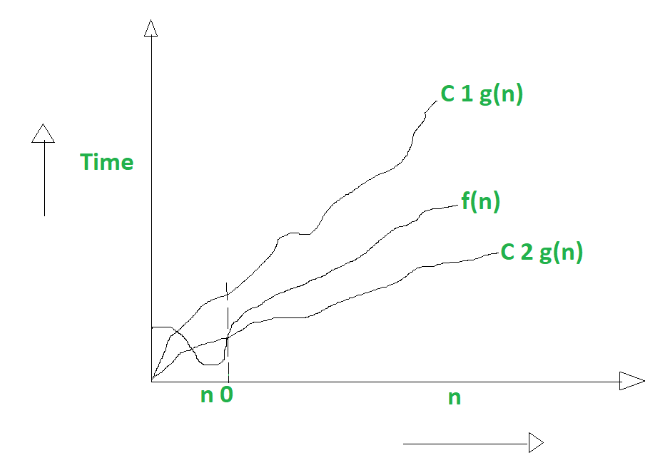
Θ\Theta-notation

Θ(g(n))={f(n):0c1g(n)f(n)c2g(n) for all nn00}for any c1,c2>0\Theta(g(n))=\{f(n): 0\leq c_1g(n) \leq f(n) \leq c_2g(n)\ for\ all\ n \geq n_0 \geq 0 \} for\ any\ c_1, c_2>0

가령, n2/22n=Θ(n2),with c1=1/4, c2=1/2, and n0=8n^2/2 - 2n = \Theta(n^2), with\ c_1=1/4,\ c_2 = 1/2,\ and\ n_0 = 8.

이미지 링크: https://www.geeksforgeeks.org/difference-between-big-oh-big-omega-and-big-theta/
profile
System Software Engineer

0개의 댓글