-
Widget Attribute Tags
- WBP_TextValueRow에 GameplayTag형 변수를 추가함.
이를 통해 각 Row들에 각각 표기할 Attribute에 해당하는 GameplayTag를 설정하고,
해당 GameplayTag와 일치하는 FAttributeInfoSignature에만 반응하도록 함.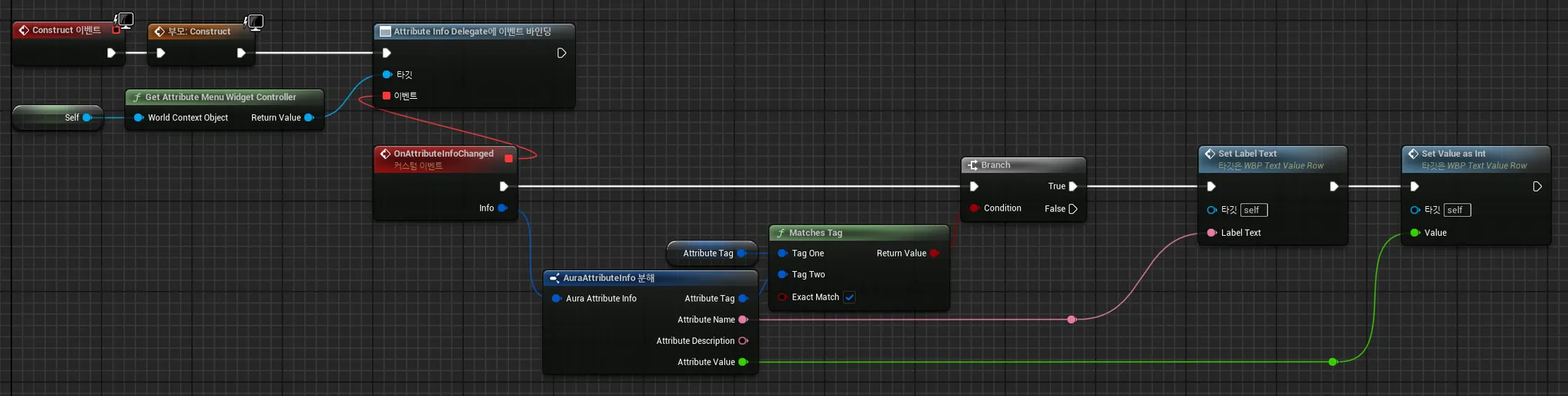
- WBP_TextValueRow에 GameplayTag형 변수를 추가함.
-
Mapping Tags to Attributes
- OverlayWidget에서 했던 것과 비슷하게, WidgetController가 Model 데이터들을 Broadcast 할 수 있게 해주는 작업을 해야 한다.
-
직접 작성하는 방법
- AttributeMenuWidgetController에서 아래와 같이 BroadcastInitialValues()를 작성하면, WBP_AttributeMenu의 각 Row 위젯들마다 모두 자신의 GameplayTag에 해당하는 정보를 델리게이트로 전달받을 수 있음.
void UAttributeMenuWidgetController::BroadcastInitialValues() { UAuraAttributeSet* AS = CastChecked<UAuraAttributeSet>(AttributeSet); check(AttributeInfo); // 아래 구문을 모든 Attribute마다 작성해주어야 함. FAuraAttributeInfo Info = AttributeInfo->FindAttributeInfoForTag(FAuraGameplayTag::Attribute_Primary_Strength);\ Info.AttributeValue = AS->GetStrength(); FAttributeInfoSignature.Broadcast(Info); }- 하지만 이 방법은 새로운 Attribute가 추가될 때마다 AttributeMenuWidgetController에 새로운 위젯을 바인딩 시켜줘야 하는 번거로움이 있음.
- 따라서 관용구가 추가되는 것 자체는 막을 수 없더라도, 관용구를 최대한 한 곳에만 집중해놓으면 사소한 코드 오류가 발생하는 횟수를 줄일 수 있으므로, AttributeMenuWidgetController에는 Attribute가 몇 개이든지 상관없이 모든 Attribute를 FAttributeInfoSignature로 발송할 수 있도록 하려 함.
- AuraAttributeSet는 게임 내 캐릭터들이 사용하는 Attribute들이 존재하는 곳이고, 이미 Replication을 위한 관용구나, ATTRIBUTE_ACCESSORS와 같은 매크로가 많이 사용되고 있기 때문에 위의 목적을 위한 관용구를 추가하기에 적절한 곳임.
- AttributeMenuWidgetController에서 아래와 같이 BroadcastInitialValues()를 작성하면, WBP_AttributeMenu의 각 Row 위젯들마다 모두 자신의 GameplayTag에 해당하는 정보를 델리게이트로 전달받을 수 있음.
-
Delegate 및 BindStatic()을 활용하는 방법
- DECLARE_DELEGATE_RetVal() 매크로를 이용하여 반환값이 있는 델리게이트를 선언함.
DECLARE_DELEGATE_RetVal(’반환형’, ‘델리게이트명’)의 형태로 작성하면 됨.
DECLARE_DELEGATE_RetVal(FGameplayAttribute, FAttributeSignature) 델리게이트를 선언함.
- FGameplayAttribute를 반환형으로 결정한 이유는, ATTRIBUTE_ACCESSORS 매크로 덕분에 각 Attribute들에 대한 Getter 함수가 알아서 생성되어 있고, 이 함수들의 반환형이 FGameplayAttribute이기 때문임.
(Strength라는 이름의 Attribute가 있다면, ATTRIBUTE_ACCESSORS를 통해 해당 Attribute 자체를 반환하는 GetStrengthAttribute(), Attribute의 값만을 반환하는 GetStrength()가 둘 다 생성되는데, 여기서는 GetStrengthAttribute()를 사용함)
// AuraAttributeSet.h DECLARE_DELEGATE_RetVal(FGameplayAttribute, FAttributeSignature); TMap<FGameplayTag, FAttributeSignature> TagsToAttributes; // AuraAttributeSet.cpp UAuraAttributeSet::UAuraAttributeSet() { const FAuraGameplayTags& GameplayTags = FAuraGameplayTags::Get(); FAttributeSignature StrengthDelegate; StrengthDelegate.BindStatic(GetStrengthAttribute); TagsToAttributes.Add(GameplayTags.Attributes_Primary_Strength, StrengthDelegate); }- UAuraAttributeSet의 생성자에서 FAttributeSignature 델리게이트를 선언하고, BindStatic()을 통해 해당 델리게이트에 각 Attribute에 맞는 GetAttribute() 함수를 바인딩해준다. (Getter 함수들이 Static으로 되어 있기 때문에 BindStatic() 사용)
GetAttribute()의 반환형은 FGameplayAttribute이기 때문에 델리게이트를 RetVal로 선언하여 FGameplayAttribute로 반환형을 정해준 것이다.
void UAttributeMenuWidgetController::BroadcastInitialValues() { UAuraAttributeSet* AS = CastChecked<UAuraAttributeSet>(AttributeSet); check(AttributeInfo); for (auto& Pair : AS->TagsToAttributes) { FAuraAttributeInfo Info = AttributeInfo->FindAttributeInfoForTag(Pair.Key); Info.AttributeValue = Pair.Value.Execute().GetNumericValue(AS); AttributeInfoDelegate.Broadcast(Info); } }- AttributeMenuWidgetController에서는 미리 생성된 TMap을 통해 for문으로 Attribute의 값을 FAuraAttributeInfo에 업데이트하고 이를 전파하는 내용만 있으면 된다.
(새로 Attribute가 추가되도 AuraAttributeSet에서만 관련 내용을 추가하면 됨) - 델리게이트를 활용한 덕분에 관용구를 한 곳에 몰아넣을 수 있었고, WidgetController에서는 훨씬 깔끔한 함수 작성이 가능해졌다.
하지만 이 또한 결국은 AttributeSet에 매번 델리게이트를 선언하고 BindStatic()으로 Attribute Getter 함수를 바인딩하여 TagsToAttributes 맵에 저장해두어야 한다는 반복적인 번거로움이 존재한다.
WidgetController에 직접 작성하는 것보다야 훨씬 실수의 여지도 줄어들었지만, 여전히 코드가 많이 길다.
-
TBaseStaticDelegateInstance를 활용하는 방법
-
TBaseStaticDelegateInstance를 직접 활용해 볼 수 있다.
BindStatic()의 매개변수와 함수 구현을 직접 살펴보면 아래와 같은 형태로 되어 있다.```cpp // 매개변수 BindStatic(typename TBaseStaticDelegateInstance<FuncType, UserPolicy, std::decay_t<VarTypes>...>::FFuncPtr InFunc, VarTypes&&... Vars) /** * Binds a raw C++ pointer global function delegate */ template <typename... VarTypes> inline void BindStatic(typename TBaseStaticDelegateInstance<FuncType, UserPolicy, std::decay_t<VarTypes>...>::FFuncPtr InFunc, VarTypes&&... Vars) { new (*this) TBaseStaticDelegateInstance<FuncType, UserPolicy, std::decay_t<VarTypes>...>(InFunc, Forward<VarTypes>(Vars)...); } ``` -
이 중에서 TBaseStaticDelegateInstance가 바로 함수를 묶는 함수 포인터의 역할을 한다.
또한 어차피 TBaseStaticDelegateInstance를 new로 생성하는 역할만 하고 있는 것을 볼 수 있다.
해당 클래스의 일부를 살펴보면 아래와 같다.```cpp /** * Implements a delegate binding for regular C++ functions. */ template <typename FuncType, typename UserPolicy, typename... VarTypes> class TBaseStaticDelegateInstance; template <typename RetValType, typename... ParamTypes, typename UserPolicy, typename... VarTypes> class TBaseStaticDelegateInstance<RetValType(ParamTypes...), UserPolicy, VarTypes...> : public TCommonDelegateInstanceState<RetValType(ParamTypes...), UserPolicy, VarTypes...> { private: using Super = TCommonDelegateInstanceState<RetValType(ParamTypes...), UserPolicy, VarTypes...>; using DelegateBaseType = typename UserPolicy::FDelegateExtras; public: using FFuncPtr = RetValType(*)(ParamTypes..., VarTypes...); template <typename... InVarTypes> explicit TBaseStaticDelegateInstance(FFuncPtr InStaticFuncPtr, InVarTypes&&... Vars) : Super (Forward<InVarTypes>(Vars)...) , StaticFuncPtr(InStaticFuncPtr) { check(StaticFuncPtr != nullptr); } // IDelegateInstance interface // ..... private: // C++ function pointer. FFuncPtr StaticFuncPtr; }; ```-
주석을 보면, 일반적인 C++ 함수에 대한 델리게이트 바인딩을 시행한다고 되어 있다.
즉, BindStatic()은 편리하게 사용할 수 있는 방법을 제공할 뿐이고, TBaseStaticDelegateInstance가 실질적인 델리게이트 바인딩을 시행한다고 보면 될 듯 하다.- 몇몇 변수나 함수 이름을 참고해본다면, TBaseStaticDelegateInstance는 Static 함수에 대한 델리게이트 바인딩을 시행하는 듯 하고, 그 외 다른 DelegateInstance들도 DelegateInstancesImpl.h 내부에 존재하는 것으로 보인다.
다만 Attribute Getter 함수들은 Static 함수들이므로 여기서는 TBaseStaticDelegateInstance를 사용하는 것이다.
- 몇몇 변수나 함수 이름을 참고해본다면, TBaseStaticDelegateInstance는 Static 함수에 대한 델리게이트 바인딩을 시행하는 듯 하고, 그 외 다른 DelegateInstance들도 DelegateInstancesImpl.h 내부에 존재하는 것으로 보인다.
-
그렇다면 굳이 델리게이트를 선언해서 BindStatic()으로 Attribute Getter 함수들을 묶기보다는, TBaseStaticDelegateInstance를 직접 사용한다면 훨씬 깔끔하게 처리가 가능할 것이다.
-
이 중에서도 FFuncPtr가 변수 이름 그대로 함수 포인터 역할을 한다.
#include "CoreMinimal.h" #include "AbilitySystemComponent.h" #include "AuraAttributeSet.generated.h" #define ATTRIBUTE_ACCESSORS(ClassName, PropertyName) \ GAMEPLAYATTRIBUTE_PROPERTY_GETTER(ClassName, PropertyName) \ GAMEPLAYATTRIBUTE_VALUE_GETTER(PropertyName) \ GAMEPLAYATTRIBUTE_VALUE_SETTER(PropertyName) \ GAMEPLAYATTRIBUTE_VALUE_INITTER(PropertyName) USTRUCT() struct FEffectProperties { // ... }; UCLASS() class AURA_API UAuraAttributeSet : public UAttributeSet { GENERATED_BODY() public: UAuraAttributeSet(); virtual void GetLifetimeReplicatedProps(TArray<FLifetimeProperty>& OutLifetimeProps) const override; virtual void PreAttributeChange(const FGameplayAttribute& Attribute, float& NewValue) override; virtual void PostGameplayEffectExecute(const struct FGameplayEffectModCallbackData& Data) override; TMap<FGameplayTag, TBaseStaticDelegateInstance<FGameplayAttribute(), FDefaultDelegateUserPolicy>::FFuncPtr> TagsToAttributes; // ... private: void SetEffectProperties(const FGameplayEffectModCallbackData& Data, FEffectProperties& OutEffectProperties) const; };- TBaseStaticDelegateInstance 대신 FGameplayAttribute(*)()와 같은 방식으로 원시적인 C++의 함수 포인터를 사용하는 것도 가능하다.
C++의 원시적인 함수 포인터
[반환형](*함수명)(매개변수)의 형태로 이루어짐.

따라서 FGameplayAttribute(*)()는 매개변수가 없고,
FGameplayAttribute를 반환하는 함수를 지칭하는 것.
- TBaseStaticDelegateInstance 대신 FGameplayAttribute(*)()와 같은 방식으로 원시적인 C++의 함수 포인터를 사용하는 것도 가능하다.
-
typedef, template/using/typename
- typedef
- 일종의 별칭을 선언하는 역할을 한다.
typedef TBaseStaticDelegateInstance<FGameplayAttribute(), FDefaultDelegateUserPolicy>::FFuncPtr FAttributeFuncPtr;와 같은 방식으로 선언하면, FAttributeFuncPtr가 TBaseStaticDelegateInstance<FGameplayAttribute(), FDefaultDelegateUserPolicy>::FFuncPtr와 동일한 역할을 한다.
- template/using/typename
- template은 당연하겠지만, 템플릿을 사용한다고 선언하는 것이다.
- using 키워드 또한 typedef와 마찬가지로 별칭을 선언하는 역할을 한다.
typedef 키워드보다 일반적으로 더 많이 사용하는데, 이유는 using 키워드는 C++11 이후, 즉 모던 C++에서 등장한 것으로, 템플릿과 같이 사용이 가능하기에 더 유연하고, 가독성과 유지보수 측면에서 더 발전되었기 때문이라 한다. - typename은 보통 template을 사용하는 using문에서 같이 사용하며, 컴파일러가 혼동하는 것을 방지하기 위해서 사용한다.
컴파일러가 using 문에 주어진 것이 타입인지 아닌지를 모를 수 있기 때문에, typename을 명시해주어 이것이 타입임을 미리 알려주는 것이라 한다.
- 일종의 별칭을 선언하는 역할을 한다.

직접 typename 없이 빌드를 시도해봤더니, 약 30초 정도 빌드 대기를 하다가 “ 'TBaseStaticDelegateInstance<T,FDefaultDelegateUserPolicy,>::FFuncPtr': 종속 이름이 형식이 아닙니다.”라는 위와 같은 오류가 잔뜩 출력되고 빌드가 실패하는 모습을 볼 수 있었다.
- typedef
-
-
-
Responding to Attribute Changes
- AttributeMenuWidgetController는 초기화 될 때만 BroadcastInitialValues()를 통해 Attribute들의 값의 표기를 업데이트 하고 있기 때문에, Attribute가 실시간으로 변경되는 것을 반영하지 못한다.
- 따라서 이를 위해, BindCallbacksToDependencies()에 적절한 람다 함수를 바인딩하여 값이 변경될 때마다 이를 전파할 수 있도록 한다.
void UAttributeMenuWidgetController::BindCallbacksToDependencies() { UAuraAttributeSet* AS = CastChecked<UAuraAttributeSet>(AttributeSet); for (auto& Pair : AS->TagsToAttributes) { AbilitySystemComponent->GetGameplayAttributeValueChangeDelegate(Pair.Value()) .AddLambda([this, Pair, AS](const FOnAttributeChangeData& Data) { FAuraAttributeInfo Info = AttributeInfo->FindAttributeInfoForTag(Pair.Key); Info.AttributeValue = Pair.Value().GetNumericValue(AS); AttributeInfoDelegate.Broadcast(Info); } ); } }- AbilitySystemComponent에서 제공하는 GetGameplayAttributeValueChangeDelegate()를 통해, Attribute의 값이 변할 때 실행될 함수 바인딩을 할 수 있다. (OverlayWidgetController에서도 사용한 함수)
- AttributeSet에서 충분한 사전 작업을 해 둔 덕분에, TMap<FGameplayTag, FStaticFuncPtr<FGameplayAttribute()>> 변수인 TagsToAttributes에서 필요한 정보에 손쉽게 접근하여, for문으로 간단하게 람다 함수에 바인딩 하는 작업을 마칠 수 있었다.
