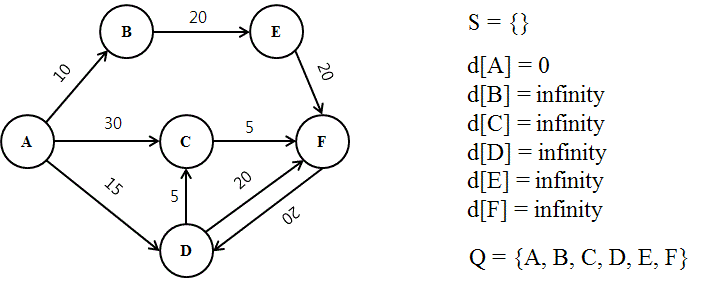
다익스트라 알고리즘
가중치가 있는 그래프에서 한 정점에서 다른 모든 정점까지의 최단 경로를 찾는 알고리즘. 음의 가중치가 없을 때 사용 가능하다.
자바 코드 예시:
import java.util.*;

public class Graph {
    private int numVertices;
    private LinkedList<Edge>[] adjList;

    private class Edge {
        int vertex;
        int weight;

        Edge(int v, int w) {
            vertex = v;
            weight = w;
        }
    }

    public Graph(int vertices) {
        numVertices = vertices;
        adjList = new LinkedList[vertices];
        for (int i = 0; i < vertices; i++) {
            adjList[i] = new LinkedList<>();
        }
    }

    public void addEdge(int src, int dest, int weight) {
        adjList[src].add(new Edge(dest, weight));
    }

    public void dijkstra(int startVertex) {
        int[] distances = new int[numVertices];
        boolean[] visited = new boolean[numVertices];
        Arrays.fill(distances, Integer.MAX_VALUE);
        distances[startVertex] = 0;
        PriorityQueue<Edge> pq = new PriorityQueue<>(Comparator.comparingInt(e -> e.weight));

        pq.add(new Edge(startVertex, 0));

        while (!pq.isEmpty()) {
            Edge current = pq.poll();
            if (visited[current.vertex]) continue;
            visited[current.vertex] = true;

            for (Edge e : adjList[current.vertex]) {
                if (!visited[e.vertex] && distances[current.vertex] + e.weight < distances[e.vertex]) {
                    distances[e.vertex] = distances[current.vertex] + e.weight;
                    pq.add(new Edge(e.vertex, distances[e.vertex]));
                }
            }
        }

        for (int i = 0; i < numVertices; i++) {
            System.out.println("Distance from " + startVertex + " to " + i + " is " + distances[i]);
        }
    }

    public static void main(String[] args) {
        Graph g = new Graph(5);
        g.addEdge(0, 1, 9);
        g.addEdge(0, 2, 6);
        g.addEdge(0, 3, 5);
        g.addEdge(0, 4, 3);
        g.addEdge(2, 1, 2);
        g.addEdge(2, 3, 4);

        g.dijkstra(0);
    }
}
출처 : https://velog.io/@agugu95/Prims-Algorithm%ED%94%84%EB%A6%BC-%EC%95%8C%EA%B3%A0%EB%A6%AC%EC%A6%98
크루스칼 알고리즘
최소 신장 트리를 찾는 알고리즘. 가중치가 있는 그래프에서 가장 가벼운 가중치부터 선택하여, 사이클을 형성하지 않는 선에서 최소 비용으로 모든 노드를 연결한다.
자바 코드 예시:
import java.util.*;

public class Graph {
    class Edge implements Comparable<Edge> {
        int src, dest, weight;

        public int compareTo(Edge compareEdge) {
            return this.weight - compareEdge.weight;
        }
    }

    class Subset {
        int parent, rank;
    }

    int vertices, edges;
    Edge[] edge;

    Graph(int v, int e) {
        vertices = v;
        edges = e;
        edge = new Edge[edges];
        for (int i = 0; i < e; ++i) {
            edge[i] = new Edge();
        }
    }

    int find(Subset subsets[], int i) {
        if (subsets[i].parent != i) {
            subsets[i].parent = find(subsets, subsets[i].parent);
        }
        return subsets[i].parent;
    }

    void union(Subset subsets[], int x, int y) {
        int xroot = find(subsets, x);
        int yroot = find(subsets, y);

        if (subsets[xroot].rank < subsets[yroot].rank) {
            subsets[xroot].parent = yroot;
        } else if (subsets[xroot].rank > subsets[yroot].rank) {
            subsets[yroot].parent = xroot;
        } else {
            subsets[yroot].parent = xroot;
            subsets[xroot].rank++;
        }
    }

    void KruskalMST() {
        Edge result[] = new Edge[vertices];
        int e = 0;
        int i = 0;
        for (i = 0; i < vertices; ++i) {
            result[i] = new Edge();
        }

        Arrays.sort(edge);
        Subset subsets[] = new Subset[vertices];
        for (i = 0; i < vertices; ++i) {
            subsets[i] = new Subset();
            subsets[i].parent = i;
            subsets[i].rank = 0;
        }

        i = 0;
        while (e < vertices - 1) {
            Edge next_edge = new Edge();
            next_edge = edge[i++];

            int x = find(subsets, next_edge.src);
            int y = find(subsets, next_edge.dest);

            if (x != y) {
                result[e++] = next_edge;
                union(subsets, x, y);
            }
        }

        for (i = 0; i < e; ++i) {
            System.out.println(result[i].src + " -- " + result[i].dest + " == " + result[i].weight);
        }
    }

    public static void main(String[] args) {
        int V = 4;  // Number of vertices in graph
        int E = 5;  // Number of edges in graph
        Graph graph = new Graph(V, E);

        // add edge 0-1
        graph.edge[0].src = 0;
        graph.edge[0].dest = 1;
        graph.edge[0].weight = 10;

        // add edge 0-2
        graph.edge[1].src = 0;
        graph.edge[1].dest = 2;
        graph.edge[1].weight = 6;

        // add edge 0-3
        graph.edge[2].src = 0;
        graph.edge[2].dest = 3;
        graph.edge[2].weight = 5;

        // add edge 1-3
        graph.edge[3].src = 1;
        graph.edge[3].dest = 3;
        graph.edge[3].weight = 15;

        // add edge 2-3
        graph.edge[4].src = 2;
        graph.edge[4].dest = 3;
        graph.edge[4].weight = 4;

        graph.KruskalMST();
    }
}
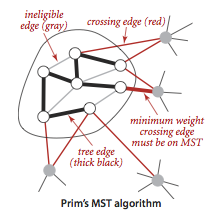
프림 알고리즘 (Prim's Algorithm)
가중치가 있는 연결 그래프에서 최소 신장 트리를 찾는 알고리즘이야. 프림 알고리즘은 임의의 정점에서 시작하여, 선택된 정점들에 인접한 정점들 중 최소 가중치 간선으로 연결된 정점을 선택하며 신장 트리를 확장해 나간다.
import java.util.*;
import java.util.PriorityQueue;

public class Graph {
    private List<List<Edge>> adjList;

    public Graph(int vertices) {
        adjList = new ArrayList<>(vertices);
        for (int i = 0; i < vertices; i++) {
            adjList.add(new ArrayList<>());
        }
    }

    public void addEdge(int src, int dest, int weight) {
        adjList.get(src).add(new Edge(src, dest, weight));
        adjList.get(dest).add(new Edge(dest, src, weight));
    }

    public void primMST() {
        boolean[] inMST = new boolean[adjList.size()];
        PriorityQueue<Edge> pq = new PriorityQueue<>(Comparator.comparingInt(e -> e.weight));
        int start = 0; // Starting from vertex 0

        // Add all edges from vertex 0
        for (Edge e : adjList.get(start)) {
            pq.add(e);
        }
        inMST[start] = true;

        while (!pq.isEmpty()) {
            Edge e = pq.poll();

            if (inMST[e.dest]) continue;

            // Include this edge in MST
            System.out.println(e.src + " - " + e.dest + " : " + e.weight);
            inMST[e.dest] = true;

            for (Edge next : adjList.get(e.dest)) {
                if (!inMST[next.dest]) {
                    pq.add(next);
                }
            }
        }
    }

    class Edge {
        int src, dest, weight;

        Edge(int src, int dest, int weight) {
            this.src = src;
            this.dest = dest;
            this.weight = weight;
        }
    }

    public static void main(String[] args) {
        Graph g = new Graph(4);
        g.addEdge(0, 1, 10);
        g.addEdge(0, 2, 6);
        g.addEdge(0, 3, 5);
        g.addEdge(1, 3, 15);
        g.addEdge(2, 3, 4);

        g.primMST();
    }
}
유니온-파인드 알고리즘
유니온-파인드 알고리즘은 서로소 집합 자료구조로, 집합의 합치기(union)와 찾기(find) 연산을 지원해. 크루스칼 알고리즘에서는 간선을 선택할 때 사이클이 형성되는지를 유니온-파인드로 확인하여 사이클을 방지할 수 있다.
public class UnionFind {
    private int[] parent;
    private int[] rank;

    public UnionFind(int size) {
        parent = new int[size];
        rank = new int[size];
        for (int i = 0; i < size; i++) {
            parent[i] = i;
            rank[i] = 0;
        }
    }

    // Find the root of the node, with path compression
    public int find(int node) {
        if (parent[node] != node) {
            parent[node] = find(parent[node]);  // Path compression
        }
        return parent[node];
    }

    // Union by rank
    public void union(int node1, int node2) {
        int root1 = find(node1);
        int root2 = find(node2);

        if (root1 != root2) {
            if (rank[root1] > rank[root2]) {
                parent[root2] = root1;
            } else if (rank[root1] < rank[root2]) {
                parent[root1] = root2;
            } else {
                parent[root2] = root1;
                rank[root1]++;
            }
        }
    }

    public static void main(String[] args) {
        // Example usage
        UnionFind uf = new UnionFind(10); // Create a union-find for 10 elements
        uf.union(1, 2);
        uf.union(2, 3);
        uf.union(4, 5);
        uf.union(6, 7);

        System.out.println("Find(1): " + uf.find(1));
        System.out.println("Find(2): " + uf.find(2));
        System.out.println("Find(3): " + uf.find(3));
        System.out.println("Find(4): " + uf.find(4));
        System.out.println("Find(5): " + uf.find(5));
        System.out.println("Find(6): " + uf.find(6));
        System.out.println("Find(7): " + uf.find(7));
        System.out.println("Find(8): " + uf.find(8));

        // Check if two elements are in the same set
        System.out.println("1 and 3 are connected: " + (uf.find(1) == uf.find(3)));
        System.out.println("4 and 6 are connected: " + (uf.find(4) == uf.find(6)));
    }
}
프림 알고리즘은 우선순위 큐를 활용하여 각 단계에서 최소 가중치를 갖는 간선을 선택하고, 크루스칼 알고리즘은 유니온-파인드를 사용하여 간선 선택 시 사이클을 방지해 최소 신장 트리를 구성한다.
이 두 알고리즘은 그래프에서 최소 신장 트리를 찾는 데 자주 사용된다!.
끝!

강준규