- 들어가기 전에
: 해당 강좌는 MIT 의 OpenCourseWare 수업을 듣고 내용을 정리한 것이다.
: 강좌명은 Introduction To Computer Science And Programming In Python, 6.0001 이며 링크는 다음과 같다.
https://ocw.mit.edu/courses/6-0001-introduction-to-computer-science-and-programming-in-python-fall-2016/video_galleries/lecture-videos/
배울 내용
- Structuring programs and hiding detais
- Functions
- Specifications
- Keywords : return vs print
- Scope
1. Structuring Programs and Hiding Details
Good Programming
- Measure good programmers by the amount of functionality
- introduce functions
- mechanism to achieve decomposition and abstraction
Create structures with decomposition
- Divide code into modules
: self-contained
: used to break up code
: reusable
: keep code organized and coherent(일관성 있는)
- Achieve decomposition with functions and classes
Supress Details with abstraction
-
Think of a piece of code as a black box
: can't see details
: don't need and don't want to see details
: hide tedious coding details -
Achieve abstraction with function specifications of docstrings
2. Functions
-
Has name / parameters / docstring (optional but recommended) / body / returns something
-
Define Functions and Call
def is_even(i) :

  # specification, docstring
  """
  input : i, a positive int
  Returns True if i is ever, otherwise False
  """

  # body
  print("inside is_even")
  return i%2 == 0

is_even(3) # call function- def : keyword
- is_even : name
- i : parameters or arguments
If no return statement in function definition
- Python returns the value None, if no return given
: not a string, but special type - represent the absence of a value
return vs. print
-
return
: only has meaning inside a function
: only one return inside a function
: has a value associated with it, given to function caller -
print
: can be used outside functions
: can execute many print stastements
: has a value associated with it, outputted to the console
3. Variable Scope
: 앞으로 나올 scope에 대한 사진들은 python tutor 라는 홈페이지에서 프로그램을 돌려본 결과이다. 주소는 다음과 같다.
https://pythontutor.com/
- See this code :
def f(x) : # x is formal parameter
	x = x+1
    print('in f(X) : x =', x)
    return x

x = 3
z = f(x) # x is actual parameter-
Formal parameter
: the identifier used in a method to stand for the value that is passed into the method by a caller. -
Actual parameter
: the actual value that is passed into the method by a caller. -
New scope / frame / environment created when enter a function
-
말하자면 전역변수 / 지역변수의 개념인데, C에서 function에 따른 변수의 scope가 정의되는 것처럼 Python에서도 function에 따른 scope가 정의된다. 아래 그림을 보자.
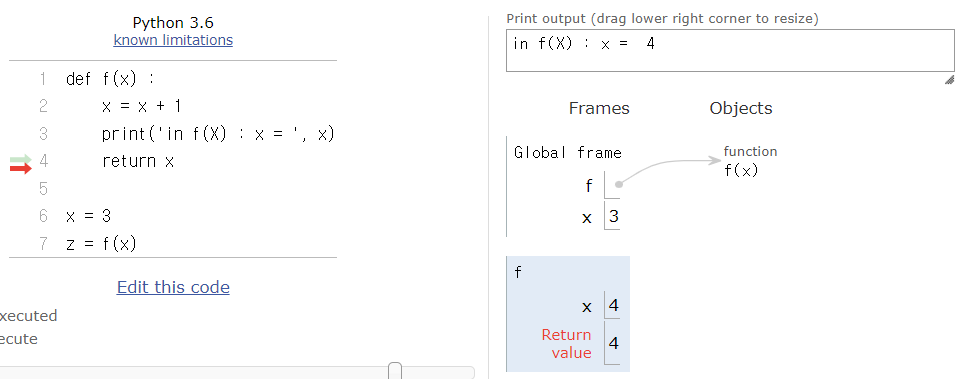
- f frame에서의 return 하는 x 값은 4. 이는 global frame에서의 x 값과는 무관하다.
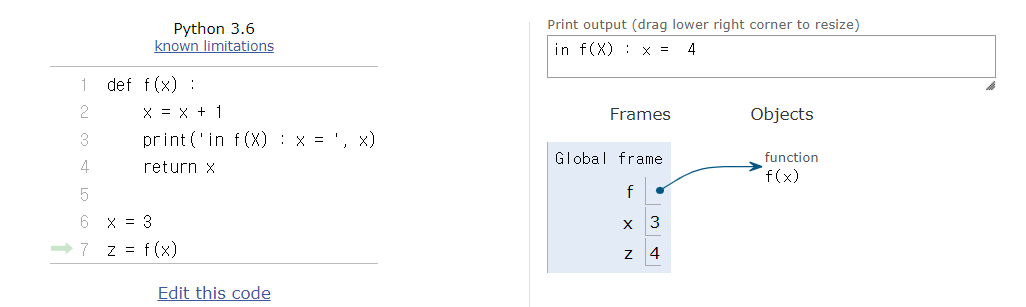
- f frame에서 return 한 값은 global frame 에서 z가 받는다.
Functions as arguments
- See this code
def func_a() :
  print('inside func_a')

def func_b(y) :
  print('inside func_b')
  return y

def func_c(z) :
  print('inside func_c')
  return z()

print(func_a())
print(5 + func_b(2))
print(func_c(func_a))-
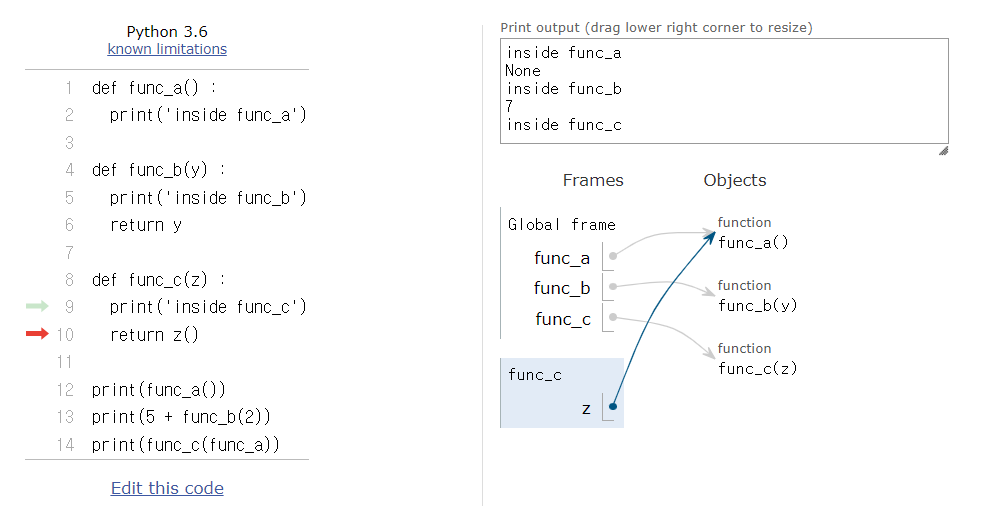
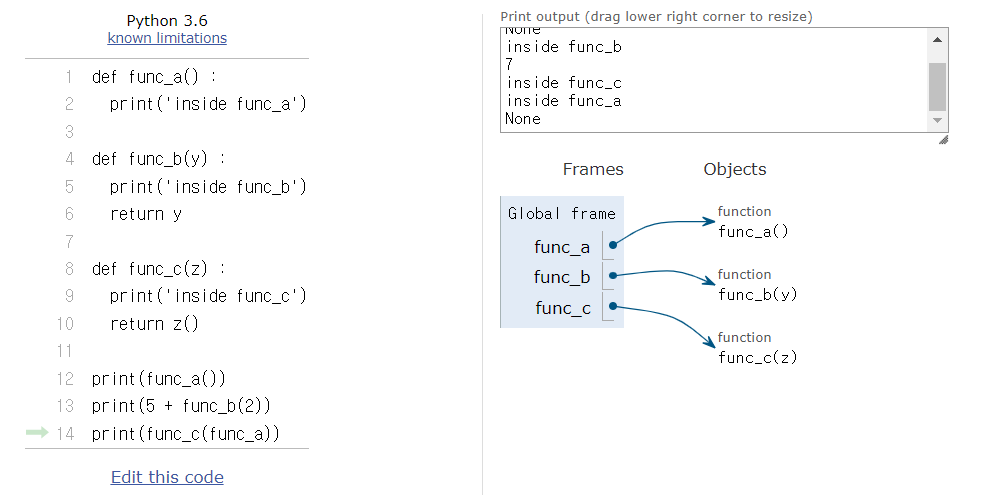
print(func_c(func_a)) 이전의 호출문은 쉬우니까 생략한다. 다음 그림을 보자.
-
func_c()를 호출, print('inside func_c') 를 수행한다. 이후, return 하기 전에 input으로 받은 func_a()를 실행한다.

-
func_a()는 None을 return한다. 이를 받아서 func_c가 return 한다. 이 return 한 값을 print한다.
Scope Example
- inside a funciton, can access a variable defined outside
def g(y) :
  print(x)
  print(x + 1)
  # just using x

x = 5
g(x)
print(x)

# rusult is 5, 6, 5- inside a function, cannot modify a variable defined outside, can using global variables, but frowned upon
# this code will make error

def h(y) :
  x += 1 # UnboundLocalError

x = 5
h(x)
print(X)
Scope details
- See this code
def g(x) :
  def h() :
    x = 'abc'
  x = x+1
  print('g: x = ', x)
  h()
  return x

x = 3
z = g(x)
print(z)-
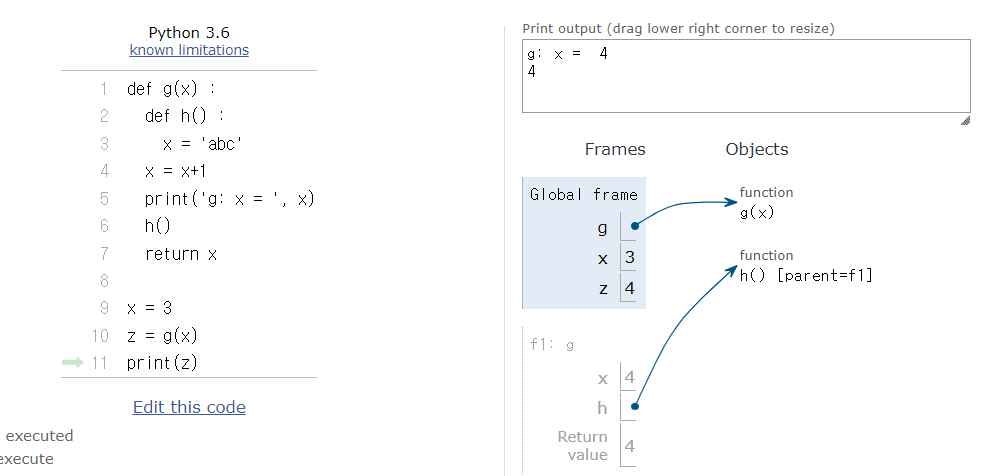
Scope 의 관점에서 하나씩 살펴보자. global scope 에서 x = 3, g scope 에서 x = 3을 받는다.
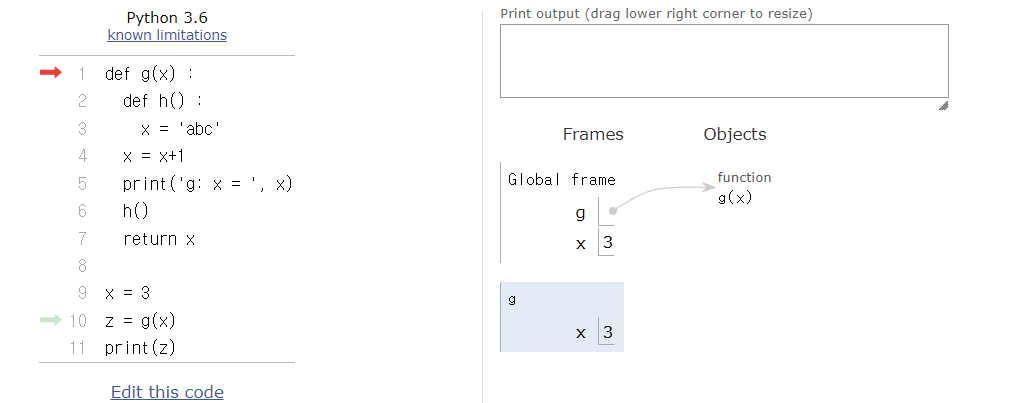
-
g 함수 내에서 정의된 h함수는 g scope 내에서 h scope를 만들고, 그 함수는 x = 'abc'라는 명령을 수행하도록 정의되었다. x는 x = x+1에 의해 3에서 1 증가한 4가 된다.
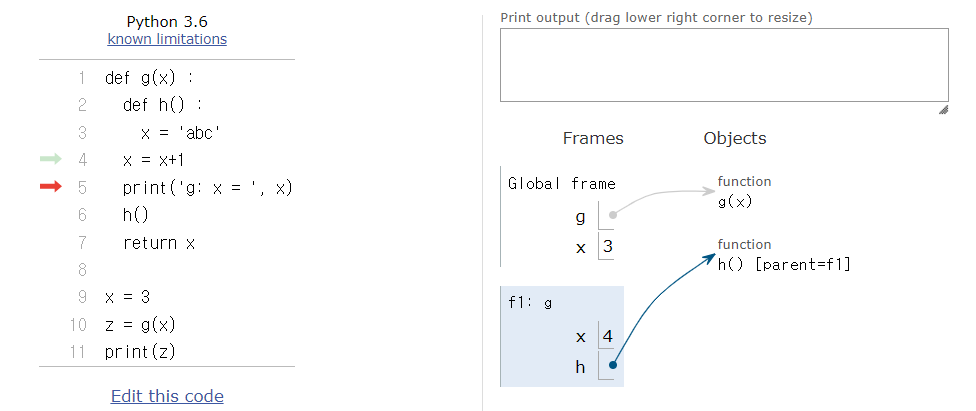
-
h() 를 수행한다. h scope 내에서 x는 'abc'로 재정의되지만, g scope에는 영향을 미치지 않는다. 그 결과 g는 x = 4 를 return한다.
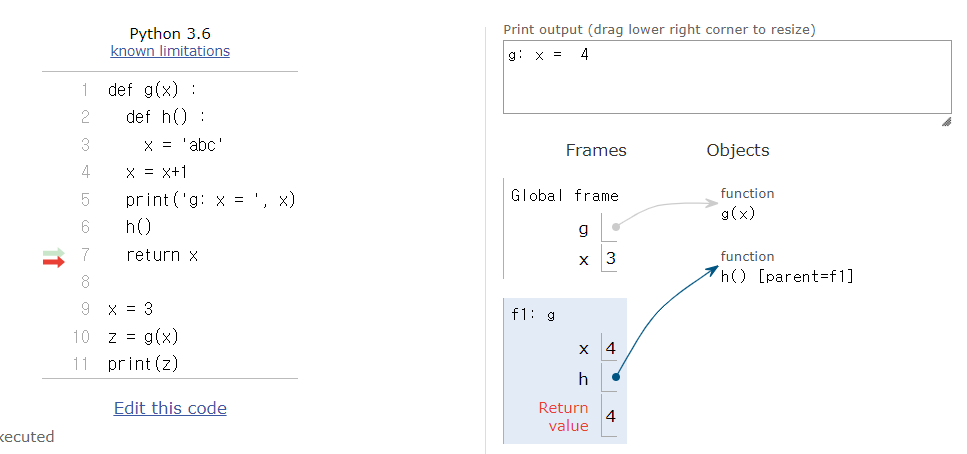
-
그 결과 z는 4를 받는다. print(z)의 결과는 4를 출력한다.