33_사용자 Exception 클래스
Exception 클래스를 상속해서 사용자 예외 클래스를 만들 수 있다.
class PasswordLengthShortException(Exception):
    def __init__(self, str):
        super().__init__(f'{str}: 길이 5미만')

class PasswordLengthLongtException(Exception):
    def __init__(self, str):
        super().__init__(f'{str}: 길이 10초과')

class PasswordWrongException(Exception):
    def __init__(self, str):
        super().__init__(f'{str}: 잘못된 비밀번호!!')

adminPw = input('input admin password: ')

try:
    if len(adminPw) < 5:
        raise PasswordLengthShortException(adminPw)

    elif len(adminPw) > 10:
        raise PasswordLengthLongtException(adminPw)

    elif adminPw != 'admin1234':
        raise PasswordWrongException(adminPw)

    elif adminPw == 'admin1234':
        print('빙고!')

except PasswordLengthShortException as e1:
    print(e1)

except PasswordLengthLongtException as e2:
    print(e2)

except PasswordWrongException as e3:
    print(e3)
=========================================================================
input admin password: admin1234
빙고!
34_텍스트 파일 쓰기
기본함수
open(), read(), write(), close()를 이용한 텍스트 파일 다루기
파일쓰기
- write()함숫를 이용한 파일에 문자열 쓰기
- file = open('C:/pythonEx/pythonTxt/test.txt', 'w')
- 'C:/pythonEx/pythonTxt/test.txt' 경로에 위치한 'test.txt' 파일을 쓰기 모드('w')로 열고, file 변수에 할당
file = open('C:/pythonEx/pythonTxt/test.txt', 'w') #C:\pythonEx\pythonTxt > /로 바꿔줘야함
strCnt = file.write('Hello world')
print(f'strCnt: {strCnt}')

file.close()
===============================
strCnt: 11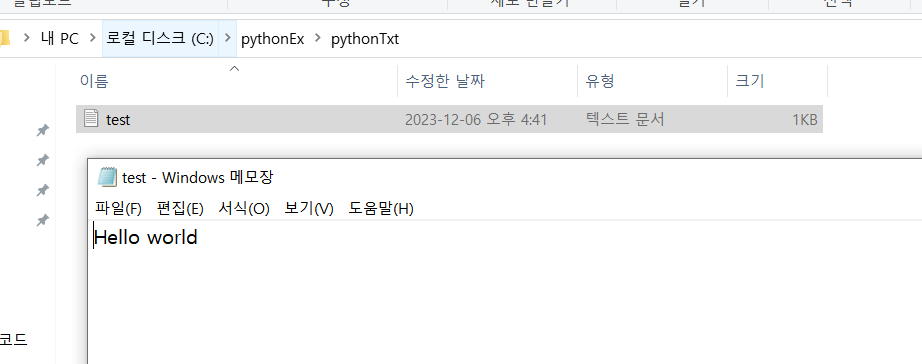
import time
lt = time.localtime()
dateStr = '[' + str(lt.tm_year) + '년' + \
          str(lt.tm_mon) + '월' + \
          str(lt.tm_mday) + '일]'

todaySchedule = input('오늘 일정: ')

file = open('C:/pythonEx/pythonTxt/test.txt', 'w')
file.write(dateStr + todaySchedule)
file.close()
====================================================
오늘 일정: python study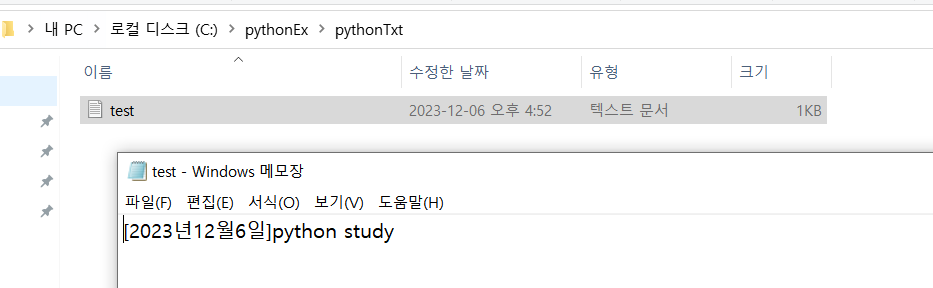
35_텍스트 파일 읽기
- read()함수를 이룡한 파일 문자열 읽기.
- file = open('C:/pythonEx/pythonTxt/test.txt', 'r')
file = open('C:/pythonEx/pythonTxt/test.txt', 'r')

str = file.read()
print(f'str: {str}')

file.close()
==============================================
str: [2023년12월6일]python study
36_텍스트 파일 열기
파일모드
파일을 어떤 목적으로 open할지 정한다.
- 'w' 쓰기전용 (파일이 있으면 덮어씌움)
- 'a' 쓰기전용 (파일이 있으면 덧붙임)
- 'x' 쓰기전용 (파일이 있으면 에러발생)
- 'r' 읽기전용(파일이 없으면 에러 발생)
37_with ~ as문
파일 닫기(close)를 생략할 수 있다.
uri = 'C:/pythonTxt/'

file = open(uri + '5_037.txt', 'a')
file.write('python study!!')
file.close()
------------------------------------
with open(uri + '5_037.txt', 'a') as f:
    f.write('python study!!'
import random
uri = 'C:/pythonEx/pythonTxt'
def writeNumbers(nums):
for idx, num in enumerate(nums):
with open(uri + 'lotto.txt', 'a') as f:
if idx < (len(nums) - 2): #마지막에 , 안나오게 하려고 한것
f.write(str(num) + ',')
elif idx == (len(nums) - 2):
f.write(str(num))
elif idx == (len(nums) - 1):
f.write('\n')
f.write('bonus: ' + str(num))
f.write('\n')
rNums = random.sample(range(1, 46), 7)
print(f'rNums: {rNums}')
writeNumbers(rNums)
===================================================
rNums: [25, 2, 39, 18, 12, 29, 1]
===================================================
25,2,39,18,12,29
bonus: 138_writelines()
- 반복 가능한 자료형의 데이터를 파일에 씀
- 리스트(list)또는 튜플 데이터를 파일에 쓰기 위한 함수
scoreDic = {'kor': 85, 'eng': 90,'mat': 92,'sci': 79,'his': 82}

uri = 'C:/pythonEx/pythonTxt'
for key in scoreDic.keys():
    with open(uri + 'scoreDic.txt', 'a') as f:
        f.write(key + '\t: ' + str(scoreDic[key]) + '\n')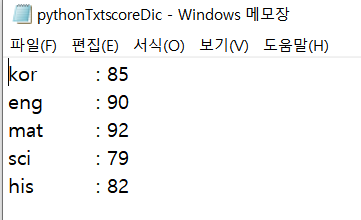
39_readlines(), readline()
readlines()
파일의 모든 데이터를 읽어서 리스트 형태로 반환한다.
readline()
한 행을 읽어서 문자열로 반환한다.
연습문제(함수)
산술연산 계산기를 함수를 이용해서 만들어 보자
def add(n1, n2):
    return n1 + n2

def sub(n1, n2):
    return n1 - n2

def mul(n1, n2):
    return n1 * n2

def div(n1, n2):
    return n1 / n2

def mod(n1, n2):
    return n1 % n2

def flo(n1, n2):
    return n1 // n2

def exp(n1, n2):
    return n1 ** n2

while True:
    print('-' * 60)
    selectNum = int(input('1.덧셈, 2.뺄셈, 3.곱셈, 4.나눗셈, 5.나머지, 6.몫, 7.제곱승, 8.종료 '))
    if selectNum == 8:
        print('Bye~!')
        break

    num1 = float(input('첫 번째 숫자 입력: '))
    num2 = float(input('두 번째 숫자 입력: '))

    if selectNum == 1:
        print(f'{num1} + {num2} = {add(num1, num2)}')

    elif selectNum == 2:
        print(f'{num1} - {num2} = {sub(num1, num2)}')

    elif selectNum == 3:
        print(f'{num1} * {num2} = {mul(num1, num2)}')

    elif selectNum == 4:
        print(f'{num1} / {num2} = {div(num1, num2)}')

    elif selectNum == 5:
        print(f'{num1} % {num2} = {mod(num1, num2)}')

    elif selectNum == 6:
        print(f'{num1} // {num2} = {flo(num1, num2)}')

    elif selectNum == 7:
        print(f'{num1} ** {num2} = {exp(num1, num2)}')

    else:
        print('잘못 입력했습니다. 다시 입력하세요.')

    print('-' * 60)
================================================================
------------------------------------------------------------
1.덧셈, 2.뺄셈, 3.곱셈, 4.나눗셈, 5.나머지, 6.몫, 7.제곱승, 8.종료 2
첫 번째 숫자 입력: 2.15
두 번째 숫자 입력: 0.15
2.15 - 0.15 = 2.0
------------------------------------------------------------
------------------------------------------------------------
1.덧셈, 2.뺄셈, 3.곱셈, 4.나눗셈, 5.나머지, 6.몫, 7.제곱승, 8.종료 8
Bye~!
이동거리와 이동시간을 반환하는 함수를 만들어 보자
def getDistance(speed, hour, minute):
    distance = speed * (hour + minute / 60)
    return distance

# 100:75 = 60:x ---> 75 * 60 / 100
def getTime(speed, distance):
    time = distance / speed
    print(f'time: {time}')
    h = int(time)
    m = int((time - h) * 100 * 60 / 100)

    return [h, m]


print('-' * 60)
s = float(input('속도(km/h) 입력 : '))
h = float(input('시간(h) 입력 : '))
m = float(input('시간(m) 입력 : '))
d = getDistance(s, h, m)

print(f'{s}(km/h)속도로 {h}(h)시간 {m}(m)분 동안 이동한 거리: {d}(km)')
print('-' * 60)

print('-' * 60)
s = float(input('속도(km/h) 입력 : '))
d = float(input('거리(km) 입력 : '))
t = getTime(s, d)

print(f'{s}(km/h)속도로 {d}(km)이동한 시간: {t[0]}(h)시간 {t[1]}(m)분')
print('-' * 60)
==========================================================================
------------------------------------------------------------
속도(km/h) 입력 : 90
시간(h) 입력 : 2
시간(m) 입력 : 45
90.0(km/h)속도로 2.0(h)시간 45.0(m)분 동안 이동한 거리: 247.5(km)
------------------------------------------------------------
------------------------------------------------------------
속도(km/h) 입력 : 90
거리(km) 입력 : 247.5
time: 2.75
90.0(km/h)속도로 247.5(km)이동한 시간: 2(h)시간 45(m)분
------------------------------------------------------------
비행기 티켓 영수증 출력 함수를 만들어 보자
childPrice = 18000
infantPrice = 25000
adultPrice = 50000
specialDC = 50

def formatedNumber(n):
    return format(n, ',')

def printAriPlaneReceipt(c1, c2, i1, i2, a1, a2):

    print('=' * 40)
    cp = c1 * childPrice
    cp_dc = int(c2 * childPrice * 0.5)
    print(f'유아 {c1}명 요금: {formatedNumber(cp)}원')
    print(f'유아 할인 대상 {c2}명 요금: {formatedNumber(cp_dc)}원')

    ip = i1 * infantPrice
    ip_dc = int(i2 * infantPrice * 0.5)
    print(f'소아 {i1}명 요금: {formatedNumber(ip)}원')
    print(f'소아 할인 대상 {i2}명 요금: {formatedNumber(ip_dc)}원')

    ap = a1 * adultPrice
    ap_dc = int(a2 * adultPrice * 0.5)
    print(f'성인 {a1}명 요금: {formatedNumber(ap)}원')
    print(f'성인 할인 대상 {a2}명 요금: {formatedNumber(ap_dc)}원')

    print('=' * 40)
    print(f'Total: {formatedNumber(c1 + c2 + i1 + i2 + a1 + a2)}명')
    print(f'TotalPrice : {formatedNumber(cp + cp_dc + ip + ip_dc + ap + ap_dc)}원')
    print('=' * 40)


childCnt = int(input('유아 입력: '))
specialDCChildCnt = int(input(f'할인대상 유아 입력: '))

infantCnt = int(input('소아 입력: '))
specialDCInfantCnt = int(input(f'할인대상 소아 입력: '))

adultCnt = int(input('성인 입력: '))
specialDCAdultCnt = int(input(f'할인대상 성인 입력: '))


printAriPlaneReceipt(childCnt, specialDCChildCnt,
                infantCnt, specialDCInfantCnt,
                adultCnt, specialDCAdultCnt)
=======================================================================
유아 입력: 1
할인대상 유아 입력: 1
소아 입력: 2
할인대상 소아 입력: 1
성인 입력: 2
할인대상 성인 입력: 0
========================================
유아 1명 요금: 18,000원
유아 할인 대상 1명 요금: 9,000원
소아 2명 요금: 50,000원
소아 할인 대상 1명 요금: 12,500원
성인 2명 요금: 100,000원
성인 할인 대상 0명 요금: 0원
========================================
Total: 7명
TotalPrice : 189,500원
========================================
재귀함수를 이용해서 팩토리얼 함수를 만들어보자
def formatedNumber(n):
    return format(n, ',')

def recursionFun(n):

    if n == 1:
        return n
    return n * recursionFun(n - 1)
inputNumber = int(input('input number: '))
inputNumberFormated = formatedNumber(recursionFun(inputNumber))
print(inputNumberFormated)
====================================================================
input number: 10
3,628,800
단리 월복리 계산기 함수
def formatedNumber(n):
    return format(n, ',')

def singleRateCalculator(m, t, r):
    totalMoney = 0
    totalRateMoney = 0

    for i in range(t):
        totalRateMoney += m * (r * 0.01)

    totalMoney = m + totalRateMoney
    return int(totalMoney)

def multiRateCalculator(m, t, r):
    t = t * 12
    rpm = (r / 12) * 0.01 #월이자.
    totalMoney = m

    for i in range(t):
        totalMoney += totalMoney * rpm
    return int(totalMoney)

money = int(input('예치금(원): '))
term = int(input('기간(년): '))
rate = int(input('연 이율(%): '))

print()
print('[단리 계산기]')
print('=' * 30)
print(f'예치금\t: {formatedNumber(money)}원')
print(f'예치기간\t: {term}년')
print(f'연 이율\t: {rate}%')
print('-' * 30)
amount = formatedNumber(singleRateCalculator(money, term, rate))
print(f'{term}년 후 총 수령액: {amount}원')
print('=' * 30)

print()
print('[월복리 계산기]')
print('=' * 30)
print(f'예치금\t: {formatedNumber(money)}원')
print(f'예치기간\t: {term}년')
print(f'연 이율\t: {rate}%')
print('-' * 30)
amount = formatedNumber(multiRateCalculator(money, term, rate))
print(f'{term}년 후 총 수령액: {amount}원')
print('=' * 30)
===============================================================
예치금(원): 10000000
기간(년): 3
연 이율(%): 3

[단리 계산기]
==============================
예치금	: 10,000,000원
예치기간	: 3년
연 이율	: 3%
------------------------------
3년 후 총 수령액: 10,900,000원
==============================

[월복리 계산기]
==============================
예치금	: 10,000,000원
예치기간	: 3년
연 이율	: 3%
------------------------------
3년 후 총 수령액: 10,940,514원
==============================
등차 수열의 n 번째 값과 합을 출력하는 함수
def sequenceCal(n1, d, n):
    valueN = 0
    sumN = 0
    i = 1

    while i <= n:
        if i == 1:
            valueN = n1
            sumN += valueN
            print('{}번째 항의 값: {}'.format(i, valueN))
            print('{}번째 항까지의 합: {}'.format(i, sumN))
            i += 1
            continue

        valueN += d
        sumN += valueN
        print('{}번째 항의 값: {}'.format(i, valueN))
        print('{}번째 항까지의 합: {}'.format(i, sumN))
        i += 1


def sequenceCal01(n1, d, n):

    # 등차 수열(일반항) 공식: an = a1 + (n-1) * d
    valueN = n1 + (n-1) * d
    print('{}번째 항의 값: {}'.format(n, valueN))

    # 등차 수열(합) 공식: sn = n(a1 + an) / 2
    sumN = n * (n1 + valueN) / 2
    print('{}번째 항까지의 합: {}'.format(n, int(sumN)))


inputN1 = int(input('a1 입력: '))
inputD = int(input('공차 입력: '))
inputN = int(input('n 입력: '))

sequenceCal(inputN1, inputD, inputN)
print('-' * 50)
sequenceCal01(inputN1, inputD, inputN)
=================================================================
a1 입력: 2
공차 입력: 3
n 입력: 7
1번째 항의 값: 2
1번째 항까지의 합: 2
2번째 항의 값: 5
2번째 항까지의 합: 7
3번째 항의 값: 8
3번째 항까지의 합: 15
4번째 항의 값: 11
4번째 항까지의 합: 26
5번째 항의 값: 14
5번째 항까지의 합: 40
6번째 항의 값: 17
6번째 항까지의 합: 57
7번째 항의 값: 20
7번째 항까지의 합: 77
--------------------------------------------------
7번째 항의 값: 20
7번째 항까지의 합: 77
이 글은 제로베이스 데이터 분석 스쿨의 강의 자료 일부를 발췌하여 작성되었습니다.
점점 더 어려워지는것같다..
이번주는 샘플프로젝트/일 + 진도(1.5) 분량으로 진행해야되다보니 복습이 부실해보인다.😭
밀린 진도를 어느정도 따라잡으면 다시 복습을 여러번 해야될것같고, 코드를 달달 외우는게 좋을것같다..! 아직 한달도 안됐으니 어려운게 당연하다고 생각하고 해야될것부터 해보자!