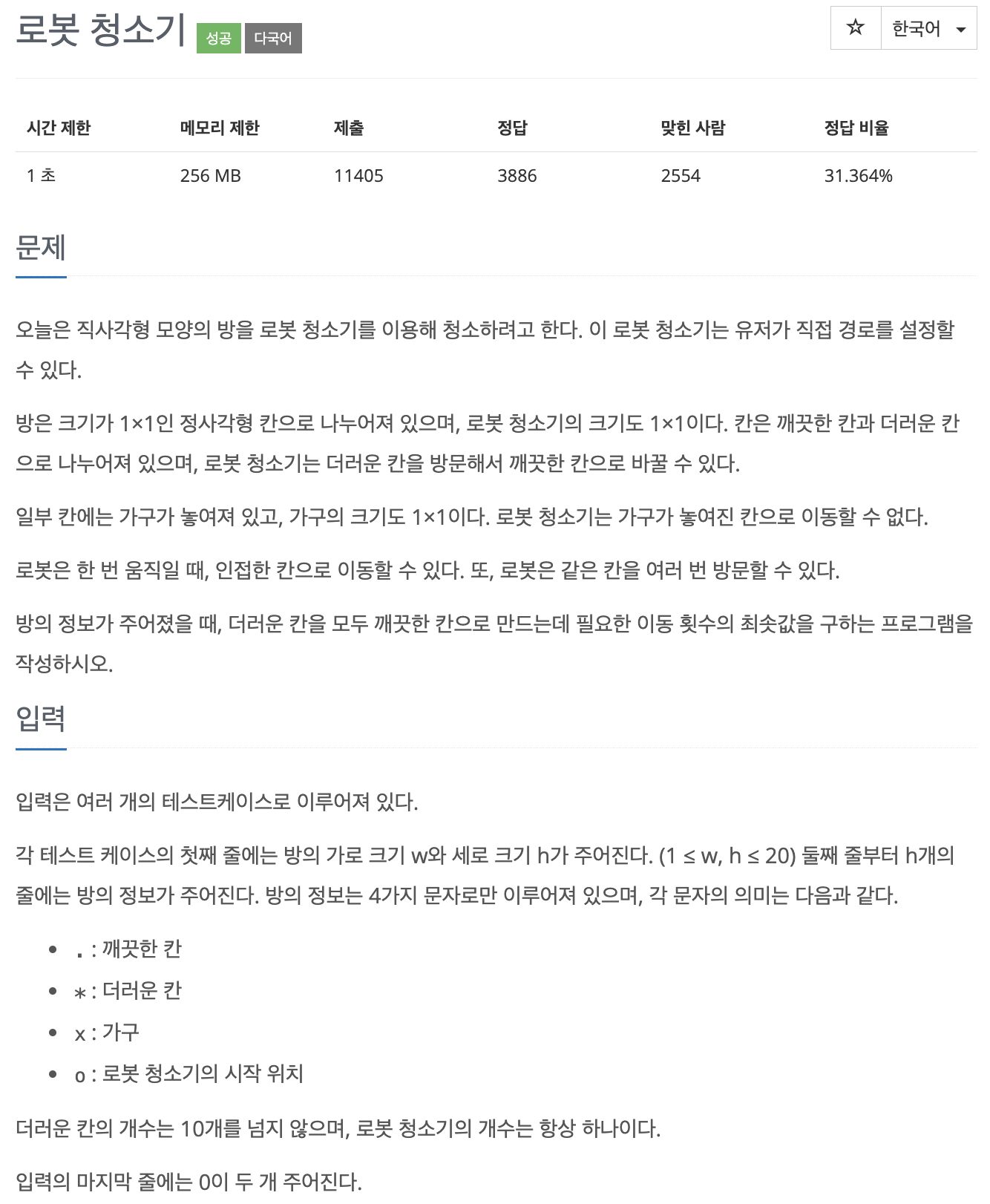
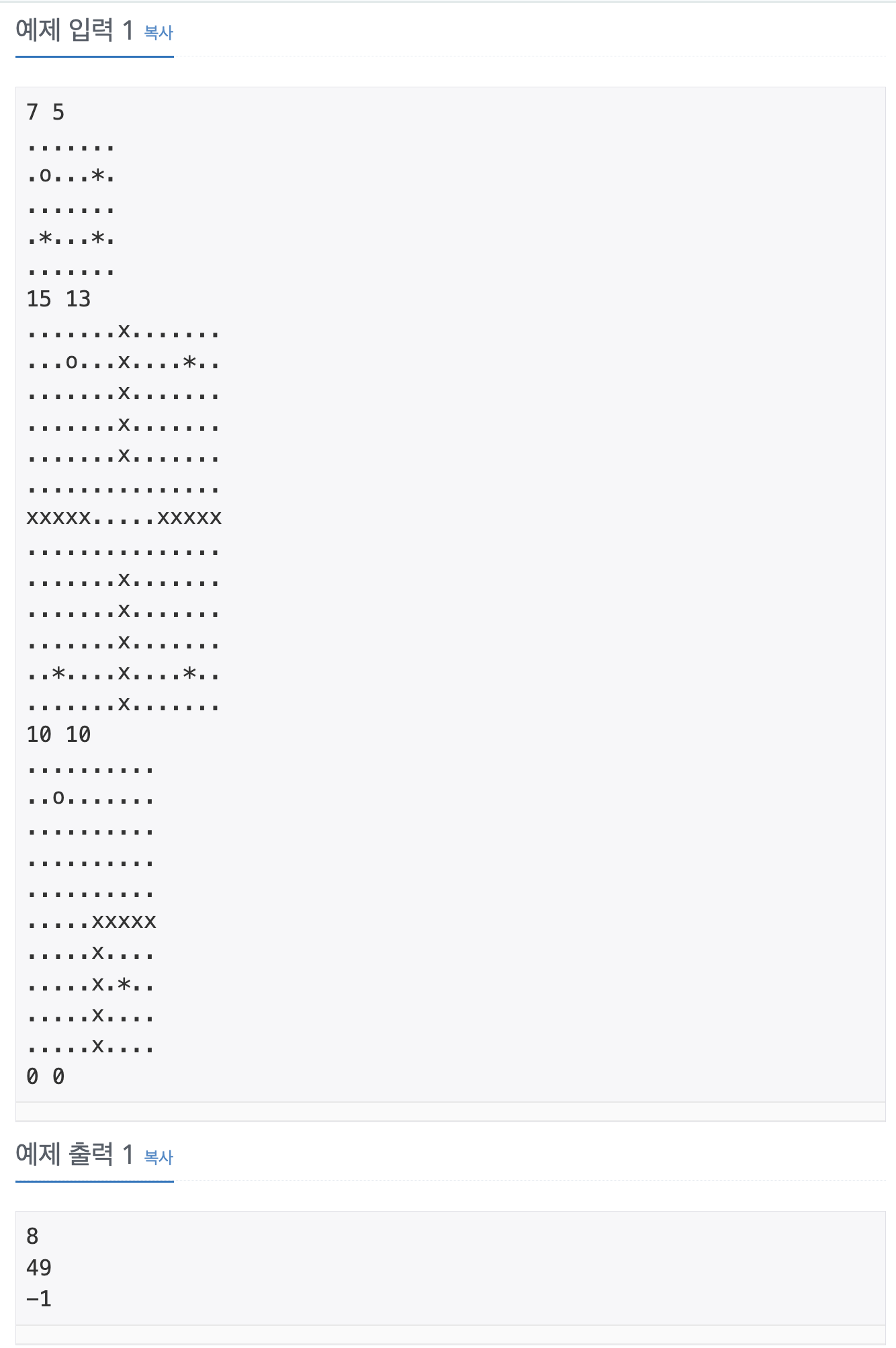
내 풀이
오답 풀이
인접한 칸 중 더러운 칸을 우선순위(가중치)로 두고 이동하지 않아도 되므로
BFS로 가구가 없는 칸으로의 탐색을 계속 진행하면서 더러운 칸을 만나면 청소 후 남은 더러운 칸 수를 -1 해준 후,
남은 더러운 칸이 0이 되었을 때의 거리값을 반환해주면 모든 칸을 청소한 최단 거리가 구해질 것이라 예상헀다.
다음 코드 실행 시 답이 아래와 같이 나온다.
j, k : 1 1
청소된 더러운 칸 : 3 1
청소된 더러운 칸 : 1 5
청소된 더러운 칸 : 3 5
(1, 1) ->
(2, 1) ->
(3, 1) ->
(3, 2) ->
(3, 3) ->
(3, 4) ->
(3, 5) ->
End
정답 : 6
j, k : 1 3
청소된 더러운 칸 : 11 2
청소된 더러운 칸 : 1 12
청소된 더러운 칸 : 11 12
(1, 3) ->
(2, 3) ->
(3, 3) ->
(4, 3) ->
(5, 3) ->
(5, 4) ->
(5, 5) ->
(6, 5) ->
(7, 5) ->
(7, 6) ->
(7, 7) ->
(7, 8) ->
(8, 8) ->
(9, 8) ->
(10, 8) ->
(11, 8) ->
(11, 9) ->
(11, 10) ->
(11, 11) ->
(11, 12) ->
End
정답 : 19
j, k : 1 2
정답 : -1
첫 번째 예제의 진행 과정을 보면 1,5 칸까지 가지 않고 3,5에서 조기종료 되어 원래 답보다 2가 작게 반환된다.
이를 통해 BFS에서 totalDirty를 이용한 종료조건에서 문제가 있는 것을 알 수 있었다.
import java.io.BufferedReader;
import java.io.IOException;
import java.io.InputStreamReader;
import java.util.*;

public class Main {
    static List<Integer> w, h, result;
    static List<char[][]> map;
    static int[] dx = {-1, 1, 0, 0};
    static int[] dy = {0, 0, -1, 1};

    public static void main(String[] args) throws IOException {
        BufferedReader br = new BufferedReader(new InputStreamReader(System.in));

        w = new ArrayList<>();
        h = new ArrayList<>();
        map = new ArrayList<>();
        result = new ArrayList<>();

        while (true) {
            StringTokenizer st = new StringTokenizer(br.readLine());
            int tw = Integer.parseInt(st.nextToken());
            int th = Integer.parseInt(st.nextToken());

            if (tw == 0 && th == 0) break;  // 입력 종료 조건

            w.add(tw);
            h.add(th);

            char[][] currentMap = new char[th][tw];
            for (int i = 0; i < th; i++) {
                String tmp = br.readLine();
                currentMap[i] = tmp.toCharArray();  // 문자열을 char 배열로 변환
            }
            map.add(currentMap);
        }

        for (int i = 0; i < map.size(); i++) {
            for (int j = 0; j < h.get(i); j++) {
                for (int k = 0; k < w.get(i); k++) {
                    if (map.get(i)[j][k] == 'o') {
                        System.out.println("j, k : " + j + " " + k);
                        if (bfs(j, k, i)) {
                            System.out.println(result.get(i));
                        } else {
                            System.out.println(-1);
                        }
                    }
                }
            }
        }
    }

    static boolean bfs(int x, int y, int num) {
        Queue<Node> queue = new LinkedList<>();
        int nh = h.get(num);
        int nw = w.get(num);
        boolean[][] visited = new boolean[nh][nw];

        visited[x][y] = true;
        queue.offer(new Node(x, y, 0, null));

        int totalDirty = 0;
        for (int i = 0; i < nh; i++) {   // 전체 칸 돌면서 남은 더러운 칸이 있는지 확인
            for (int j = 0; j < nw; j++) {
                if (map.get(num)[i][j] == '*')
                    totalDirty++;
            }
        }

        while (!queue.isEmpty()) {
            Node cur = queue.poll();

            if (map.get(num)[cur.x][cur.y] == '*') {  // 더러운 칸 도달 시
                System.out.println("청소된 더러운 칸 : " + cur.x + " " + cur.y);
                map.get(num)[cur.x][cur.y] = '.';  // 칸 청소
                totalDirty--;  // 남은 더러운 칸 수 감소

                if (totalDirty == 0) {
                    printPath(cur);  // 경로 출력
                    result.add(cur.dis);  // 모든 더러운 칸을 청소했으면 결과 추가
                    return true;
                }
            }

            for (int i = 0; i < 4; i++) {
                int nx = cur.x + dx[i];
                int ny = cur.y + dy[i];

                if (nx >= 0 && ny >= 0 && nx < nh && ny < nw && !visited[nx][ny] && map.get(num)[nx][ny] != 'x') {
                    visited[nx][ny] = true;
                    queue.offer(new Node(nx, ny, cur.dis + 1, cur));
                }
            }
        }
        return false;
    }

    static class Node {
        int x, y, dis;
        Node parent;

        Node(int x, int y, int dis, Node parent) {
            this.x = x;
            this.y = y;
            this.dis = dis;
            this.parent = parent;
        }
    }

    private static void printPath(Node node) {
        Stack<Node> path = new Stack<>();
        while (node != null) {
            path.push(node);
            node = node.parent; // 부모 노드를 통해 역추적
        }

        // 경로 역순 출력
        while (!path.isEmpty()) {
            Node step = path.pop();
            System.out.println("(" + step.x + ", " + step.y + ") -> ");
        }
        System.out.println("End");
    }

}
정답 풀이
BFS를 사용해 종료 조건을 바꾸고 어떤 방법을 다 사용해도 내가 생각한 방법으로는 풀리지 않았다.
정답 풀이를 찾아보니 DFS와 BFS를 둘 다 사용하는 방법으로 다들 풀었다.
먼저 BFS로 맵의 모든 칸을 시작점으로, 시작점부터 갈 수 있는 모든 지점까지의 최단 거리를 저장하고,
DFS로 더러운 칸의 청소 순서(순열)를 구해 각 순서로 더러운 칸을 청소한다고 했을 때 최단거리의 총합을 구하여 답을 반환한다.
정리해보면
BFS - o부터 모든 곳까지의 최단거리 구해놓기
DFS - 더러운 칸을 모두 사용해 만든 순열마다 BFS에서 구해놓은 최단거리를 더했을 때 최소가 되는 순열 찾기
정답 코드
import java.io.*;
import java.util.*;

public class Main {
    public static class Node {
        int x;
        int y;
        public Node(int x, int y){
            this.x = x;
            this.y = y;
        }

    }
    public static int h, w, minDis;
    public static ArrayList<Node> dirty;
    public static int startX, startY;
    public static char[][] map;
    public static boolean[] visited;
    public static int[][][][] dis;  //  x, y 지점에서 nx, ny 지점까지의 최단거리 저장
    public static int[] dx = {-1, 1, 0, 0};
    public static int[] dy = {0, 0, -1, 1};
    public static void main(String[] args) throws IOException {
        BufferedReader br = new BufferedReader(new InputStreamReader(System.in));

        while (true){
            StringTokenizer st = new StringTokenizer(br.readLine());
            w = Integer.parseInt(st.nextToken());
            h = Integer.parseInt(st.nextToken());

            if(h == 0 && w == 0) break;  // 입력 종료 조건

            dis = new int[h][w][h][w];
            map = new char[h][w];
            dirty = new ArrayList<>();

            for(int i = 0; i< h; i++){
                map[i] = br.readLine().toCharArray();  // 문자열을 char 배열로 변환
                for(int j = 0; j< w; j++){
                    if(map[i][j] == '*'){
                        dirty.add(new Node(i, j));
                    } else if(map[i][j] == 'o'){
                        startX = i;
                        startY = j;
                    }
                }
            }

            visited = new boolean[dirty.size()];
            minDis = Integer.MAX_VALUE;

            for(int i = 0; i< h; i++){
                for(int j = 0; j< w; j++){
                    bfs(i, j);  // i, j 부터 모든 접근 가능 지점까지의 최단거리 저장
                }
            }

            dfs(0, new int[dirty.size()]);  // 더러운 칸으로 만들 수 있는 모든 순열을 조합해 최단거리 구하기

            if(minDis == Integer.MAX_VALUE)
                System.out.println(-1);
            else
                System.out.println(minDis);

        }


    }
    public static void bfs(int x, int y){
        Queue<Node> q = new LinkedList<>();
        q.add(new Node(x, y));

        while (!q.isEmpty()){
            Node node = q.poll();
            for(int i=0;i<4;i++){
                int nx = node.x + dx[i];
                int ny = node.y + dy[i];
                if(nx < 0 || ny < 0 | nx >= h || ny >= w) continue;
                if(map[nx][ny] == 'x') continue;
                if(dis[x][y][nx][ny] != 0) continue;
                q.add(new Node(nx, ny));
                dis[x][y][nx][ny] = dis[x][y][node.x][node.y]+1;
            }
        }
    }
    public static void dfs(int depth, int[] perm){
        if(depth == dirty.size()){
            int disDFS = 0;
            int nextX = startX;
            int nextY = startY;

            for(int i=0;i<perm.length;i++){
                Node d = dirty.get(perm[i]);
                int distance = dis[nextX][nextY][d.x][d.y];
                if(distance == 0) return;
                disDFS += distance;
                nextX = d.x;
                nextY = d.y;
            }

            minDis = Math.min(minDis, disDFS);
            return;
        }

        for(int i=0;i<dirty.size();i++){
            if(visited[i]) continue;
            visited[i] = true;
            perm[depth] = i;
            dfs(depth+1, perm);
            visited[i] = false;
        }
    }
}

짱이 되고싶은 개발 기록