1. First-In-First-Out
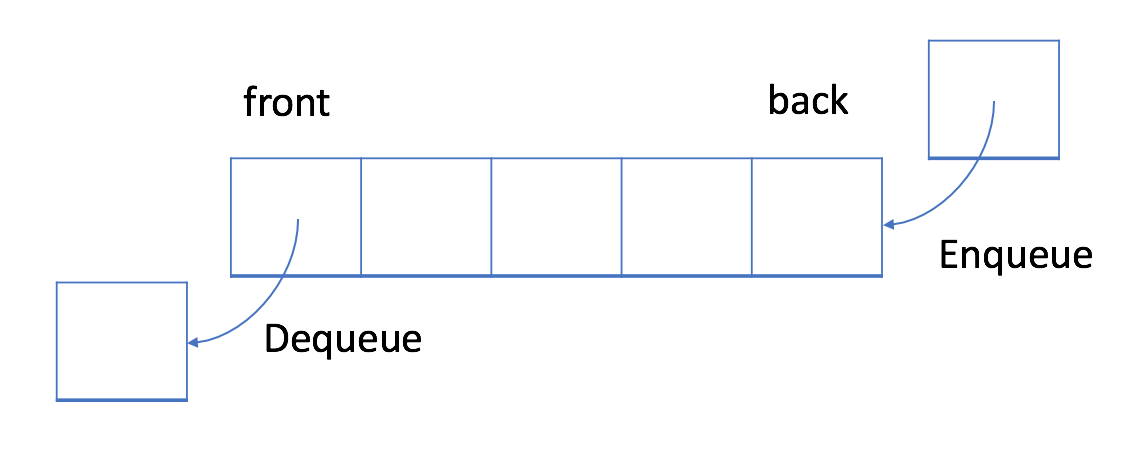
Queue is a linear structure with a FIFO characteristic
In FIFO structure - First element added to the queue will be processed first
Operations on queue
- Enqueue : Add items into end of queue
- Dequeue : Remove the first element of queue
- isEmpty : Check if queue is empty
- isFull : Check if queue is full
- Peek : Get front value of queue without removing it
Linear Queue
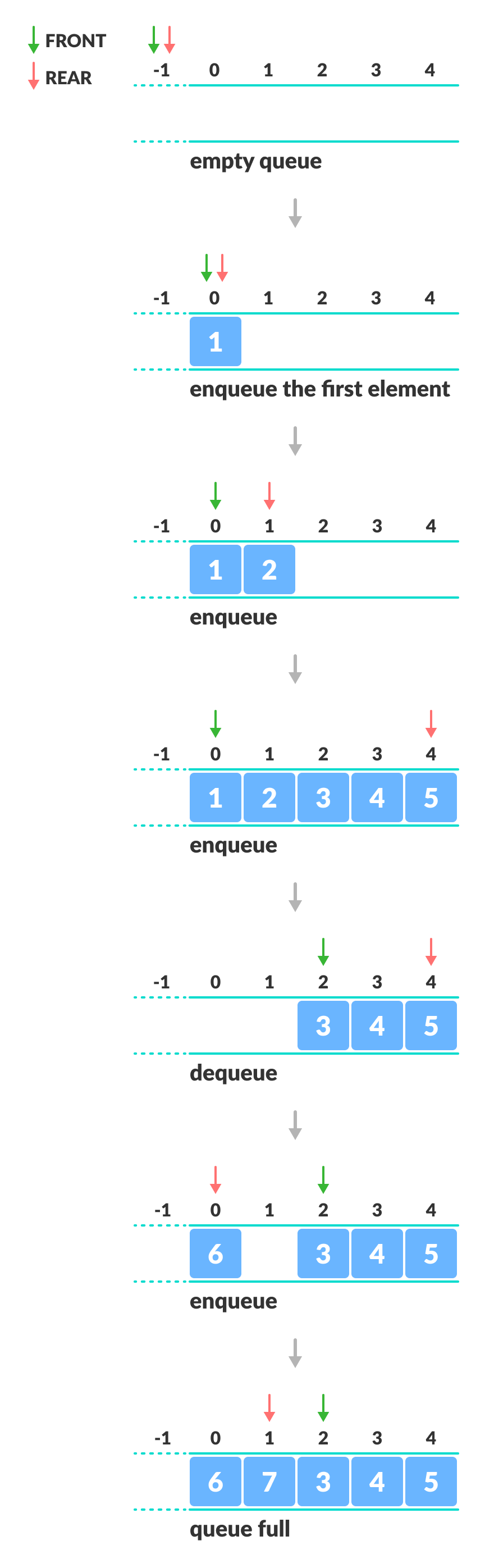
For the linear queue, array was used and 2 pointers to track the start and end of queue
Working of queue
- Two pointers : front and rear
front: track the first element of queuerear: track the last element of queue- Initially set
frontandrearvalue to -1
Enqueue operation
- Check if queue is full
- For first element (if
front==-1), setfrontto 0 - increase
rearby 1 - Add new element to position pointed by
rear
Dequeue operation
- Check if queue is empty
- Return value pointed by
front - Increase
frontindex by 1 - For last element, set
frontandrearto -1
class Queue {
   private:
  int items[SIZE], front, rear;

   public:
  Queue() {
    front = -1;
    rear = -1;
  }

  bool isFull() {
    if (front == 0 && rear == SIZE - 1) {
      return true;
    }
    return false;
  }

  bool isEmpty() {
    if (front == -1)
      return true;
    else
      return false;
  }

  void enQueue(int element) {
    if (isFull()) {
      cout << "Queue is full";
    } else {
      if (front == -1) front = 0;
      rear++;
      items[rear] = element;
      cout << endl
         << "Inserted " << element << endl;
    }
  }

  int deQueue() {
    int element;
    if (isEmpty()) {
      cout << "Queue is empty" << endl;
      return (-1);
    } else {
      element = items[front];
      if (front >= rear) {
        front = -1;
        rear = -1;
      } /* Q has only one element, so we reset the queue after deleting it. */
      else {
        front++;
      }
      cout << endl
         << "Deleted -> " << element << endl;
      return (element);
    }
  }
The implementation is easy to understand however is highly inefficient. With the movement of the front pointer, there will be more and more wasted space as front pointer moves to next array.
Therefore to solve problem, circular queue is introduced
Circular Queue
Circular Queue is a linear data structure in which we use a fixed-size array and two pointers to indicate the starting position and the ending position. And the goal is to reuse the wasted storage we mentioned previously.
Circular Queue works by the process of circular increment
When we try to increment the pointer and we reach the end of the queue, we start from the beginning of the queue.
Circular queue operations
- Two pointers : front and rear
front: track the first element of queuerear: track the last element of queue- Initially set
frontandrearvalue to -1
Enqueue operation
- Check if queue is full
- For first element (if
front==-1), setfrontto 0 - increase
rearby 1 (i.e. if the rear reaches the end, next it would be at the start of the queue) - Add new element to position pointed by
rear
Dequeue operation
- Check if queue is empty
- Return value pointed by
front - Increase
frontindex by 1 - For last element, set
frontandrearto -1
Difference of linear queue : Check whether queue is full
- Case 1 :
front==0 && rear==size-1 - Case 2 :
front == rear+1-> Whenrearstarts from 0 due to circular increment and when its value is just 1 less thatnfront
// Check if the queue is full
  bool isFull() {
    if (front == 0 && rear == SIZE - 1) {
      return true;
    }
    if (front == rear + 1) {
      return true;
    }
    return false;
  }
  // Check if the queue is empty
  bool isEmpty() {
    if (front == -1)
      return true;
    else
      return false;
  }
  // Adding an element
  void enQueue(int element) {
    if (isFull()) {
      cout << "Queue is full";
    } else {
      if (front == -1) front = 0;
      rear = (rear + 1) % SIZE;
      items[rear] = element;
      cout << endl
         << "Inserted " << element << endl;
    }
  }
  // Removing an element
  int deQueue() {
    int element;
    if (isEmpty()) {
      cout << "Queue is empty" << endl;
      return (-1);
    } else {
      element = items[front];
      if (front == rear) {
        front = -1;
        rear = -1;
      }
      // Q has only one element,
      // so we reset the queue after deleting it.
      else {
        front = (front + 1) % SIZE;
      }
      return (element);
    }
  }