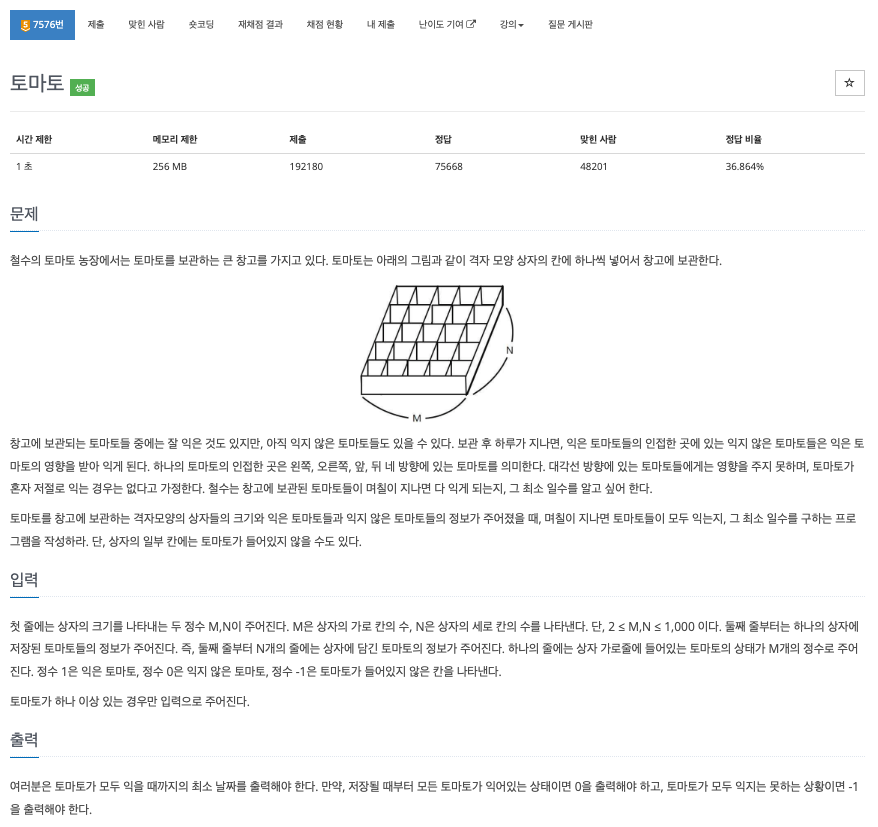
처음에는 단순하게 익은 토마토에서부터 BFS를 돌면서 count를 1씩 증가시키면 된다고 생각했었는데, 처음에 익은 토마토가 여러 개일 경우 이 방법은 사용할 수 없었다.
그래서 두번째로 생각한 방법은 BFS를 할 때 익은 토마토를 모두 큐에 넣고 시작하는 거 였는데 결국 이 방법도 첫번째와 다를게 없었다.
그래서 생각해낸 방법은 bfs를 돌면서 count를 증가시키는 것이 아니라 bfs를 돌면서 해당 노드에 그 전 노드의 값 +1을 해주는 것이었다.
풀이
- time, map 배열을 선언하고 map에 입력값을 저장한다.
- time 배열은 0으로 전부 초기화하고, map에 저장하면서 익은 토마토가 저장될 경우 큐에 추가하고 time 배열의 해당 좌표를 1로 초기화한다.
- map이 0인 부분 즉, 익지 않은 토마토가 있는 부분은 -1로 초기화한다.
- bfs를 돌면서 익지 않은 토마토일 경우 직전 토마토의 time+1값으로 초기화한다.
- BFS를 전부 돌면, 이중반복문으로 time에 -1인 부분이 있는지 확인하고 있으면 -1, 없으면 result를 출력한다.
코드
package BOJ;

import java.io.*;
import java.util.*;

public class sol7576 {

    static int N, M;
    static int[][] map;
    static int[][] time;
    static Queue<Point> tomato;
    static int[] dx = {0, 0, 1, -1};
    static int[] dy = {1, -1, 0, 0};
    static int result = 0;


    public static void main(String[] args) throws IOException {
        BufferedReader br = new BufferedReader(new InputStreamReader(System.in));
        StringTokenizer st = new StringTokenizer(br.readLine());

        M = Integer.parseInt(st.nextToken());
        N = Integer.parseInt(st.nextToken());

        map = new int[N][M];
        time = new int[N][M];
        tomato = new LinkedList<>();

        for (int i = 0; i < N; i++) {
            st = new StringTokenizer(br.readLine());
            for (int j = 0; j < M; j++) {
                map[i][j] = Integer.parseInt(st.nextToken());
                if (map[i][j] == 1) tomato.add(new Point(i, j));
                if(map[i][j]==0) time[i][j] = -1;
            }
        }

        bfs();

        for (int i = 0; i < N; i++) {
            for (int j = 0; j < M; j++) {
                if (time[i][j] == -1) {
                    System.out.println(-1);
                    return;
                }
                result = Math.max(result, time[i][j]);
            }
        }
        System.out.println(result);

    }

    public static void bfs() {

        while (!tomato.isEmpty()) {
            Point t = tomato.poll();
            for (int i = 0; i < 4; i++) {
                int newX = t.x + dx[i];
                int newY = t.y + dy[i];
                if ((newX >= 0 && newX < N) && (newY >= 0 && newY < M)) {
                    if (map[newX][newY] == 0 && time[newX][newY] == -1) {
                        tomato.add(new Point(newX, newY));
                        time[newX][newY] = time[t.x][t.y] + 1;
                    }
                }
            }
        }


    }

    public static class Point {
        int x, y;

        public Point(int x, int y) {
            this.x = x;
            this.y = y;
        }
    }
}
리뷰
BFS 알고리즘을 사용할 때 이런식으로 특정 값을 채우는 것이 아닌 거리 등을 계산할 때는 배열의 값을 업데이트하는 방식을 사용하면 좋겠다는 것을 알게되었다.

like the water flowing