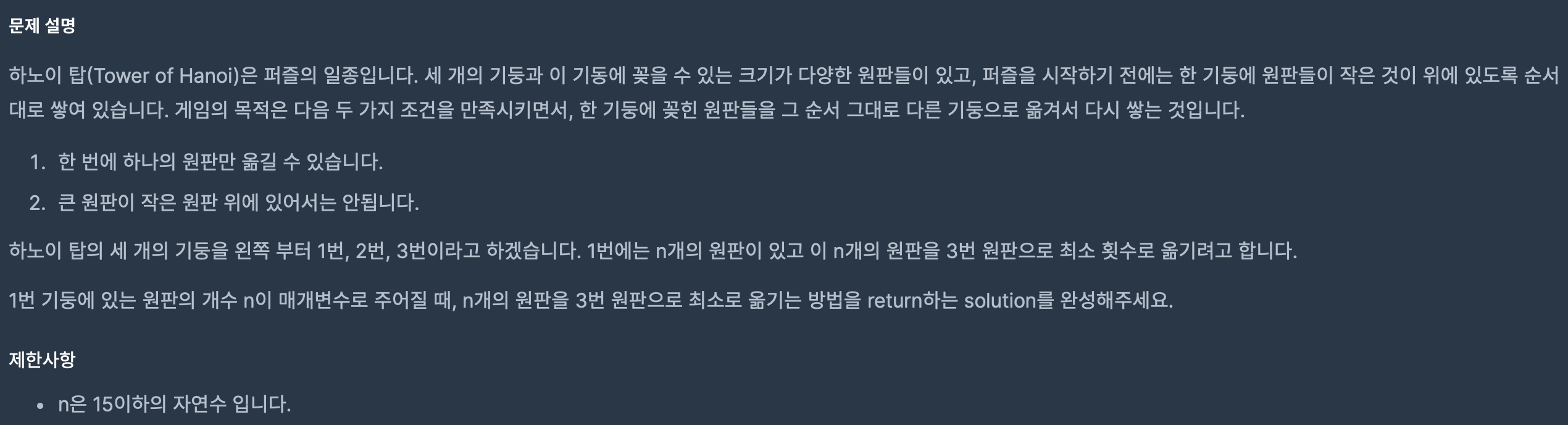
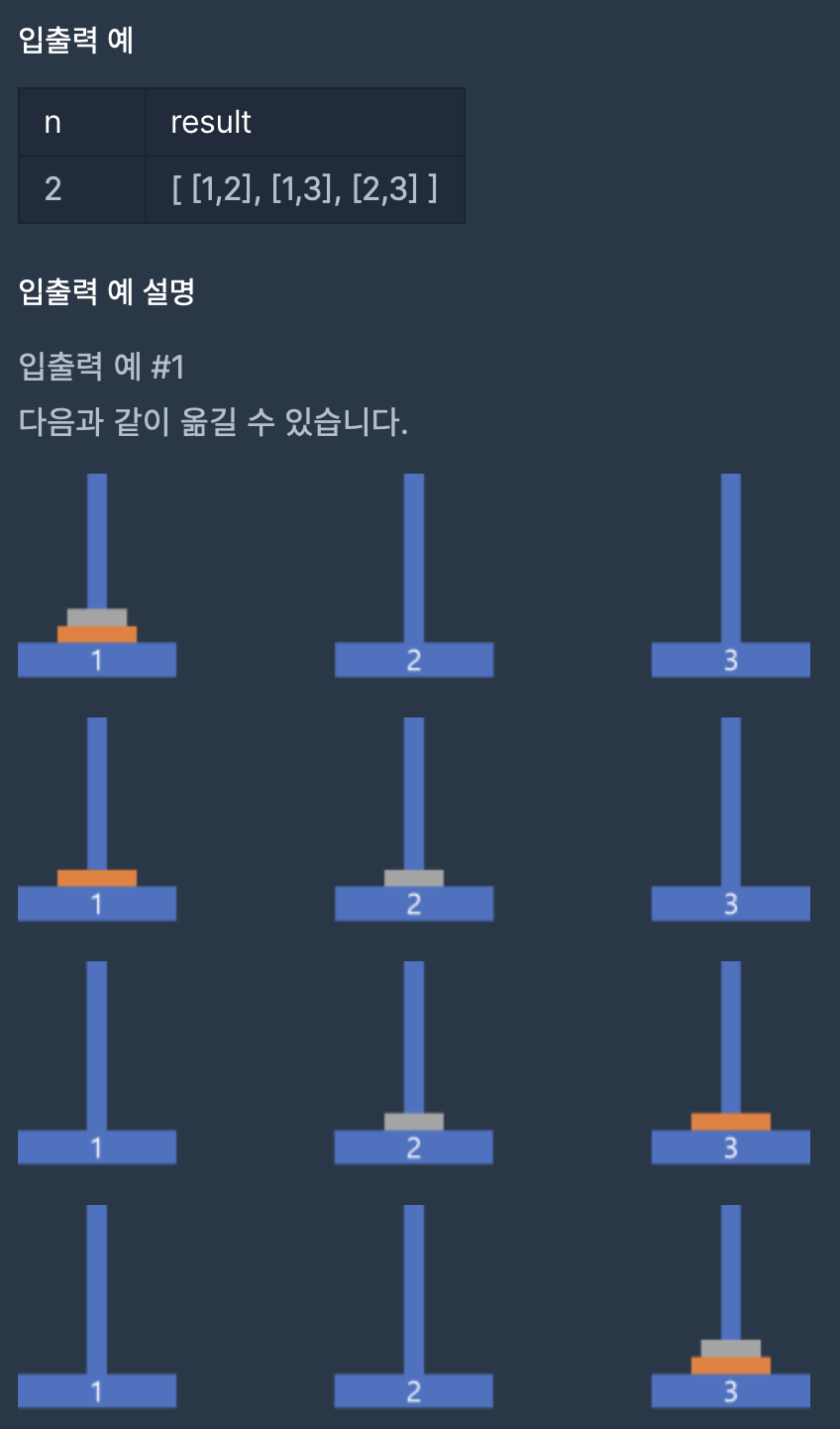
하노이의 탑은 고전적인 재귀 문제로 잘 알려져있다.
이전에도제로베이스에서 학습한적이 있는데
아직 해당 알고리즘이 이해가 되지 않아 다시 학습을 하며 참고했다.
문제 접근 방식
- 한번에 하나의 원판만 이동 가능
- 원판의 갯수가 짝수이면, 첫번째 원판은 중간 기둥에 놓는다.
- 원판의 갯수가 홀수이면, 첫번째 원판은 마지막 기둥에 놓는다.
- 마지막 원판은 무조건 마지막 기둥에 있어야 한다.
- 원판을 이동하기 위해 하위 문제로 원판을 나누고 재귀적으로 호출한다.
📌정적 변수 선언
- 메서드와 메서드에서 같이 접근할수 있는 List 변수를 선언했다.
- 해당 List에서 이동 기록을 저장한다.
public static List<int[]> list;📌 메서드
- 원판의 개수를 받은 n
- 시작 기둥인 from
- 중간 기둥인 sub
- 마지막 기둥인 to
public static void hanoi(int n, int from, int sub, int to)- 마지막 원판은 무조건 from 기둥에서 to 기둥으로 간다.
if (n == 1) {
   list.add(new int[]{from, to});
   return;
}- n - 1 번째의 원판을 보조 기둥으로 이동
- 현재 기둥에서 목표 기둥으로 가장 큰 원판을 이동
- 마지막으로 n - 1 개의 원판을 보조 기둥에서 목표 기둥 으로 이동
hanoi(n - 1, from, to, sub);
list.add(new int[]{from, to});
hanoi(n - 1, sub, from, to);
}
📌 메서드
- list를 ArrayList 로 초기화 하고(동적 리스트로 받기 위해) 함수를 호출하여 원판을 이동시킨다.
list = new ArrayList<>();
hanoi(n, 1, 2, 3);- list에 저장된 이동 기록을 2차원 정수형 배열에 저장한다.
int [][] answer = new int[list.size()][];
    for (int i = 0; i < list.size(); i++) {
        answer[i] = list.get(i);
    }
시각적으로 이해하기
n = 2
- 해당 코드는 넘어간다 (현재 은 2 이기 때문)
if (n == 1) {
   list.add(new int[]{from, to});
   return;
}- 해당 코드를 만나면서 시작 (이때 분할된다.)
hanoi(n - 1, from, to, sub); // 1, 1, 3, 2- 은 1 이므로 재귀호출되어 해당 코드로 돌아온다.
if (n == 1) {
   list.add(new int[]{from, to}); // 1, 2
   return;
}- 리스트에 저장 (분할된 코드는 여기서 따로 저장)
list.add(new int[]{from, to}); // 1, 3- 분할된 코드는 해당 코드를 만나며 한번더 위치 교환
hanoi(n - 1, sub, from, to); // 1, 2, 1, 3함수 호출 흐름
hanoi(2, 1, 2, 3)
  - hanoi(1, 1, 3, 2)
      - list.add(new int[]{1, 2})
  - list.add(new int[]{1, 3})
  - hanoi(1, 2, 1, 3)
      - list.add(new int[]{2, 3})
표로 이동을 구현했을 때
| n | f | s | t |
|---|---|---|---|
| 2 | 1 | 2 | 3 |
| 1 | 1 | 3 | 2 |
| 2 | 1 | 2 | 3 |
| 1 | 2 | 1 | 3 |
1번째, 3번째가 분기점
{{1, 2}, {1, 3}, {2, 3}}
재귀 트리 구조
hanoi(n, from, sub, to)
    -> hanoi(n-1, from, to, sub)
    -> move largest from `from` to `to`
    -> hanoi(n-1, sub, from, to)
n = 3 일때 재귀 트리 구조
hanoi(3, 1, 2, 3)
|
|- hanoi(2, 1, 3, 2)
   |
   |- hanoi(1, 1, 2, 3)
   |- move 1 from 1 to 2
   |- hanoi(1, 3, 1, 2)
|- move 2 from 1 to 3
|- hanoi(2, 2, 1, 3)
   |
   |- hanoi(1, 2, 3, 1)
   |- move 2 from 2 to 3
   |- hanoi(1, 1, 2, 3)
💻 최종 코드 💻
import java.util.ArrayList;
import java.util.Arrays;
import java.util.List;

class Solution {
    public static List<int[]> list;

    public int[][] solution(int n) {
        list = new ArrayList<>();
        hanoi(n, 1, 2, 3);


        int [][] answer = new int[list.size()][];
        for (int i = 0; i < list.size(); i++) {
            answer[i] = list.get(i);
        }

        return answer;
    }

    public static void hanoi(int n, int from, int sub, int to) {
        if (n == 1) {
           list.add(new int[]{from, to});
           return;
        }

        hanoi(n - 1, from, to, sub);
        list.add(new int[]{from, to});
        hanoi(n - 1, sub, from, to);
    }

    public static void main(String[] args) {
        int n = 15;
        Solution sol = new Solution();
        int[][] arr = sol.solution(n);
        System.out.println(Arrays.deepToString(arr));
    }
}
👉재귀호출
- 해당 코드를 예시로, 이 커질수록 재귀 트리의 깊이와 폭은 급격히 증가한다.
- 이 증가할때 마다, 재귀 호출이 만큼의 이동을 필요로 한다.
- 해당 문제의 제한조건인 인 경우에는
총 32767번의 이동이 필요로 하게 된다.
해당 코드로 확인해본 결과 32767번의 계산 횟수가 확인되었다.
public class Main {
    public static int hanoi(int n, int from, int sub, int to) {
        if (n == 1) {
            return 1;
        }
        int cnt = 0;
        cnt += hanoi(n - 1, from, to, sub);
        cnt++;
        cnt += hanoi(n - 1, sub, from, to);

        return cnt;
    }

    public static void printHanoi(int n) {
        System.out.println(hanoi(n, 1, 2, 3));
    }
    public static void main(String[] args) {
        int n = 15;
        printHanoi(n); // 32767
    }
}
👏👏👏👏👏👏👏👏👏

재귀호출이 아직 많이 헷갈리고 부족하지만,
해당 문제를 풀어보면서 재귀호출이 뭔가멀티버스?같이 분기가 나뉘는걸로 느껴졌다.
제대로 이해한건진 모르겠지만, 재귀는 학습이 더 많이 필요한것 같다.
Hello World