
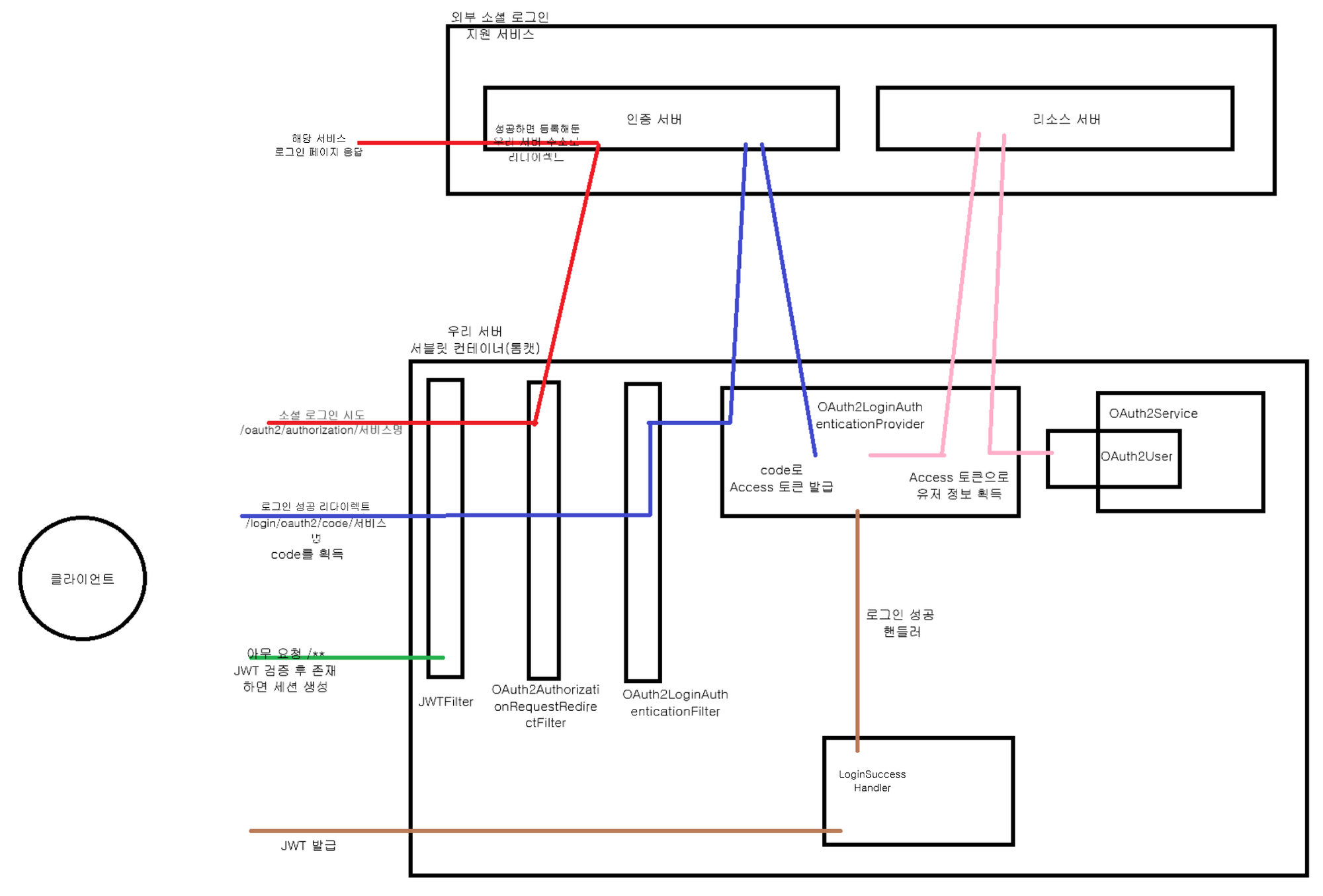
OAuth2 클라이언트 의존성에 의해 필터나 Provider는 기본적으로 제공을 해준다. 하지만 리소스 서버에서 제공해주는 유저 정보는 직접 구현해야 한다.
@Service
public class CustomOAuth2UserService extends DefaultOAuth2UserService {

    private final UserRepository userRepository;

    public CustomOAuth2UserService(UserRepository userRepository) {

        this.userRepository = userRepository;
    }

    @Override
    public OAuth2User loadUser(OAuth2UserRequest userRequest) throws OAuth2AuthenticationException {

        OAuth2User oAuth2User = super.loadUser(userRequest);
        System.out.println(oAuth2User);

        String registrationId = userRequest.getClientRegistration().getRegistrationId();
        OAuth2Response oAuth2Response = null;
        if (registrationId.equals("naver")) {

            oAuth2Response = new NaverResponse(oAuth2User.getAttributes());
        }
        else if (registrationId.equals("google")) {

            oAuth2Response = new GoogleResponse(oAuth2User.getAttributes());
        }
        else {

            return null;
        }
        String username = oAuth2Response.getProvider()+" "+oAuth2Response.getProviderId();
        UserEntity existData = userRepository.findByUsername(username);

        if (existData == null) {

            UserEntity userEntity = new UserEntity();
            userEntity.setUsername(username);
            userEntity.setEmail(oAuth2Response.getEmail());
            userEntity.setName(oAuth2Response.getName());
            userEntity.setRole("ROLE_USER");

            userRepository.save(userEntity);

            UserDTO userDTO = new UserDTO();
            userDTO.setUsername(username);
            userDTO.setName(oAuth2Response.getName());
            userDTO.setRole("ROLE_USER");

            return new CustomOAuth2User(userDTO);
        }
        else {

            existData.setEmail(oAuth2Response.getEmail());
            existData.setName(oAuth2Response.getName());

            userRepository.save(existData);

            UserDTO userDTO = new UserDTO();
            userDTO.setUsername(existData.getUsername());
            userDTO.setName(oAuth2Response.getName());
            userDTO.setRole(existData.getRole());

            return new CustomOAuth2User(userDTO);
        }
    }
}
OAuth2Response
- 네이버 데이터
{
		resultcode=00, message=success, response={id=123123123, name=원승현}
}- 구글 데이터
{
		resultcode=00, message=success, id=123123123, name=원승현
}
OAuth2Response 인터페이스(DTO)
public interface OAuth2Response {

    //제공자 (Ex. naver, google, ...)
    String getProvider();
    //제공자에서 발급해주는 아이디(번호)
    String getProviderId();
    //이메일
    String getEmail();
    //사용자 실명 (설정한 이름)
    String getName();
}
NaverResponse(DTO)
public class NaverResponse implements OAuth2Response{

    private final Map<String, Object> attribute;

    public NaverResponse(Map<String, Object> attribute) {

        this.attribute = (Map<String, Object>) attribute.get("response");
    }

    @Override
    public String getProvider() {

        return "naver";
    }

    @Override
    public String getProviderId() {

        return attribute.get("id").toString();
    }

    @Override
    public String getEmail() {

        return attribute.get("email").toString();
    }

    @Override
    public String getName() {

        return attribute.get("name").toString();
    }
}
GoogleResponse(DTO)
public class GoogleResponse implements OAuth2Response{

    private final Map<String, Object> attribute;

    public GoogleResponse(Map<String, Object> attribute) {

        this.attribute = attribute;
    }

    @Override
    public String getProvider() {

        return "google";
    }

    @Override
    public String getProviderId() {

        return attribute.get("sub").toString();
    }

    @Override
    public String getEmail() {

        return attribute.get("email").toString();
    }

    @Override
    public String getName() {

        return attribute.get("name").toString();
    }
}
OAuth2UserService 등록(SecurityConfig)
@Configuration
@EnableWebSecurity
public class SecurityConfig {

    private final CustomOAuth2UserService customOAuth2UserService;

    public SecurityConfig(CustomOAuth2UserService customOAuth2UserService) {

        this.customOAuth2UserService = customOAuth2UserService;
    }

    @Bean
    public SecurityFilterChain filterChain(HttpSecurity http) throws Exception {

        //csrf disable
        http
                .csrf((auth) -> auth.disable());

        //From 로그인 방식 disable
        http
                .formLogin((auth) -> auth.disable());

        //HTTP Basic 인증 방식 disable
        http
                .httpBasic((auth) -> auth.disable());

        //oauth2
        http
                .oauth2Login((oauth2) -> oauth2
                        .userInfoEndpoint((userInfoEndpointConfig) -> userInfoEndpointConfig
                                .userService(customOAuth2UserService)));

        //경로별 인가 작업
        http
                .authorizeHttpRequests((auth) -> auth
                        .requestMatchers("/").permitAll()
                        .anyRequest().authenticated());

        //세션 설정 : STATELESS
        http
                .sessionManagement((session) -> session
                        .sessionCreationPolicy(SessionCreationPolicy.STATELESS));

        return http.build();
    }
}
UserEntity
@Entity
@Getter
@Setter
public class UserEntity {

    @Id
    @GeneratedValue(strategy = GenerationType.IDENTITY)
    private Long id;

    private String username;
		private String name;

    private String email;

    private String role;
}
UserDTO
@Getter
@Setter
public class UserDTO {

    private String role;
    private String name;
    private String username;
}
CustomOAuth2User
public class CustomOAuth2User implements OAuth2User {

    private final UserDTO userDTO;

    public CustomOAuth2User(UserDTO userDTO) {

        this.userDTO = userDTO;
    }

    @Override
    public Map<String, Object> getAttributes() {

        return null;
    }

    @Override
    public Collection<? extends GrantedAuthority> getAuthorities() {

        Collection<GrantedAuthority> collection = new ArrayList<>();

        collection.add(new GrantedAuthority() {

            @Override
            public String getAuthority() {

                return userDTO.getRole();
            }
        });

        return collection;
    }

    @Override
    public String getName() {

        return userDTO.getName();
    }

    public String getUsername() {

        return userDTO.getUsername();
    }
}
스프링 시큐리티 기본 방식에서(OAuth2가 아닌) UsernamePasswordAuthenticationFilter를 커스텀한 필터에서 authenticationManager를 통해, 전달 받은 로그인 정보를 UserDetailService에서 가져온 UserDetails와 비교해서 정보가 일치하면 로그인 성공을 하듯이 CustomOAuth2UserService는 CustomOAuth2User(DB에 저장된 정보)를 전달해준다.
참고자료: 개발자 유미 스프링 OAuth2 클라이언트 JWT