Week 5-1. Radiometry and Reflectance
1. Light and Scene
light and shadow
refraction 굴절
reflection
interrelection: reciprocal reflection 상호 반사(엘베 거울)
scattering
more complex appearances
2. Radiometric Concepts
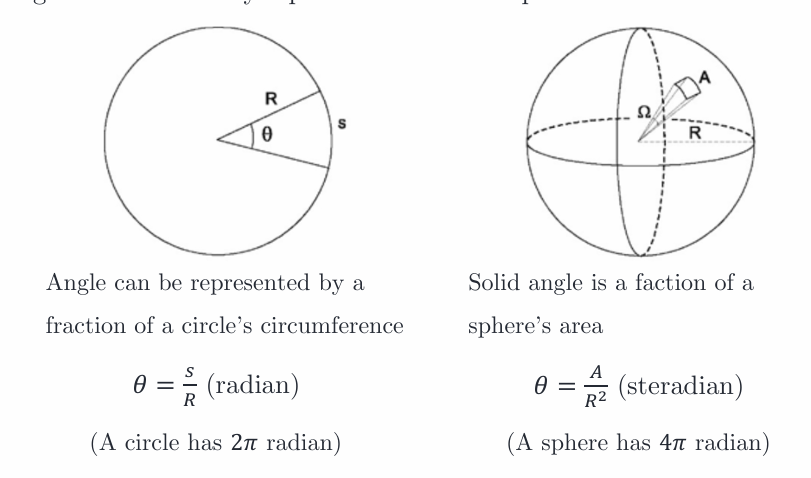
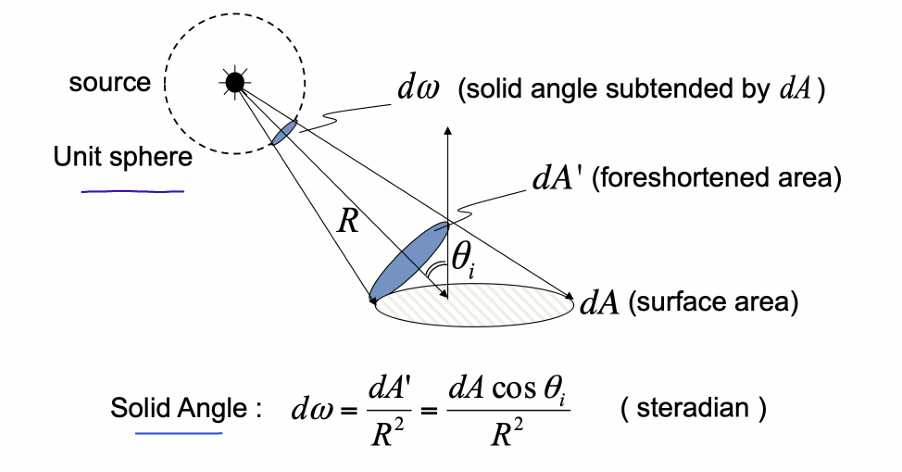
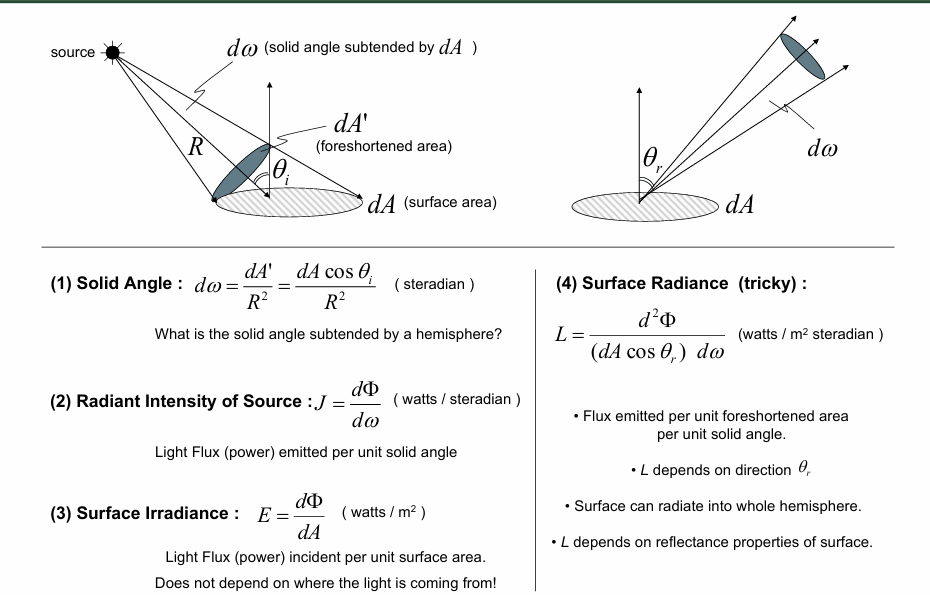
Solid Angle
projected area of a surface patch onto a unit sphere from a point
it is subtended by a point and a surface patch
unit sphere 위에 있는 surface patch와 점의 사이 부분 (projected area), 그림 참고
subtend: 범위를 정하다
steradian: 입체 호도법
foreshorten: 단축하다
Radiant Intensity of Source:
light radiant flux emitted per unit solid angle
radiant flux(power): radiant energy emitted per unit time
solid angle 기준 power
Surface Irradiance 방사율:
light radiant flux(power) incident 광속 입사 (received) per unit surface area, not depend on light이 온 곳
surface area기준 power
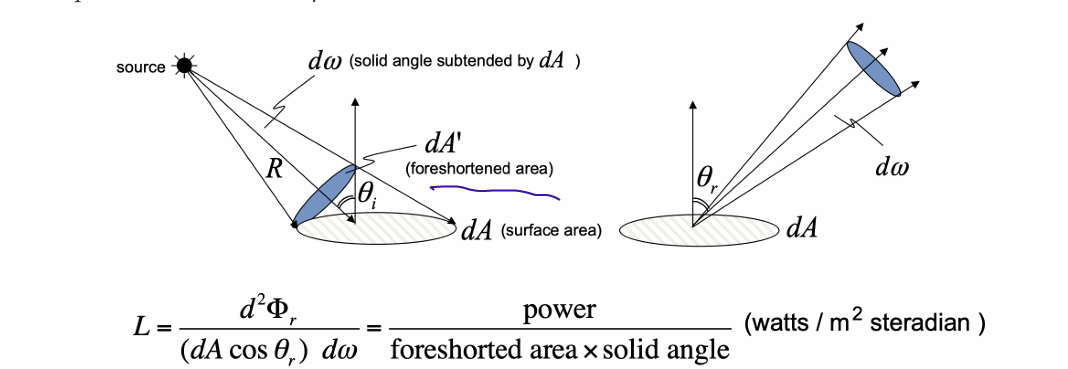
Surface Radiance
Flux emitted per unit foreshortened 단축된 area per unit solid angle
• Surface can radiate into whole hemisphere 반구
• L depends on reflectance properties of surface
• L depends on direction
power / (foreshorted area x solid angle)
반구 다 방사 가능, 반사율에 의존, 에 의존
- Radiometric Concepts
3. BRDF (Bi-Directional Reflectance Distributin Function)
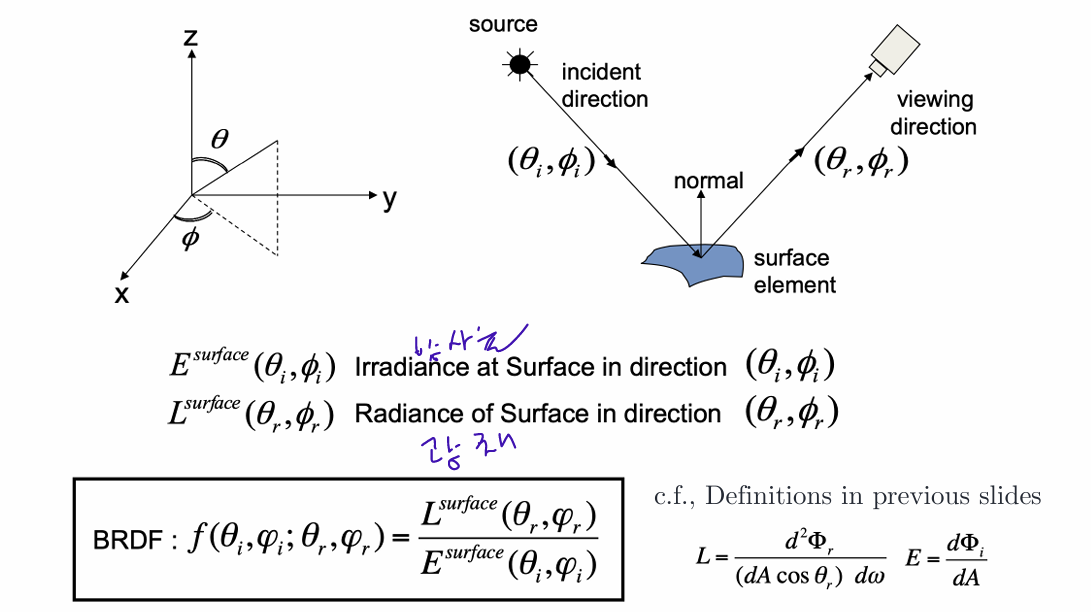
Reflectance: Ratio of outgoing energy to incoming energy at a single point
BRDF(Bi-Directional Reflectance Distributin Function) of a surface:
Given an illumination and a viewing direction, measure of how bright the surface appears
BRDF f=L/E = radiance/irradiance = (power/forshorted area x solid angle) / (power/surface area)
Important Properties of BRDFs
-
Conservation of Energy
-
Helmholtz Reciprocity (follows from 2nd Law of Thermodynamics 열역학)
source, viewing directions 바뀌어도 됨
-
Common Assumption: Isotropy (Rotational Symmetry) 등방성
surface is rotated about the normal해도 안바뀜
변수 3개로 해도 됨
4. Mechanisms of Reflection
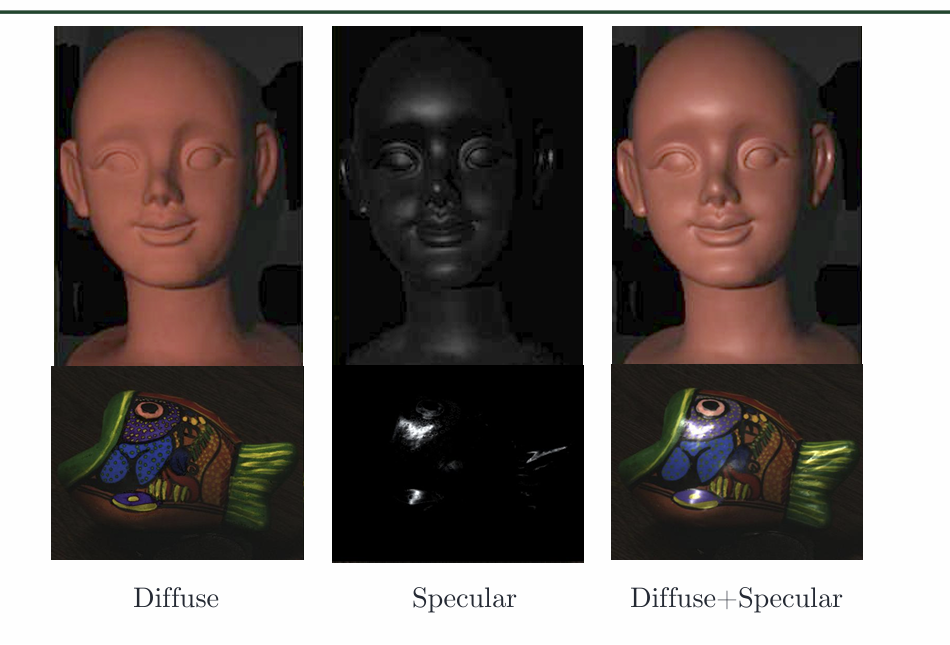
- Body Reflection:
diffuse reflection, matte appearance, Non-Homogeneous Medium, Clay, paper, etc. - Surface Reflection 정반사:
Specular Reflection, Glossy Appearance, Highlights, Dominant for Metals
Image Intensity = Body Reflection + Surface Reflection
Diffuse Reflection and Lambertian BRDF
Lambertian surface: equally bright from any view direction, independent of outgoing direction
Lambertian BRDF:
albedo- 달, 행성이 반사하는 태양 광선의 비율
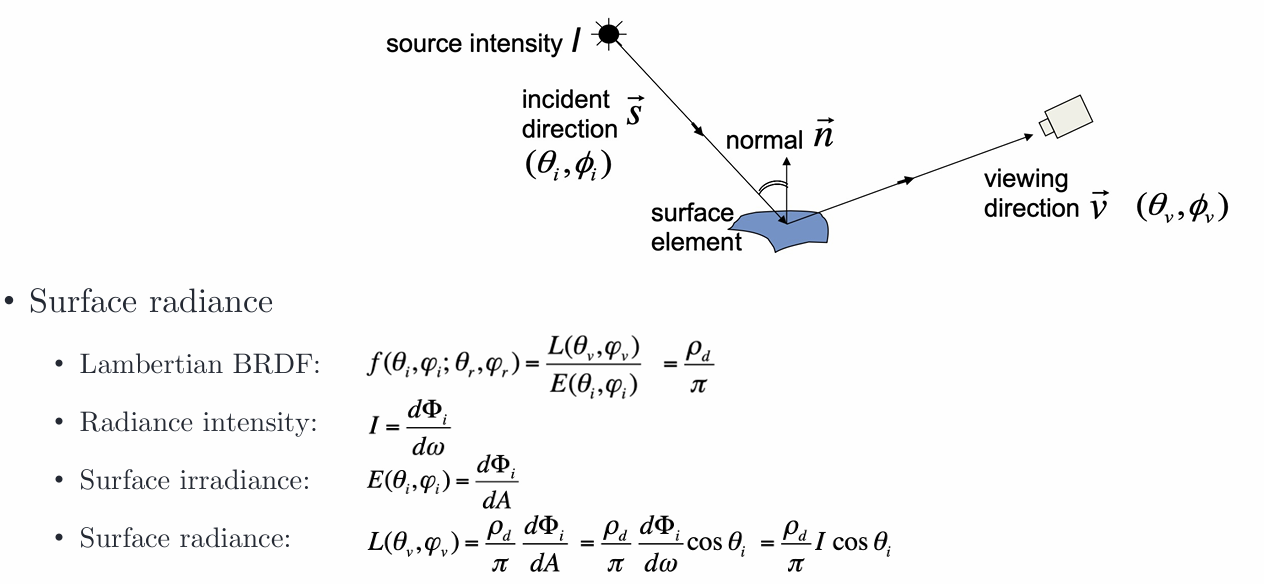
BRDF = L/E, L = BRDF * E
Lambert's Cosine Law: reflected energy는 방향, surface norma 사이 각도의 cosine에 비례
Specular Reflection and Mirror BRDF
Mirror BRDF:
모든 입사각은 한 방향으로 반사 only when
Mirror BRDF (double-delta function):
Surface Radiance:
Combining Specular and Diffuse: Dichromatic Reflection
Observed Image Color = a x Body Color + b x Specular Reflection Color