Week 4-1. Boundary Detection
1. Boundaries of Objects
edge detection, multi-scale edge detection, sometimes hard for humans
2. Hough Transform for Line Detection
Edges need not be connected, need not visible
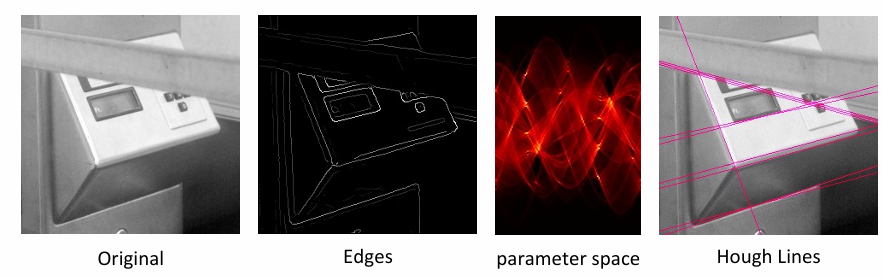
Edges VOTE for the possible models
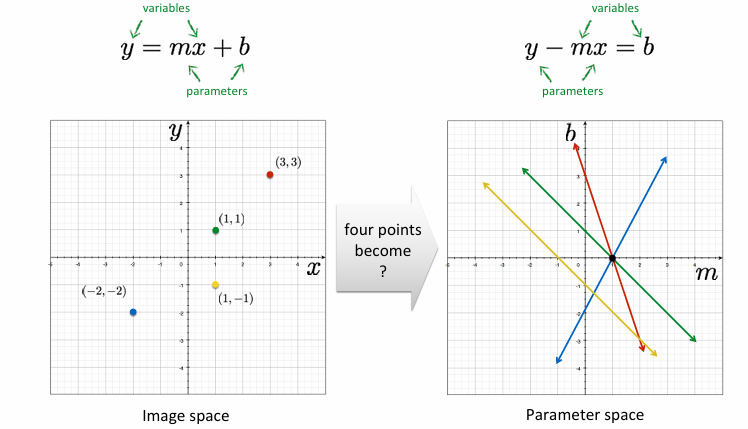
- Image and Parameter Space
y = mx + b -> parameter space: b = -mx + y
각 점(1,1),...을 지날 수 있는 모든 직선의 기울기 m과 y절편 b를 나타내는 직선이 그려짐
교점 좌표는 두 점을 동시에 지나는 유일한 직선의 (기울기 m, y절편 b)를 의미
parameter space의 직선들이 많이 교차되는 지점으로 직선 검출 가능
- Algorithm
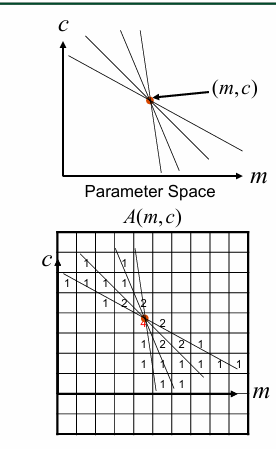
직선들이 많이 교차하는 점을 찾기 위해 축적 배열 A 사용
0으로 초기화된 2차원 배열에서 직선이 지나가는 위치의 배열 원소 값을 1씩 증가시켜 생성
일정 임계값 이상인 점의 m,c(기울기, y절편)로 직선 검출
- Quantize parameter space (m,c)
- Create accumulator array A(m,c) 축적자
- Set A(m,c) = 0
- for each image edge 증가
A(m,c) = A(m,c) + 1 if (m,c) on the line - find local maxima in A(m,c)
Better Parameterization
-> improvement: finite accumulator size
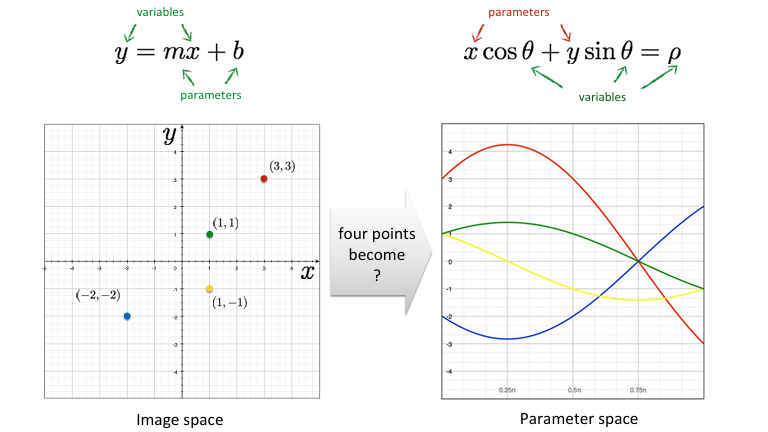
극좌표계의 직선 방정식 사용
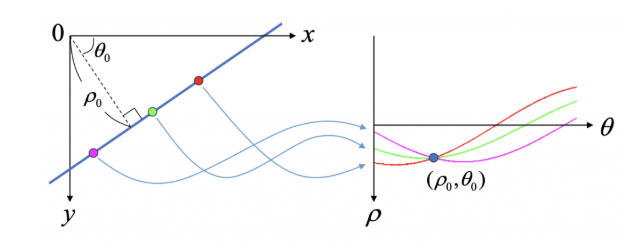
Line equation: : perpendicular distance to line from origin 수직 거리
image space is limited
Given a point
image space -> parameter space, 의 공간으로 변환
곡선들이 많이 교차되는 점을 축적 배열로 찾음, 직선 검출
Image and Parameter Space
Mechanics of the Hough Transform
- line 수: Hough array의 peak 세기, 인접한 피크는 하나로 취급
- line에 속한 points: line에 가까운 points 찾기
- Quantization error- cell 크기:
too big: 다른 line을 합침
too small: line 못 찾음, large vote가 없음 - difficulties of noise
noise 크면, fewer votes land in the single bin, false peaks
clutter: 혼란
3. Hough Transform for Circle Detection
Imae and Parameter Space
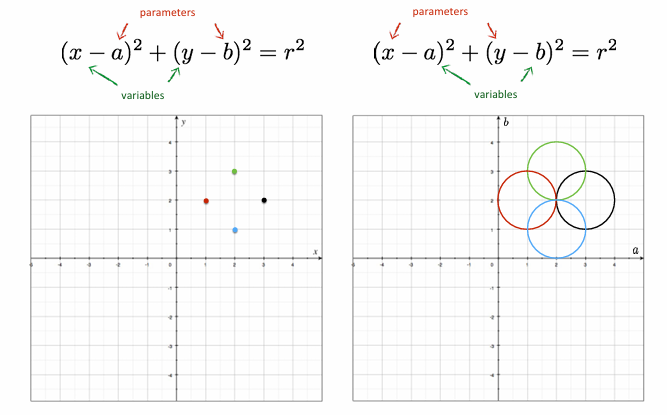
radius is unknown
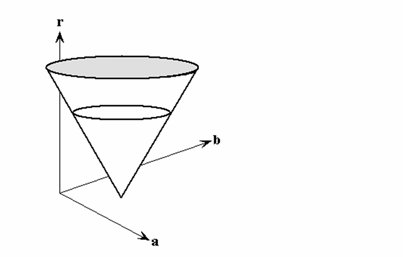
surface of a cone
use Accumulator array A(a,b,r)
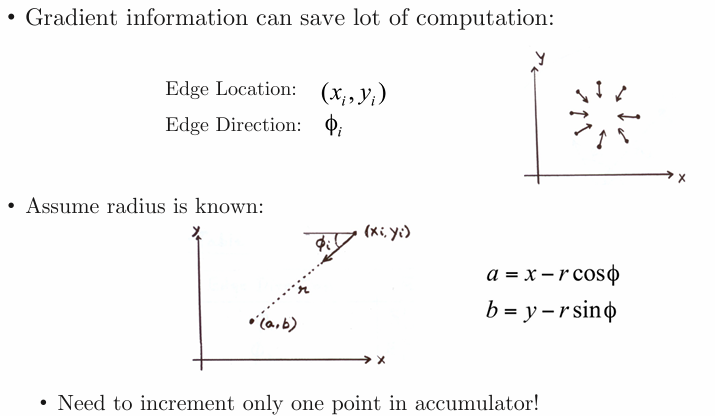
save computation: Gradient information
assume radius is known- increment only one point in accumulator
Finding Coins
Pennie 주황 동전, quarter 나머지 동전 size: 27, 34.5 pixels
Pennie Hough detector, Quarter Hough detector
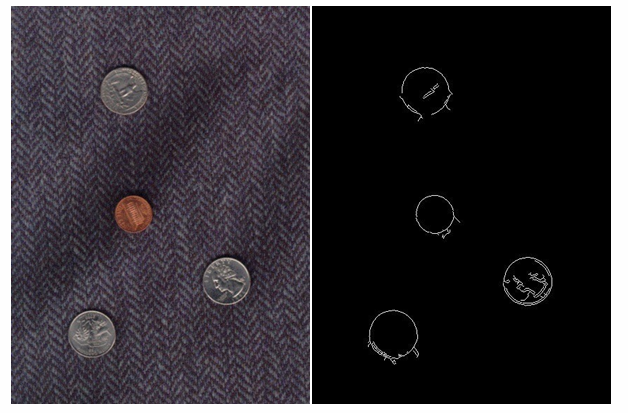
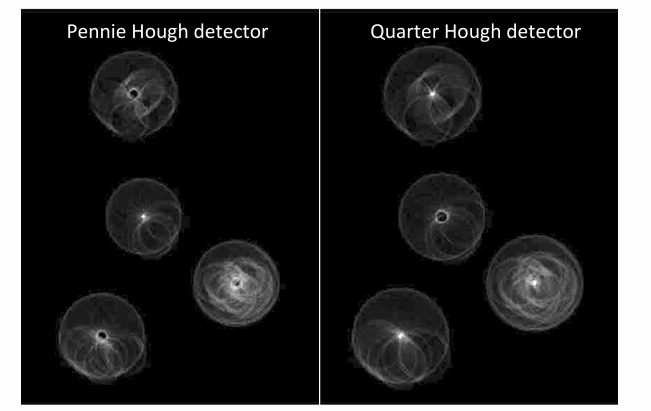
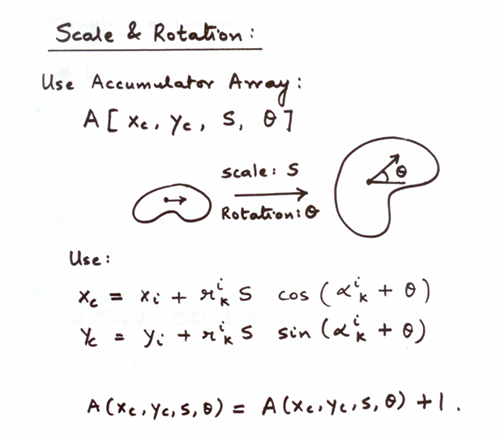
4. Generalized Hough Transform
Model Shape NOT described by equation, Silhouette only
Goal: Find the object center
1. Pick a reference point
2. For each point obtain
: a vector form from boundary point to reference
: gradient orientation 방향
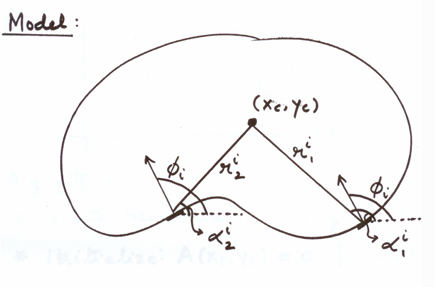
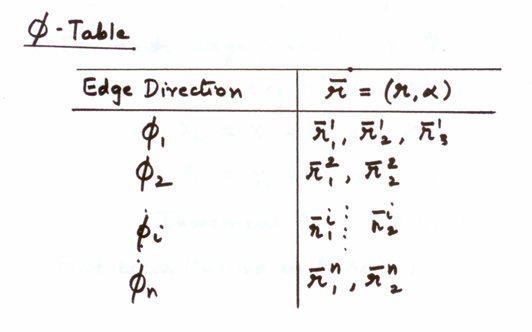
Finding object center given edges
Initialize Accumulator Array
For each edge point , compute:
increment accumulator:
Find local maxima in
Comments
good:Deals with occlusion well 폐색
Detects multiple instances
Robust to noise
Bad: Bad computational complexity
Difficult to set parameters