8-2. Image Alignment and Warping
warping: 뒤틀림
1. Image Alignment and Warping
Image Alignment
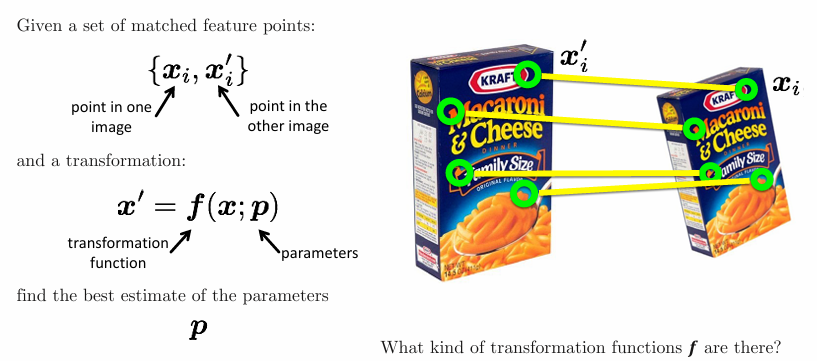
we will fit the parameters of some transformation according to a set of matching feature pairs (“correspondences”)
- Two broad approaches
- Direct (pixel-based) alignment: Search for alignment where most pixels agree
- Feature-based alignment: Search for alignment where extracted features agree (Can be verified using pixel-based alignment)
Alignment: Given two images, what is the transformation between them?
Warping: Given a source image and a transformation, what does the transformed output look like?
Gloabl Warping/Transformation
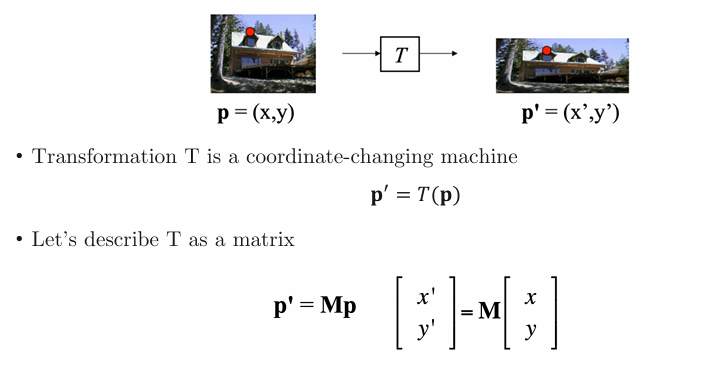
2. 2x2 Transformation
Scaling
a coordinate means multiplying each of its components by a scalar
Uniform scaling: this scalar is the same for all components, x2
Non-uniform scaling: different scalars per component, Xx2 Yx0.5
- Scaling operation:
x' = ax
y' = by
in matrix form:
[x'y'] = [a00b][xy]
scaling matrix S
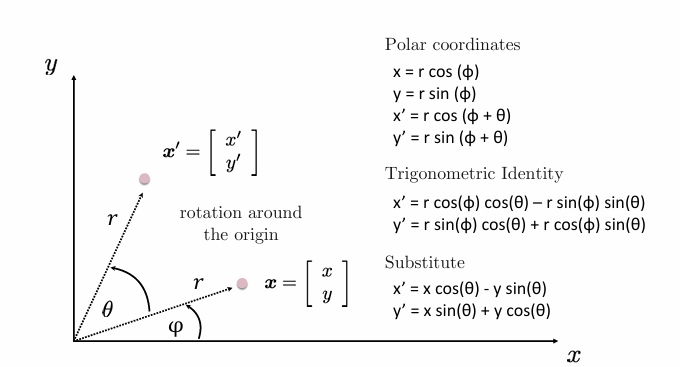
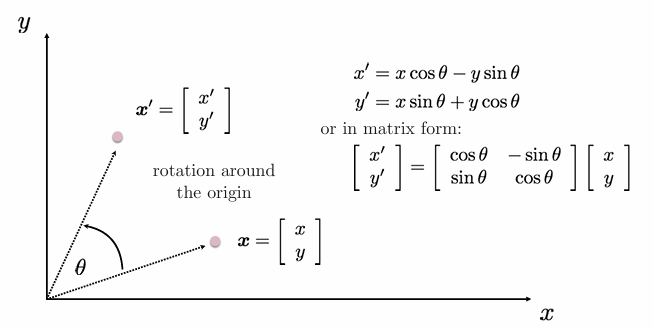
Rotation
Shear
절단
x' = x + ay
y' = bx + y
in matrix form:
[x'y'][1ab1][xy]
2x2 Image Transformation
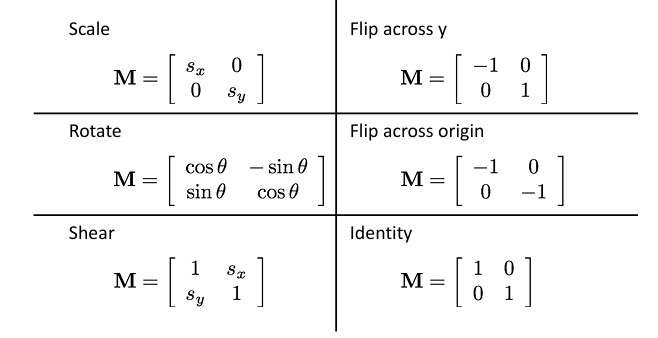
• Origin maps to the origin
• Lines map to lines
• Parallel lines remain parallel
• Closed under composition
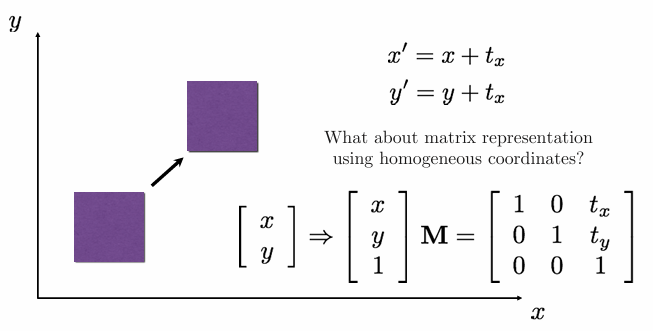
Translation
x' = x + t_x
y' = y + t_y
matrix representation Impossible! -> 3x3
3. 3x3 Transformation
Homogeneous Coordinates
동차 좌표: n차원 좌표에 한 차원을 덧붙여 표시
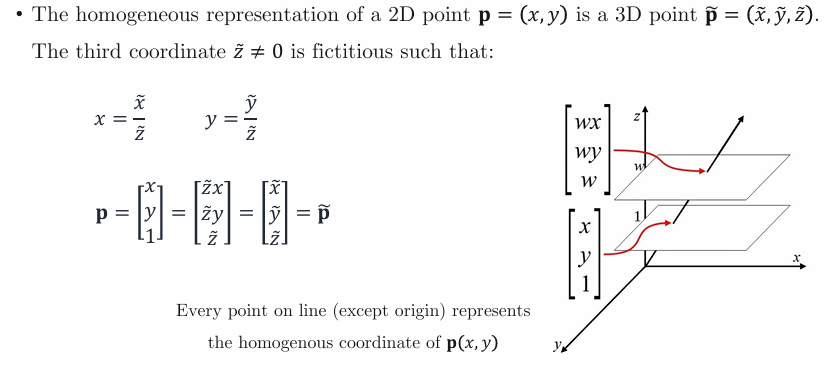
Translation
Basic 2D Transformation
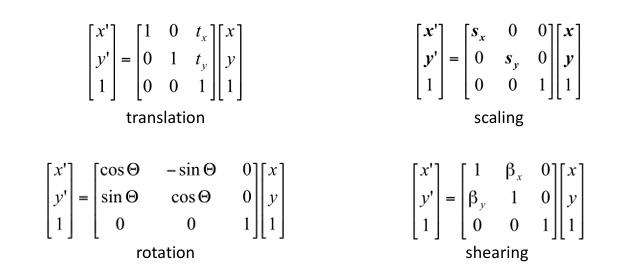
Affine Transformation
방향 크기뿐만 아니라 위치도 포함하는 변환
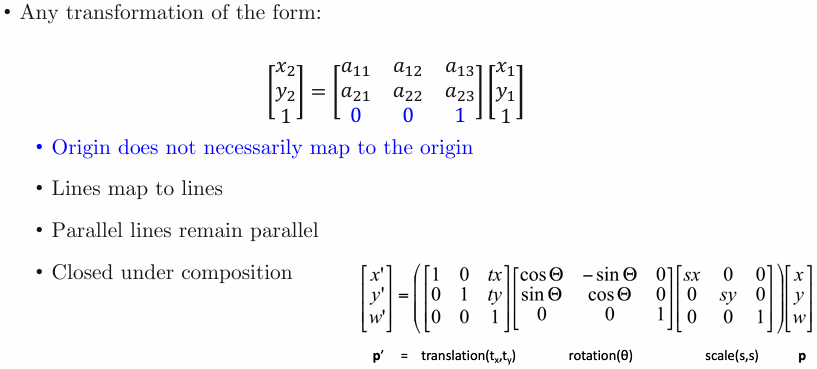
2x2와 다른 점: Origin does not necessarily map to the origin
4. Determining Unknown Transformations
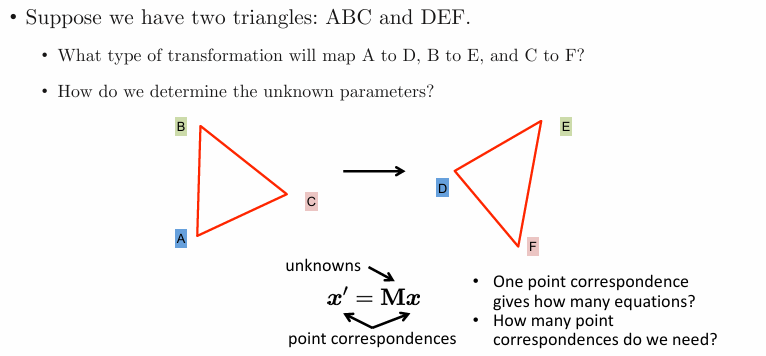
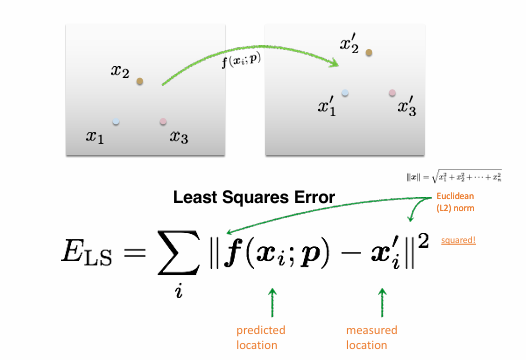
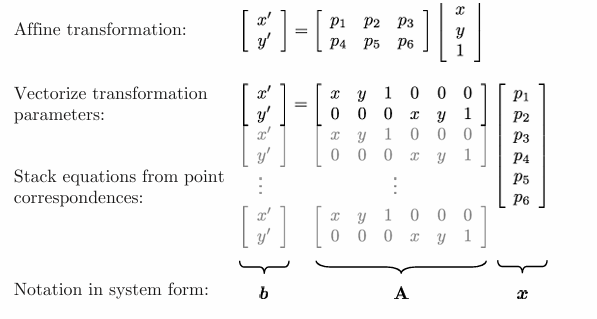
vectorize transformation parameters?
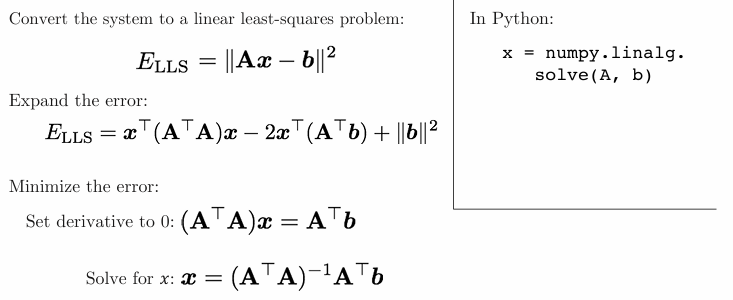
미분해서 0되는 값 x
5. RANSAC (RANdom SAmple Consensus)
outlier에 민감하지 않게 하는 방법
Outlier
• An erroneous pair of matching points from two images
• An edge point is noise, or doesn’t belong to the line we are fitting
RANSAC (RANdom SAmple Consensus)
approach: avoid the impact of outliers, look for inliers
intuition: outlier로 계산할 때 결과 line이 나머지 points의 support를 받지 못한다
- Algorithm:
- Sample (randomly) the number of points required to fit the model
- Solve for model parameters using samples
- Score by the fraction of inliers within a preset threshold of the model
• Repeat 1-3 until the best model is found with high confidence
점 뽑고 선 만들고 이 선을 따르는 나머지 점들의 수를 점수 매긴다(얼마나 support하는지)
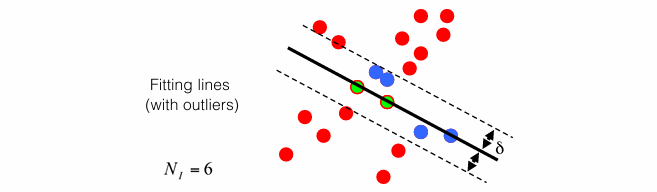
사진으로 설명
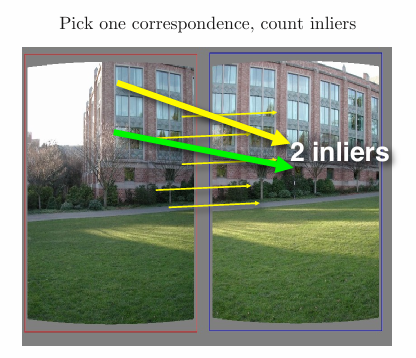
1 correspondence 뽑음, 나머지 점들을 이 식으로 계산해 잘 짝지어진 inlier 개수를 셈
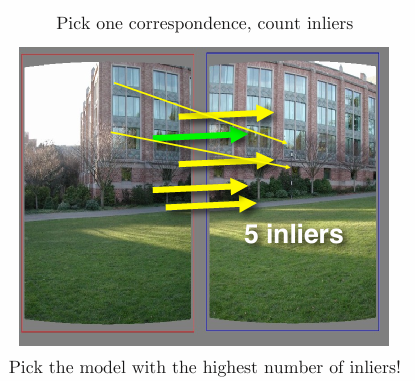
더 많아서 이 모델을 뽑음
Estimating Affine Transformation using RANSAC
- RANSAC loop
- Get three point correspondences (randomly)
- Compute M which minimizes
- Count inliers
- Keep M if largest number of inliers
• Recompute M using all inliers
Pros and Cons of RANSAC
Pros
• Simple and general
• Applicable to many different problems
• Often works well in practice
Cons
• Lots of parameters to tune
• Doesn’t work well for low inlier ratios (too many iterations, or can fail completely)
• Can’t always get a good initialization of the model based on the minimum number of samples