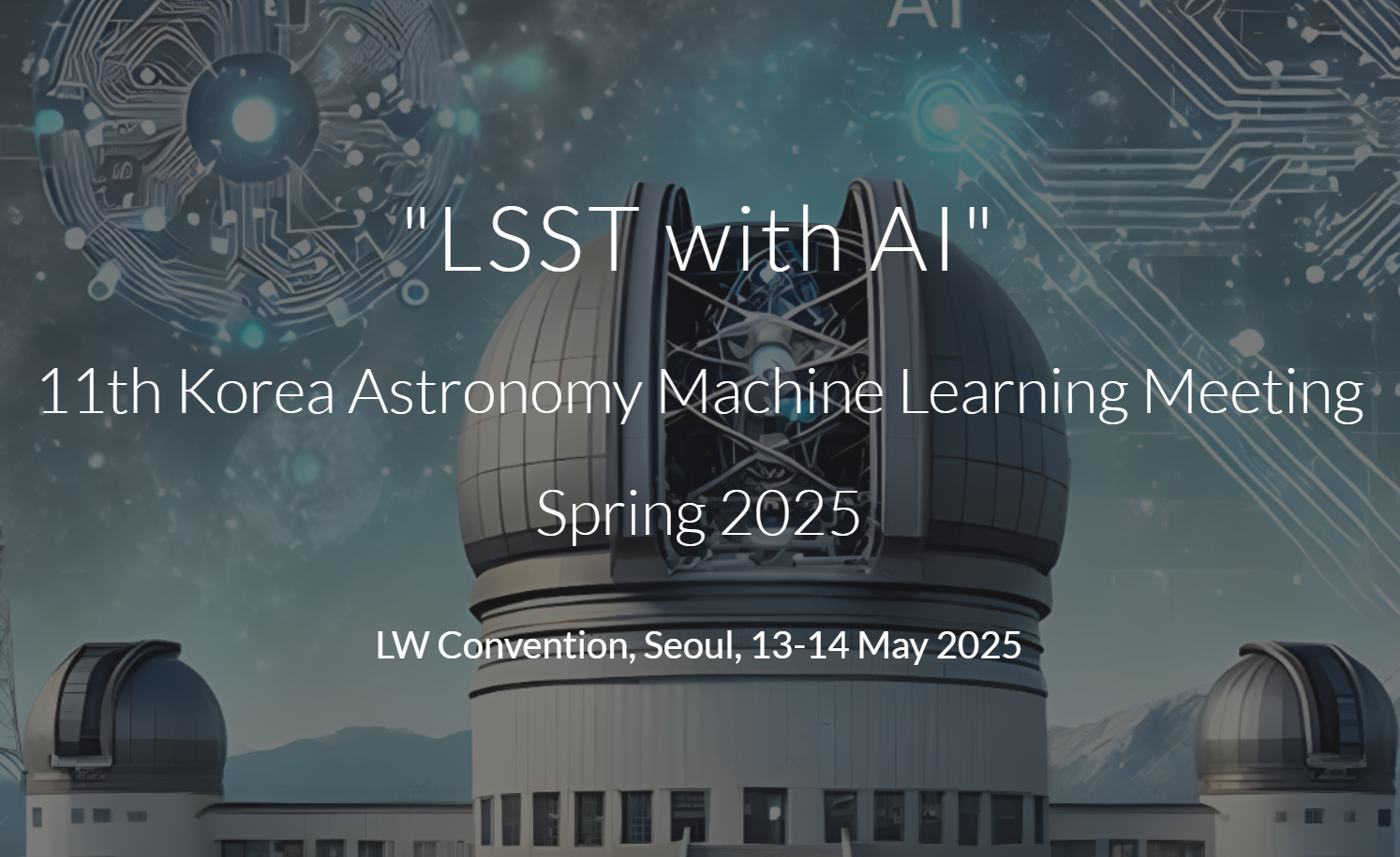
졸업연구를 진행하며 AI를 천문학 분야에 어떻게 적용할 수 있는지 배우기 위해
한국 천문 연구원에서 주최하는 세미나에 참석하게 되었다!
🛰️ An introduction to LSST - survey and data
Yun-Kyeong Sheen (KASI)
LSST (Legacy Survey of Space and Time)
Lubin Observatory: a unique servey telescope
LSST 자료 종류
- Prompt Data Products
- 매 60초마다 변광/변위 현상 보고
- 매 24시간마다 차등측광결과 보고
- 기존에 발견할 수 없었던 어두운 변광 현상을 전천에 걸쳐서 탐색
=> 가까운 우주에서 심우주까지 다양한 변광 현상과 특이 천체의 발견
- Data Release Data Products
- 매년 비공개 천체 목록과 깊은 영상 배포
- 가장 완벽한 천체 목록과 시계열 측광 자료, 깊은 영상 제공
=> 긴 시간에 걸친 천체의 광도 변화를 추적하고 깊은 영상을 이용하여 새로운 천체 발견
The most Complete catalog of astronomical objects + Time series data of all the objects = inevitable in astronomy and space science
=> LSST: A Game Changer
The primary science objectives of LSST
- probing dark energy and dark matter
- Taking an inventory of the solar system
- Exploring the translent optical sky
- Mapping the milky way
LSST 운영 방식과 자료 사용 권한
- 미국의 rubin 천문대가 주도하는 LSST 사업 -> 그 외 국가들은 자료 이용을 위한 합의가 필요
- rubin 천문대에서 모든 참여 국가에게 건설비용 대신 현물기여(in-kind contribution)을 요구
- 우리 기관의 주도하에 미국에 LSST 공동 운영 계획서 제출 후 협상중
- 제안한 in-kind contribution 항목 별로 PI 숫자가 정해지고, 그 숫자만큼의 국내 연구자만이 자료 사용 가능
- 자료 사용 권한이 없으면 논문 출판 불가
- Data Release 2년 후에 공개되는 자료만 이용 -> time domain science 선도 불가
🛰️ An Introduction to Machine Learning
Min-su Shin
AI?
making computers behave in ways that, until recently, we thought required human intelligence
ML?
study of computer algorithms that allow computer programs to automatically improve computer programs to automatically improve through experience
- (machine) Leaning = representation + evaluation + optimization
- inference of unknown target distribution = finding useful/right correlation(상관관계)
popular usages ML
- Regression -> supervised ML
- clustering -> unsupervised ML
Astronomical problem types
- Taxonomy/Classification
- star vs galaxy in optical catalogs
- real vs bogus in difference imaging
- Detection/Separation
- Source deblending in optical images
- variability detection in time-series data
- Parameter estimaion (including inverse problems)
- cosmological parameters in survey data
- source parameters of GW objects
- Recommendation/ranking
- Matched tamplate SEDs
- Prediction/Simulation/Generation
- Mock survey image generaion- PFS generation in images
Challenges in using ML
- How to represent models and data?
- What to evaluate? How to evaluate?
- What to optimize? How to optimize?
A Few Useful Things to Know about MachineLearning - Pedro Domingos
- LEARNING = REPRESENTATION + EVALUATION + OPTIMIZATION.
- IT'S GENERALIZATION THAT COUNTS.
- DATA ALONE IS NOT ENOUGH.
- OVERFITTING HAS MANY FACES.
- INTUITION FAILS IN HIGH DIMENSIONS.
- THEORETICAL GUARANTEES ARE NOT WHAT THEY SEEM.
- FEATURE ENGINEERING IS THE KEY.
- MORE DATA BEATS A CLEVERER ALGORITHM.
- LEARN MANY MODELS, NOT JUST ONE,
- SIMPLICITY DOES NOT IMPLY ACCURACY.
- REPRESENTABLE DOES NOT IMPLY LEARNABLE.
- CORRELATION DOES NOT IMPLY CAUSATION.
Classification 논문 예시)
star-galaxy classification in multi-band optical imaging
🛰️ Summary of the practical application tutorial activities
Cristiano Sabiu
Contents
Classification/Regression
- Decision Trees/Random forest
- Artificial Neural Networks
- CNN/DL
- Transfer Learning and Fine-tuning
Real data application
- Star/Galaxy/QSO classification in SDSS photometry
- photometric redshift estimation using SDSS 5 bands
- Galaxy image classification (Galaxy Zoo)
Desicion Tree
A decision tree is a set of "if statements, with true/false outputs that decide how you should proceed.
examples
- "Should I take an umbrella to work?"
- "How should I bet on my hand of cards, to maximise payoff"
The different components of the decision tree are
- The "feature" (or observable property) used in making the decision.
- The value of the feature used make the "split", 182 are often called "nodes"
- The decisions from the split are called "branches"
- When a final condition is reached. This is called the leaf of the tree, or final node. The "depth" of the tree, describes the maximum number of splitting conditions
Eg) Measuring Galaxy Redshift
In astronomy we want to know how far away galaxies are. Because the universe is expanding it turns out that the doppler shift of galaxy light is a good proxy for distance.
but using Decision Tree, high resolution spectra is difficult to obtain
Random forest
The random forest algorithm, in three easy steps.
- Select a random sample of the training data.
- Select a subset of predictors (features)
- Train a decision tree.
- Repeating 1-3 N-times (creating N decision trees)
When I want to make a prediction: Query your data down each tree.
Get a set of results, one for each tree. Take the mean answer!
The is an example of a more general approach known as ensemble learning
Galaxy Zoo
- Members of the public classified galaxies with their eyes (and brains)
- The crowdsourced science projected generated a lot of public interest.
- 1 Million galaxies from SDSS were given multiple classifications.
- It became possible to do large scale statistics with galaxy morphology!
🛰️ Practical application tutorial session I: machine learning with survey catalogs
https://github.com/csabiu/KAML-2025/blob/main/KAML_catalogues_classification.ipynb
https://github.com/csabiu/KAML-2025/blob/main/KAML_catalogues_regression.ipynb