Project
Pneumonia X-ray Binary Classification Model Development
- Period: Apr 29, 2026~ May 15, 2026
- Key Contributions & Experience
- Baseline Construction & Transfer Learning:
Established an initial training pipeline based on prior technical workflows. Selected ResNet18 as the standard benchmark model and successfully implemented transfer learning by adapting the Fully Connected (FC) layer for binary classification.- Data Pipeline Optimization:
Applied structural image transformation and augmentation techniques tailored for thoracic radiography scans to improve feature representation.- Hyperparameter Tuning:
Configured the training to run for 50 epochs considering the limited dataset scale, gaining hands-on insight into computational bottlenecks and training time efficiency in deep learning models.- Collaborative Peer Review:
While executed as an individual project, actively engaged in technical discussions and brainstorming sessions with peers. Exchanged research directions, presented empirical hypotheses, and integrated constructive feedback to continuously pivot and refine the model's structural approach.
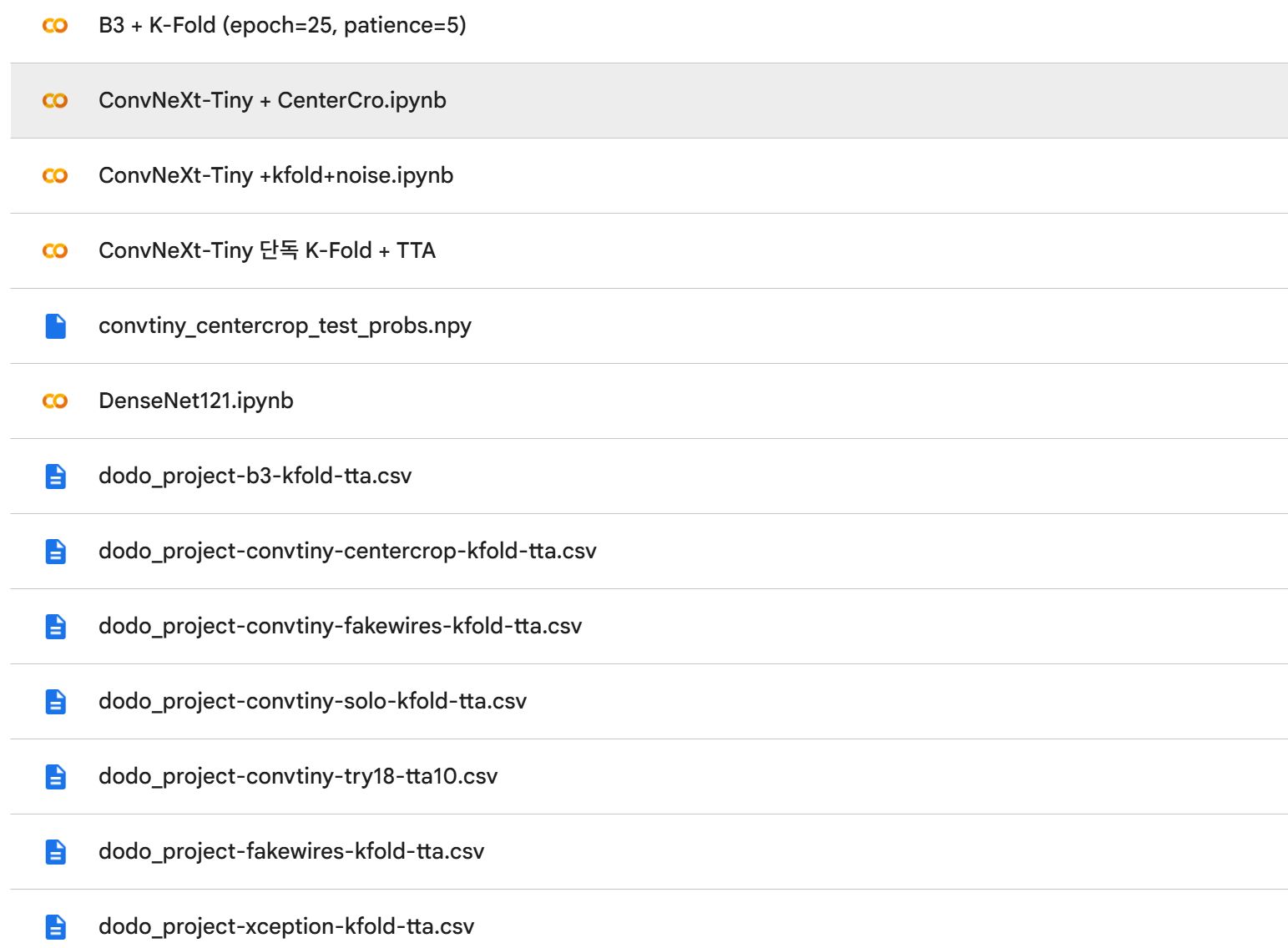
Main Pipeline Source Code
Try 1. ResNet18 == Baseline
Oversampling: N/A
Tuning: Full fine-tuning
Transform: Resize(224) -> HFlip -> Rotate(10) -> ToTensor -> Normalize
Optimizer: Adam(lr=1e-4) + StepLR
Loss: Weighted CrossEntropyLoss
Training: max_epoch=50, patience=5
Tuning: Full fine-tuning
Transform: Resize(224) -> HFlip -> Rotate(10) -> ToTensor -> Normalize
Optimizer: Adam(lr=1e-4) + StepLR
Loss: Weighted CrossEntropyLoss
Training: max_epoch=50, patience=5
Try 2. EfficientNet B0+B1 esmble
Oversampling: Applied
Validation: 5-Fold K-Fold + 5x TTA
Ensemble Logic: 50:50 soft voting probability average: (B0_probs + B1_probs) / 2
Validation: 5-Fold K-Fold + 5x TTA
Ensemble Logic: 50:50 soft voting probability average: (B0_probs + B1_probs) / 2
Try 3. ConvNeXt-Tiny
Oversampling: Applied
Input Scale: 224x224 | Parameters: 28M
Modification: Replaced head with Linear(in_features, 2)
Tuning: Full layer fine-tuning
Validation: 5-Fold Stratified K-Fold + 5x TTA
Input Scale: 224x224 | Parameters: 28M
Modification: Replaced head with Linear(in_features, 2)
Tuning: Full layer fine-tuning
Validation: 5-Fold Stratified K-Fold + 5x TTA
Try 4. DenseNet121
Modification: Replaced head with Linear(1024, 2) directly
Parameters: 8M Validation: 5-Fold Stratified K-Fold + 5x TTA
Parameters: 8M Validation: 5-Fold Stratified K-Fold + 5x TTA
Try 5. ConvTiny + DenseNet OR
Execution: Combined Try 10 and Try 18 via OR logic
Final class = 1 if either model predicted 1
Discrepant outputs accounted for only 1.3% (8/624 samples)
Final class = 1 if either model predicted 1
Discrepant outputs accounted for only 1.3% (8/624 samples)
