- python3
Problem
You are given an array of strings tokens that represents an arithmetic expression in a Reverse Polish Notation.
Evaluate the expression. Return an integer that represents the value of the expression.
Note that:
- The valid operators are '+', '-', '*', and '/'.
Each operand may be an integer or another expression. - The division between two integers always truncates toward zero.
- There will not be any division by zero.
- The input represents a valid arithmetic expression in a reverse polish notation.
- The answer and all the intermediate calculations can be represented in a 32-bit integer.
Example 1:
Input: tokens = ["2","1","+","3","*"]
Output: 9
Explanation: ((2 + 1) * 3) = 9
Example 2:
Input: tokens = ["4","13","5","/","+"]
Output: 6
Explanation: (4 + (13 / 5)) = 6
Example 3:
Input: tokens = ["10","6","9","3","+","-11","*","/","*","17","+","5","+"]
Output: 22
Explanation: ((10 * (6 / ((9 + 3) * -11))) + 17) + 5
= ((10 * (6 / (12 * -11))) + 17) + 5
= ((10 * (6 / -132)) + 17) + 5
= ((10 * 0) + 17) + 5
= (0 + 17) + 5
= 17 + 5
= 22
Constraints:
- 1 <= tokens.length <= 104
- tokens[i] is either an operator: "+", "-", "*", or "/", or an integer in the range [-200, 200].
Plan Solution
- Create a stack to store integers.
- Create a dictionary to match each math function.
- If an element in the list is an operator, call the corresponding function. If it is a value, push the integer onto the stack.
- Return the final value from the stack.
Code
class Solution:
    def evalRPN(self, tokens: List[str]) -> int:

        def add (a,b):
            return a + b

        def subtract (a,b):
            return a - b

        def multiply (a,b):
            return a * b

        def divide (a,b):
            return int(a / b)
        stack = []
        oprs = {'+': add,
                '-': subtract,
                '*': multiply,
                '/': divide
                }

        for op in tokens:
            if op not in oprs:
                stack.append(int(op))
            else:
                b = stack.pop()
                a = stack.pop()
                new = oprs[op](a, b)
                stack.append(new)

        return stack.pop()
Result
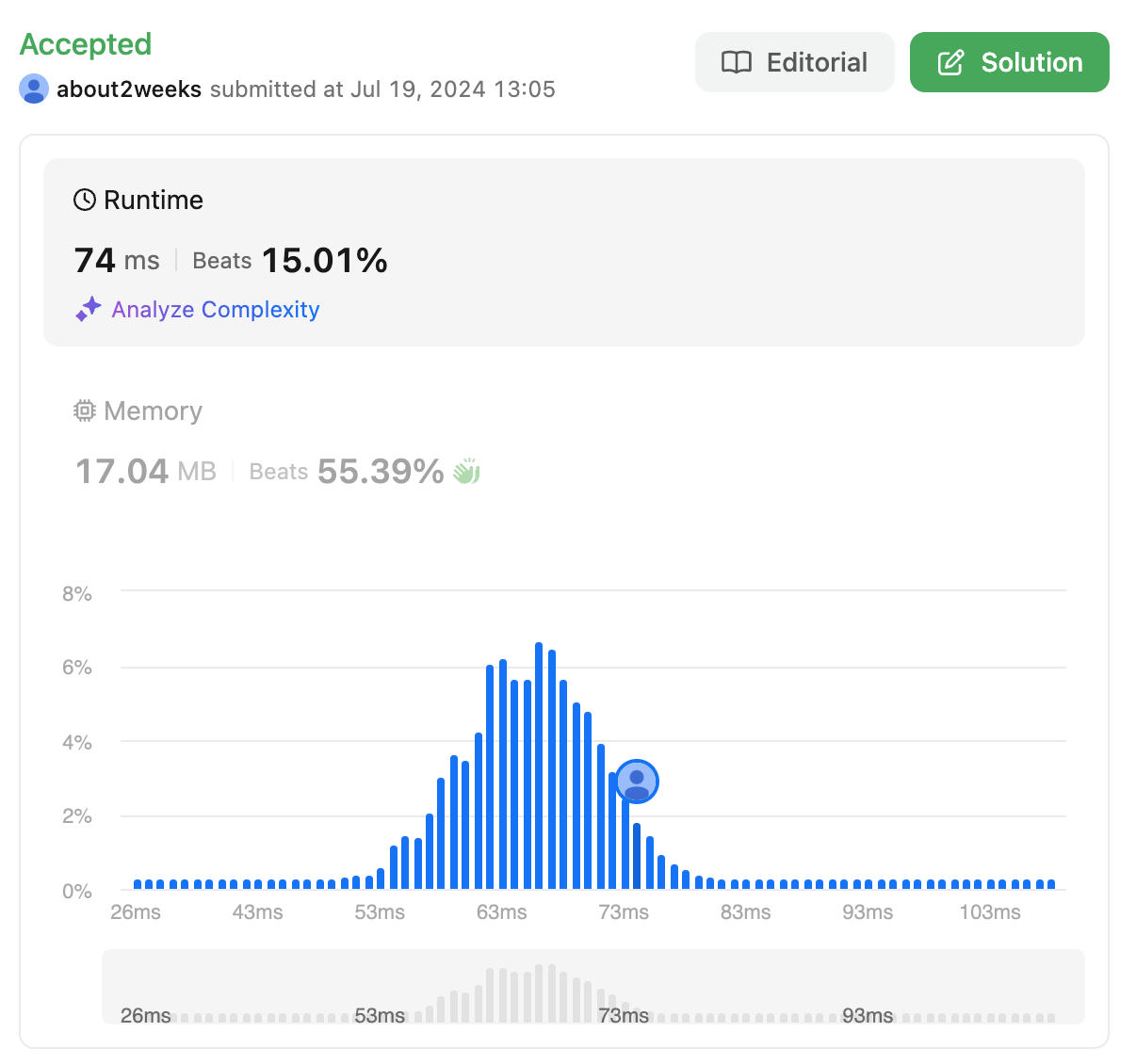
- Time Complexity : O(n)
- Space Complexity : O(n)

알쏭달쏭혀요