- python3
📎 Problem
You have a lock in front of you with 4 circular wheels. Each wheel has 10 slots: '0', '1', '2', '3', '4', '5', '6', '7', '8', '9'. The wheels can rotate freely and wrap around: for example we can turn '9' to be '0', or '0' to be '9'. Each move consists of turning one wheel one slot.
The lock initially starts at '0000', a string representing the state of the 4 wheels.
You are given a list of deadends dead ends, meaning if the lock displays any of these codes, the wheels of the lock will stop turning and you will be unable to open it.
Given a target representing the value of the wheels that will unlock the lock, return the minimum total number of turns required to open the lock, or -1 if it is impossible.
Example 1:
Input: deadends = ["0201","0101","0102","1212","2002"], target = "0202"
Output: 6
Explanation:
A sequence of valid moves would be "0000" -> "1000" -> "1100" -> "1200" -> "1201" -> "1202" -> "0202".
Note that a sequence like "0000" -> "0001" -> "0002" -> "0102" -> "0202" would be invalid,
because the wheels of the lock become stuck after the display becomes the dead end "0102".
Example 2:
Input: deadends = ["8888"], target = "0009"
Output: 1
Explanation: We can turn the last wheel in reverse to move from "0000" -> "0009".
Example 3:
Input: deadends = ["8887","8889","8878","8898","8788","8988","7888","9888"], target = "8888"
Output: -1
Explanation: We cannot reach the target without getting stuck.
Constraints:
- 1 <= deadends.length <= 500
- deadends[i].length == 4
- target.length == 4
- target will not be in the list deadends.
- target and deadends[i] consist of digits only.
Plan Solution
- Deadend는 방문한 곳이라 간주하고 해시로 만든다.
- 큐에 "0000"을 넣어 방문한다.
- 큐에서 하나를 꺼내 타겟과 비교한다. 같을 시 현재 스텝 수를 리턴한다.
- BFS로 현재 갈 수 있는 숫자를 탐색해 방문한 곳인지 아닌지 판단한다. 방문한 곳이 아니라면 방문했다고 체크한 뒤에 큐에 넣는다.
- 맨처음 큐에 들어 있는 길이, 즉 한 레벨이 끝나면 한 스텝을 추가한다.
- 큐가 끝날 때까지 돌린다.
Code
class Solution:
    def openLock(self, deadends: List[str], target: str) -> int:

        def bfs(code):
        	# 4칸을 위한 반복문
            for i in range(4):
                x = int(code[i])
                # 숫자를 위아래로 돌림
                for diff in (-1,1):
                    y = (x+ diff+10)%10
                    # 한 번 생성되면 해당값을 리턴하는 yeild
                    yield code[:i] + str(y) + code[i + 1:]


        deadSet = set(deadends)
        if "0000" in deadSet:
            return -1
        q = deque(["0000"])
        steps = 0
		# 큐에 아무것도 없을 때까지 반복
        while q:
        	# 현재 큐에 들어있는 길이만큼 큐에서 꺼냄
            for _ in range(len(q)):
                curr = q.popleft()
                if curr == target:
                    return steps
                for neighbor in bfs(curr):
                    if neighbor in deadSet:
                        continue
                    deadSet.add(neighbor)
                    q.append(neighbor)
            steps+=1

        return -1
Result
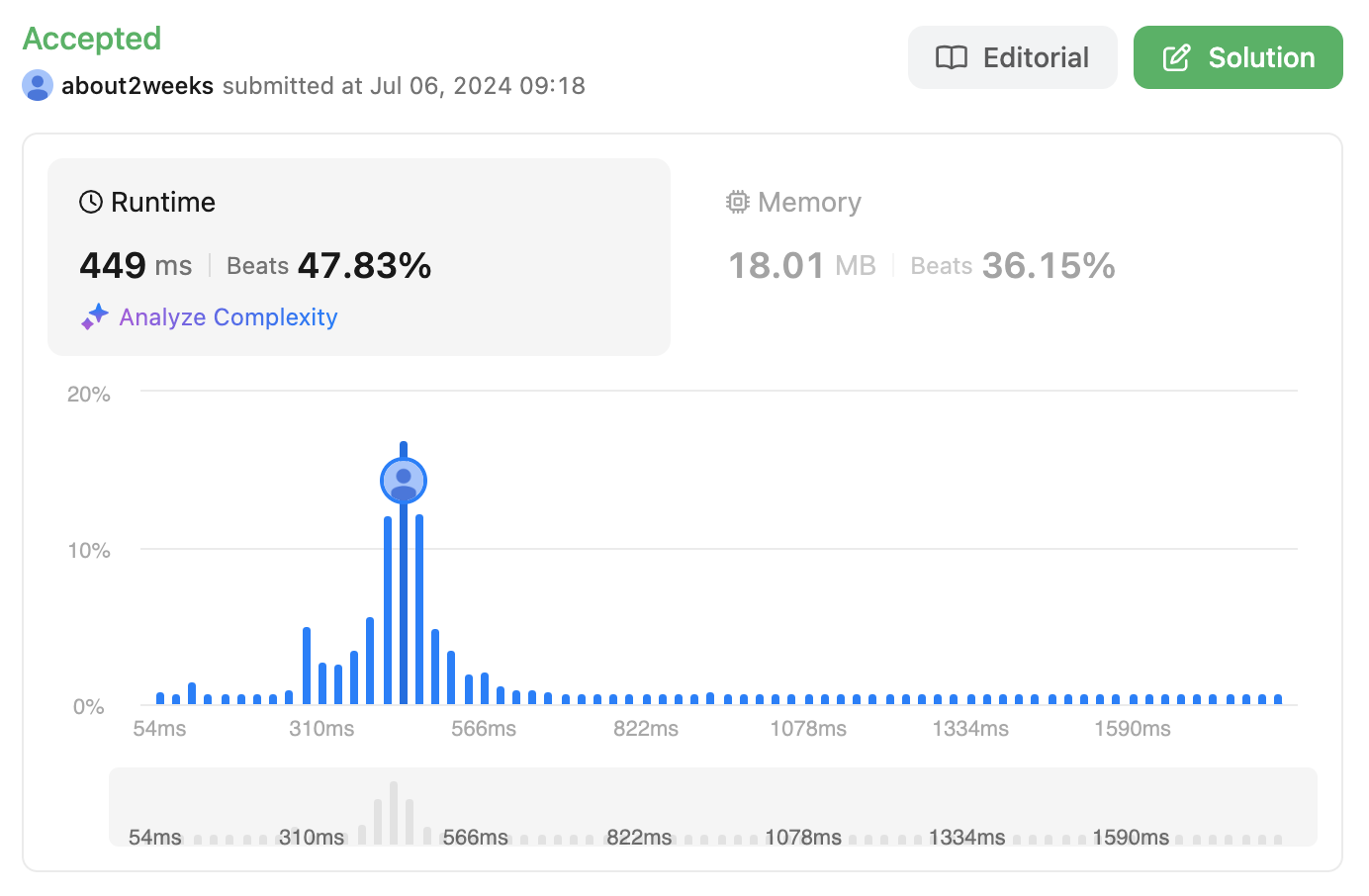
- Time Complexity : O(N^2 * A^N + D), where N is number of dials (4 in our case), A is number of alphabet (10 in our case), D is size of deadends.
- There are 10^4 possible combinations => O(A^N)
- To get neighbors, for each combination, we are looping 4 times (which is N) and in each iteration, there are substring operations which costs O(N) => O(N^2)
- Total O(D) to create the hashset - Space Complexity : O(10*n)

알쏭달쏭혀요