Memory vs Disk
Memory Access
- Almost trasparent at the application level
- with the use of virtual memory
- no need to manage the offset
Disk Access
- Through a system call (Linux kernel)
- requires indication of the offset directly
- requires conversion of the disk format to a memory-readable format
File Format Design
File Format
- Similar to an unmanaged-memory-model programming language
- Assigns a fixed-size data block
- Uses a pointer for the reference of
- memory chunk
- variable length data structure
- Doesn't care about
- continuous memory segment
- memory fragmentation
- deallocation of memory
- Should care about (disk)
- garbage collection
- fragmentation
Binary Encoding
- Should encode data as a compact and serializable(binary) format
- to save them efficiently on disk
- In other words, to design an efficient page layout
- Record
- consists of a combination of data types like int, char, bool
- transferred as a byte sequence format
- through network and stored on disk
- Variable Length data
- uses Pascal-style string (null terminated)
- consists of size and data
String {
	size uint_16
  data byte[size]
}```
- Bit Data
- Boolean
- uses 1 bit each
- 8 booleans in 1 byte (grouping)
- Enum
- commonly used in binary format and communication protocol
enum NodeType { ROOT, // 0x00h INTERNAL, // 0x01h LEAF // 0x02h }; - Flag
- (grouping) boolean + enum
- uses OR operator or bitmask(or shift op.)// Set a bit flags |= HAS_OVERFLOW_PAGES; flags |= (1 « 2); // Remove a bit flags &= -HAS_OVERFLOW_PAGES; flags &= ~(1 << 2); // Check a bit is_set = (flags & HAS_OVERFLOW_PAGES) != 0; is_set = (flags & (1 << 2)) != 0;
- Boolean
Principle of File Format Design
-
Addressing
- decide whether divide a file into a block or several blocks
- In-place update mostly uses fixed-page size
- with the ease of read and write
-
File Structure
- header + pages + trailer
- Most data stores have a pre-defined schema
- no need to store field name reptitively
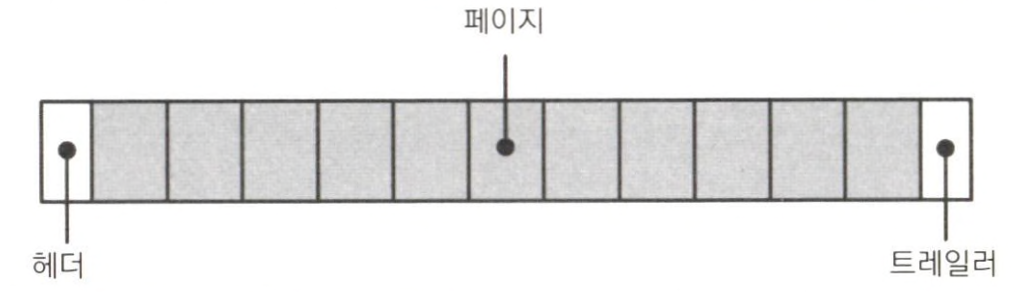
Page Structure
B-tree Node
- consists of one page or several pages
- has the same meaning as a page(block)
Fixed-length Record
- has a triplet structure(k-key, v-value, p-pointer)
- not proper for variable-length records
- inefficient once returning deleted record pages

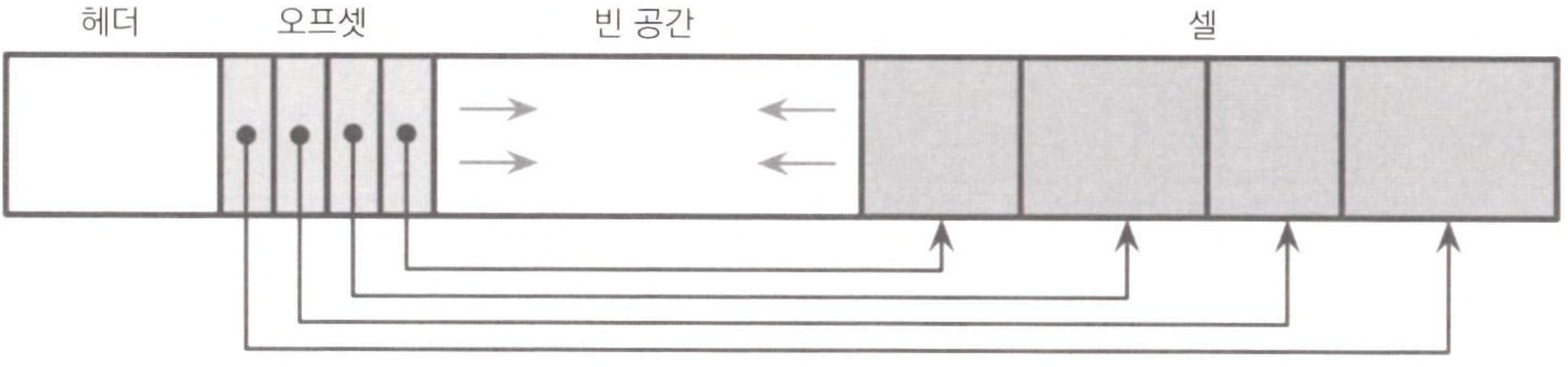
Slotted Page
- Satisfies the followings:
- stores variable-length record with the minimum overhead
- returns deleted record pages efficiently
- refers to records in pages regardless of the exact location
- Consists of three components:
- Header
- contains important info of the page and cells
- including DB version (in a way that every version can read the version value in the file)
- checksum (to detect the damage of data)
- Pointers
- points to each cell
- Cells
- Key cell
- Key-value cell
- Header
- Manages record deletion by
- deleting the cell of record
- updating the memory size and pointer to the availability list
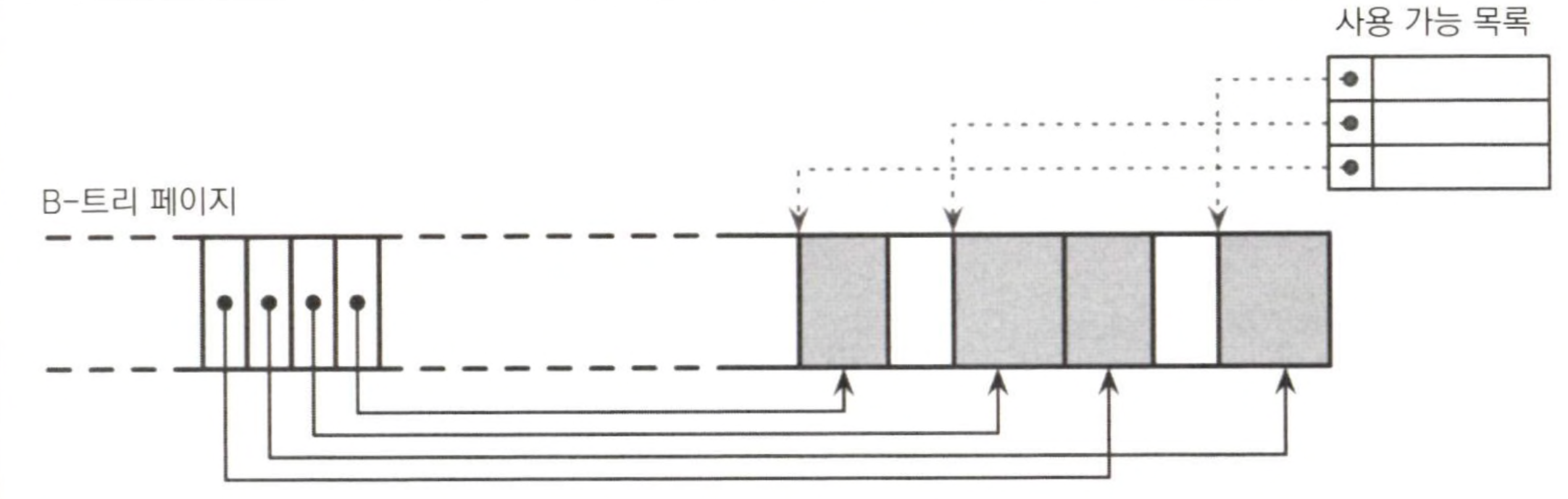
- should find available segments using Best Fit or First Fit strategy