In today's digital era, hospitals and healthcare institutions rely heavily on technology to manage patient records, appointments, billing, and medical information efficiently. Traditional paper-based systems are time-consuming, prone to errors, and difficult to maintain. This is where a Hospital Management System (HMS) becomes essential.
A Hospital Management System Project in Java is one of the most popular real-world projects for students and aspiring software developers. It combines Java programming, database management, and software design principles to create a system that automates hospital operations. More importantly, it helps developers understand how enterprise applications are built and managed.
In this article, we'll explore the Hospital Management System project, its features, architecture, modules, technologies used, and the benefits of developing such a system using Java.
What is a Hospital Management System?
A Hospital Management System is a software application designed to manage the day-to-day activities of a hospital. It provides a centralized platform for handling patient information, doctor schedules, appointments, billing records, prescriptions, and medical reports.
The primary objective of this system is to improve operational efficiency, reduce paperwork, and enhance patient care.
A Hospital Management System can be used by:
Hospital Administrators
Doctors
Receptionists
Laboratory Staff
Pharmacists
Patients
By digitizing hospital operations, healthcare organizations can save time, reduce errors, and provide better services.
Why Develop a Hospital Management System in Java?
Java has been one of the most trusted programming languages for enterprise application development. Its platform independence, security, and object-oriented nature make it an excellent choice for building management systems.
Developing a Hospital Management System using Java helps developers learn:
Object-Oriented Programming
The project uses concepts such as:
Classes and Objects
Inheritance
Encapsulation
Polymorphism
Abstraction
Database Connectivity
Developers learn how to connect Java applications with databases using JDBC.
CRUD Operations
The project involves Create, Read, Update, and Delete operations on patient and hospital records.
Real-World Application Development
Unlike simple academic programs, this project simulates a real business environment and provides practical industry experience.
Key Features of Hospital Management System
A complete Hospital Management System consists of multiple modules working together to streamline healthcare operations.
Patient Management
The patient management module stores and manages patient information such as:
Patient ID
Name
Age
Contact Details
Medical History
Admission Information
This ensures that patient records can be accessed quickly whenever needed.
Doctor Management
This module manages doctor-related information, including:
Doctor Profiles
Specializations
Availability
Consultation Schedules
It helps hospitals efficiently allocate doctors based on patient needs.
Appointment Scheduling
Patients can book appointments with doctors through the system.
Benefits include:
Reduced waiting time
Better schedule management
Improved patient experience
Billing Management
The billing module automates financial transactions such as:
Consultation Fees
Room Charges
Laboratory Charges
Medicine Costs
Automatic bill generation minimizes manual calculation errors.
Medical Records Management
Doctors can maintain digital records containing:
Diagnosis Details
Treatment Plans
Prescriptions
Test Reports
This helps improve continuity of patient care.
Pharmacy Management
The pharmacy module tracks:
Medicine Inventory
Stock Availability
Sales Records
Purchase Details
This ensures medicines are always available when required.
Laboratory Management
The laboratory module handles:
Diagnostic Tests
Sample Collection
Test Results
Report Generation
It simplifies the management of pathology and diagnostic services.
Technologies Used in Hospital Management System
A Hospital Management System can be developed using various technologies depending on project requirements.
Frontend Technologies
Java Swing
JavaFX
HTML
CSS
JavaScript
Backend Technologies
Core Java
Advanced Java
Spring Framework
Spring Boot
Database
MySQL
PostgreSQL
Oracle Database
Connectivity Tools
JDBC
Hibernate
JPA
Development Tools
Eclipse IDE
IntelliJ IDEA
NetBeans
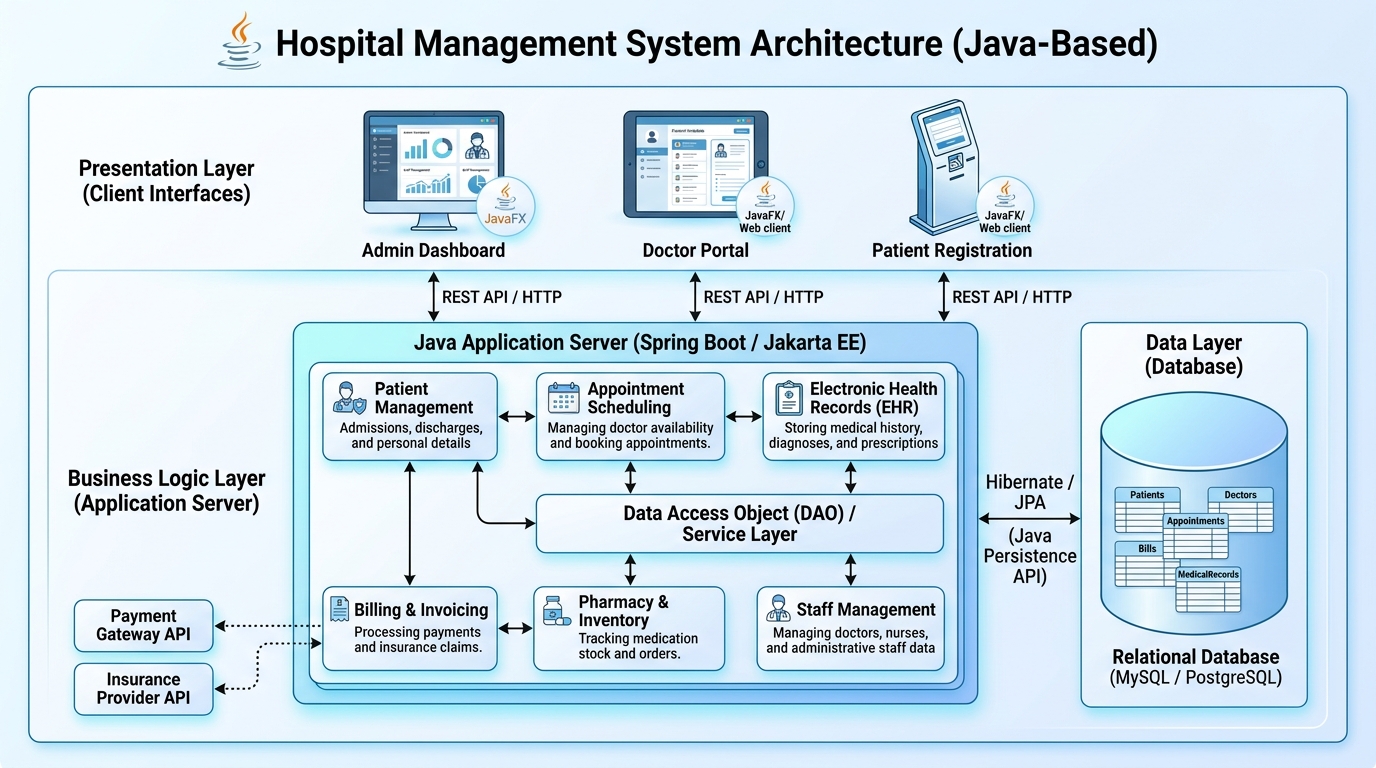
Architecture of Hospital Management System
A typical Hospital Management System follows a three-layer architecture.
Presentation Layer
This layer provides the user interface for interacting with the system.
Examples include:
Login Screens
Registration Forms
Appointment Booking Pages
Business Logic Layer
The business layer contains application logic such as:
Appointment Processing
Billing Calculations
Validation Rules
Report Generation
Database Layer
The database layer stores all system data securely.
This includes:
Patient Records
Doctor Information
Appointments
Billing Data
Separating these layers improves maintainability and scalability.
Core Modules of the Project
Admin Module
The administrator manages the overall system.
Responsibilities include:
Adding Doctors
Managing Staff
Viewing Reports
Monitoring Operations
Doctor Module
Doctors can:
View Appointments
Access Patient Records
Update Medical Information
Generate Prescriptions
Patient Module
Patients can:
Register
Book Appointments
View Reports
Access Medical History
Billing Module
This module handles:
Invoice Generation
Payment Tracking
Financial Reporting
Database Design
Database design is one of the most important aspects of this project.
Common tables include:
Patients Table
Contains:
Patient ID
Name
Gender
Age
Contact Number
Doctors Table
Contains:
Doctor ID
Name
Department
Specialization
Appointments Table
Contains:
Appointment ID
Patient ID
Doctor ID
Appointment Date
Billing Table
Contains:
Bill ID
Patient ID
Amount
Payment Status
Proper relationships between these tables ensure efficient data management.
Workflow of Hospital Management System
Let's understand the workflow with a practical example.
Step 1: Patient Registration
A patient registers and receives a unique patient ID.
Step 2: Appointment Booking
The patient selects a doctor and books an appointment.
Step 3: Doctor Consultation
The doctor reviews patient information and records observations.
Step 4: Medical Tests
If necessary, laboratory tests are assigned.
Step 5: Billing
The system automatically generates a bill.
Step 6: Report Generation
Medical reports and prescriptions are stored for future reference.
This workflow significantly reduces manual effort and improves efficiency.
Benefits of Hospital Management System
Improved Efficiency
Automates routine administrative tasks.
Better Patient Experience
Provides faster access to healthcare services.
Reduced Errors
Digital records minimize human mistakes.
Enhanced Data Security
Sensitive information can be protected through authentication and authorization mechanisms.
Faster Decision-Making
Doctors can quickly access complete patient histories.
Challenges in Developing the Project
While developing a Hospital Management System, developers may encounter several challenges.
Managing Large Volumes of Data
Hospitals generate massive amounts of information daily.
Data Security
Patient data must be protected from unauthorized access.
Scalability
The system should accommodate future growth.
Error Handling
Robust exception handling is essential for reliability.
Best Practices
To build a professional Hospital Management System:
Follow Object-Oriented Programming principles.
Use proper database normalization.
Implement input validation.
Secure user authentication.
Write reusable and maintainable code.
Perform regular testing and debugging.
These practices improve software quality and long-term maintainability.
Future Enhancements
Modern Hospital Management Systems are evolving rapidly with advanced technologies.
Potential enhancements include:
Online Consultations
Patients can consult doctors remotely through video calls.
Artificial Intelligence
AI can assist in diagnosis and treatment recommendations.
Cloud Integration
Cloud-based storage enables secure access from multiple locations.
Mobile Applications
Patients can manage appointments through smartphones.
Electronic Health Records (EHR)
Centralized patient records can be shared across healthcare institutions.
Conclusion
The Hospital Management System Project in Java is an excellent real-world project that helps developers understand software development, database management, and enterprise application architecture. It demonstrates how technology can streamline hospital operations, improve patient care, and reduce administrative workload.링크텍스트
For students, freshers, and Java developers, this project provides valuable hands-on experience with Java, JDBC, MySQL, OOP concepts, and application design. More importantly, it serves as a strong portfolio project that showcases practical problem-solving skills and real-world development expertise.