Microservices architecture has become the foundation of many modern applications. Instead of building a single large application, organizations divide functionality into smaller, independent services that work together to deliver business features.
Companies like Netflix, Amazon, Uber, and Spotify use microservices to achieve scalability, flexibility, and faster development cycles.
However, breaking an application into multiple services introduces an important challenge:
How do these services communicate with each other?
For example, when a customer places an order in an e-commerce application, the Order Service may need to communicate with the Payment Service, Inventory Service, Notification Service, and Shipping Service. Without effective communication, the entire workflow can fail.
Understanding microservices communication methods is essential for developers, software architects, and anyone learning modern application development.
Why Communication is Important in Microservices
In a monolithic application, modules communicate directly within the same codebase.
In a microservices architecture:
Services run independently
Services may be deployed on different servers
Services may use different technologies
Services need reliable communication mechanisms
A single business operation often requires multiple services working together.
For example:
Customer Places Order
↓
Order Service
↓
Payment Service
↓
Inventory Service
↓
Notification Service
The success of the entire process depends on smooth communication between services.
Types of Microservices Communication
Microservices communication is generally divided into two categories:
Synchronous Communication
The calling service waits for a response before continuing.
Example:
Service A
↓
Request
↓
Service B
↓
Response
Asynchronous Communication
The calling service sends a message and continues processing without waiting.
Example:
Service A
↓
Message Queue
↓
Service B
Both approaches are widely used depending on business requirements.
- REST API Communication
REST APIs are the most commonly used communication method in microservices.
Services communicate using HTTP requests and responses.
Example:
GET /products/101
The Product Service returns product information to another service.
How REST Works
Order Service
↓
HTTP Request
↓
Product Service
↓
HTTP Response
↓
Order Service
The requesting service waits until the response is received.
Advantages of REST
Easy to implement
Simple to understand
Works with almost every programming language
Uses standard HTTP protocols
JSON format is human-readable
Disadvantages of REST
Higher network overhead
Slower compared to some alternatives
Service dependency can affect availability
Real-World Example
When an Order Service needs product details before processing an order, it may call the Product Service using a REST API.
- gRPC Communication
As applications grow, performance becomes increasingly important.
gRPC is a high-performance communication framework developed by Google.
Unlike REST, which typically uses JSON, gRPC uses Protocol Buffers for data exchange.
How gRPC Works
User Service
↓
gRPC Request
↓
Profile Service
↓
gRPC Response
Advantages of gRPC
Faster than REST
Smaller payload sizes
Strongly typed contracts
Efficient for internal service communication
Disadvantages of gRPC
More complex setup
Less human-readable
Requires Protocol Buffer definitions
Common Use Cases
High-performance systems
Real-time applications
Internal service communication
3. Message Queue Communication
Not every request requires an immediate response.
In many systems, services communicate using message queues.
Popular tools include:
RabbitMQ
ActiveMQ
Amazon SQS
How Message Queues Work
Order Service
↓
Send Message
↓
Queue
↓
Notification Service
The Order Service sends a message and continues processing.
The Notification Service processes the message later.
Advantages
Loose coupling
Improved reliability
Better scalability
Handles traffic spikes effectively
Disadvantages
More infrastructure to manage
Eventual consistency challenges
4. Apache Kafka Communication
Apache Kafka is one of the most popular event-streaming platforms.
Instead of sending requests directly between services, events are published to Kafka topics.
Kafka Workflow
User Service
↓
Publish Event
↓
Kafka Topic
↓
Email Service
Analytics Service
Recommendation Service
Multiple services can consume the same event independently.
Example
When a user registers:
User Registered Event
This event can trigger:
Welcome Email
Analytics Update
Loyalty Program Enrollment
Without creating direct dependencies.
Advantages
High throughput
Excellent scalability
Event-driven architecture support
Fault tolerance
Challenges
Learning curve
Additional infrastructure complexity
5. Event-Driven Communication
Event-driven architecture focuses on events rather than direct requests.
When something important happens, an event is published.
Other services react to that event.
Example
Order Created
Triggers:
Inventory Update
Payment Processing
Notification Sending
Analytics Tracking
Each service responds independently.
Benefits
Loose coupling
Better scalability
Easier service independence
Improved system flexibility
6. API Gateway Communication
As the number of services grows, clients should not communicate directly with every service.
This is where an API Gateway becomes useful.
Architecture
Client
↓
API Gateway
↓
User Service
Order Service
Payment Service
Product Service
The gateway acts as a central entry point.
Benefits
Authentication management
Request routing
Rate limiting
Monitoring
Security enforcement
API Gateways simplify communication for frontend applications.
Service Discovery
One challenge in microservices is locating services.
A service may move between servers or containers.
Service Discovery helps services find each other dynamically.
Popular solutions include:
Eureka
Consul
Kubernetes Service Discovery
This eliminates the need for hardcoded service addresses.
REST vs gRPC vs Kafka
Feature REST gRPC Kafka
Communication Type Synchronous Synchronous Asynchronous
Speed Moderate Very Fast High Throughput
Data Format JSON Protocol Buffers Events
Human Readable Yes No Partial
Complexity Low Medium High
Best For General APIs Internal Services Event Streaming
Choosing the Right Communication Method
There is no universal solution.
Choose based on your requirements.
Use REST When
Building simple applications
Exposing public APIs
Working with frontend applications
Use gRPC When
Performance is critical
Services communicate frequently
Internal communication needs optimization
Use Kafka When
Event-driven architecture is required
Multiple consumers need the same data
High scalability is important
Use Message Queues When
Tasks can be processed later
Reliability is a priority
Common Mistakes Developers Make
Using REST Everywhere
Not every communication requires synchronous APIs.
Ignoring Failures
Network failures happen.
Implement:
Retry mechanisms
Circuit breakers
Timeouts
Tight Coupling
Services should remain independent.
Avoid designs where one service heavily depends on another.
Choosing Complex Solutions Too Early
Small applications often work perfectly with REST APIs.
Introducing Kafka or advanced messaging systems too early can increase complexity unnecessarily.
Real-World Communication Strategy
Most enterprise applications use multiple communication methods together.
Example:
REST APIs
↓
Frontend Communication
gRPC
↓
High-Speed Internal Communication
Kafka
↓
Event Processing
RabbitMQ
↓
Background Jobs
Different problems require different solutions.
Conclusion
Microservices communication is the backbone of modern distributed systems.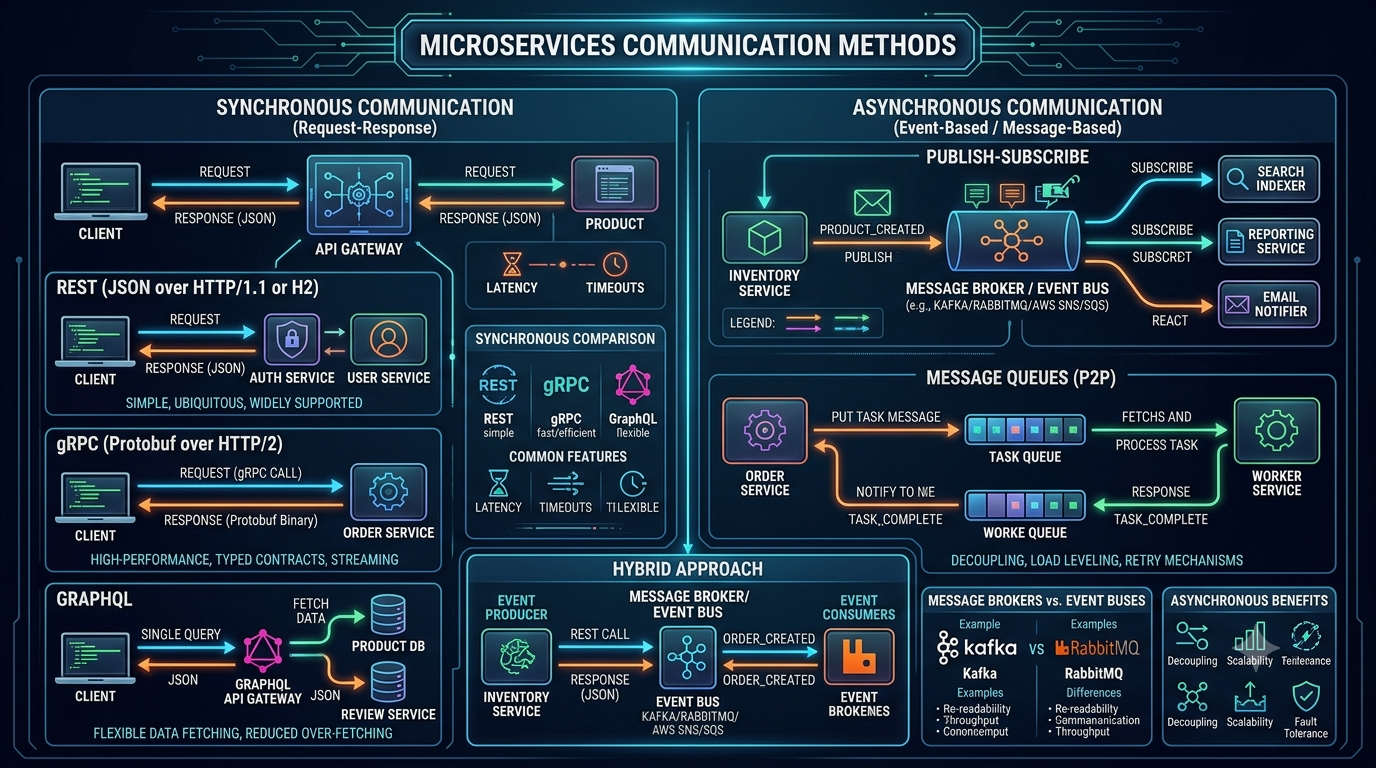
Whether you use REST APIs, gRPC, Message Queues, Kafka, or Event-Driven Architecture, the goal remains the same: enabling services to exchange information efficiently and reliably.
The best communication method depends on your application's requirements, performance expectations, scalability needs, and operational complexity.
As a developer, understanding these communication patterns will help you design better systems, build scalable applications, and prepare for real-world software engineering challenges.
In microservices, success is not just about creating independent services—it's about ensuring they communicate effectively to deliver a seamless user experience. 🚀