Modern React applications feel incredibly fast, even when handling complex user interfaces and frequent state updates. But have you ever wondered how React updates the UI without reloading the entire page?
The answer lies in React's Reconciliation Algorithm — a powerful mechanism that allows React to efficiently update the DOM while maintaining excellent performance.
In this article, we'll explore what reconciliation is, how it works, and why understanding it can help you build better React applications.
What is React Reconciliation?
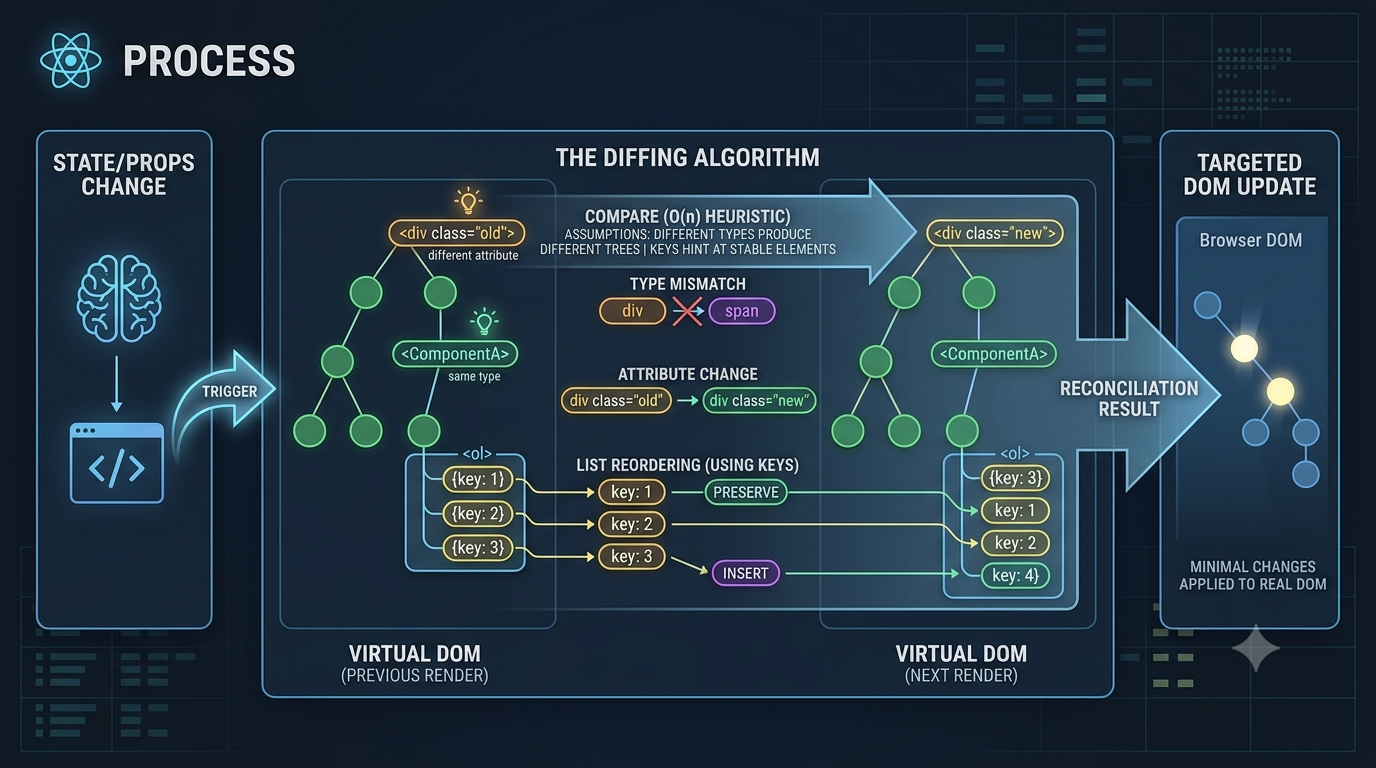
Reconciliation is the process React uses to compare the current UI with a new UI after a state or prop change.
Instead of updating the entire DOM, React:
Creates a new Virtual DOM tree.
Compares it with the previous Virtual DOM tree.
Identifies the differences.
Updates only the necessary parts of the actual DOM.
This process helps React deliver fast and efficient UI updates.
The Role of the Virtual DOM
Before understanding reconciliation, it's important to know about the Virtual DOM.
The Virtual DOM is a lightweight JavaScript representation of the real DOM.
When data changes:
function Counter() {
const [count, setCount] = useState(0);
return
{count}
;}
React creates a new Virtual DOM tree and compares it with the previous one. This comparison helps React determine exactly what changed.
Instead of rebuilding the entire page, React updates only the affected elements.
How React Reconciliation Works
Let's say the initial UI is:
0
After a state update:
1
React performs the following steps:
Step 1: State Changes
setCount(1);
Step 2: Create a New Virtual DOM
React generates a new Virtual DOM representation.
Step 3: Compare Old and New Trees
React compares:
0
1
Step 4: Update the Real DOM
Instead of recreating the entire element, React updates only the text node.
This targeted update is what makes React highly efficient.
Understanding the Diffing Algorithm
Comparing two complete DOM trees can be expensive.
To optimize performance, React uses a Diffing Algorithm that follows two important assumptions:
- Different Element Types Create Different TreesHello
Changing to:
Hello
Since the element types are different, React removes the old element and creates a new one.
- Keys Help React Identify Elements
When rendering lists, React uses keys to track elements efficiently.
users.map(user => (
))
Keys allow React to identify which items were added, removed, or reordered without re-rendering the entire list.
Why Keys Matter
Keys are crucial for efficient reconciliation.
✅ Good:
key={user.id}
❌ Bad:
key={index}
Using array indexes as keys can cause unnecessary re-renders and unexpected UI behavior when items are inserted, deleted, or reordered.
Always use a stable and unique identifier whenever possible.
React Fiber: Modern Reconciliation
React 16 introduced Fiber Architecture, a complete rewrite of React's reconciliation engine.
Fiber enables React to:
Pause rendering work
Prioritize updates
Resume interrupted tasks
Improve application responsiveness
This architecture powers modern React features such as:
Concurrent Rendering
Suspense
Transitions
Streaming SSR
As a result, React applications remain smooth even when handling complex updates.
Performance Best Practices
To make the most of React's reconciliation process:
Use Stable Keys
key={product.id}
Use React.memo()
export default React.memo(ProductCard);
Use useMemo()
const filteredProducts = useMemo(
() => filterProducts(products),
[products]
);
Keep State Local
Avoid storing state higher in the component tree unless necessary. Local state reduces unnecessary re-renders and improves performance.
Common Misconceptions
"React Updates the Entire DOM"
Not true. React updates only the parts that have changed.
"Re-render Means DOM Update"
A component can re-render without causing any actual DOM changes if the output remains the same.
"Virtual DOM Makes Everything Faster"
The Virtual DOM itself isn't magic. The real benefit comes from minimizing expensive DOM operations.
Why Understanding Reconciliation Matters
Many React performance issues stem from misunderstandings about rendering behavior.
By understanding reconciliation, you'll be able to:
Optimize React applications effectively
Avoid unnecessary re-renders
Use keys correctly
Improve UI performance
Build scalable frontend applications
Conclusion
React's Reconciliation Algorithm is the engine behind React's fast and efficient UI updates. By comparing Virtual DOM trees, using the Diffing Algorithm, and updating only the necessary parts of the DOM, React ensures high performance even in large-scale applications.[링크텍스트](https://ashokitech.com/reactjs-online-training/)
Whether you're building a small portfolio or a complex enterprise application, understanding reconciliation will help you write cleaner, faster, and more optimized React code.