Monolithic vs Microservices Architecture in MERN Applications
When developers begin building MERN Stack applications, architecture is often the last thing on their minds.
The focus is usually on: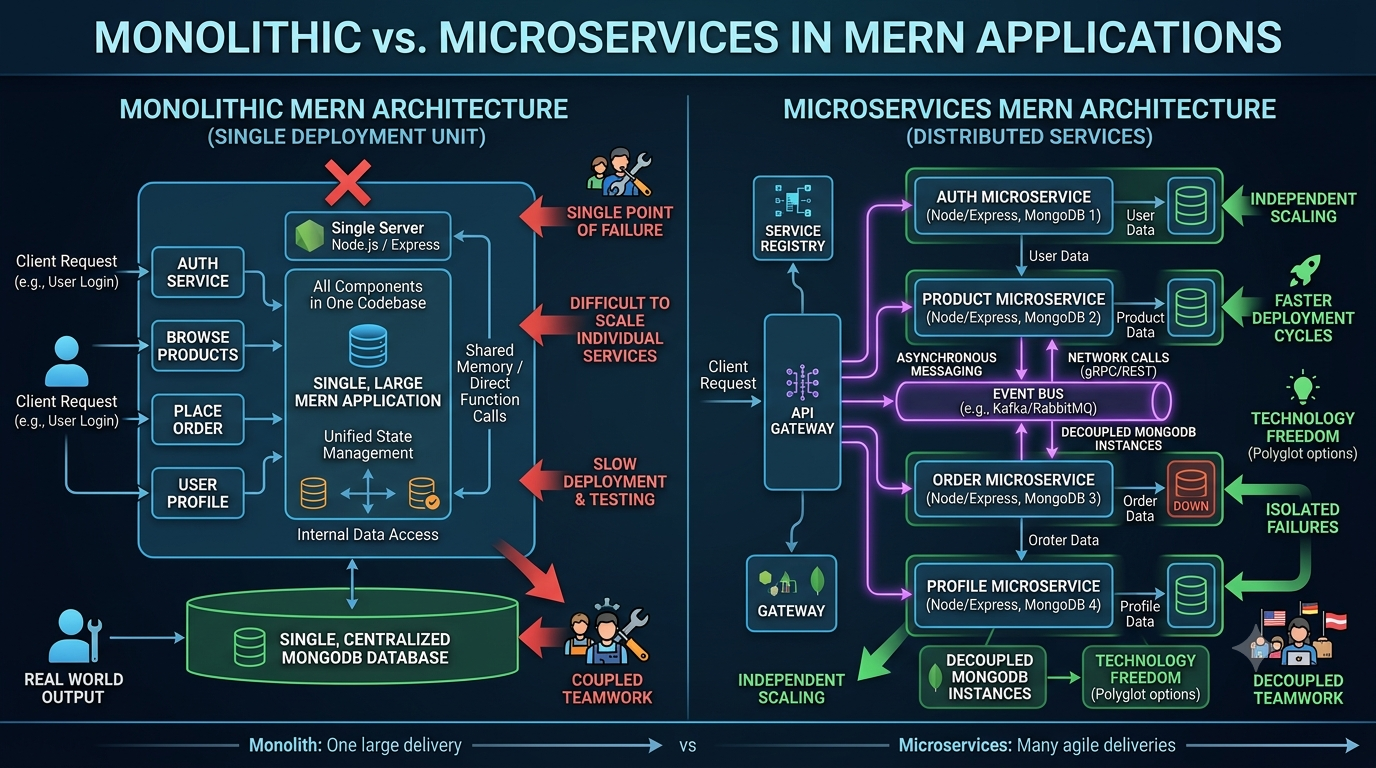
링크텍스트
Creating React components
Building Express APIs
Connecting MongoDB
Implementing authentication
And for small projects, that's perfectly fine.
However, as applications grow, architecture becomes one of the most important decisions a development team can make.
A poor architectural choice can lead to:
Difficult maintenance
Slower deployments
Scalability issues
Increased development costs
A good architectural choice, on the other hand, enables applications to grow smoothly and efficiently.
This brings us to one of the most debated topics in modern software engineering:
Monolithic vs Microservices Architecture.
If you're learning through MERN Stack Online Training, understanding these architectural styles is essential because most modern applications eventually face this decision.
In this article, we'll explore both architectures in detail, understand their advantages and disadvantages, and learn when each approach makes sense for MERN applications.
Understanding Architecture in MERN Applications
Before comparing monoliths and microservices, let's understand what architecture means.
Application architecture defines:
How components interact
How services communicate
How data flows through the system
How applications scale
Think of architecture as the blueprint of a building.
Without a proper blueprint, even a beautiful building can become difficult to maintain.
The same applies to software.
What is a Monolithic Architecture?
A monolithic application contains all business functionality inside a single codebase and deployment unit.
Typical MERN Monolith:
React Frontend
↓
Node.js + Express Application
↓
MongoDB Database
Everything resides in one project.
Example modules:
Authentication
Users
Products
Orders
Payments
Notifications
All these features run within the same application.
How a Monolithic MERN Application Works
Consider an E-Commerce Application.
Client Request
↓
Express Server
↓
Authentication Module
↓
Order Module
↓
Payment Module
↓
MongoDB
All requests are processed inside a single backend application.
This approach is simple and easy to understand.
Advantages of Monolithic Architecture
Simpler Development
Everything exists in one codebase.
Developers can:
Run the entire application locally
Debug easily
Navigate code quickly
This makes monoliths ideal for beginners.
Easier Deployment
Deployment is straightforward.
Build Application
↓
Deploy Application
↓
Run Application
Only one deployment pipeline is required.
Faster Initial Development
For startups and small teams:
Fewer moving parts
Less infrastructure
Faster feature delivery
This is why many successful companies started with monolithic applications.
Simplified Testing
Since everything exists in one application:
Integration testing becomes easier
End-to-end testing is straightforward
Developers don't need to mock multiple services.
Challenges of Monolithic Architecture
As applications grow, problems begin to appear.
Large Codebases Become Difficult to Maintain
After several years:
Authentication
Products
Orders
Payments
Reviews
Notifications
Reports
Analytics
All modules become tightly coupled.
Making changes becomes risky.
Scalability Limitations
Imagine:
Order Service
receives heavy traffic.
In a monolith:
Scale Entire Application
Even if only the Order module needs additional resources.
This increases infrastructure costs.
Slower Deployment Cycles
A small change requires redeploying the entire application.
Example:
Minor Payment Fix
↓
Deploy Entire System
This can slow development significantly.
What is Microservices Architecture?
Microservices divide an application into multiple independent services.
Each service focuses on a specific business capability.
Example:
User Service
Product Service
Order Service
Payment Service
Notification Service
Each service:
Has its own codebase
Can be deployed independently
Can scale independently
How Microservices Work in MERN Applications
Instead of one large backend:
React Frontend
↓
API Gateway
↓| User Service |
| Product Service |
| Order Service |
| Payment Service |
↓MongoDB Databases
Services communicate using APIs.
This architecture promotes modularity.
Advantages of Microservices Architecture
Independent Scalability
Suppose only the Product Service experiences heavy traffic.
You can scale:
Product Service
without scaling:
User Service
Payment Service
This improves resource utilization.
Independent Deployments
Teams can deploy services separately.
Example:
Update Payment Service
↓
Deploy Payment Service
No need to redeploy the entire system.
Better Team Productivity
Large organizations often have multiple teams.
Example:
Team A → User Service
Team B → Product Service
Team C → Order Service
Teams work independently without interfering with each other.
Improved Fault Isolation
If one service fails:
Notification Service Down
The rest of the application can continue functioning.
This improves system resilience.
Challenges of Microservices
Despite their popularity, microservices are not always the best choice.
Increased Complexity
Instead of managing one application:
1 Application
you manage:
10 Services
or more.
This requires:
Service discovery
Monitoring
Logging
API gateways
Complexity grows rapidly.
Difficult Debugging
A request may pass through:
Frontend
↓
Gateway
↓
User Service
↓
Order Service
↓
Payment Service
Finding issues becomes more challenging.
Distributed Data Management
Each service may have its own database.
Managing:
Data consistency
Transactions
Synchronization
becomes significantly harder.
Monolithic vs Microservices: Side-by-Side Comparison
Feature Monolithic Microservices
Development Speed Faster Initially Slower Initially
Deployment Single Deployment Independent Deployments
Scalability Entire Application Individual Services
Complexity Low High
Team Collaboration Limited Excellent
Maintenance Difficult at Scale Easier at Scale
Infrastructure Cost Lower Initially Higher Initially
Debugging Easier More Complex
Real-World Example
Imagine building a food delivery application.
Features include:
Authentication
Restaurant Management
Orders
Payments
Delivery Tracking
Monolithic Approach
Everything exists in one backend application.
Suitable for:
MVPs
Startups
Small teams
Microservices Approach
Separate services:
User Service
Restaurant Service
Order Service
Payment Service
Delivery Service
Suitable for:
High traffic systems
Large engineering teams
Rapidly growing businesses
When Should You Choose a Monolith?
Choose a monolithic architecture if:
Team size is small
Product is new
Requirements change frequently
Development speed is important
Infrastructure budget is limited
Most startups should begin with a monolith.
When Should You Choose Microservices?
Microservices make sense when:
Application is large
Teams are growing
Independent scaling is required
Deployment bottlenecks exist
Business domains are clearly separated
Adopting microservices too early often creates unnecessary complexity.
Common Mistake: Starting with Microservices
Many developers believe:
Microservices = Modern
Therefore:
Microservices = Better
This is incorrect.
Many successful companies started as monoliths.
Examples include:
Amazon (early stages)
Shopify (initial versions)
Etsy (initial versions)
They adopted microservices only when business requirements justified the complexity.
How Modern MERN Applications Evolve
Typical evolution:
Small Startup
↓
Monolithic MERN Application
↓
Growing User Base
↓
Modular Monolith
↓
Selective Microservices
↓
Distributed Architecture
This gradual approach is often the most practical.
Skills Developers Learn from Both Architectures
Understanding both architectures helps developers master:
Backend Development
Express.js
Node.js
REST APIs
Database Design
MongoDB
Data Modeling
System Design
Scalability
Reliability
Performance Optimization
DevOps Concepts
Containers
CI/CD
Deployment Strategies
These are valuable skills taught in professional MERN Stack Online Training programs and real-time development environments.
Why Architecture Knowledge Matters in Interviews
Modern frontend and backend interviews often include questions such as:
What is a monolithic architecture?
What are microservices?
When should you migrate to microservices?
What are the challenges of distributed systems?
How do services communicate?
Understanding these concepts demonstrates software engineering maturity.
Final Thoughts
There is no universal winner in the Monolithic vs Microservices debate.
The right choice depends on:
Team size
Business requirements
Budget
Growth expectations
Technical expertise
For most MERN applications, starting with a well-structured monolith is often the smartest approach. It allows teams to move quickly, validate ideas, and keep complexity under control.
As the application grows, specific modules can gradually evolve into microservices when scalability and organizational needs demand it.
The best architecture isn't the most complex one.
It's the one that solves today's problems while remaining flexible enough to handle tomorrow's growth. 🚀