In this post, we create a basic bulletin board with simple CRUD functionalities. Below is the ERD diagram for this project.
ERD Diagram
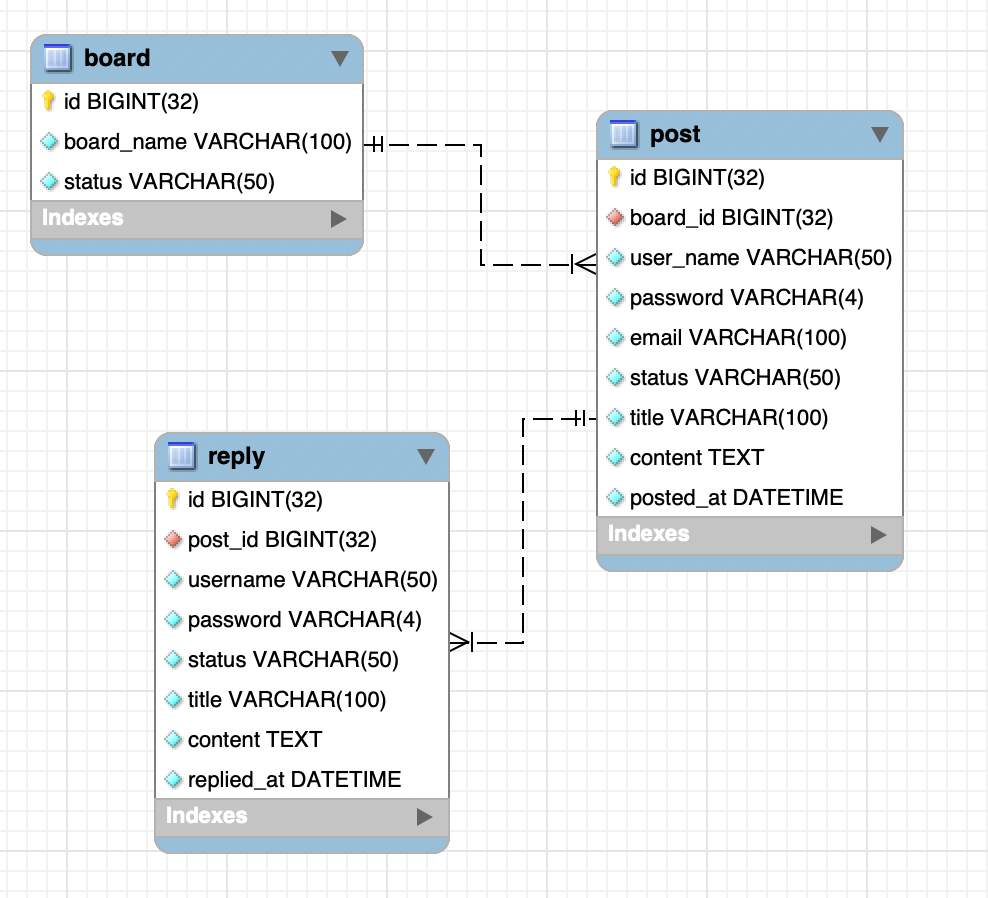
- Each board contains multiple posts, hence the 1:N relationship with post table.
- Each post can have multiple replies attached to it, hence the 1:N relationship with reply table.
- Each post has
user_nameandemailrelated to the person who created the post, as well as apasswordrequired to view, edit and delete the post. - Each post has
title,contentandposted_at. - Reply is similar to post.
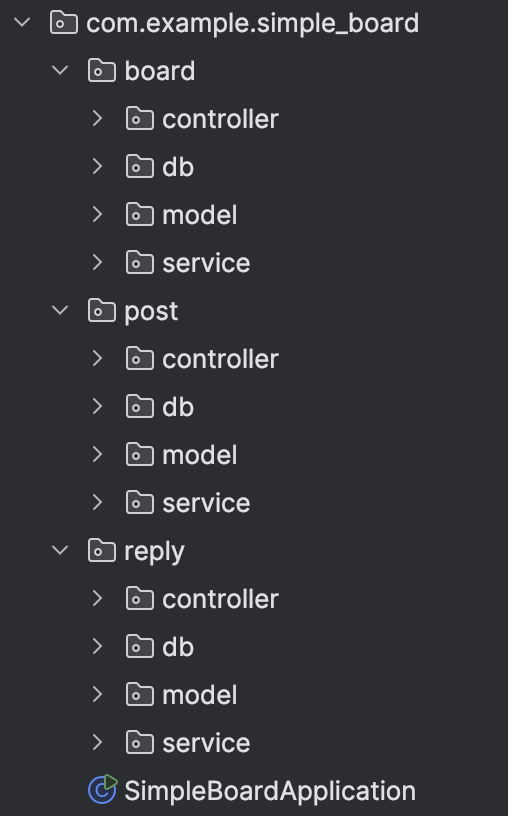
Package Structure:
Board
Controller
BoardApiController:
@RestController
@RequestMapping("/api/board")
@RequiredArgsConstructor
public class BoardApiController {

    private final BoardService boardService;

    @PostMapping("")
    public BoardEntity create(
            @Valid
            @RequestBody BoardRequest boardRequest
    ){
        return boardService.create(boardRequest);
    }

    @GetMapping("/id/{id}")
    public BoardEntity view(
            @PathVariable Long id
    ){
        return boardService.view(id);
    }
}
DB
BoardEntity
@Getter
@Setter
@NoArgsConstructor
@AllArgsConstructor
@Builder
@ToString
@Entity(name = "board")
public class BoardEntity {

    @Id
    @GeneratedValue(strategy = GenerationType.IDENTITY)
    private long id;

    private String boardName;
    private String status;

    @OneToMany(
            mappedBy = "board" //PostEntity 안에 board라는 변수가 있어야 함
    )
    private List<PostEntity> postList = List.of();
}- The
@OneToManyannotation inBoardEntityrepresents a one-to-many relationship in the context of Object-Relational Mapping (ORM) using JPA. The relationship signifies that oneBoardEntitycan be associated with multiplePostEntityobjects. - The
mappedByattribute indicates the field in thePostEntityclass that owns the relationship. It avoids creating a separate join table for this relationship. - JPA appends
_idto the field name specified inmappedBywhen generating the foreign key column name in the database. This naming rule ensures that the database reflects the relationship between the entities. - In the above case,
mappedby = "board"must match the fieldprivate BoardEntity board;inPostEntity. And since the parent side is not the owning side, no column related to the child entity is added to the parent entity's table. - Behavior without
mappedby, there would be join table creation: JPA creates a join table to manage the relationship instead of a foreign key column.
BoardRepository
package com.example.simple_board.board.db;

import org.springframework.data.jpa.repository.JpaRepository;

public interface BoardRepository extends JpaRepository<BoardEntity, Long> {}
Model
BoardRequest
@Getter
@Setter
@ToString
@NoArgsConstructor
@AllArgsConstructor
@Builder
@JsonNaming(value = PropertyNamingStrategies.SnakeCaseStrategy.class)
public class BoardRequest {
    @NotBlank
    private String BoardName;
}
Purpose of BoardRequest
- Encapsulation of API input:
- The
BoardRequestclass encapsulates the data that the API expects in a structured format. When a client sends a request to create a new board, theBoardRequestclass defines the structure of that data.
- The
- Mapping client data to entity:
- The
BoardRequestprovides a clear mechanism to map incoming data to theBoardEntity.
var entity = BoardEntity.builder() .boardName(boardRequest.getBoardName()) .status("REGISTERED") .build();- This prevents the direct use of
BoardEntityas an API input model, which could expose database-specific fields (id,postList, etc) unnecessarily or allow manipulation of fields that should not be modified by the client (e.g. `status)
- The
- Separation of concerns:
- The
BoardEntityis tightly coupled with the database schema and persistence logic, whileBoardRequestis designed specifically for client-server communication. - By using
BoardRequest, we decouple the database entity from the API layer, making the system more maintainable and adaptable to changes.
- The
Service
BoardService
@Service
@RequiredArgsConstructor
public class BoardService {
    private final BoardRepository boardRepository;

    public BoardEntity create(
            BoardRequest boardRequest
    ){
        var entity = BoardEntity.builder()
                .boardName(boardRequest.getBoardName())
                .status("REGISTERED")
                .build();

        return boardRepository.save(entity);
    }

    public BoardEntity view(Long id) {
        return boardRepository.findById(id).get(); //assume exists
    }
}
Post
Controller
PostApiController
@RestController
@RequestMapping("/api/post")
@RequiredArgsConstructor
public class PostApiController {
    private final PostService postService;

    @PostMapping("")
    public PostEntity create(
            @Valid
            @RequestBody PostRequest postRequest
    ){
        return postService.create(postRequest);
    }

    @PostMapping("/view")
    public PostEntity view(
            @Valid
            @RequestBody PostViewRequest postViewRequest
    ){
        return postService.view(postViewRequest);

    }

    @GetMapping("/all")
    public List<PostEntity> list(){
        return postService.all();
    }

    @PostMapping("/delete")
    public void delete(
            @Valid
            @RequestBody PostViewRequest postViewRequest
    ){
        postService.delete(postViewRequest);
    }
}
DB
PostEntity
@Getter
@Setter
@NoArgsConstructor
@AllArgsConstructor
@Builder
@ToString
@Entity(name = "post")
public class PostEntity {
    @Id
    @GeneratedValue(strategy = GenerationType.IDENTITY)
    private Long id;

    @ManyToOne
    @JsonIgnore
    @ToString.Exclude
    private BoardEntity board;

    private String userName;
    private String password;
    private String email;
    private String status;
    private String title;

    @Column(columnDefinition = "TEXT")
    private String content;

    private LocalDateTime postDate;

    @Transient
    private List<ReplyEntity> replyList = List.of();
}-
@Entity(name = "post"): Marks this as a JPA entity, meaning it is mapped to a database table. Thename = "post"specifies that this entity corresponds to theposttable in the database. -
@ToString.Exclude: Excludes theboardfield from thetoString()output to prevent circular references. -
@JsonIgnore: Prevents this field from being serialized into JSON when the object is converted. Avoids circular references during serialization (e.g.BoardEntityreferencingPostEntityand vice versa) -
Column(columnDefinition = "TEXT"): Specifies that thecontentfield should be stored asTEXTcolumn in the database. Ensures the database can handle large text conetnt, such as long posts or articles.
- Without@Column(columnDefinition = "TEXT"), JPA will map thecontentfield to a column with the typeVARCHARby default. The maximum lengthVARCHARvaries by database and is typically limited to 255 characters unless explicitly configured.
-
@Persisentmarks a field in the entity class that should not stored in the database. The field exists only in the Java application's memory and is excluded from all databasea operations likeINSERT,UPDATE,SELECT, orDELETE.
- Examples include derived fields (e.g. calculated values based on other fields), Fields used for temporary operations or user interaction, Non-persistent fields in a DTO or view layer.- Without
@Transientannotation, JPA will treat the field as a persistent field, giving rise to the following issues:
- Database Mapping: JPA will attempt to map the field to a column in the database.- If the column does not exist in the database, it may cause:
- Schema mismatch errors (if schema validation is enabled)
- Runtime exceptions when querying or persisting the entity.
- If the column does not exist in the database, it may cause:
- By using
@Transient, it ensures that replies (ReplyEntity) are not directly mapped but stored in-memory, suggesting replies are handled separately (e.g. fetched via a service or repository)
- Without
Model
PostRequest
@Getter
@Setter
@ToString
@NoArgsConstructor
@AllArgsConstructor
@Builder
@JsonNaming(value = PropertyNamingStrategies.SnakeCaseStrategy.class)
public class PostRequest {

    private Long boardId = 1L;

    @NotBlank
    private String userName;

    @NotBlank
    @Size(min = 4, max = 4)
    private String password;

    @NotBlank
    @Email
    private String email;

    @NotBlank
    private String title;

    @NotBlank
    private String content;
}
PostViewRequst
@Getter
@Setter
@ToString
@NoArgsConstructor
@AllArgsConstructor
@Builder
@JsonNaming(value = PropertyNamingStrategies.SnakeCaseStrategy.class)
public class PostViewRequest {
    @NotNull
    private Long postId;

    @NotNull
    private String password;

}
Why have both PostRequest and PostViewRequest
- Having separate
PostRequestandPostViewRequestclasses is a design decision that aligns with the Single Responsibility Principle (SRP) and enhances the clarity, security, and maintainability of the codebase. PostRequestrepresents the data required to create a new post.PostViewRequestrepresents the data required to view or interact with an existing post securely.- The fields and validation rules for creating a post and viewing a post are fundamentally different. Separate classes allow tailored validation rules for each operation, ensuring correctness and reducing risk of errors.
- Future scalability: As the application grows, additional operations may require furthre distinctions:
- New features might demand updates toPostViewRequest(e.g. includingauthToken.PostRequestcan evolve independently (e.g. adding tags or categories for posts)
Service
PostService
@Service
@RequiredArgsConstructor
public class PostService {
    private final PostRepository postRepository;
    private final ReplyService replyService;
    private final BoardRepository boardRepository;

    public PostEntity create(
            PostRequest postRequest
    ){
        var boardEntity = boardRepository.findById(postRequest.getBoardId()).get(); //temporary

        var entity = PostEntity.builder()
                .board(boardEntity) //temporarily fixed to 1
                .userName(postRequest.getUserName())
                .password(postRequest.getPassword())
                .email(postRequest.getEmail())
                .status("REGISTERED")
                .title(postRequest.getTitle())
                .content(postRequest.getContent())
                .postDate(LocalDateTime.now())
                .build();

        return postRepository.save(entity);
    }

    public PostEntity view(PostViewRequest postViewRequest) {
        return postRepository.findFirstByIdAndStatusOrderByIdDesc(postViewRequest.getPostId(), "REGISTERED")
                .map( it -> {
                    if(!it.getPassword().equals(postViewRequest.getPassword())){
                        var format = "Incorrect Password %s vs %s";
                        throw new RuntimeException(String.format(format, it.getPassword(), postViewRequest.getPassword()));
                    }

                    //RETURN replies to the corresponding post also
                    var replyList = replyService.findAllByPostId(it.getId());
                    it.setReplyList(replyList);

                    return it;
                }).orElseThrow(
                        ()->{
                            return new RuntimeException("Such post does not exist: " + postViewRequest.getPostId());
                        }
                );
    }

    public List<PostEntity> all() {
        return postRepository.findAll();
    }

    public void delete(PostViewRequest postViewRequest) {
        postRepository.findById(postViewRequest.getPostId())
                .map(it -> {
                    if(!it.getPassword().equals(postViewRequest.getPassword())){
                        var format = "Incorrect Password %s vs %s";
                        throw new RuntimeException(String.format(format, it.getPassword(), postViewRequest.getPassword()));
                    }
                    it.setStatus("UNREGISTERED");
                    postRepository.save(it);
                    return it;
                }).orElseThrow(
                        () -> {
                            return new RuntimeException("Such post does not exist: " + postViewRequest.getPostId());
                        }
                );
    }
}
Circular Reference Issue
- Circular references occur when two entities reference each other directly, resulting in infinite loops when serializing objects (e.g., converting to JSON or logging).
- In our case,
BoardEntityreferencesPostEntitythroughpostList:
//Within BoardEntity:
@OneToMany(
            mappedBy = "board"
    )
private List<PostEntity> postList = List.of();- And
PostEntityreferencesBoardEntitythrough theboardfield:
//Within PostEntity:
@ManyToOne
//@JsonIgnore
//@ToString.Exclude
private BoardEntity board;- Annotations like
@JsonIgnoreor@ToString.Excludecan temporarily mitigate the issue but these solutions are not ideal because:
- Loss of data: Prevent certain fields from being included in the serialized output (e.g. ignoringboardinPostEntitymay hide useful data.)- Couple logic: Tie serialization and logging behavior to the entity design, which violates separation of concerns.
- The proper solution is to introduce the DTOs (Data Transfer Objects) like
BoardDto, which separate the serialized structure from the entity logic. This approach ensures flexibility, eliminates circular references, and adheres to best practices.
Introducing BoardDto & PostDto
@Getter
@Setter
@ToString
@NoArgsConstructor
@AllArgsConstructor
@Builder
@JsonNaming(value = PropertyNamingStrategies.SnakeCaseStrategy.class)
public class BoardDto {

    private long id;
    private String boardName;
    private String status;
    private List<PostDto> postList = List.of();
}
@Getter
@Setter
@ToString
@NoArgsConstructor
@AllArgsConstructor
@Builder
@JsonNaming(value = PropertyNamingStrategies.SnakeCaseStrategy.class)
public class PostDto {
private Long id;
private Long boardId;
private String userName;
private String password;
private String email;
private String status;
private String title;
private String content;
private LocalDateTime postDate;
}- When using
BoardDto, the risk of entering an infinite loop during serialization, even with JPA relationships, is eliminated. This is becauseBoardDtoserves as a separate, lightweight representation of theBoardEntityobject, designed specifically for transferring data between the application and the client. - By having
BoardDtoandPostDto, we break the direct linkage betweenBoardEntityandPostEntityin the serialized output. Instead of serializing entities with their circular references, we map the entity data into theBoardDtostructure, which includes only the fields necessary for the client. This ensures that serialization stops at theBoardDtoandPostDtolevel, preventing recursive traversal into related entities. - Even though the underlying JPA relationships remain intact for database operations and domain logic,
BoardDtoabstracts those relationships for the client layer, eliminating the possibility of an infinite loop. This approach adheres to best practices including separation of concerns and decoupling of persistence logic from API representation. - Notably, returning raw DTOs to the client has several limitations and is not considered ideal in modern software design. Instead DTOs should be wrapped in a standardized API response object.
Setting up JPA relationship between Post and Reply
ReplyEntity
- Initially, in
ReplyEntity,
private Long postId;- With JPA relationship,
@ManyToOne
@ToString.Ignore
@JsonIgnore
private PostEntity post;
PostEntity
- Initially, in
PostEntity,
private List<ReplyEntity> replyList = List.of();- With JPA relationship,
@OneToMany( mappedby = "post" )
private List<ReplyEntity> replyList = List.of();
PostService
- In
view(PostViewRequest postViewRequest), there was an additional step to query all replies corresponding to the post we want to view, by usingfindAllByPostId(Long id)method specified inReplyService.
public PostEntity view(PostViewRequest postViewRequest) {
        return postRepository.findFirstByIdAndStatusOrderByIdDesc(postViewRequest.getPostId(), "REGISTERED")
                .map( it -> {
                    if(!it.getPassword().equals(postViewRequest.getPassword())){
                        var format = "Incorrect Password %s vs %s";
                        throw new RuntimeException(String.format(format, it.getPassword(), postViewRequest.getPassword()));
                    }

                    //RETURN replies to the corresponding post also
                    var replyList = replyService.findAllByPostId(it.getId());
                    it.setReplyList(replyList);

                    return it;
                }).orElseThrow(
                        ()->{
                            return new RuntimeException("Such post does not exist: " + postViewRequest.getPostId());
                        }
                );
}- After setting up the JPA relationship between
PostandReply, we no longer need the above additional step to query all replies that correspond to the post of interest:
public PostEntity view(PostViewRequest postViewRequest) {
        return postRepository.findFirstByIdAndStatusOrderByIdDesc(postViewRequest.getPostId(), "REGISTERED")
                .map( it -> {
                    if(!it.getPassword().equals(postViewRequest.getPassword())){
                        var format = "Incorrect Password %s vs %s";
                        throw new RuntimeException(String.format(format, it.getPassword(), postViewRequest.getPassword()));
                    }

                    //RETURN replies to the corresponding post also
                    //Don't need this anymore after setting up the JPA relationship between post and reply
                    //var replyList = replyService.findAllByPostId(it.getId());
                    //it.setReplyList(replyList);

                    return it;
                }).orElseThrow(
                        ()->{
                            return new RuntimeException("Such post does not exist: " + postViewRequest.getPostId());
                        }
                );
    }
Post Deletion Issue
- In current implementation, when a user deletes a post, it does not actually deletes it but marks it as
UNREGISTERED. Consequently, with aGETrequest tohttp://localhost:8080/api/board/id/1, which invokesview()inBoardApiControllerandBoardService, there is no additional step to filter outUNREGISTEREDposts in a board. BoardApiController:
@GetMapping("/id/{id}")
    public BoardDto view(
            @PathVariable Long id
    ){
        return boardService.view(id);
}BoardService:
public BoardDto view(Long id) {
        var entity = boardRepository.findById(id).get(); //assume exists, unsafe implementation
        return boardConverter.toDto(entity);
}- As a result, the response looks like below:
{
    "id": 1,
    "board_name": "QnA Board",
    "status": "REGISTERED",
    "post_list": [
        {
            "id": 1,
            "board_id": 1,
            "user_name": "Choi",
            "password": "1111",
            "email": "choi@gmail.com",
            "status": "UNREGISTERED",
            "title": "Making enquiry!",
            "content": "My order was not delivered",
            "post_date": "2025-01-01T16:16:47"
        },
        {
            "id": 2,
            "board_id": 1,
            "user_name": "Choi",
            "password": "1111",
            "email": "choi@gmail.com",
            "status": "REGISTERED",
            "title": "Question about my product",
            "content": "The product I ordered is not being delivered",
            "post_date": "2025-01-05T17:06:36"
        }
    ]
}- We can fix this issue such that only
REGISTEREDposts are returned, by adding an annotation inBoardEntity:
@Where(clause = "status = 'REGISTERED'")
@OrderBy("id desc")
private List<PostEntity> postList = List.of();
Pagination of posts
The current implementation of retrieving posts is not ideal since the server returns all existing (and 'REGISTERED' posts), which might cause an issue when the number of posts increases. Ideally, we would only want to retrieve posts corresponding to the page they belong to. To implement pagination, we create a new pacakge common where we define Api.java and Pagination.java.
Api:
@Getter
@Setter
@ToString
@NoArgsConstructor
@AllArgsConstructor
@Builder
public class Api<T> {
    private T body;
    private Pagination pagination;
}-
The purpose of
Api<T>class is a generic wrapper used for structuring API responses in a standardized format. It allows returning both data (body) and pagination metadata (pagination) in a single response object. -
Pagination:
@Getter
@Setter
@ToString
@NoArgsConstructor
@AllArgsConstructor
@Builder
public class Pagination {
    private Integer page; //The current page index
    private Integer size; //The number of elements per page
    private Integer currentElements; //The number of elements present in current page (useful when the last page has fewer elements
    private Integer totalPage; //Total number of pages available
    private Long totalElements; //Total count of elements in the dataset. totalelement can be long, Integer might not be sufficient to hold this data.
}- The purpose of
Paginationclass is to serve as a data transfer object (DTO) that holds pagination-related metadata. It is used to send pagination details in API responses when dealing with paginated results.
First, we modify the list() method in PostApiController, which previously retrieved all posts:
@GetMapping("/all")
    public Api<List<PostEntity>> list(
            @PageableDefault(page = 0, size = 10)
            Pageable pageable
    ){
        return postService.all(pageable);
    }
PageableDefault(page = 0, size = 10) Pageable pageable:
- Automatically injects pagination parameters (page and size) into the method.- Default values:
page = 0-> First page (0-based index)size = 10-> Each page contains up to 10 posts
- Default values:
Api<List<PostEntity>>
- Wraps the paginated list of posts inside an API response wrapper, which includes:
-body-> List ofPostEntityobjects (actual data)
-pagination-> Pagination metadata
Next, we modify the postService.all() method:
public Api<List<PostEntity>> all(Pageable pageable) {
        var list = postRepository.findAll(pageable);

        var pagination = Pagination.builder()
                .page(list.getNumber()) // Current page index
                .size(list.getSize()) // Page size (number of elements per page)
                .currentElements(list.getNumberOfElements()) // Number of elements in the current page
                .totalElements(list.getTotalElements()) //Total elements in the dataset
                .totalPage(list.getTotalPages()) //Total number of pages
                .build();

        var response = Api.<List<PostEntity>>builder()
                .body(list.toList())
                .pagination(pagination)
                .build();

        return response;
}- Now, the above method returns
Api<List<PostEntity>>, meaningbodyis a list ofPostEntityobjects (the actual posts) andpaginationis the metadata about pagination (current page, total pages, etc.) - The
postRepository.findAll(pageable)returns aPage<PostEntity>object,listhas access to the methods from thePage<T>interface in Spring Data JPA.
Outcome of pagination
- For the
GETrequesthttp://localhost:8080/api/post/all?page=0&size=5where we are fetching page number 0 with page size 5, we get the following:
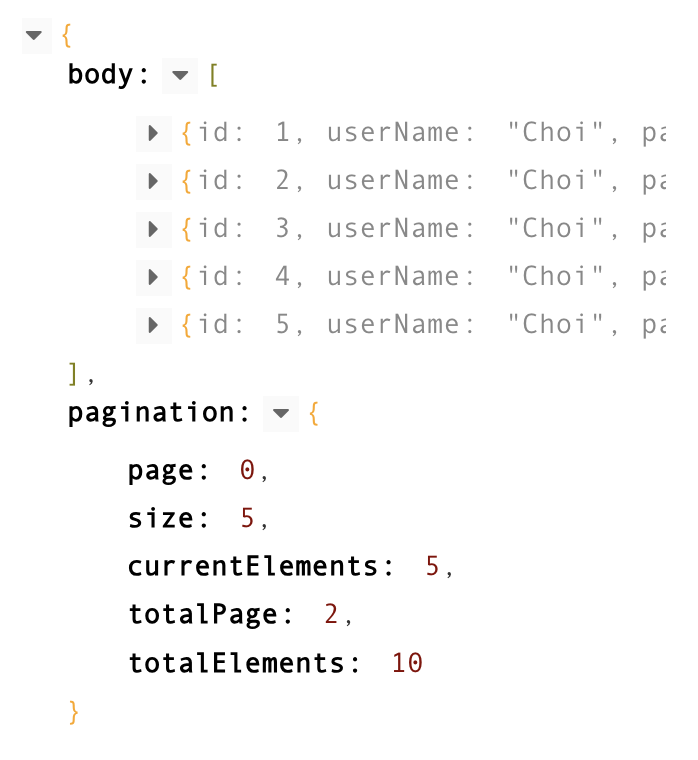
- For the
GETrequest with page number 1 and page size 5, we get:
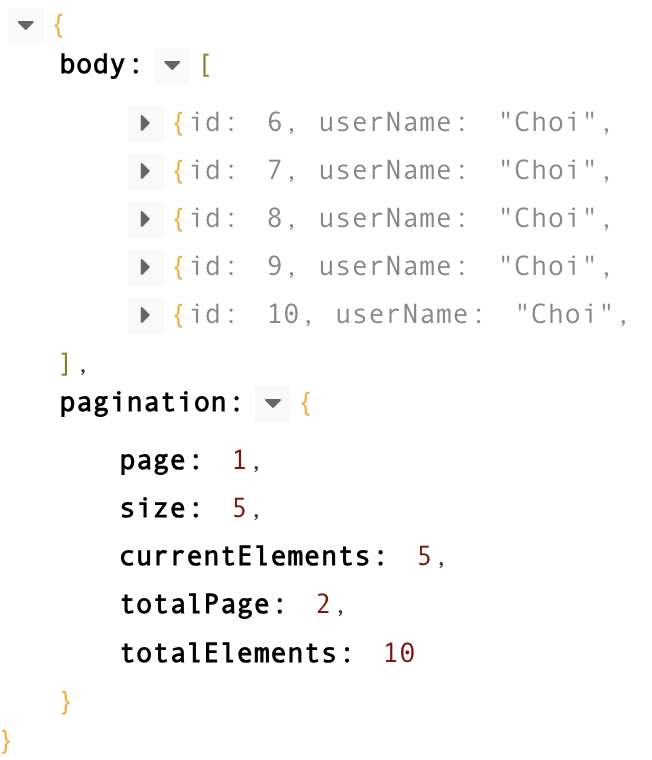
- We can also sort the elements in the page by adding the following to the annoation:
@PageableDefault(page = 0, size = 5, sort = "id", direction = Sort.Direction.DESC)- This will return the elements in descending order of id.