Spring
HandlerInterceptorintercepts HTTP requests at the controller level, i.e., after Spring has matched the request to a specific handler (controller method). Interceptors are mainly used for cross-cutting concerns like logging, authentication, metrics, etc., without touching the servlet layer directly
Key methods in HandlerInterceptor
- preHandle(HttpServletRequest, HttpServletResponse, Object Handler):
- When it runs: Before the controller method executes- Purpose: Can stop request processing (return
false), log, authenticate, or modify the request
- Purpose: Can stop request processing (return
- postHandle(HttpServletRequest, HttpServletResponse, Object Handler, ModelAndView):
- When it runs: After the controller method executes, but before view rendering- Purpose: Can modify the
ModelAndViewor add attributes
- Purpose: Can modify the
- afterCompletion(HttpServletRequest, HttpServletResponse, Object Handler, Exception):
- When it runs: After the complete request is finished (response sent)- Purpose: Cleanup, logging, metrics, exception handling
@Slf4j
@Component
public class OpenApiInterceptor implements HandlerInterceptor {


    @Override
    public boolean preHandle(HttpServletRequest request, HttpServletResponse response, Object handler) throws Exception {
        log.info("pre handle");
        return HandlerInterceptor.super.preHandle(request, response, handler);
    }

    @Override
    public void postHandle(HttpServletRequest request, HttpServletResponse response, Object handler, ModelAndView modelAndView) throws Exception {
        log.info("post Handle");
        HandlerInterceptor.super.postHandle(request, response, handler, modelAndView);
    }

    @Override
    public void afterCompletion(HttpServletRequest request, HttpServletResponse response, Object handler, Exception ex) throws Exception {
        log.info("after completion");
        HandlerInterceptor.super.afterCompletion(request, response, handler, ex);
    }
}- Despite the above interceptor classes added, it will not log anything. Simply annotating our class with
@Componentdoes not automatically attach it to Spring MVC's request handling.
- Spring detectsHandlerInterceptorbeans, but they do nothing until we register them via a configuration.
@Configuration
public class WebConfig implements WebMvcConfigurer {

    @Autowired
    private OpenApiInterceptor openApiInterceptor;

    @Override
    public void addInterceptors(InterceptorRegistry registry){
        registry.addInterceptor(openApiInterceptor)
                .addPathPatterns("/**");
    }
}@Configurationmarks this class as a Spring configuration class. Spring will detect it and use it to configure MVC settings.addInterceptors()is called by Spring MVC to register any interceptors.registry.addInterceptor(openApiInterceptor)addes myOpenApiInterceptorto the interceptor chain..addPathPatterns("/**)tells Spring to apply this interceptor to all paths, but we can also limit it so specific paths, e.g.,/api/**.- Now calling the POST method again after adding the configuration file, we get all the
log()from theOpenApiInterceptor.
Overall flow
Incoming HTTP Request
         |
         v
+----------------------+
|   Servlet Filter(s)  |  <- e.g., LoggerFilter
|  (implements Filter) |
+----------------------+
         |
         v
+---------------------------+
|  DispatcherServlet        |
|  (Spring MVC front controller) |
+---------------------------+
         |
         v
+---------------------------+
|   HandlerInterceptor(s)   |  <- e.g., OpenApiInterceptor
|   preHandle()             |
+---------------------------+
         |
         v
+---------------------------+
|       Controller          |  <- e.g., UserApiController
+---------------------------+
         |
         v
+---------------------------+
| HandlerInterceptor(s)     |
| postHandle()              |
+---------------------------+
         |
         v
+---------------------------+
|  View Rendering / Response | (if any)
| afterCompletion()          | <- HandlerInterceptor
+---------------------------+
         |
         v
+----------------------+
|   Servlet Filter(s)  |  <- LoggerFilter can do post-processing here too
+----------------------+
         |
         v
HTTP Response sent to client- This is in line with the below diagram:
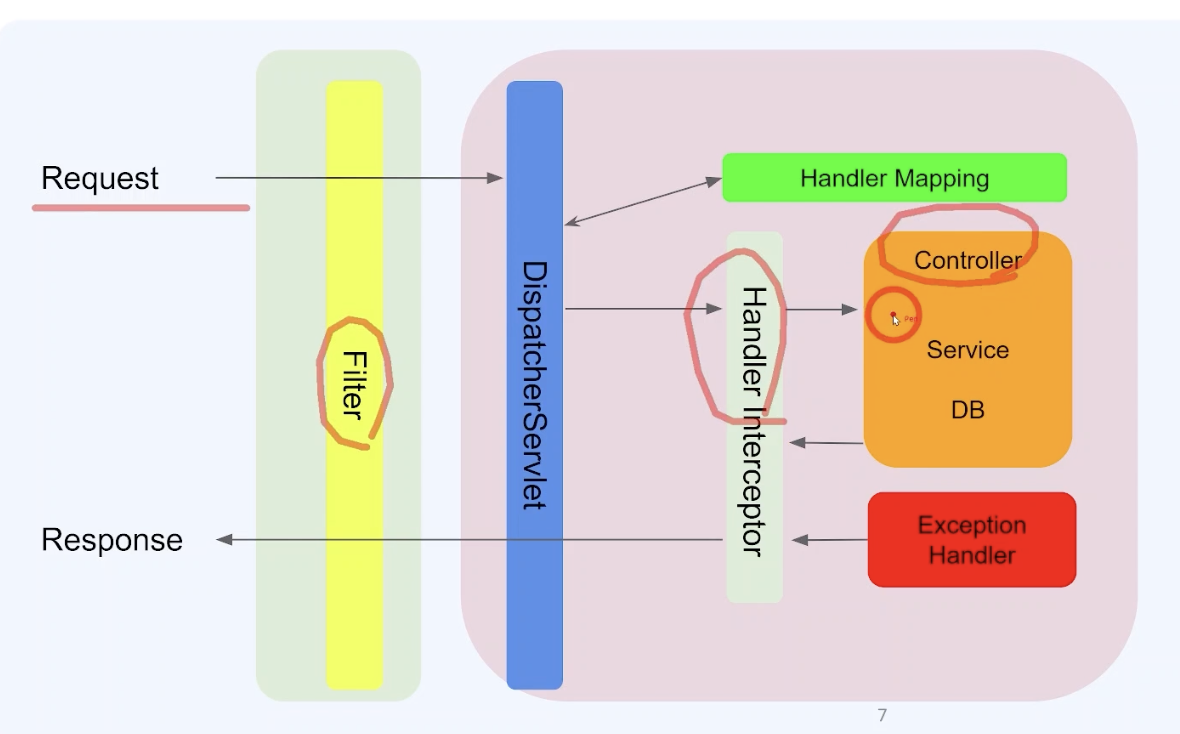
- With the POST request, the log is as below:
2025-08-19T00:17:38.895+08:00  INFO 22757 --- [filter] [nio-8080-exec-1] com.example.filter.filter.LoggerFilter   : before entry //filter
2025-08-19T00:17:38.912+08:00  INFO 22757 --- [filter] [nio-8080-exec-1] c.e.f.interceptor.OpenApiInterceptor     : pre handle //interceptor
2025-08-19T00:17:38.999+08:00  INFO 22757 --- [filter] [nio-8080-exec-1] c.e.filter.controller.UserApiController  : UserRequest(name=Choi, phoneNumber=null, email=choi@gmail.com, age=45) //Controller
2025-08-19T00:17:39.028+08:00  INFO 22757 --- [filter] [nio-8080-exec-1] c.e.f.interceptor.OpenApiInterceptor     : post Handle //Interceptor
2025-08-19T00:17:39.029+08:00  INFO 22757 --- [filter] [nio-8080-exec-1] c.e.f.interceptor.OpenApiInterceptor     : after completion //Interceptor
2025-08-19T00:17:39.030+08:00  INFO 22757 --- [filter] [nio-8080-exec-1] com.example.filter.filter.LoggerFilter   : req : {
  "name": "Choi",
  "phoneNumber": "010-2321-2321",
  "email": "choi@gmail.com",
  "age": 45
} //Filter
2025-08-19T00:17:39.030+08:00  INFO 22757 --- [filter] [nio-8080-exec-1] com.example.filter.filter.LoggerFilter   : res : {"name":"Choi","phone_number":null,"email":"choi@gmail.com","age":45}
2025-08-19T00:17:39.030+08:00  INFO 22757 --- [filter] [nio-8080-exec-1] com.example.filter.filter.LoggerFilter   : after entry
Application
- We first create a marker annotation for demo purposes:
@Target(value = { ElementType.METHOD, ElementType.TYPE})
@Retention(RetentionPolicy.RUNTIME)
public @interface OpenApi {
}
@Target(value = {ElementType.METHOD, ElementType.TYPE})
- Defines where this annotation can be applied.ElementType.TYPEcan be placed on classes, interfaces, enumsElementType.METHODcan be placed on methods
@Retention(RetentionPolicy.RUNTIME)
- Defines how long the annotation information is kept.RUNTIME-> the annotation will be available runtime, and reflection (e.g. Spring interceptors, AOP, or custom code) can read it.- This means frameworks like Spring can detect @OpenApi annotation during execution
- We modify the
preHandle()method in our interceptor class as below:
@Override
public boolean preHandle(HttpServletRequest request, HttpServletResponse response, Object handler) {
    log.info("pre handle");

    var handlerMethod = (HandlerMethod) handler;

    // Check if the method itself has @OpenApi
    var methodLevel = handlerMethod.getMethodAnnotation(OpenApi.class);
    if(methodLevel != null){
    	log.info("method level");
        return true; // allow request to proceed
    }

    // Check if the class has @OpenApi
    var classLevel = handlerMethod.getBeanType().getAnnotation(OpenApi.class);
    if(classLevel != null){
    	log.info("class level");
        return true; // allow request to proceed
    }

    log.info("not @OpenApi : {}", request.getRequestURI());
    return false; // block request (controller method will not run)
}- In the line
var handlerMethod = (HandlerMethod) handler;, what is ahandlerhere?
- In a SpringHandlerInterceptor, thepreHandlemethod signature is:boolean preHandle(HttpServletRequest request, HttpServletResponse response, Object handler)- The
handlerobject represents the thing that will handle the reqeust. - In SpringMVC, if the request is mapped to a controller method,
handlerwill be of typeHandlerMethod.- Why cast to
HandlerMethod? - We want to inspect annotations on the controller class/method.
- To do this, we need Spring's
HandlerMethodAPI, which gives us reflective access.
- To do this, we need Spring's
- Why cast to
HandlerMethodprovides methods like:getMethod() // the actual java.lang.reflect.Method getBeanType() // the controller's class getMethodAnnotation(...) // check if a method has a certain annotation getBean() // the actual controller object- Without casting, we can't call these methods on
handler(since it's just anObjectby default).
- The
- Also the modified
UserApiController:
public class UserApiController {

    @OpenApi
    @PostMapping("")
    public UserRequest register(
            @RequestBody
            UserRequest userRequest
    ){
        log.info("{}", userRequest);
        return userRequest;
    }

    @GetMapping("/hello")
    public void hello(){
        log.info("Hello");
    }
}- Once we send a request to
/helloendpoint, we get the following log:
2025-08-19T00:46:39.377+08:00  INFO 24943 --- [filter] [nio-8080-exec-1] com.example.filter.filter.LoggerFilter   : before entry
2025-08-19T00:46:39.396+08:00  INFO 24943 --- [filter] [nio-8080-exec-1] c.e.f.interceptor.OpenApiInterceptor     : pre handle
2025-08-19T00:46:39.397+08:00  INFO 24943 --- [filter] [nio-8080-exec-1] c.e.f.interceptor.OpenApiInterceptor     : not @OpenApi : /api/user/hello
2025-08-19T00:46:39.399+08:00  INFO 24943 --- [filter] [nio-8080-exec-1] com.example.filter.filter.LoggerFilter   : req :
2025-08-19T00:46:39.399+08:00  INFO 24943 --- [filter] [nio-8080-exec-1] com.example.filter.filter.LoggerFilter   : res :
2025-08-19T00:46:39.399+08:00 INFO 24943 --- [filter] [nio-8080-exec-1] com.example.filter.filter.LoggerFilter : after entry- And since the
hello()method mapped to/helloendpoint was not annotated with@OpenApiand theUserApiControllerclass was not annotated with@OpenApi, thepreHandle()method returned false and the request was not proceeded. - But if we annotate the
UserApiControllerclass with@OpenApiannotation, all methods (includinghello()) method will have the annotation, therefore the request will be proceeded, as shown below:
@OpenApi
@Slf4j
@RestController
@RequestMapping("/api/user")
public class UserApiController {

    @OpenApi
    @PostMapping("")
    public UserRequest register(
            @RequestBody
            UserRequest userRequest
    ){
        log.info("{}", userRequest);
        return userRequest;
    }

    @GetMapping("/hello")
    public void hello(){
        log.info("Hello");
    }
}
2025-08-19T00:52:01.599+08:00 INFO 25315 --- [filter] [nio-8080-exec-1] com.example.filter.filter.LoggerFilter : before entry
2025-08-19T00:52:01.620+08:00 INFO 25315 --- [filter] [nio-8080-exec-1] c.e.f.interceptor.OpenApiInterceptor : pre handle
2025-08-19T00:52:01.621+08:00 INFO 25315 --- [filter] [nio-8080-exec-1] c.e.f.interceptor.OpenApiInterceptor : class level
2025-08-19T00:52:01.637+08:00 INFO 25315 --- [filter] [nio-8080-exec-1] c.e.filter.controller.UserApiController : Hello
2025-08-19T00:52:01.656+08:00 INFO 25315 --- [filter] [nio-8080-exec-1] c.e.f.interceptor.OpenApiInterceptor : post Handle
2025-08-19T00:52:01.656+08:00 INFO 25315 --- [filter] [nio-8080-exec-1] c.e.f.interceptor.OpenApiInterceptor : after completion
2025-08-19T00:52:01.657+08:00 INFO 25315 --- [filter] [nio-8080-exec-1] com.example.filter.filter.LoggerFilter : req :
2025-08-19T00:52:01.659+08:00 INFO 25315 --- [filter] [nio-8080-exec-1] com.example.filter.filter.LoggerFilter : res :
2025-08-19T00:52:01.659+08:00 INFO 25315 --- [filter] [nio-8080-exec-1] com.example.filter.filter.LoggerFilter : after entryWhen we have multiple interceptors:
- In
WebConfigconfiguration:
@Configuration
public class WebConfig implements WebMvcConfigurer {

    @Autowired
    private OpenApiInterceptor openApiInterceptor;

    @Override
    public void addInterceptors(InterceptorRegistry registry){
        registry.addInterceptor(openApiInterceptor)
                .addPathPatterns("/**");

        //we can add more interceptor(s)
        registry.addInterceptor(someOtherInterceptor)
                .addPathPatterns("/**");
    }
}- And the interceptors will run based on the order of addition to registry. OR we can order them using
.order().