1. CONFOUNDING AND NONCOLLAPSIBILITY
1) The Divergence
"효과 추정에서 편향의 의미인 confounding 개념"과 "non-collapsibility 개념"을 많은 통계학 문헌에서 구분하고 있지 않습니다. 예를 들어, Y에 대해 세 가지 회귀 벡터 W, X, Z를 포함한 일반화 선형 모형을 고려해 봅시다:
g[E(Y∣W=w,X=x,Z=z)]=α+wβ+Xγ+zδ(13)
회귀 분석에서 β가 Z에 대해 collapsible하다는 것은 Z를 생략하더라고 β=β∗가 성립하는 경우를 의미합니다.
g[E(Y∣W=w,X=x)]=α∗+wβ∗+Xγ∗(14)
(13)과 (14)에서 β=β∗일 때 Z의 요소를 confounders로 정의합니다. 그러므로, β=β∗인 경우에는 Z를 non-confounders입니다.
그럼에도 불구하고, confounding 개념"과 "non-collapsibility개념"은 동일하지 않습니다: confounding은 non-collapsibility 여부와 상관없이 발생할 수 있으며, non-collapsibility 역시 confounding 여부와 상관없이 발생할 수 있습니다. 수학적으로 동일한 결론에 다른 용어를 사용한 저자들은 non-collapsibility을 bias라 부르고, confounding을 covariate imbalance라고 불렀습니다.
(A) non-collapsibility without confounding
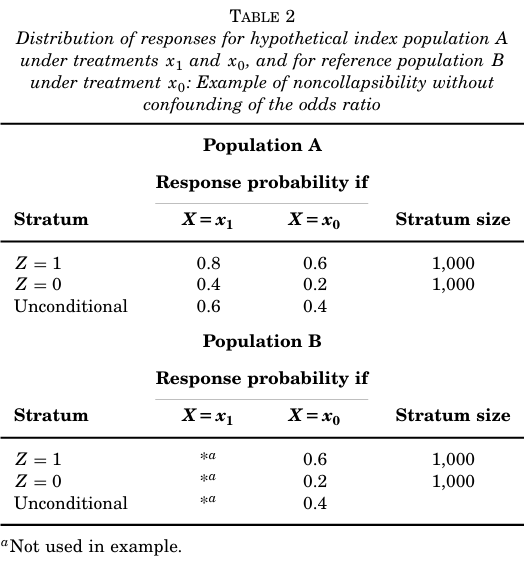
Table 2는 "가상의 목표 모집단 A에서 x1 이거나 x0 처치 하의 반응변수 분포"와 "가상의 참조 모집단 B에서 x0 처치 하의 반응변수 분포"를 보여준다. A는 x1 처치를, B는 x0 처치를 받았다고 가정하고, "x0 대신 x1을 받았을 때 A에 미친 효과를 추정"하고자 한다. 만약 반응변수의 오즈를 결과 모수 μ로 사용하면,
μA1=(1−0.6)0.6=1.50,μA0=μB0=(1−0.4)0.4=0.67
이 된다. 따라서 오즈비에 대한 confounding은 존재하지 않는다.
μA0μA1=μB0μA1=0.671.50=2.25
이다. 그럼에도 불구하고, 공변량 Z는 A와 B에서 반응변수와 association 되어 있습니다. 게다가, 오즈비는 collapsible하지 않습니다: Z의 수준별로 보면, x1 처치 하의 모집단 A를 x0 처치 하의 모집단 A 또는 B와 비교한 오즈비는
(0.6/0.4)(0.8/0.2)=(0.2/0.8)(0.4/0.6)=2.67
로 unconditional (crude) 오즈비 2.25보다 높습니다.
이 결과는 효과 척도로서 오즈비의 독특한 성질을 보여줍니다. 처치 x1 (참조 처치 x0 대비)은 모집단 A에서 반응변수의 오즈를 125% 증가시키지만, Z의 각 계층 내에서는 반응변수의 오즈를 167% 증가시킵니다. 만약 Z가 처치와 conditional로 반응변수와 association되어 있지만, unconditional으로 반응변수와 association되지 않는 경우, 계층별 오즈비는 unconditional 오즈비가 1이 아닌 경우 더 1에서 멀어지게 됩니다. 이러한 현상은 종종 unconditional 오즈비의 bias로 해석되지만, 사실 unconditional 효과를 계층별 또는 개별 효과의 추정치로 잘못 해석하지 않는다면 bias는 존재하지 않습니다.
(B) confounding without non-collapsibility
전체 효과에 대한 오즈비가 collapsible하면서도 confounded한 수치적 예를 생성하려면, Table 2를 약간만 수정하면 된다. 즉, 모집단 B에서 Z=0인 층의 크기를 1,500으로 변경한다. 이 변경으로 인해 모집단 B에서 Z=1의 비율이 0.5에서 0.4로 감소하며, 처치 x0 하의 모집단 B에서의 unconditional 반응변수의 확률은
0.4(0.6)+0.6(0.2)=0.36
이 되고, 처치 x0 하의 모집단 B에서의 unconditional 반응변수의 오즈 μB0는
0.36/(1−0.36)=0.5625
가 된다. 따라서
μB0(=0.5625)<μA0(=0.67)
이며, 결과적으로 오즈비의 confounding이 발생합니다. 모집단 A에서 x1이 오즈에 미친 참 효과 μA1/μA0는 이전과 같이 2.25이지만, 이는 unconditional 오즈비 μA1/μB0=1.50/0.5625=2.67보다 작습니다. 그럼에도 불구하고, 이 unconditional 오즈비는 계층별 오즈비와 동일하다.
2) Conditions for Equivalence
Table 2의 예시에서 μ가 결과의 오즈를 나타낼 때, μA0=μB0임을 보여줍니다 (no confounding). 심지어 오즈비가 confounders에 대해 non-collapsibility인 경우에도 해당됩니다. 반대로 수정된 예에서는, 오즈비가 collapsible한 경우에도 μA0=μB0가 될 수 있음을 보여줍니다.
non-confounding과 collapsibility사이의 차이에 대한 확률적 설명은 Z가 치료와 unconditional로 unassociated하고 충분히 제어되는 경우 μA0=μB0가 된다는 것입니다 (Table 2). 반면, 수정된 예에서처럼 오즈비의 collapsibility은 반응변수 Y를 conditional로 Z가 치료와 unassociated일 때 발생합니다. 따라서 이 차이는 비조건부 연관성 (unconditional associations)과 조건부 연관성(conditional associations)의 비동등성 (non-equivalence)에서 비롯된 결과일 뿐입니다.
효과 측도가 difference or ratio of response proportions 로 정의될 경우, Z가 A와 B에서 동일한 분포를 가진다면 (즉, Z와 치료가 unconditionally unassociated) 해당 측도가 Z에 대해 collapsibility을 시사합니다. 그러나 non-collapsibility without confounding와 confounding without non-collapsibility이 Z가 충분히 통제된 경우에는 발생하지 않습니다. 더 일반적으로, 효과 측도가 모집단 구성원에 대한 평균 효과로 표현될 수 있는 경우 (예: linear causal model (4) 하에서), non-collapsibility와 confounding의 조건은 동일해질 수 있습니다. 이러한 경우, non-collapsibility 와 confounding은 동일한 개념이 되며, 이는 두 개념이 종종 구분되지 않는 이유를 설명할 수 있습니다. 오즈비에서 두 개념이 동등하지 않는 이유는 처치가 오즈에 미치는 unconditionally 효과가 모집단 구성원에 대한 평균 처치 효과와 동일하지 않기 때문입니다.
설명 변수들이 Y에 미치는 causal effects를 나타내기 위해 전체 회귀 모델 (13)을 고려한다고 할 때 Z에 대한 non-collapsibility은 g가 항등 (identity)이거나 log-link가 아니라면 confounding와 동일한 개념이 아닙니다. 즉, β와 β∗는 각각 X와 Z 수준 내에서 W를 조작 (manipulate)한 효과를 편향 없이 (unbiased) 나타낼 수 있지만 β∗=β일 수 있습니다. Table 2는 로지스틱 모델에서 이 점을 보여주며, 로지스틱 모델에서의 non-collapsibility이 항상 편향을 나타내는 것은 아님을 보여준다. β와 β∗ 간의 차이는 cluster-specific 효과와 모집단 평균 효과 간의 구분에 해당 합니다.
- cluster-specific 모델: Z를 W와 X에 독립적이며 관찰되지 않은 단변량 cluster-specific 랜덤 변수로 고려하는 전체 모델. 예: (13). 이 경우 Z는 평균이 0이고 분산이 1인 랜덤 변수이다. δ2는 랜덤 효과(random effects) 분산들의 벡터에 해당한다.
