설치
- Gin 설치
go get -u github.com/gin-gonic/ginHTTP 상태를 던지기 위해 net/http 도 같이 쓴다.
시작하기
func main() {
  r := gin.Default()
  r.GET("/ping", func(c *gin.Context) {
    c.JSON(http.StatusOK, gin.H{
      "message": "pong",
    })
  })
  r.Run() // listen and serve on 0.0.0.0:8080 (for windows "localhost:8080")
}
Gin v1
- API 프로즌되서 새로운 릴리즈가 코드를 부수지 않는다.
Gin 은 encoding/json 을 디폴트 json 패키지로 쓴다. 하지만 다른걸로 써도 된다.
- jsoniter
- go-json
- sonic
go build -tags=jsoniter .
go build -tags=go_json .
$ go build -tags="sonic avx" .
MsgPack 렌더링을 디폴트로 하지만 disable 시킬 수 있다.
go build -tags=nomsgpack .API 예시
GET, POST, PUT, DELETE, PATCH, HEAD, OPTIONS 를 제공한다.
디폴트로 포트가 8080 이다.
- parameter in path
func main() {
  router := gin.Default()

  // This handler will match /user/john but will not match /user/ or /user
  router.GET("/user/:name", func(c *gin.Context) {
    name := c.Param("name")
    c.String(http.StatusOK, "Hello %s", name)
  })

  // However, this one will match /user/john/ and also /user/john/send
  // If no other routers match /user/john, it will redirect to /user/john/
  router.GET("/user/:name/*action", func(c *gin.Context) {
    name := c.Param("name")
    action := c.Param("action")
    message := name + " is " + action
    c.String(http.StatusOK, message)
  })

  // For each matched request Context will hold the route definition
  router.POST("/user/:name/*action", func(c *gin.Context) {
    b := c.FullPath() == "/user/:name/*action" // true
    c.String(http.StatusOK, "%t", b)
  })

  // This handler will add a new router for /user/groups.
  // Exact routes are resolved before param routes, regardless of the order they were defined.
  // Routes starting with /user/groups are never interpreted as /user/:name/... routes
  router.GET("/user/groups", func(c *gin.Context) {
    c.String(http.StatusOK, "The available groups are [...]")
  })

  router.Run(":8080")
}
c.
- Param
- c.FullPath
- c.String
:name 이나, *action 으로 사용할 수 있다.
c.Param 으로 받는다.
c.FullPath 도 있다.
- Querystring parameters
func main() {
  router := gin.Default()

  // Query string parameters are parsed using the existing underlying request object.
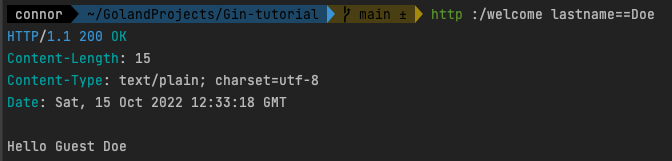
  // The request responds to a url matching:  /welcome?firstname=Jane&lastname=Doe
  router.GET("/welcome", func(c *gin.Context) {
    firstname := c.DefaultQuery("firstname", "Guest")
    lastname := c.Query("lastname") // shortcut for c.Request.URL.Query().Get("lastname")

    c.String(http.StatusOK, "Hello %s %s", firstname, lastname)
  })
  router.Run(":8080")
}
c.
-
DefaultQuery
-
Query
-
Multipart/Urlencoded Form
func main() {
  router := gin.Default()

  router.POST("/form_post", func(c *gin.Context) {
    message := c.PostForm("message")
    nick := c.DefaultPostForm("nick", "anonymous")

    c.JSON(http.StatusOK, gin.H{
      "status":  "posted",
      "message": message,
      "nick":    nick,
    })
  })
  router.Run(":8080")
}- c.PostForm
- c.DefaultPostForm
폼데이터를 이렇게 사용한다.
- Upload files
func main() {
  router := gin.Default()
  // Set a lower memory limit for multipart forms (default is 32 MiB)
  router.MaxMultipartMemory = 8 << 20  // 8 MiB
  router.POST("/upload", func(c *gin.Context) {
    // Single file
    file, _ := c.FormFile("file")
    log.Println(file.Filename)

    // Upload the file to specific dst.
    c.SaveUploadedFile(file, dst)

    c.String(http.StatusOK, fmt.Sprintf("'%s' uploaded!", file.Filename))
  })
  router.Run(":8080")
}- Grouping routes
func main() {
  router := gin.Default()

  // Simple group: v1
  v1 := router.Group("/v1")
  {
    v1.POST("/login", loginEndpoint)
    v1.POST("/submit", submitEndpoint)
    v1.POST("/read", readEndpoint)
  }

  // Simple group: v2
  v2 := router.Group("/v2")
  {
    v2.POST("/login", loginEndpoint)
    v2.POST("/submit", submitEndpoint)
    v2.POST("/read", readEndpoint)
  }

  router.Run(":8080")
}
router.
- Group
- 로그파일 작성
func main() {
    // Disable Console Color, you don't need console color when writing the logs to file.
    gin.DisableConsoleColor()

    // Logging to a file.
    f, _ := os.Create("gin.log")
    gin.DefaultWriter = io.MultiWriter(f)

    // Use the following code if you need to write the logs to file and console at the same time.
    // gin.DefaultWriter = io.MultiWriter(f, os.Stdout)

    router := gin.Default()
    router.GET("/ping", func(c *gin.Context) {
        c.String(http.StatusOK, "pong")
    })

    router.Run(":8080")
}
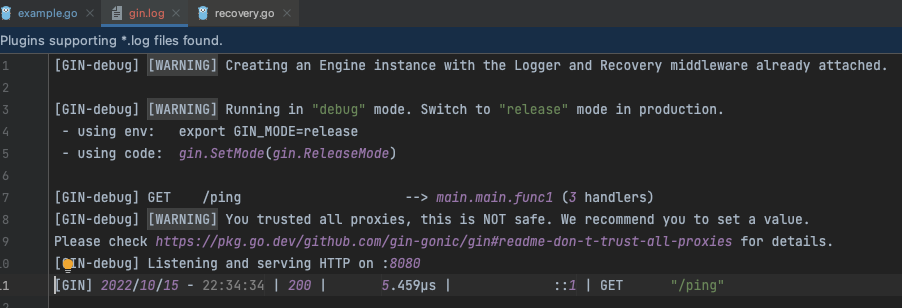
로그와 콘솔을 같이 찍고싶으면 io.MultiWriter 에 두번째 인자로 os.Stdout 을 준다.
- 커스텀 로그 포맷
func main() {
  router := gin.New()

  // LoggerWithFormatter middleware will write the logs to gin.DefaultWriter
  // By default gin.DefaultWriter = os.Stdout
  router.Use(gin.LoggerWithFormatter(func(param gin.LogFormatterParams) string {

    // your custom format
    return fmt.Sprintf("%s - [%s] \"%s %s %s %d %s \"%s\" %s\"\n",
        param.ClientIP,
        param.TimeStamp.Format(time.RFC1123),
        param.Method,
        param.Path,
        param.Request.Proto,
        param.StatusCode,
        param.Latency,
        param.Request.UserAgent(),
        param.ErrorMessage,
    )
  }))
  router.Use(gin.Recovery())

  router.GET("/ping", func(c *gin.Context) {
    c.String(http.StatusOK, "pong")
  })

  router.Run(":8080")
}- 모델 바인딩과 밸리데이션
// Binding from JSON
type Login struct {
  User     string `form:"user" json:"user" xml:"user"  binding:"required"`
  Password string `form:"password" json:"password" xml:"password" binding:"required"`
}

func main() {
  router := gin.Default()

  // Example for binding JSON ({"user": "manu", "password": "123"})
  router.POST("/loginJSON", func(c *gin.Context) {
    var json Login
    if err := c.ShouldBindJSON(&json); err != nil {
      c.JSON(http.StatusBadRequest, gin.H{"error": err.Error()})
      return
    }

    if json.User != "manu" || json.Password != "123" {
      c.JSON(http.StatusUnauthorized, gin.H{"status": "unauthorized"})
      return
    }

    c.JSON(http.StatusOK, gin.H{"status": "you are logged in"})
  })

  // Example for binding XML (
  //  <?xml version="1.0" encoding="UTF-8"?>
  //  <root>
  //    <user>manu</user>
  //    <password>123</password>
  //  </root>)
  router.POST("/loginXML", func(c *gin.Context) {
    var xml Login
    if err := c.ShouldBindXML(&xml); err != nil {
      c.JSON(http.StatusBadRequest, gin.H{"error": err.Error()})
      return
    }

    if xml.User != "manu" || xml.Password != "123" {
      c.JSON(http.StatusUnauthorized, gin.H{"status": "unauthorized"})
      return
    }

    c.JSON(http.StatusOK, gin.H{"status": "you are logged in"})
  })

  // Example for binding a HTML form (user=manu&password=123)
  router.POST("/loginForm", func(c *gin.Context) {
    var form Login
    // This will infer what binder to use depending on the content-type header.
    if err := c.ShouldBind(&form); err != nil {
      c.JSON(http.StatusBadRequest, gin.H{"error": err.Error()})
      return
    }

    if form.User != "manu" || form.Password != "123" {
      c.JSON(http.StatusUnauthorized, gin.H{"status": "unauthorized"})
      return
    }

    c.JSON(http.StatusOK, gin.H{"status": "you are logged in"})
  })

  // Listen and serve on 0.0.0.0:8080
  router.Run(":8080")
}
Gin 은 Must bind 와 Should bind 두 가지 메서드를 제공한다.
바인딩에러가 있을 때 에러가 리턴된다.
should bind 는 에러의 리턴이 요청과 에러를 적절하게 다루도록 개발자에게 책임을 묻는다.
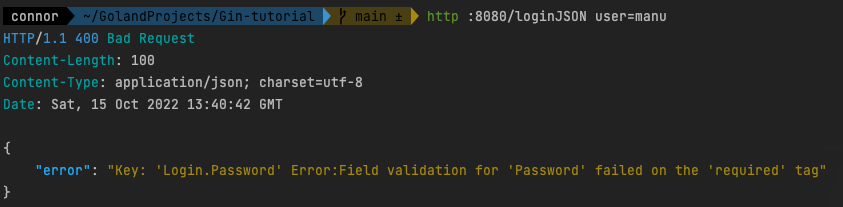
binding:"required" 를 줌으로써 request 에 필수값을 줄 수 있다.
c.
-
ShouldBindJSON
-
커스텀 validation
package main

import (
  "net/http"
  "time"

  "github.com/gin-gonic/gin"
  "github.com/gin-gonic/gin/binding"
  "github.com/go-playground/validator/v10"
)

// Booking contains binded and validated data.
type Booking struct {
  CheckIn  time.Time `form:"check_in" binding:"required,bookabledate" time_format:"2006-01-02"`
  CheckOut time.Time `form:"check_out" binding:"required,gtfield=CheckIn" time_format:"2006-01-02"`
}

var bookableDate validator.Func = func(fl validator.FieldLevel) bool {
  date, ok := fl.Field().Interface().(time.Time)
  if ok {
    today := time.Now()
    if today.After(date) {
      return false
    }
  }
  return true
}

func main() {
  route := gin.Default()

  if v, ok := binding.Validator.Engine().(*validator.Validate); ok {
    v.RegisterValidation("bookabledate", bookableDate)
  }

  route.GET("/bookable", getBookable)
  route.Run(":8085")
}

func getBookable(c *gin.Context) {
  var b Booking
  if err := c.ShouldBindWith(&b, binding.Query); err == nil {
    c.JSON(http.StatusOK, gin.H{"message": "Booking dates are valid!"})
  } else {
    c.JSON(http.StatusBadRequest, gin.H{"error": err.Error()})
  }
}
http :8085/bookable check_in==2030-04-16 check_out==2030-04-17
http :8085/bookable check_in==2030-03-10 check_out==2030-03-09
http :8085/bookable check_in==2022-10-14 check_out==2022-10-20

binding gtfield=CheckIn 으로 체크아웃이 체크인보다 과거이면 에러를 띄운다.
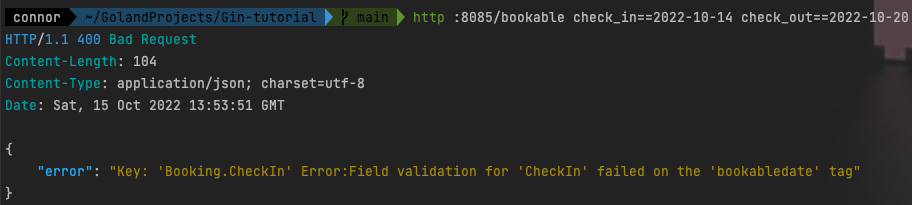
binding:"bookabledate" 의 커스텀 validation 으로 check_in 이 과거이면 에러를 띄운다.
- Only Bind Query String
package main

import (
  "log"
  "net/http"

  "github.com/gin-gonic/gin"
)

type Person struct {
  Name    string `form:"name"`
  Address string `form:"address"`
}

func main() {
  route := gin.Default()
  route.Any("/testing", startPage)
  route.Run(":8085")
}

func startPage(c *gin.Context) {
  var person Person
  if c.ShouldBindQuery(&person) == nil {
    log.Println("====== Only Bind By Query String ======")
    log.Println(person.Name)
    log.Println(person.Address)
  }
  c.String(http.StatusOK, "Success")
}
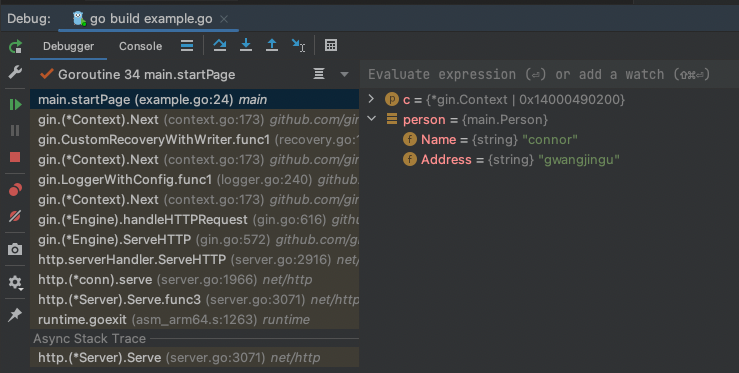
http :8085/testing name==connor address==gwangjingu
http post :8085/testing name==connor address==gwangjingu
http get :8085/testing name=connor address=gwangjingu
http :8085/testing name=connor address=gwangjingu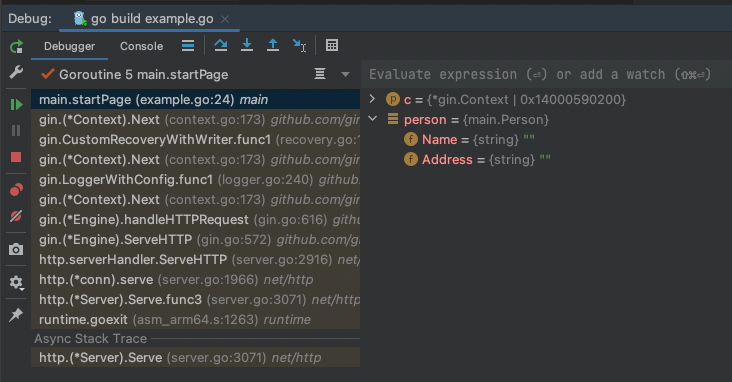
GET, POST 모두 쿼리스트링만 바인딩한다.
- Bind Query String or Post Data
package main

import (
  "log"
  "net/http"
  "time"

  "github.com/gin-gonic/gin"
)

type Person struct {
        Name       string    `form:"name"`
        Address    string    `form:"address"`
        Birthday   time.Time `form:"birthday" time_format:"2006-01-02" time_utc:"1"`
        CreateTime time.Time `form:"createTime" time_format:"unixNano"`
        UnixTime   time.Time `form:"unixTime" time_format:"unix"`
}

func main() {
  route := gin.Default()
  route.GET("/testing", startPage)
  route.Run(":8085")
}

func startPage(c *gin.Context) {
  var person Person
  // If `GET`, only `Form` binding engine (`query`) used.
  // If `POST`, first checks the `content-type` for `JSON` or `XML`, then uses `Form` (`form-data`).
  // See more at https://github.com/gin-gonic/gin/blob/master/binding/binding.go#L88
        if c.ShouldBind(&person) == nil {
                log.Println(person.Name)
                log.Println(person.Address)
                log.Println(person.Birthday)
                log.Println(person.CreateTime)
                log.Println(person.UnixTime)
        }

  c.String(http.StatusOK, "Success")
}
http :8085/testing name==connor address==gwangjingu birthday==1995-11-29
http post :8085/testing name==connor address==gwangjingu birthday==1995-11-29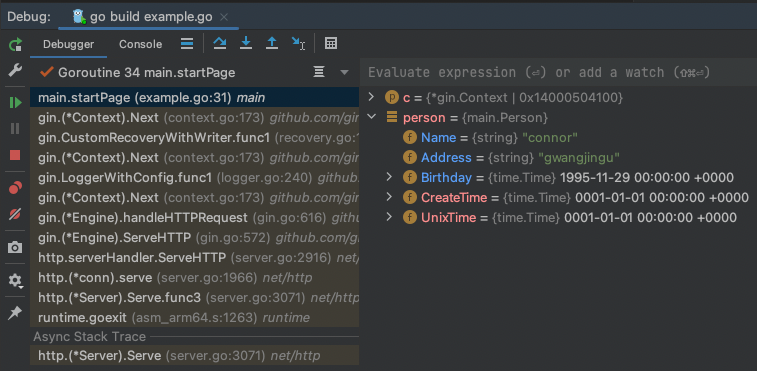
http get :8085/testing name=connor address=gwangjingu birthday=1995-11-29
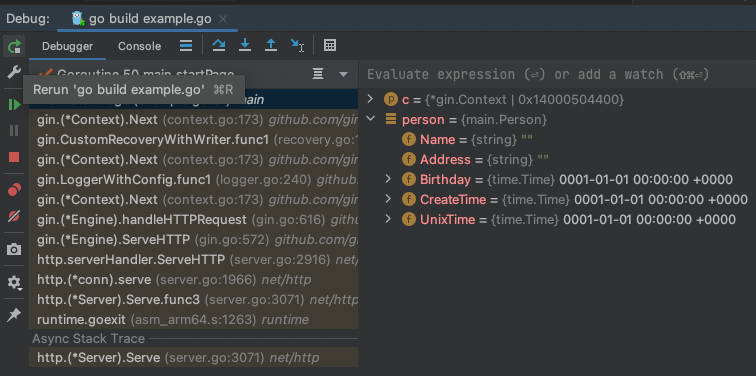
http :8085/testing name=connor address=gwangjingu birthday=1995-11-29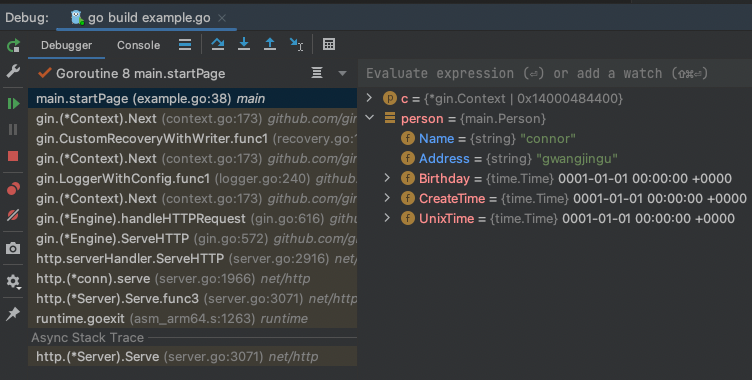
왜 날짜는 바인딩이 안되지 ?
요약
ShouldBindQueryGET, POST query 바인딩ShouldBindGET, POST query 및 POST body 바인딩
- Bind Uri
package main

import (
  "net/http"

  "github.com/gin-gonic/gin"
)

type Person struct {
  ID string `uri:"id" binding:"required,uuid"`
  Name string `uri:"name" binding:"required"`
}

func main() {
  route := gin.Default()
  route.GET("/:name/:id", func(c *gin.Context) {
    var person Person
    if err := c.ShouldBindUri(&person); err != nil {
      c.JSON(http.StatusBadRequest, gin.H{"msg": err.Error()})
      return
    }
    c.JSON(http.StatusOK, gin.H{"name": person.Name, "uuid": person.ID})
  })
  route.Run(":8088")
}
http :8088/thinkerou/987fbc97-4bed-5078-9f07-9141ba07c9f3
http :8088/thinkerou/not-uuid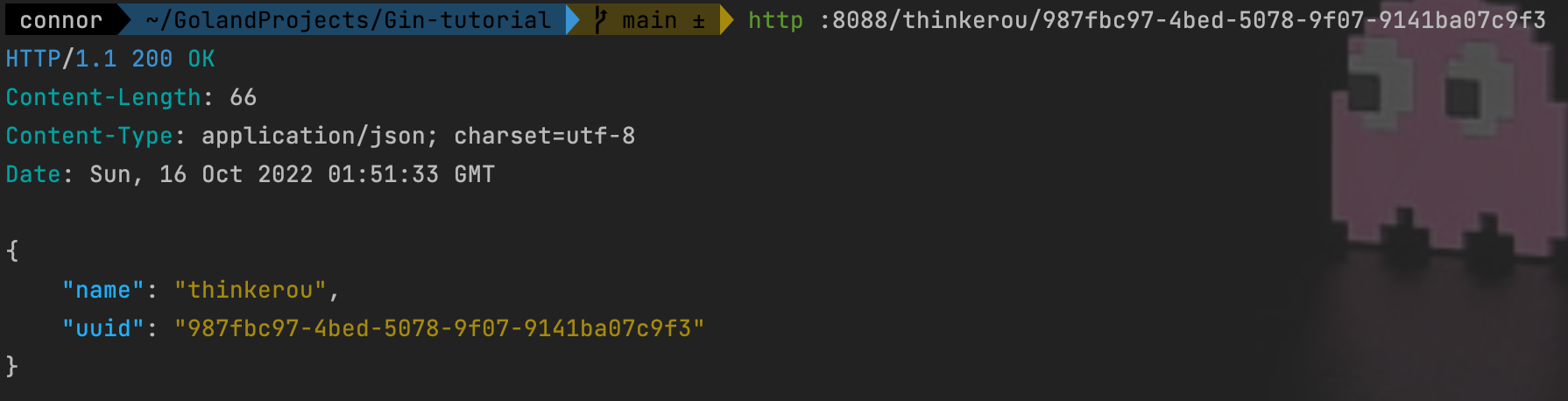
binding 에 uuid 를 주면 valid 를 검증한다.
c.
ShoudBindUri를 통해 path variable 을 매핑한다.
- Bind Header
package main

import (
  "fmt"
  "net/http"

  "github.com/gin-gonic/gin"
)

type testHeader struct {
  Rate   int    `header:"Rate"`
  Domain string `header:"Domain"`
}

func main() {
  r := gin.Default()
  r.GET("/", func(c *gin.Context) {
    h := testHeader{}

    if err := c.ShouldBindHeader(&h); err != nil {
      c.JSON(http.StatusOK, err)
    }

    fmt.Printf("%#v\n", h)
    c.JSON(http.StatusOK, gin.H{"Rate": h.Rate, "Domain": h.Domain})
  })

  r.Run()

// client
// curl -H "rate:300" -H "domain:music" 127.0.0.1:8080/
// output
// {"Domain":"music","Rate":300}
}
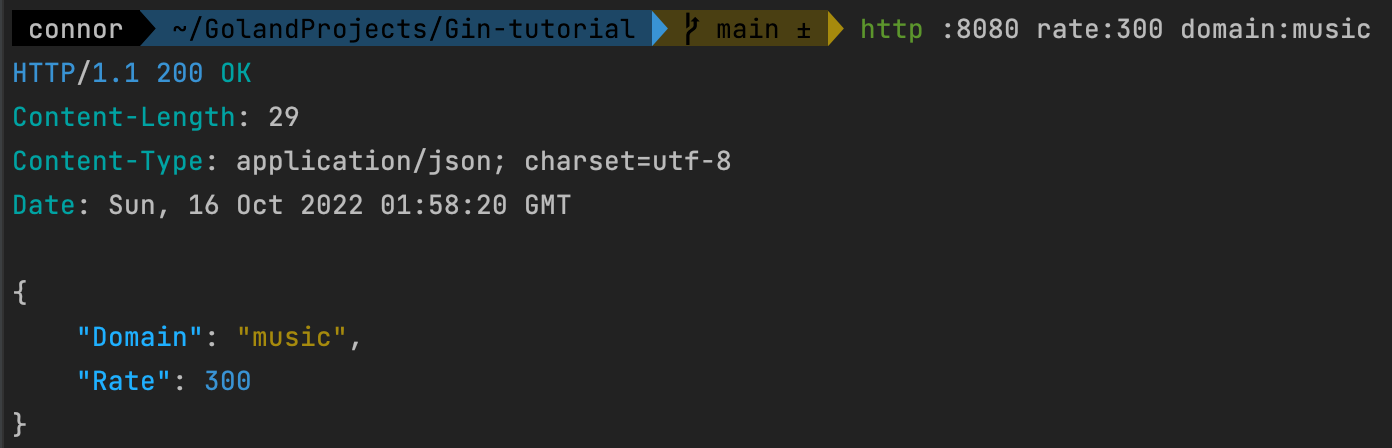
http :8080 rate:300 domain:musicc.
ShouldBindHeader
- Bind HTML checkboxes
...

type myForm struct {
    Colors []string `form:"colors[]"`
}

...

func formHandler(c *gin.Context) {
    var fakeForm myForm
    c.ShouldBind(&fakeForm)
    c.JSON(http.StatusOK, gin.H{"color": fakeForm.Colors})
}

...<form action="/" method="POST">
<p>Check some colors</p>
<label for="red">Red</label>
<input type="checkbox" name="colors[]" value="red" id="red">
<label for="green">Green</label>
<input type="checkbox" name="colors[]" value="green" id="green">
<label for="blue">Blue</label>
<input type="checkbox" name="colors[]" value="blue" id="blue">
<input type="submit">
</form>ShouldBind 로 가능하다.
- XML, JSON, YAML, ProtoBuf response
func main() {
  r := gin.Default()

  // gin.H is a shortcut for map[string]interface{}
  r.GET("/someJSON", func(c *gin.Context) {
    c.JSON(http.StatusOK, gin.H{"message": "hey", "status": http.StatusOK})
  })

  r.GET("/moreJSON", func(c *gin.Context) {
    // You also can use a struct
    var msg struct {
      Name    string `json:"user"`
      Message string
      Number  int
    }
    msg.Name = "Lena"
    msg.Message = "hey"
    msg.Number = 123
    // Note that msg.Name becomes "user" in the JSON
    // Will output  :   {"user": "Lena", "Message": "hey", "Number": 123}
    c.JSON(http.StatusOK, msg)
  })

  r.GET("/someXML", func(c *gin.Context) {
    c.XML(http.StatusOK, gin.H{"message": "hey", "status": http.StatusOK})
  })

  r.GET("/someYAML", func(c *gin.Context) {
    c.YAML(http.StatusOK, gin.H{"message": "hey", "status": http.StatusOK})
  })

  r.GET("/someProtoBuf", func(c *gin.Context) {
    reps := []int64{int64(1), int64(2)}
    label := "test"
    // The specific definition of protobuf is written in the testdata/protoexample file.
    data := &protoexample.Test{
      Label: &label,
      Reps:  reps,
    }
    // Note that data becomes binary data in the response
    // Will output protoexample.Test protobuf serialized data
    c.ProtoBuf(http.StatusOK, data)
  })

  // Listen and serve on 0.0.0.0:8080
  r.Run(":8080")
}
gin.H 는 map 의 shortcut 이다.
- SecureJSON
func main() {
  r := gin.Default()

  // You can also use your own secure json prefix
  // r.SecureJsonPrefix(")]}',\n")

  r.GET("/someJSON", func(c *gin.Context) {
    names := []string{"lena", "austin", "foo"}

    // Will output  :   while(1);["lena","austin","foo"]
    c.SecureJSON(http.StatusOK, names)
  })

  // Listen and serve on 0.0.0.0:8080
  r.Run(":8080")
}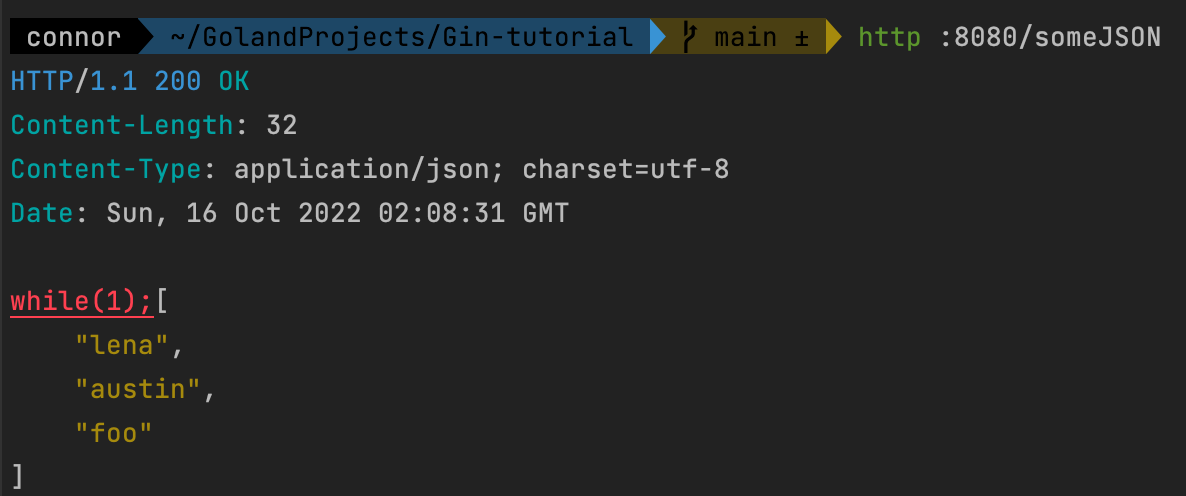
세션 하이재킹을 막습니다.
- JSONP
func main() {
  r := gin.Default()

  r.GET("/JSONP", func(c *gin.Context) {
    data := gin.H{
      "foo": "bar",
    }

    //callback is x
    // Will output  :   x({\"foo\":\"bar\"})
    c.JSONP(http.StatusOK, data)
  })

  // Listen and serve on 0.0.0.0:8080
  r.Run(":8080")

        // client
        // curl http://127.0.0.1:8080/JSONP?callback=x
}- AsciiJSON
func main() {
  r := gin.Default()

  r.GET("/someJSON", func(c *gin.Context) {
    data := gin.H{
      "lang": "GO语言",
      "tag":  "<br>",
    }

    // will output : {"lang":"GO\u8bed\u8a00","tag":"\u003cbr\u003e"}
    c.AsciiJSON(http.StatusOK, data)
  })

  // Listen and serve on 0.0.0.0:8080
  r.Run(":8080")
}
value 를 아스키코드로 반환합니다.
- PureJSON
func main() {
  r := gin.Default()

  // Serves unicode entities
  r.GET("/json", func(c *gin.Context) {
    c.JSON(http.StatusOK, gin.H{
      "html": "<b>Hello, world!</b>",
    })
  })

  // Serves literal characters
  r.GET("/purejson", func(c *gin.Context) {
    c.PureJSON(http.StatusOK, gin.H{
      "html": "<b>Hello, world!</b>",
    })
  })

  // listen and serve on 0.0.0.0:8080
  r.Run(":8080")
}
Go 1.6 부터 지원합니다.
HMTL 코드를 그대로 반환하기 위해서는 PureJSON 을 사용합니다.
- Serving static files
func main() {
  router := gin.Default()
  router.Static("/assets", "./assets")
  router.StaticFS("/more_static", http.Dir("my_file_system"))
  router.StaticFile("/favicon.ico", "./resources/favicon.ico")
  router.StaticFileFS("/more_favicon.ico", "more_favicon.ico", http.Dir("my_file_system"))

  // Listen and serve on 0.0.0.0:8080
  router.Run(":8080")
}- Redirects
r.GET("/test", func(c *gin.Context) {
  c.Redirect(http.StatusMovedPermanently, "http://www.google.com/")
})

r.POST("/test", func(c *gin.Context) {
  c.Redirect(http.StatusFound, "/foo")
})
외부로도 내부로도 이동 가능하다.
아래와 같이 Router redirect 도 가능하다.
r.GET("/test", func(c *gin.Context) {
    c.Request.URL.Path = "/test2"
    r.HandleContext(c)
})
r.GET("/test2", func(c *gin.Context) {
    c.JSON(http.StatusOK, gin.H{"hello": "world"})
})- 커스텀 미들웨어
func Logger() gin.HandlerFunc {
  return func(c *gin.Context) {
    t := time.Now()

    // Set example variable
    c.Set("example", "12345")

    // before request

    c.Next()

    // after request
    latency := time.Since(t)
    log.Print(latency)

    // access the status we are sending
    status := c.Writer.Status()
    log.Println(status)
  }
}

func main() {
  r := gin.New()
  r.Use(Logger())

  r.GET("/test", func(c *gin.Context) {
    example := c.MustGet("example").(string)

    // it would print: "12345"
    log.Println(example)
  })

  // Listen and serve on 0.0.0.0:8080
  r.Run(":8080")
}
router.Use 로 미들웨어를 사용할 수 있다.
- BasicAuth() 미들웨어 사용하기
// simulate some private data
var secrets = gin.H{
  "foo":    gin.H{"email": "foo@bar.com", "phone": "123433"},
  "austin": gin.H{"email": "austin@example.com", "phone": "666"},
  "lena":   gin.H{"email": "lena@guapa.com", "phone": "523443"},
}

func main() {
  r := gin.Default()

  // Group using gin.BasicAuth() middleware
  // gin.Accounts is a shortcut for map[string]string
  authorized := r.Group("/admin", gin.BasicAuth(gin.Accounts{
    "foo":    "bar",
    "austin": "1234",
    "lena":   "hello2",
    "manu":   "4321",
  }))

  // /admin/secrets endpoint
  // hit "localhost:8080/admin/secrets
  authorized.GET("/secrets", func(c *gin.Context) {
    // get user, it was set by the BasicAuth middleware
    user := c.MustGet(gin.AuthUserKey).(string)
    if secret, ok := secrets[user]; ok {
      c.JSON(http.StatusOK, gin.H{"user": user, "secret": secret})
    } else {
      c.JSON(http.StatusOK, gin.H{"user": user, "secret": "NO SECRET :("})
    }
  })

  // Listen and serve on 0.0.0.0:8080
  r.Run(":8080")
}
gin.Accounts 는 map[string][string] 의 shortcut 이다.
http -a foo:bar :8080/admin/secrets 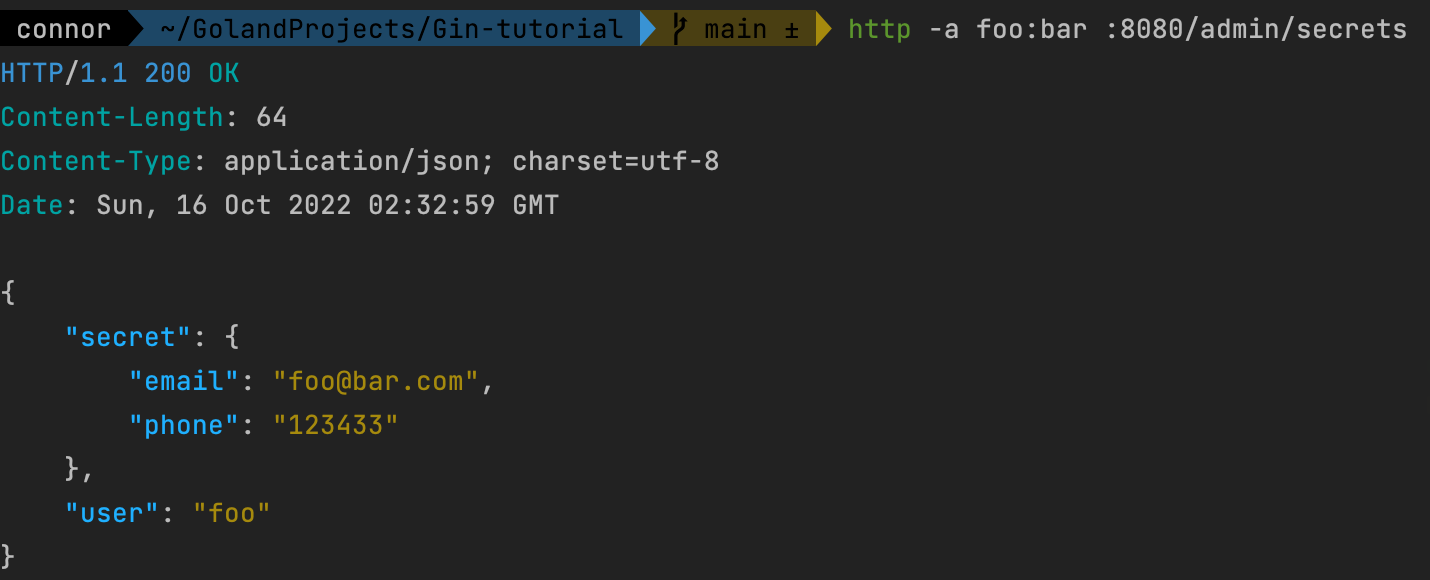
요청에 Basic-auth 로 검증할 수 있다.
- Goroutines inside a middleware
func main() {
  r := gin.Default()

  r.GET("/long_async", func(c *gin.Context) {
    // create copy to be used inside the goroutine
    cCp := c.Copy()
    go func() {
      // simulate a long task with time.Sleep(). 5 seconds
      time.Sleep(5 * time.Second)

      // note that you are using the copied context "cCp", IMPORTANT
      log.Println("Done! in path " + cCp.Request.URL.Path)
    }()
  })

  r.GET("/long_sync", func(c *gin.Context) {
    // simulate a long task with time.Sleep(). 5 seconds
    time.Sleep(5 * time.Second)

    // since we are NOT using a goroutine, we do not have to copy the context
    log.Println("Done! in path " + c.Request.URL.Path)
  })

  // Listen and serve on 0.0.0.0:8080
  r.Run(":8080")
}
미들웨어나 핸들러 안에서 새로운 고루틴을 시작할 때 original context 를 안에서 사용하지 않도록 한다.
사용하더라도 read-only copy 만 사용해야 한다.
- 커스텀 HTTP Configuration
func main() {
  router := gin.Default()

  s := &http.Server{
    Addr:           ":8080",
    Handler:        router,
    ReadTimeout:    10 * time.Second,
    WriteTimeout:   10 * time.Second,
    MaxHeaderBytes: 1 << 20,
  }
  s.ListenAndServe()
}- Support Let's Encrypt
package main

import (
  "log"
  "net/http"

  "github.com/gin-gonic/autotls"
  "github.com/gin-gonic/gin"
  "golang.org/x/crypto/acme/autocert"
)

func main() {
  r := gin.Default()

  // Ping handler
  r.GET("/ping", func(c *gin.Context) {
    c.String(http.StatusOK, "pong")
  })

  m := autocert.Manager{
    Prompt:     autocert.AcceptTOS,
    HostPolicy: autocert.HostWhitelist("example1.com", "example2.com"),
    Cache:      autocert.DirCache("/var/www/.cache"),
  }

  log.Fatal(autotls.RunWithManager(r, &m))
}- Run multiple service using Gin
package main

import (
  "log"
  "net/http"
  "time"

  "github.com/gin-gonic/gin"
  "golang.org/x/sync/errgroup"
)

var (
  g errgroup.Group
)

func router01() http.Handler {
  e := gin.New()
  e.Use(gin.Recovery())
  e.GET("/", func(c *gin.Context) {
    c.JSON(
      http.StatusOK,
      gin.H{
        "code":  http.StatusOK,
        "error": "Welcome server 01",
      },
    )
  })

  return e
}

func router02() http.Handler {
  e := gin.New()
  e.Use(gin.Recovery())
  e.GET("/", func(c *gin.Context) {
    c.JSON(
      http.StatusOK,
      gin.H{
        "code":  http.StatusOK,
        "error": "Welcome server 02",
      },
    )
  })

  return e
}

func main() {
  server01 := &http.Server{
    Addr:         ":8080",
    Handler:      router01(),
    ReadTimeout:  5 * time.Second,
    WriteTimeout: 10 * time.Second,
  }

  server02 := &http.Server{
    Addr:         ":8081",
    Handler:      router02(),
    ReadTimeout:  5 * time.Second,
    WriteTimeout: 10 * time.Second,
  }

  g.Go(func() error {
    err := server01.ListenAndServe()
    if err != nil && err != http.ErrServerClosed {
      log.Fatal(err)
    }
    return err
  })

  g.Go(func() error {
    err := server02.ListenAndServe()
    if err != nil && err != http.ErrServerClosed {
      log.Fatal(err)
    }
    return err
  })

  if err := g.Wait(); err != nil {
    log.Fatal(err)
  }
}- Graceful shutdown or restart
router := gin.Default()
router.GET("/", handler)
// [...]
endless.ListenAndServe(":4242", router)
Go 1.8 버전 이후를 사용하면 fcbock/endless 와 같은 라이브러리 없이 http.Server 의 빌트인 Shutdown() 메서드를 사용해서 graceful shutowns 을 구현할 수 있다.
아래 예시를 보자.
// +build go1.8

package main

import (
  "context"
  "log"
  "net/http"
  "os"
  "os/signal"
  "syscall"
  "time"

  "github.com/gin-gonic/gin"
)

func main() {
  router := gin.Default()
  router.GET("/", func(c *gin.Context) {
    time.Sleep(5 * time.Second)
    c.String(http.StatusOK, "Welcome Gin Server")
  })

  srv := &http.Server{
    Addr:    ":8080",
    Handler: router,
  }

  // Initializing the server in a goroutine so that
  // it won't block the graceful shutdown handling below
  go func() {
    if err := srv.ListenAndServe(); err != nil && errors.Is(err, http.ErrServerClosed) {
      log.Printf("listen: %s\n", err)
    }
  }()

  // Wait for interrupt signal to gracefully shutdown the server with
  // a timeout of 5 seconds.
  quit := make(chan os.Signal)
  // kill (no param) default send syscall.SIGTERM
  // kill -2 is syscall.SIGINT
  // kill -9 is syscall.SIGKILL but can't be caught, so don't need to add it
  signal.Notify(quit, syscall.SIGINT, syscall.SIGTERM)
  <-quit
  log.Println("Shutting down server...")

  // The context is used to inform the server it has 5 seconds to finish
  // the request it is currently handling
  ctx, cancel := context.WithTimeout(context.Background(), 5*time.Second)
  defer cancel()

  if err := srv.Shutdown(ctx); err != nil {
    log.Fatal("Server forced to shutdown:", err)
  }

  log.Println("Server exiting")
}- Build a single binary with templates
func main() {
  r := gin.New()

  t, err := loadTemplate()
  if err != nil {
    panic(err)
  }
  r.SetHTMLTemplate(t)

  r.GET("/", func(c *gin.Context) {
    c.HTML(http.StatusOK, "/html/index.tmpl",nil)
  })
  r.Run(":8080")
}

// loadTemplate loads templates embedded by go-assets-builder
func loadTemplate() (*template.Template, error) {
  t := template.New("")
  for name, file := range Assets.Files {
    defer file.Close()
    if file.IsDir() || !strings.HasSuffix(name, ".tmpl") {
      continue
    }
    h, err := ioutil.ReadAll(file)
    if err != nil {
      return nil, err
    }
    t, err = t.New(name).Parse(string(h))
    if err != nil {
      return nil, err
    }
  }
  return t, nil
}
go-assets 을 사용
- Bind form-data request with custom struct
type StructA struct {
    FieldA string `form:"field_a"`
}

type StructB struct {
    NestedStruct StructA
    FieldB string `form:"field_b"`
}

type StructC struct {
    NestedStructPointer *StructA
    FieldC string `form:"field_c"`
}

type StructD struct {
    NestedAnonyStruct struct {
        FieldX string `form:"field_x"`
    }
    FieldD string `form:"field_d"`
}

func GetDataB(c *gin.Context) {
    var b StructB
    c.Bind(&b)
    c.JSON(http.StatusOK, gin.H{
        "a": b.NestedStruct,
        "b": b.FieldB,
    })
}

func GetDataC(c *gin.Context) {
    var b StructC
    c.Bind(&b)
    c.JSON(http.StatusOK, gin.H{
        "a": b.NestedStructPointer,
        "c": b.FieldC,
    })
}

func GetDataD(c *gin.Context) {
    var b StructD
    c.Bind(&b)
    c.JSON(http.StatusOK, gin.H{
        "x": b.NestedAnonyStruct,
        "d": b.FieldD,
    })
}

func main() {
    r := gin.Default()
    r.GET("/getb", GetDataB)
    r.GET("/getc", GetDataC)
    r.GET("/getd", GetDataD)

    r.Run()
}- Try to bind body into different structs
type formA struct {
  Foo string `json:"foo" xml:"foo" binding:"required"`
}

type formB struct {
  Bar string `json:"bar" xml:"bar" binding:"required"`
}

func SomeHandler(c *gin.Context) {
  objA := formA{}
  objB := formB{}
  // This c.ShouldBind consumes c.Request.Body and it cannot be reused.
  if errA := c.ShouldBind(&objA); errA == nil {
    c.String(http.StatusOK, `the body should be formA`)
  // Always an error is occurred by this because c.Request.Body is EOF now.
  } else if errB := c.ShouldBind(&objB); errB == nil {
    c.String(http.StatusOK, `the body should be formB`)
  } else {
    ...
  }
}
다른 구조체로 body 를 바인드하려면 ShouldBind 를 사용할 수 없다.
ShouldBind 는 한번만 사용할 수 있다.
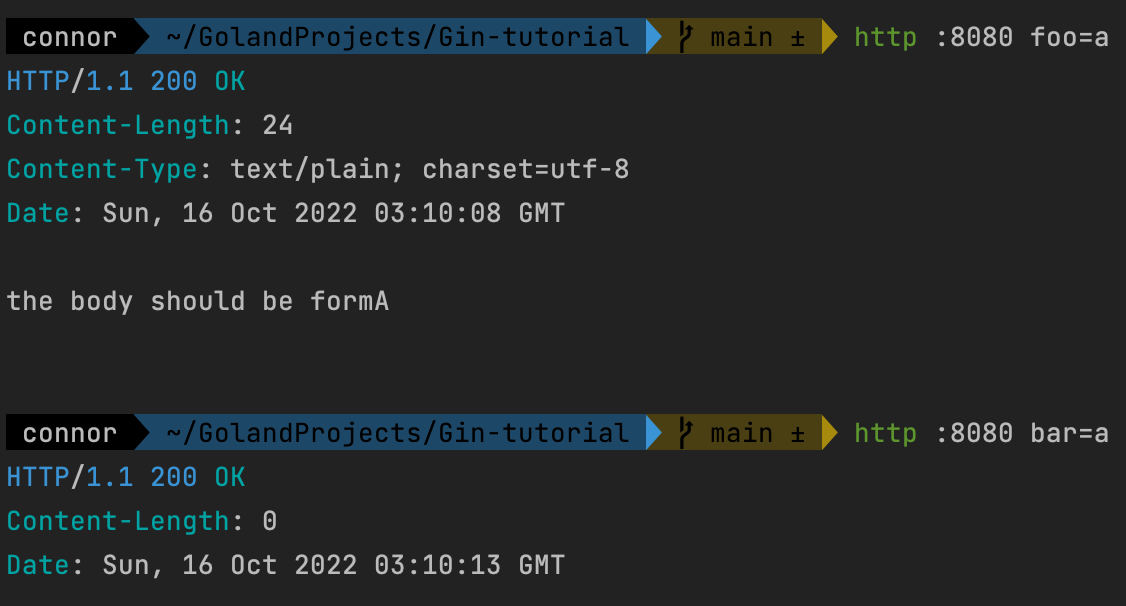
type formA struct {
	Foo string `json:"foo" xml:"foo" binding:"required"`
}

type formB struct {
	Bar string `json:"bar" xml:"bar" binding:"required"`
}

func SomeHandler(c *gin.Context) {
	objA := formA{}
	objB := formB{}
	// This reads c.Request.Body and stores the result into the context.
	if errA := c.ShouldBindBodyWith(&objA, binding.JSON); errA == nil {
		c.String(http.StatusOK, `the body should be formA`)
		// At this time, it reuses body stored in the context.
	} else if errB := c.ShouldBindBodyWith(&objB, binding.JSON); errB == nil {
		c.String(http.StatusOK, `the body should be formB JSON`)
		// And it can accepts other formats
	} else if errB2 := c.ShouldBindBodyWith(&objB, binding.XML); errB2 == nil {
		c.String(http.StatusOK, `the body should be formB XML`)
	} else {
		//...
	}
}

func main() {
	r := gin.Default()
	r.POST("/", SomeHandler)

	r.Run()
}
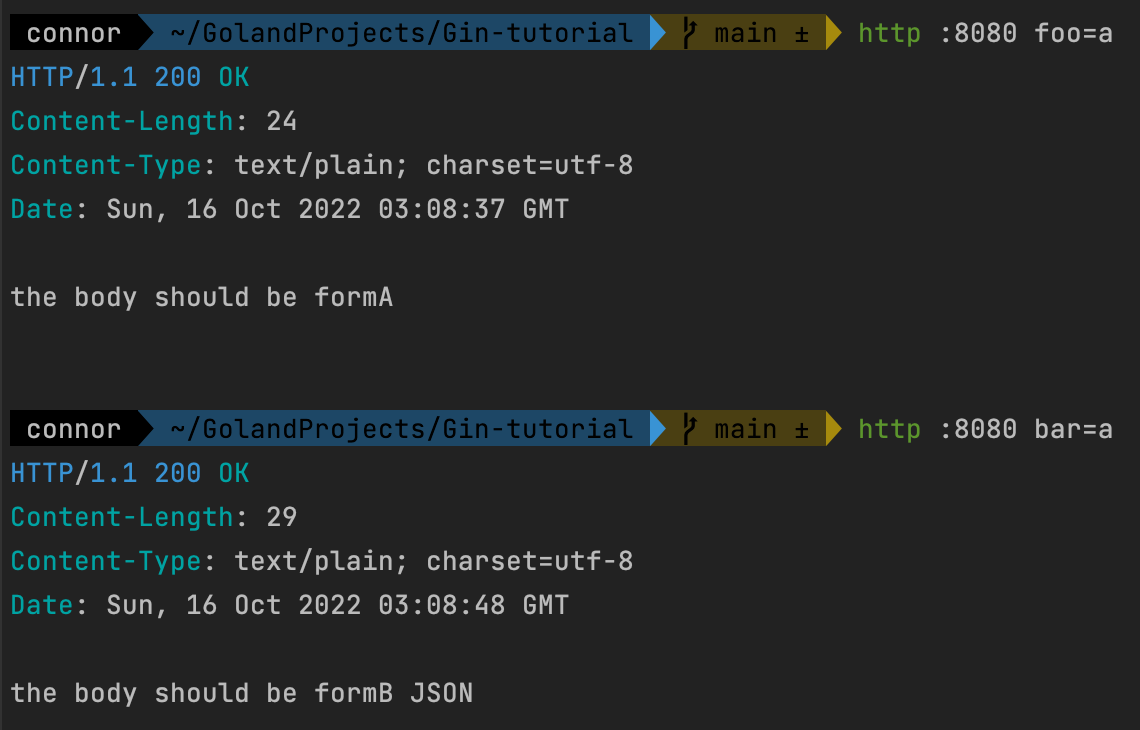
대신에 ShouldBindBodyWith 을 사용해야 한다.
- Bind form-data request with custom struct and custom tag
const (
  customerTag = "url"
  defaultMemory = 32 << 20
)

type customerBinding struct {}

func (customerBinding) Name() string {
  return "form"
}

func (customerBinding) Bind(req *http.Request, obj interface{}) error {
  if err := req.ParseForm(); err != nil {
    return err
  }
  if err := req.ParseMultipartForm(defaultMemory); err != nil {
    if err != http.ErrNotMultipart {
      return err
    }
  }
  if err := binding.MapFormWithTag(obj, req.Form, customerTag); err != nil {
    return err
  }
  return validate(obj)
}

func validate(obj interface{}) error {
  if binding.Validator == nil {
    return nil
  }
  return binding.Validator.ValidateStruct(obj)
}

// Now we can do this!!!
// FormA is a external type that we can't modify it's tag
type FormA struct {
  FieldA string `url:"field_a"`
}

func ListHandler(s *Service) func(ctx *gin.Context) {
  return func(ctx *gin.Context) {
    var urlBinding = customerBinding{}
    var opt FormA
    err := ctx.MustBindWith(&opt, urlBinding)
    if err != nil {
      ...
    }
    ...
  }
}- http2 server push
package main

import (
  "html/template"
  "log"
  "net/http"

  "github.com/gin-gonic/gin"
)

var html = template.Must(template.New("https").Parse(`
<html>
<head>
  <title>Https Test</title>
  <script src="/assets/app.js"></script>
</head>
<body>
  <h1 style="color:red;">Welcome, Ginner!</h1>
</body>
</html>
`))

func main() {
  r := gin.Default()
  r.Static("/assets", "./assets")
  r.SetHTMLTemplate(html)

  r.GET("/", func(c *gin.Context) {
    if pusher := c.Writer.Pusher(); pusher != nil {
      // use pusher.Push() to do server push
      if err := pusher.Push("/assets/app.js", nil); err != nil {
        log.Printf("Failed to push: %v", err)
      }
    }
    c.HTML(http.StatusOK, "https", gin.H{
      "status": "success",
    })
  })

  // Listen and Server in https://127.0.0.1:8080
  r.RunTLS(":8080", "./testdata/server.pem", "./testdata/server.key")
}
http.Pusher 는 go.18 이후 버전부터 지원된다.
html 템블릿과 함께 보내주는 것 같다.
- Define format for the log of routes
import (
  "log"
  "net/http"

  "github.com/gin-gonic/gin"
)

func main() {
  r := gin.Default()
  gin.DebugPrintRouteFunc = func(httpMethod, absolutePath, handlerName string, nuHandlers int) {
    log.Printf("endpoint %v %v %v %v\n", httpMethod, absolutePath, handlerName, nuHandlers)
  }

  r.POST("/foo", func(c *gin.Context) {
    c.JSON(http.StatusOK, "foo")
  })

  r.GET("/bar", func(c *gin.Context) {
    c.JSON(http.StatusOK, "bar")
  })

  r.GET("/status", func(c *gin.Context) {
    c.JSON(http.StatusOK, "ok")
  })

  // Listen and Server in http://0.0.0.0:8080
  r.Run()
}- Set and get a cookie
import (
    "fmt"

    "github.com/gin-gonic/gin"
)

func main() {

    router := gin.Default()

    router.GET("/cookie", func(c *gin.Context) {

        cookie, err := c.Cookie("gin_cookie")

        if err != nil {
            cookie = "NotSet"
            c.SetCookie("gin_cookie", "test", 3600, "/", "localhost", false, true)
        }

        fmt.Printf("Cookie value: %s \n", cookie)
    })

    router.Run()
}- 모든 프록시를 허용하지 마라.
너의 gin.Engine 에 SetTrustedProxies() 함수를 사용해 네트워크 주소를 특정하거나 네트워크 CIDRs 를 특정해라.
그들은 IPv4 주소가 될수도 있고, IPv4 CIDRs 가 될수도, IPv6 나 IPv6 CIDRs 가 될 수 있다.
만약 어떠한 프록시도 사용하지 않는다면 Engine.SetTrustedProxies(nil) 후에 Context.ClientIP() 를 사용해 이 기능을 disable 시킬 수 있다.
이것은 불필요한 혼란을 줄이기 위해 리모트 주소를 리턴할 것이다.
import (
  "fmt"

  "github.com/gin-gonic/gin"
)

func main() {

  router := gin.Default()
  router.SetTrustedProxies([]string{"192.168.1.2"})

  router.GET("/", func(c *gin.Context) {
    // If the client is 192.168.1.2, use the X-Forwarded-For
    // header to deduce the original client IP from the trust-
    // worthy parts of that header.
    // Otherwise, simply return the direct client IP
    fmt.Printf("ClientIP: %s\n", c.ClientIP())
  })
  router.Run()
}
만약 클라이언트 아이피가 192.168.1.2 라면 X-Forwarded-For 헤더를 사용해라.
그 헤더의 믿을만한 부분으로부터 기존의 클라이언트 IP 를 추론하기 위해.
만약 당신이 CDN 서비스를 사용하고 있다면 TrustedProxies 를 스킵하기 위해 Engine.TrustedPlatform 을 사용할 수 있다.
이것은 TrustedProxies 보다 우선권을 갖는다.
import (
  "fmt"

  "github.com/gin-gonic/gin"
)

func main() {

  router := gin.Default()
  // Use predefined header gin.PlatformXXX
  router.TrustedPlatform = gin.PlatformGoogleAppEngine
  // Or set your own trusted request header for another trusted proxy service
  // Don't set it to any suspect request header, it's unsafe
  router.TrustedPlatform = "X-CDN-IP"

  router.GET("/", func(c *gin.Context) {
    // If you set TrustedPlatform, ClientIP() will resolve the
    // corresponding header and return IP directly
    fmt.Printf("ClientIP: %s\n", c.ClientIP())
  })
  router.Run()
}- Testing
package main

import (
  "net/http"

  "github.com/gin-gonic/gin"
)

func setupRouter() *gin.Engine {
  r := gin.Default()
  r.GET("/ping", func(c *gin.Context) {
    c.String(http.StatusOK, "pong")
  })
  return r
}

func main() {
  r := setupRouter()
  r.Run(":8080")
}
위와 같은 코드가 있으면 이 코드를 테스트 해보자.
package main

import (
  "net/http"
  "net/http/httptest"
  "testing"

  "github.com/stretchr/testify/assert"
)

func TestPingRoute(t *testing.T) {
  router := setupRouter()

  w := httptest.NewRecorder()
  req, _ := http.NewRequest(http.MethodGet, "/ping", nil)
  router.ServeHTTP(w, req)

  assert.Equal(t, http.StatusOK, w.Code)
  assert.Equal(t, "pong", w.Body.String())
}
NewRecoder() 로 response 를 담는다.
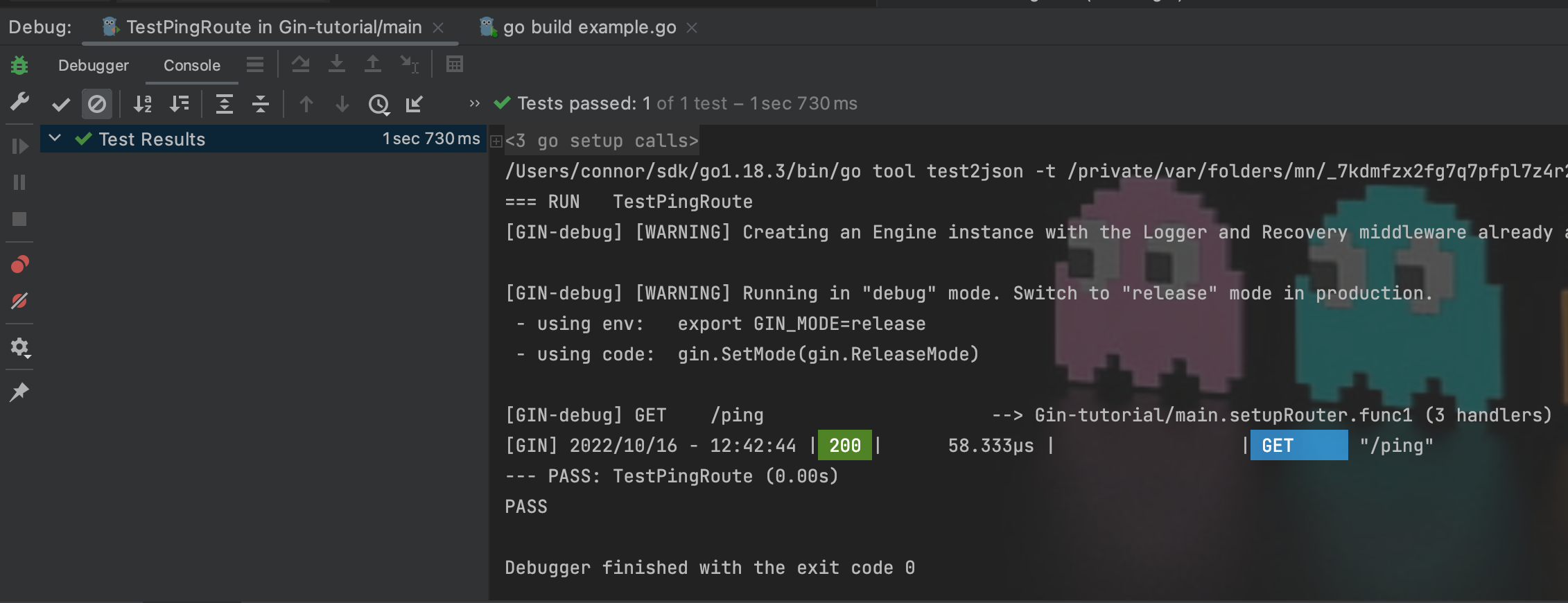
테스트에 성공했다.
-
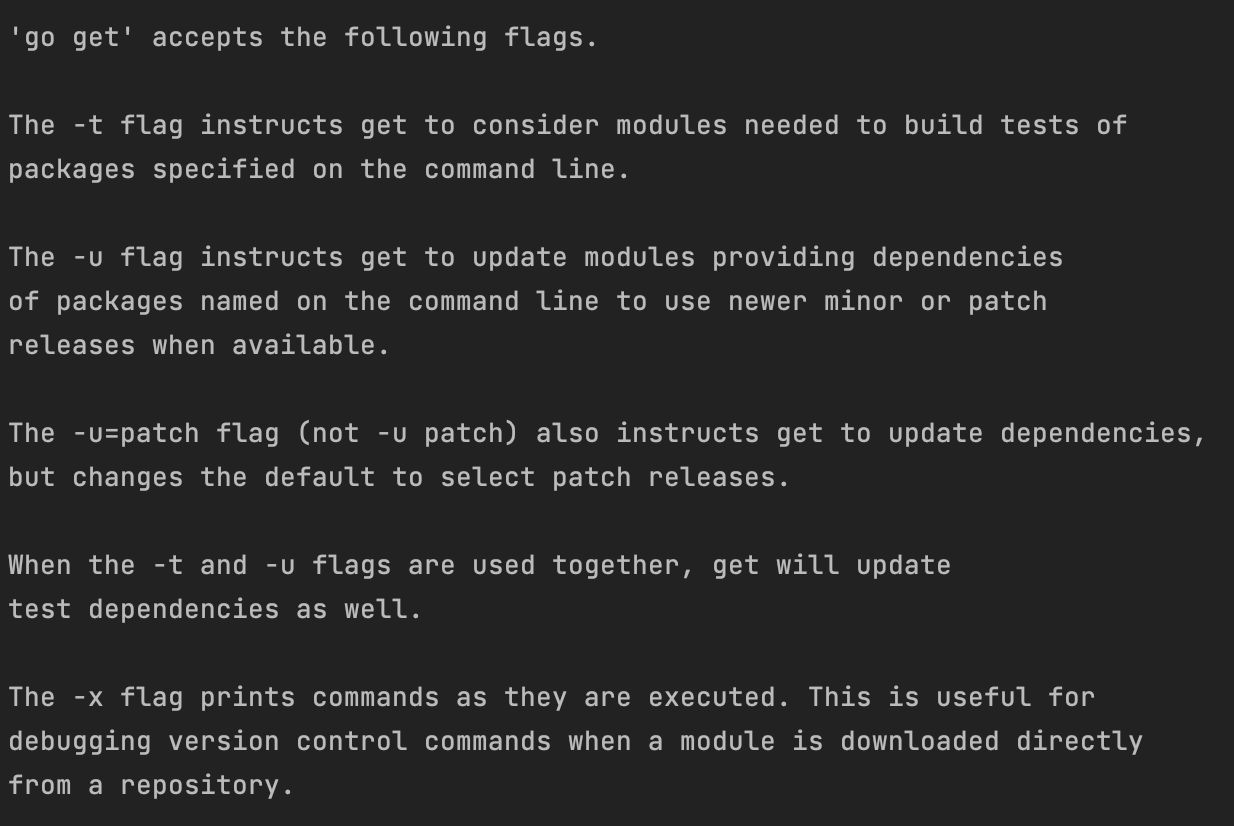
go get 플래그에 대해서
-
-t테스트들을 빌드하기 위해 필요하다. -
-uupgrade -
-x커맨드를 출력한다. -
Users
Gin 웹 프레임워크를 사용하는 멋진 프로젝트의 리스트이다.
- gorush: 푸시알림 서버
- fnproject: 컨테이너
- photoprism: 개인 사진관리
- krakend: API 게이트웨이 미들웨어
- picfit: 이미지 리사이징 서버
- brigade: 쿠버네티스를 위한 이벤트 베이스 스크립팅
- dkron: 잡 스케줄링 시스템