
문제 링크
문제 설명
가장 기본적인 BFS DFS 문제 중 하나이다.
간략하게 문제를 설명하자면
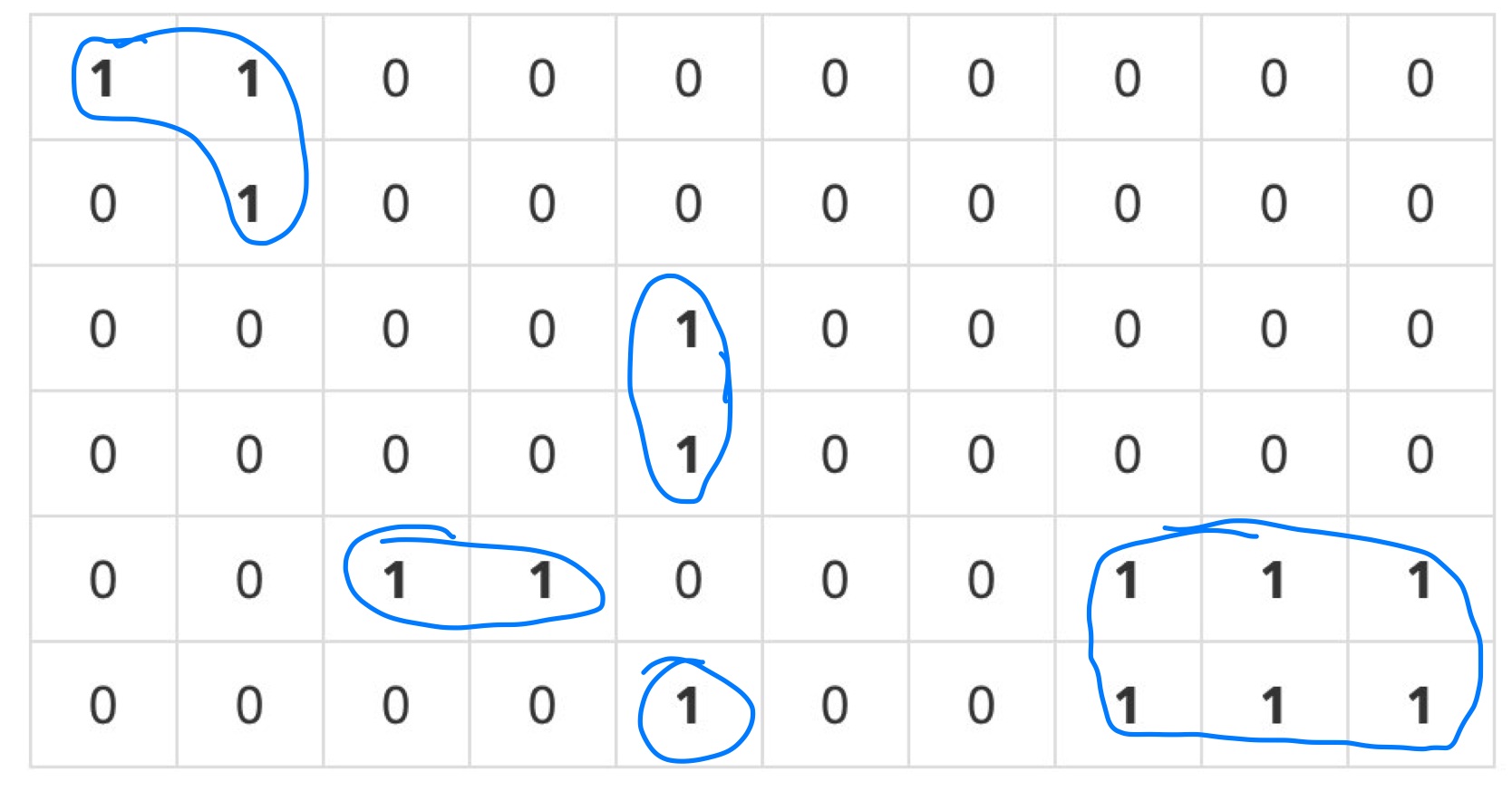
위와 같은 Map이 있을 때 서로 인접한(상하좌우) 1들을 하나의 그룹으로 볼 때, 총 몇개의 그룹이 나오는지 보는 문제이다.
그렇다면 위의 표를 기준으로 봤을 때 정답은 5가 되는 것이다.
풀이 과정
- 0과 1로 이루어진 map을 만든다.
- map의 X와 Y를 돌며 1인 경우를 찾는다.
- BFS 혹은 DFS를 사용하여 인접한 1까지 한번에 체크한다.
- 위의 과정을 테스트 횟수만큼 반복
풀이는 위와 같은 순서로 진행
map 생성 코드
    let fs = require("fs");
    let input = fs.readFileSync("./input.text").toString().trim().split("\n");
    let N = parseInt(input.shift());
	let Answer = 0;
    var SIZE = input.shift().split(' ').map(Number);

    var map = new Array(SIZE[0]);
    for (let i = 0; i < map.length; i++) {
        map[i] = new Array(SIZE[1]).fill(0);

    }
    for (let i = 0; i < SIZE[2]; i++) {
        const [LocX, LocY] = input.shift().split(" ").map(Number);
        map[LocX][LocY] = 1;
    }
BFS(너비 우선 탐색) 함수 코드
    const BFS = (nowX, nowY) => {
        let LocQueue = [];
        let dx = [1, -1, 0, 0];
        let dy = [0, 0, 1, -1];
        LocQueue.push([nowX, nowY]);
        while (LocQueue.length) {
            const [X, Y] = LocQueue.shift();
            map[X][Y] = 0;
            for (let i = 0; i < dx.length; i++) {
                const nextX = X + dx[i];
                const nextY = Y + dy[i];
                if (nextY >= SIZE[1] || nextX >= SIZE[0] || nextX <0 || nextY < 0) continue;
                if (map[nextX][nextY] === 1) {
                    LocQueue.push([nextX, nextY]);
                }
            }
        }
    };
전체 코드
    const BFS = (nowX, nowY) => {
            let LocQueue = [];
            let dx = [1, -1, 0, 0];
            let dy = [0, 0, 1, -1];
            LocQueue.push([nowX, nowY]);
            while (LocQueue.length) {
                const [X, Y] = LocQueue.shift();
                map[X][Y] = 0;
                for (let i = 0; i < dx.length; i++) {
                    const nextX = X + dx[i];
                    const nextY = Y + dy[i];
                    if (nextY >= SIZE[1] || nextX >= SIZE[0] || nextX <0 || nextY < 0) continue;
                    if (map[nextX][nextY] === 1) {
                        LocQueue.push([nextX, nextY]);
                    }
                }
            }
        };

    for (let i = 0; i < N; i++) {
        let Answer = 0;
        var SIZE = input.shift().split(' ').map(Number);
        var map = new Array(SIZE[0]);

        for (let i = 0; i < map.length; i++) {
            map[i] = new Array(SIZE[1]).fill(0);
        }

        for (let i = 0; i < SIZE[2]; i++) {
            const [LocX, LocY] = input.shift().split(" ").map(Number);
            map[LocX][LocY] = 1;
        }

        for (let i = 0; i < SIZE[0]; i++) {
            for (let j = 0; j < SIZE[1]; j++) {
                if (map[i][j] === 1) {
                    BFS(i, j);
                    Answer++;
                }
            }
        }
        console.log(Answer);
}
그런데 위와 같이 했을 때 시간초과가 나게 된다.
그래서 BFS가 아니라 DFS를 사용하여 다시 풀어보게 되었다.
DFS(깊이 우선 탐색) 함수 코드
    function DFS(X, Y) {
        let dx = [1, -1, 0, 0];
        let dy = [0, 0, 1, -1];
        map[X][Y] = 0;
        for (let i = 0; i < dx.length; i++) {
            const nextX = X + dx[i];
            const nextY = Y + dy[i];
            if (nextY < SIZE[1] && nextX < SIZE[0] && nextX >= 0 && nextY >= 0){
                if (map[nextX][nextY] === 1) {
                    DFS(nextX, nextY);
                }
            }
        }
    }
전체 코드
    let input = require("fs").readFileSync("/dev/stdin").toString().trim().split("\n");
    let N = input.shift();


    function DFS(X, Y) {
        let dx = [1, -1, 0, 0];
        let dy = [0, 0, 1, -1];
        map[X][Y] = 0;
        for (let i = 0; i < dx.length; i++) {
            const nextX = X + dx[i];
            const nextY = Y + dy[i];
            if (nextY < SIZE[1] && nextX < SIZE[0] && nextX >= 0 && nextY >= 0){
                if (map[nextX][nextY] === 1) {
                    DFS(nextX, nextY);
                }
            }
        }
    }

    for (let i = 0; i < N; i++) {
        let Answer = 0;
        var SIZE = input.shift().split(' ').map(Number);

        var map = new Array(SIZE[0]);
        for (let i = 0; i < map.length; i++) {
            map[i] = new Array(SIZE[1]).fill(0);

        }
        for (let i = 0; i < SIZE[2]; i++) {
            const [LocX, LocY] = input.shift().split(" ").map(Number);
            map[LocX][LocY] = 1;
        }
        for (let i = 0; i < SIZE[0]; i++) {
            for (let j = 0; j < SIZE[1]; j++) {
                if (map[i][j] === 1) {
                    DFS(i, j);
                    Answer++;
                }
            }
        }
        console.log(Answer);
    }
이렇게 탐색하는 부분만 DFS로 바꿔주니 시간초과 문제가 해결되고 통과할 수 있었다.
후기
솔직히 말하면 아직까지도 왜 두 코드에서 시간 차이가 나는지 정확하게는 모르겠다.
DFS의 풀이가 인접 행렬이 아닌 인접 리스트 방식으로 할 경우 DFS는 O(n + e)이고 BFS는 O(n^2) 라고 하지만
위의 풀이의 경우 인접 행렬을 사용했고 두 풀이 모두 시간 복잡도는 O(행의 수 * 열의 수)가 나오는데 왜 차이가 있는지 모르겠다.

JavaScript를 사용하는 모두를 위해