기본 배열 생성
test_array = np.array([1,4,5,8], float)
#또는
list1 = [[1,4,5,8], [2,3,6,7]]
array1 = np.array(list1, int)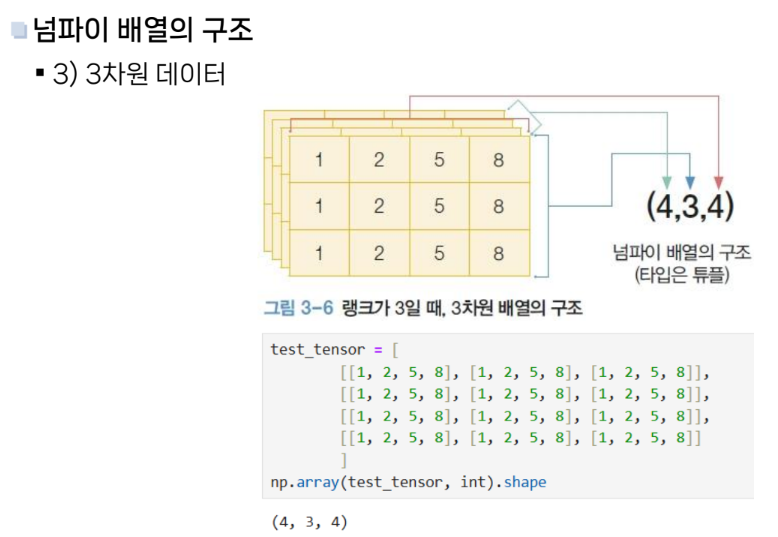
Rank(차원)은 3개. != Dimensionality
(열, 행, 채널) 순으로 표시합니다
배열 변환
x = np.array([[1, 2, 5, 8], [1, 2, 5, 8]])[[1 2 5 8][1 2 5 8]]
Reshape()
x = x.reshape(-1,)
x
x = x.reshape(4,2)
x
[1 2 5 8 1 2 5 8 ]
[[1 2 ][ 5 8 ]
[ 1 2 ][ 5 8 ]]
- 데이터의 총 갯수가 일정하다는 가정하에 변환 가능
x = x.reshape(2, -1)
x
[[1 2 5 8
1 2 5 8]]
-1로 입력하면 알아서 사이즈를 찾아간다
Flatten()
x = x.flatten()
x
[1 2 5 8 1 2 5 8]
Indexing, Slicing, Range
#arange(start,stop,step)
np.arange(5,0,-1)

np.ones(shape=5,2), dtype=np.int8)
np.zeros(shape=2,2), dtype=np.float32)
np.empty(shape=2,4), dtype=np.float32) # 초기화되지 않은 무작위 배열 생성

x = np.arange(12).reshape(3,4)

#x와 같은 배열의 1 또는 0 생성
np.ones_like(x)
np.zeros_like(x)
np.identity(n=4, dtype=int) # I 생성
eye, diag
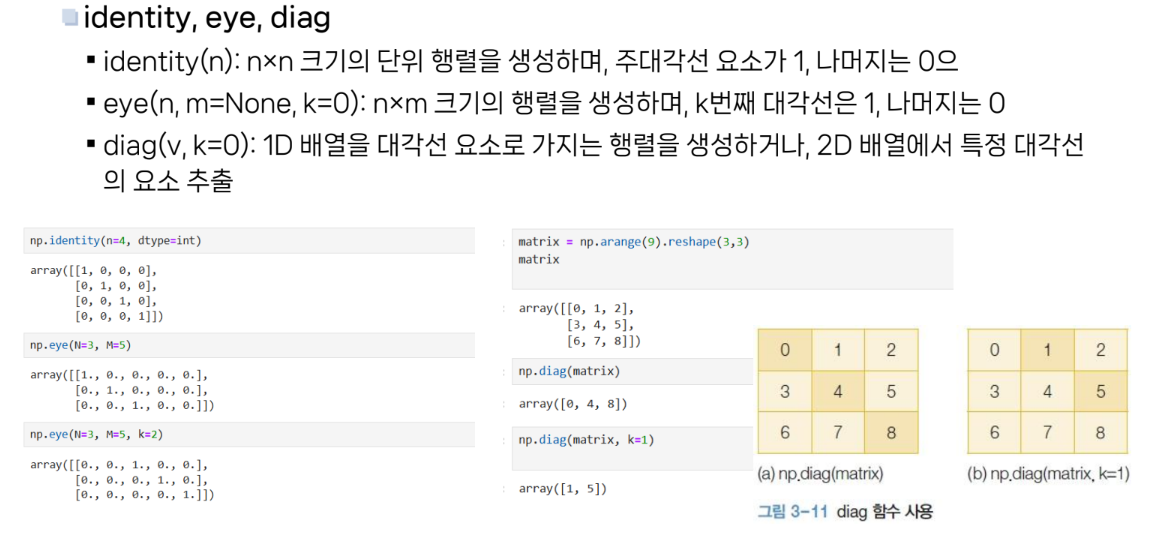
#Identity Matrix지만 정사각형이 아닌 행렬 생성
np.eye(N,M)

#k는 기본값이 0이고 n번째부터 diagonal의 대각선 요소 추출
np.diag(matrix, k=1)- 균등분포와 정규함수
np.random.uniform(low, high, size)
np.random.normal(mean, std, size) Size는 숫자 갯수

안녕하세요! 강민수입니다.