전체적인 다이어그램
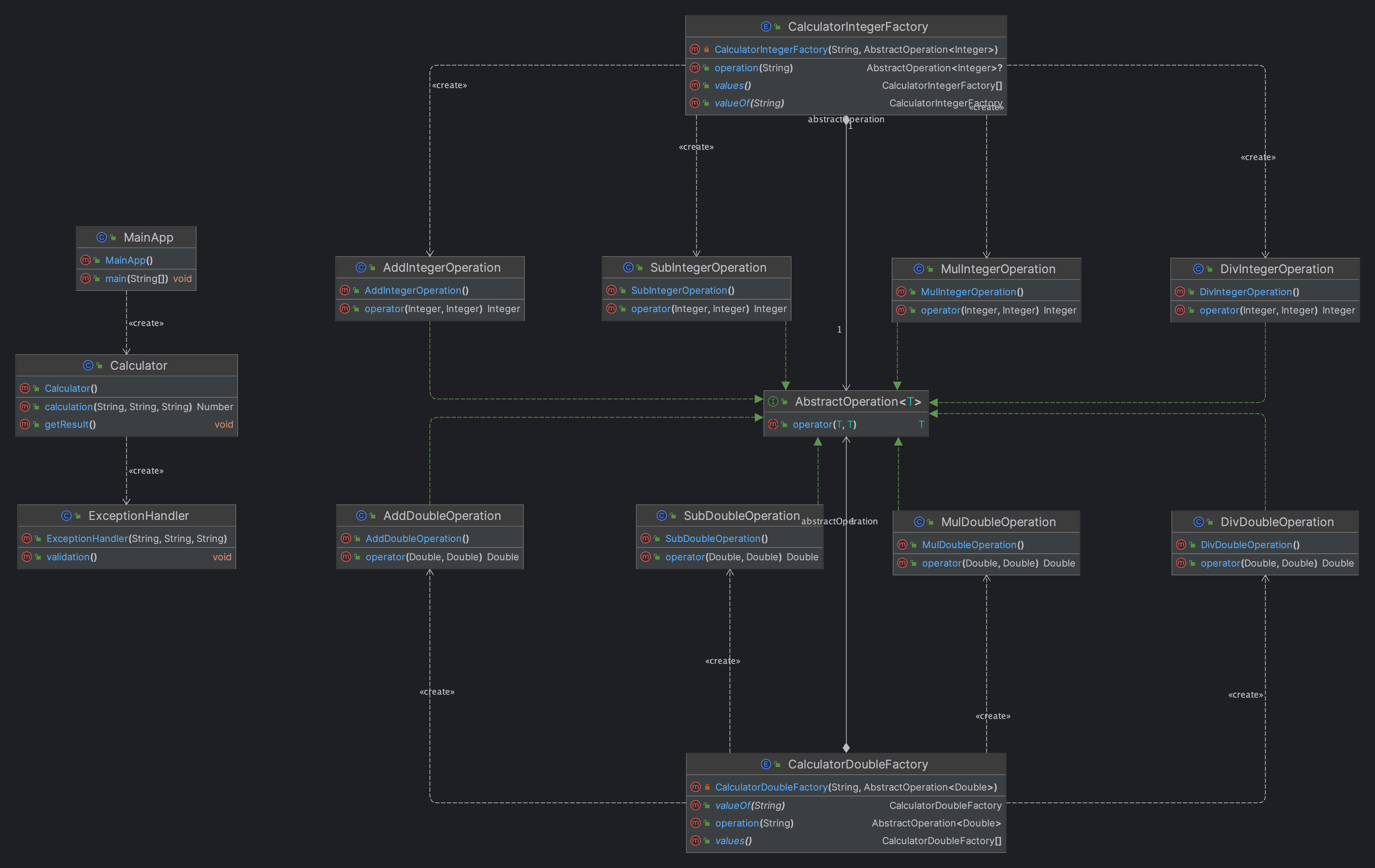
적용된 아키텍쳐 패턴 - 팩토리 메서드 패턴
팩토리 메서드 패턴에 대해
펙토리 메서드 패턴은 객체 생성의책임을 서브클래스에게위임하여 객체의 생성 방식을변경할 수 있는디자인 패턴입니다.- 객체 생성의 구체적인 클래스를 정의하지 않고
인터페이스나추상 클래스를 통해 객체를 생성하는 방법을 정의합니다.
주요 개념
- Product
팩토리 메서드 패턴에서 생성되는 객체의공통 인터페이스를 정의합니다.- 프로젝트에서는
AbstractOperation이 해당됩니다.
- Concrete Product
- 제품 인터페이스를 구현한
구체적인 클래스들입니다. - 프로젝트에서는
AddIntegerOperation,AddDoubleOperation등이 해당됩니다.
- 제품 인터페이스를 구현한
- Factory
- 객체 생성을 위한 메서드를 정의하는
인터페이스또는추상클래스입니다.
- 객체 생성을 위한 메서드를 정의하는
- Concreate Factory
팩토리 인터페이스를 구현하여 구체적인제품을 생성하는클래스입니다.- 이 클래스는 특정 제품 객체를 생성하는 방법을 제공합니다.
- 프로젝트에서는
CalculatorIntegerFactory,CalculatorDoubleFactory해당됩니다.
구조
+---------------------+
|   Product           |
+---------------------+
| +operation()        |
+---------------------+
           ^
           |
+---------------------+
|   ConcreteProductA  |
+---------------------+
| +operation()        |
+---------------------+
           ^
           |
+---------------------+
|   ConcreteProductB  |
+---------------------+
| +operation()        |
+---------------------+

+---------------------+
|   Creator           |
+---------------------+
| +factoryMethod()   |
+---------------------+
           ^
           |
+---------------------+
|   ConcreteCreatorA  |
+---------------------+
| +factoryMethod()   |
+---------------------+
           ^
           |
+---------------------+
|   ConcreteCreatorB  |
+---------------------+
| +factoryMethod()   |
+---------------------+
장점
- 객체 생성로직을
팩토리 메서드에서캡슐화하여, 클라이언트 코드가객체 생성 방식에 신경 쓸 필요가 없습니다. - 새로운 제품이 추가되더라도
클라이언트 코드의변경 없이팩토리 메서드만수정하면 됩니다. - 클라이언트 코드가
구체적인 클래스에의존하지 않고,인터페이스나추상 클래스에 의존하기 때문에 클래스간의결합도가 낮아집니다.
구현 코드
AbstractOperation - interface
public interface AbstractOperation<T extends Number> {

    T operator(T firstNumber, T secondNumber);
}double,int어떤 타입이 들어올지 모르기때문에제네릭 타입으로메소드를 정의해줍니다.
AddIntegerOperation - class
public class AddIntegerOperation implements AbstractOperation<Integer> {
    @Override
    public Integer operator(Integer firstNumber, Integer secondNumber) {
        return firstNumber + secondNumber;
    }
}AbstactOperation<Integer>인터페이스를 상속받아 구현한구현체입니다.Interger타입으로 메소드를 수행하기 때문에제네릭 타입을명시해줍니다.
AddDoubleOperation - class
public class AddDoubleOperation implements AbstractOperation<Double> {

    @Override
    public Double operator(Double firstNumber, Double secondNumber) {
        return firstNumber + secondNumber;
    }
}-
AbstactOperation<Double>인터페이스를 상속받아 구현한구현체입니다. -
Double타입으로 메소드를 수행하기 때문에제네릭 타입을명시해줍니다. -
각 연산자에 맞춰
나머지 연산자에 대한구현도 해줍니다.
CalculatorIntegerFactory - enum
public enum CalculatorIntegerFactory {

    ADDINTEGER("+", new AddIntegerOperation()),
    SUBINTEGER("-", new SubIntegerOperation()),
    MULINTEGER("*", new MulIntegerOperation()),
    DIVINTEGER("/", new DivIntegerOperation());

    private final String operator;
    private final AbstractOperation<Integer> abstractOperation;

    CalculatorIntegerFactory(String operator, AbstractOperation<Integer> abstractOperation) {
        this.operator = operator;
        this.abstractOperation = abstractOperation;
    }

    public static AbstractOperation<Integer> operation(String operator) throws Exception {
        for (CalculatorIntegerFactory value : values()) {
            if(value.operator.equals(operator)) return value.abstractOperation;
        }
        return null;
    }
}Factory는enum클래스로 구현합니다.- 생성자통해
연산자,AbstactOperation을 주입받습니다. operation메서드를 통해 연산자와 일치하는enum상수를 찾습니다.- 일치하는
enum상수가 있으면 그에 해당하는AbstractOperation<Integer>객체를 반환합니다. Double타입도 동일하게enum클래스로 구현합니다.
ExceptionHandler - class
public class ExceptionHandler {

    private final String firstNum;
    private final String secondNum;
    private final String operator;
    private static final String OPERATION_REG = "[+\\-*/]";

    public ExceptionHandler(String firstNum, String secondNum, String operator) {
        this.firstNum = firstNum;
        this.secondNum = secondNum;
        this.operator = operator;
    }

    public void validation() throws Exception {
        boolean firstType = new TypeValidation().type(firstNum);
        boolean secondType = new TypeValidation().type(secondNum);

        if (!Pattern.matches(OPERATION_REG, this.operator)) throw new Exception("연산자 타입이 맞지 않습니다.");
        if ((firstType && !secondType) || (!firstType && secondType)) throw new Exception("숫자 타입이 서로 맞지 않습니다.");
        if (this.operator.equals("/") && secondType && Double.parseDouble(secondNum) == 0.0)
            throw new Exception("0으로 나눌 수 없습니다.");
        if (this.operator.equals("/") && !secondType && Integer.parseInt(secondNum) == 0)
            throw new Exception("0으로 나눌 수 없습니다.");
    }

}- 각 상황에 맞는 에러 처리하기 위한 클래스입니다.
if (!Pattern.matches(OPERATION_REG, this.operator))- 연산자 타입이 맞이 않으면 에러를 발생시킵니다.
if ((firstType && !secondType) || (!firstType && secondType))- 첫번째 수와 두번째 수가 서로 타입이 안맞을 경우 예외를 발생시킵니다.
if (this.operator.equals("/") && secondType && Double.parseDouble(secondNum) == 0.0)- 나눗셈 연산을 수행할 때 두번째 수가
0.0일경우 예외를 발생시킵니다.
- 나눗셈 연산을 수행할 때 두번째 수가
if (this.operator.equals("/") && !secondType && Integer.parseInt(secondNum) == 0)- 나눗셈 연산을 수행할 때 두번째 수가
0일 경우 얘외를 발생시킵니다.
- 나눗셈 연산을 수행할 때 두번째 수가
ArithmeticCalculator - class
public class ArithmeticCalculator {

    private final List<Number> result = new ArrayList<>();

    public Number calculation(String firstNumber, String secondNumber, String operator) throws Exception {

        new ExceptionHandler(firstNumber, secondNumber, operator).validation();
        boolean isDoubleType = new TypeValidation().type(firstNumber);

        if (isDoubleType) {
            AbstractOperation<Double> doubleAbstractOperation = CalculatorDoubleFactory.operation(operator);
            Double answer = doubleAbstractOperation.operator(Double.parseDouble(firstNumber), Double.parseDouble(secondNumber));
            result.add(answer);
            return answer;
        }

        AbstractOperation<Integer> integerOperation = CalculatorIntegerFactory.operation(operator);
        Integer answer = integerOperation.operator(Integer.parseInt(firstNumber), Integer.parseInt(secondNumber));
        result.add(answer);
        return answer;
    }

    public void getResult() {
        AtomicInteger idx = new AtomicInteger(0);
        result.forEach(number -> {
            int cnt = idx.incrementAndGet();
            System.out.println(cnt + "번째 연산결과 :" + number);
        });
    }
펙토리 메서드를 통해 객체를 생성하고List에 결과를 저장하는 로직이 담겨있는 클래스입니다.new ExceptionHandler()를 통해타입 검증을 수행합니다.- 이후 각 타입에 맞춰
AbstractOperation<T>타입을 생성해줍니다. - 연산을 수행한 결과값은
List에 저장해줍니다. getResult()메소드는lamda를 통해 저장한 연산결과를 출력해주는 메서드입니다.
📖 톺아보기
팩토리 메서드 패턴을 통해객체 생성 방식을 선택할 수 있었습니다.- 팩토리 메서드 패턴을 통해 객체 생성의 책임을 팩토리 메서드에 위임함으로써 객체 생성 로직과 비즈니스 로직을 분리할 수 있었습니다. 이는 클래스가 단일 책임을 가지게 하고, 객체 생성과 관련된 코드가 변경되더라도 비즈니스 로직에는 영향을 미치지 않도록 합니다. -
단일 책임 원칙 (SRP) - 새로운 Product를 추가할 때 기존의 코드나 클래스는 수정하지 않고 새로운 팩토리 메서드를 추가하거나 기존의 팩토리 클래스를 확장함으로써 새 객체를 생성할 수 있었습니다. -
개방/페쇄 원칙 (OCP) - 팩토리 메서드 패턴은 구체적인 클래스를 직접 생성하지 않고, 추상화된 팩토리 메서드를 통해 객체를 생성하기 때문에 고수준 모듈이 저수준 모듈에 의존하지 않도록 코딩할 수 있었습니다. -
의존 역전 원칙(DIP) 객체 지향 프로그래밍에 대해 조금 더 다가가는 계기가 되었습니다.

✅ 적당한 추상화를 찾아가는 개발자입니다.