문제설명
Given two 0-indexed integer arrays nums1 and nums2, return a list answer of size 2 where:
answer[0]is a list of all distinct integers innums1which are not present innums2.answer[1]is a list of all distinct integers innums2which are not present innums1.
Note that the integers in the lists may be returned in any order.
제한사항
1 <= nums1.length, nums2.length <= 10001000 <= nums1[i], nums2[i] <= 1000
입출력 예
Example 1:
Input: nums1 = [1,2,3], nums2 = [2,4,6]
Output: [[1,3],[4,6]]
Explanation:
For nums1, nums1[1] = 2 is present at index 0 of nums2, whereas nums1[0] = 1 and nums1[2] = 3 are not present in nums2. Therefore, answer[0] = [1,3].
For nums2, nums2[0] = 2 is present at index 1 of nums1, whereas nums2[1] = 4 and nums2[2] = 6 are not present in nums2. Therefore, answer[1] = [4,6].
Example 2:
Input: nums1 = [1,2,3,3], nums2 = [1,1,2,2]
Output: [[3],[]]
Explanation:
For nums1, nums1[2] and nums1[3] are not present in nums2. Since nums1[2] == nums1[3], their value is only included once and answer[0] = [3].
Every integer in nums2 is present in nums1. Therefore, answer[1] = [].
답
내가 쓴 답
/**
 * @param {number[]} nums1
 * @param {number[]} nums2
 * @return {number[][]}
 */
var findDifference = function(nums1, nums2) {
    let result = []
    let set1 = new Set(nums1);
    let set2 = new Set(nums2);

    arr1 = [...set1].filter(element => !set2.has(element))
    arr2 = [...set2].filter(element => !set1.has(element))
  result = [[...arr1], [...arr2]];
  return result
};
다른풀이
/**
 * @param {number[]} nums1
 * @param {number[]} nums2
 * @return {number[][]}
 */
var findDifference = function(nums1, nums2) {
    let nums1Set = new Set(nums1)
    let nums2Set = new Set(nums2)

    let result = [[], []]
    for (num of nums1Set) {
        if (!nums2Set.has(num)) result[0].push(num)
    }

    for (num of nums2Set) {
        if (!nums1Set.has(num)) result[1].push(num)
    }

    return result
};
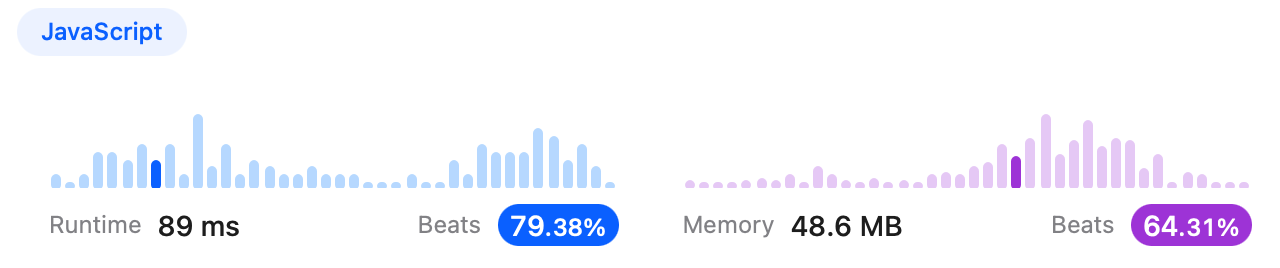
속도 백분위
피드백
- 풀이 아이디어 : filter함수로 공통요소를 찾아내는 동시에 공통요소가 아닌 요소들로 이루어진 배열부터 찾아야겠다고 생각이 들었다.
처음에는 Set함수를 쓰지 않았는데, ChatGPT에게 물어봤을때 중복을 제외시키는게 시간복잡도 측면에서 좋다고해서 Set함수까지 포함시켰다.
이 문제를 통해 두 배열을 합칠때 concat함수를 이용하는 것과 스프레드 연산자를 이용하는 방법을 익힐 수 있었다.
복습
Filter()함수
function findCommonElements(arr1, arr2) {
    return arr1.filter(element => arr2.includes(element));
}
논리 부정연산자(!)
function findUniqueElements(arr1, arr2) {
    return arr1.filter(element => !arr2.includes(element));
}
배열 합칠때
(1) concat()
let result = []
let set1 = new Set(nums1);
let set2 = new Set(nums2);

let arr1 = [...set1].filter(element => !set2.has(element))
let arr2 = [...set2].filter(element => !set1.has(element))

result = result.concat(arr1, arr2);
(2) 스프레드 연산자
let result = []
let set1 = new Set(nums1);
let set2 = new Set(nums2);

let arr1 = [...set1].filter(element => !set2.has(element))
let arr2 = [...set2].filter(element => !set1.has(element))

result = [...result, ...arr1, ...arr2];
주의사항 : 최대한 정확하게 작성하려고 하지만, 틀릴내용이 있을 수도 있으니 유의!