Sorting
lists a set of data in ascending or descending order
Sorting is essential whe searching data
Ex) What if words in the English dictionary are not sorted alphabetically?
Target of Sorting
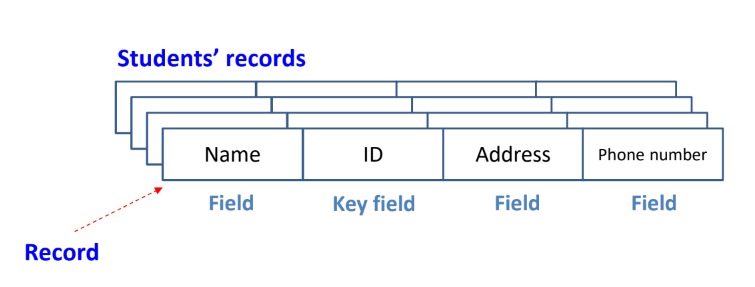
Record
- Data to be sorted
- Consists of multiple fields
- Key field is used to identify records
Sorting Algorithm
No golden solution that workds for all cases perfectly
Sorting algorithm must be chosen by considering the following cases
- the number of records(data)
- record size
- key characteristics(letter, integer, floating number)
- internal / external memory sorting
trade off : memory↑, speed↓ / memory↓, speed↑
Evaluation criteria of sorting algorithm
- the number of comparisons
- the number of moves of data
Summary of Sorting Algorithms
| Best | Average | Worst | Stability | |
|---|---|---|---|---|
| Insert sort | O(n) | O(n²) | O(n²) | Yes |
| Selection sort | O(n²) | O(n²) | O(n²) | No |
| Bubble sort | O(n²) | O(n²) | O(n²) | Yes |
| Shell sort | O(n) | O(n^1.5) | O(n^1.5) | No |
| Quick sort | O(nlog₂n) | O(nlog₂n) | O(n²) | No |
| Heap sort | O(nlog₂n) | O(nlog₂n) | O(nlog₂n) | No |
| Merge sort | O(nlog₂n) | O(nlog₂n) | O(nlog₂n) | Yes |
| Count sort | O(n) | O(n) | O(n) | Yes |
| Radix sort | O(dn) | O(dn) | O(dn) | Yes |
Insert sort ~ Bubble sort : not using devide and conquer (=간단한 sorting 방법)
Quick sort ~ Merge sort : devide and conquer
Count sort, Radix sort : integer sorting
Simple but inefficient algorithms
insert sort, selection sort, bubble sort
Complex but efficient algorithms
quick sort, heap sort, merge sort, radix sort
Internal sort
Sort a set of data that is stored in main memory
External sort
Sort a set of data, when most of the data is stored in the external storage device and only a part of the data is stored in the main memory
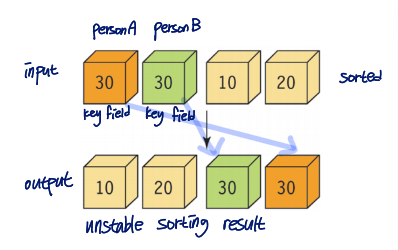
Stability of sorting algorithm
The relative position of records with the same key value does not change after sorting
Example of unstable sort
Selection Sort
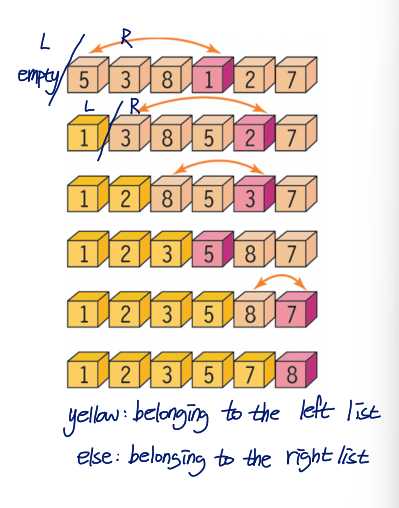
An input array : left and right lists
- left list : sorted data
- right list : unordered data
- initially, the left list is empty, and all the numbers to sort are in the right list
Procedure
- Select the minimum value in the right list and exchange it with the first number of right list
- Increase the left list size
- Decrease the right list size
Iterate 1-3 until the right list is empty
Pseudo code
selection_sort(A, n)

for i←0 to n-2 do
	least ← an index of the smallest value among A[i], A[i+1],...,A[n-1];
    Swap A[i] and A[least];
    i++;
C code
#define SWAP(x, y, t) ( (t)=(x), (x)=(y), (y)=(t) )

void selection_sort(int list[], int n){
	int i, j, least, temp;
    for(i=0; i<n-1; i++){
    	least = i;
        for(j=i+1; j<n; j++){
        	if(list[j]<list[least])
            	least = j;
        }
        SWAP(list[i], list[least], temp);
    }
}- # of comparisons : (n-1)+(n-2)+...+1 = n(n-1)/2 = O(n²)
- # of moves : 3(n-1)
- Time complexity : O(n²)
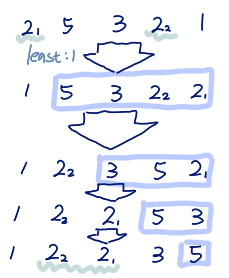
- The selection sort is not stable
Insertion Sort
Iteratively insert a new record in the right place the sorted part
Pseudo code
insertion_sort(A, n)

1. for i←1 to n-1 do
2.		key ← A[i];
3. 		j ← i-1;
4. 		while j>=0 and A[j]>key do
5.			A[j+1]←A[j];
6.			j←j-1;
7. 		A[j+1] ← key
Procedure
- Starting from i=1
- Copy the i-th integer, which is the current number to insert, into the key variable
- Start at (i-1)-th position, since the currently sorted array is up to i-1
- If the value in the sorted array is greater than the key value,
- Move the j-th data to the (j+1)-th data
- Decrease j
- Because the j-th integer is less than key, copy the key into the (j+1) position
C code
void insertion_sort(int list[], int n){
	int i, j, key;
    for(i=1; i<n; i++){
    	key = list[i];
        for(j=i-1; j>=0 && list[j]>key; j--)
        	list[j+1] = list[j];
        list[j+1] = key;
    }
}
Time Complexity of Insert Sort
Best case : when the data is already sorted
- # of comparisons: n-1
- # of moves : 0
Wort case : when sorted in reverse order
- # of comparisons : ∑(i=1~n-1) i = n(n-1)/2 = O(n²)
- # of moves : n(n-1)/2 + 2(n-1) = O(n²)
Property
- when the data size is large, the time complexity increases significantly
- Stable sort
- It is very efficient when the data is mostly sorted
Bubble Sort
Procedure
- Swap two adjacent data, when they are not in order
- This comparison-exchange process is repeated from the left to the right
Pseudo code
BubbleSort(A, n)

for i←n-1 to 1 do
	for j←0 to i-1 do
    	Swap if when j and j+1 elements are not in order
        j++;

    i--;
C code
#define SWAP(x,y,t) ((t)=(x), (x)=(y), (y)=(t))
void bubble_sort(int list[], int n){
	int i, j, temp;
    for(i=n-1; i>0; i--){
    	for(j=0; j<i; j++)
        	if(list[j]>list[j+1])
            	SWAP(list[j], list[j+1], temp);
    }
}
Time Complexity of Bubble Sort
Best case : when the data is already sorted
- # of comparisons: ∑(i=1~n-1) i = n(n-1)/2
- # of moves : 0
near implement에서 중요해서 고려해야 함 ((t=x; x=y; y=t)하는 과정에 energy consumsion 발생)
Worst case : when sorted in reverse order
- # of comparisons: ∑(i=1~n-1) i = n(n-1)/2
- # of moves : 3*comparison count = 3∑(i=1~n-1) i = 3n(n-1)/2
It is stable sort
Shell Sort
Motivation
- Insert sort is very efficient when the data is mostly sorted
- the insertion sort moves elements only to neighboring positions
- by allowing elements to move to a remote location, they can be sorted with a smaller amount of moves
Procedure
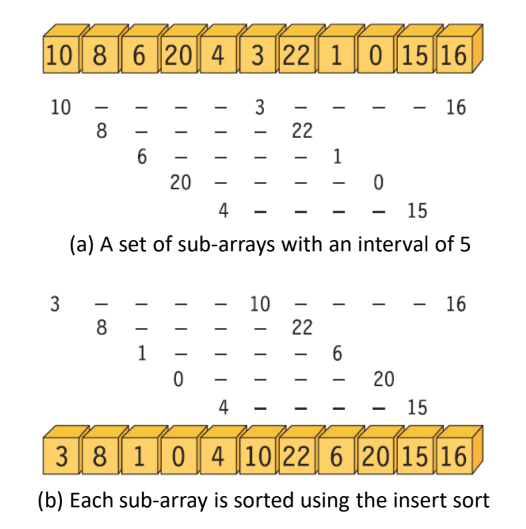
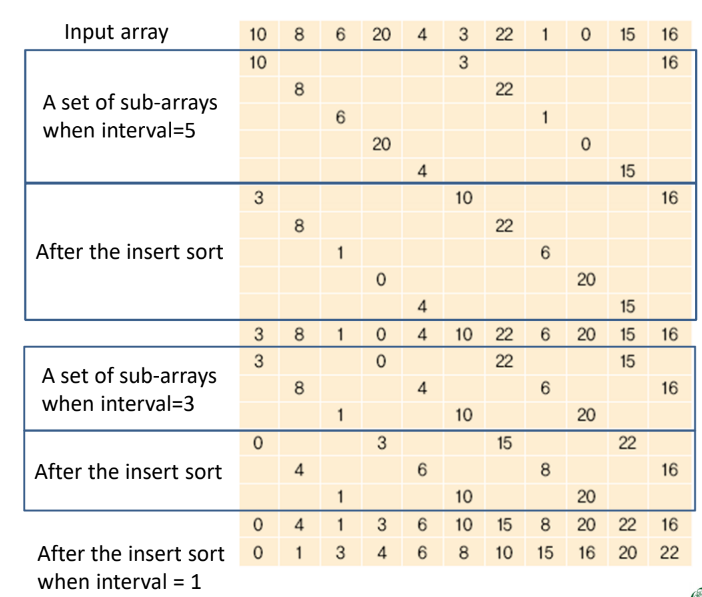
- Divide the array into a set of sub-arrays with an interval
- Apply the insert sort to each sub-array
- Decrease the interval
Iterate 1-3 until the interval becomes 1
C code
// Insert and sort elements apart by interval
//the range of sort is first to last
inc_insertion_sort(int list[], int first, int last, int gap){
	int i, j, key;
    for(i=first+gap; i<=last; i+=gap){
    	key = list[i];
        for(j=i-gap; j>=first && key<list[j]; j-=gap){
        	list[j+gap] = list[j];
        }
        list[j+gap] = key;
    }
}

//n= size
void sehll_sort(int list[], int n) {
	int i, gap;
    for(gap = n/2; gap>0; gap/=2){
    	if((gap%2)==0) gap++;
        for(i=0; i<gap; i++){
        	inc_insertion_sort(list, i, n-1, gap);
        }
    }
}
Advantages of shell sort
- Increases the likelihood of completing the sort with less amount of moves by moving remote data in a sub-array
- Since the sub-arrays become progressively sorted, the insertion sort becomes faster when the interval decreases
Time complexity
- Worst case : O(n²)
- Average case : O(n^1.5)
Merge Sort
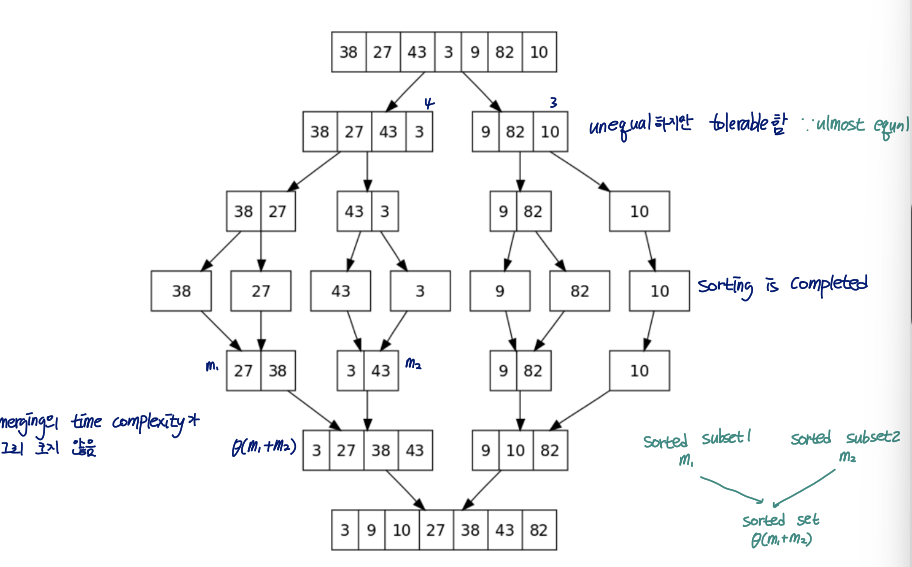
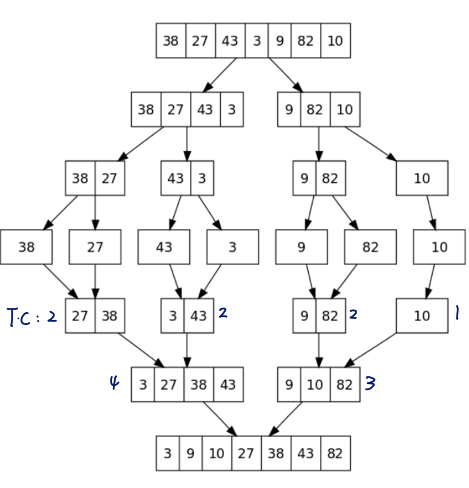
Using the divide and conquer method
- Divide the array into two equal sized and sort the split arrays
- Sort the entire array by summing the two sorted arrays
Example
Input: (27 10 12 20 25 13 15 22)
1. Divide: divide it into (27 10 12 20) and (25 13 15 22)
2. Conquer: Sort the sub-arrays - (10 12 20 27) and (13 15 22 25)
3. Combine: Merge the sorted sub-arrays: (10 12 13 15 20 22 25 27)
Pseudo code
merge_sort(list, left, right)
1. 	if left<righta
2.		mid = (left+right)/2;
3.		merge_sort(list, left, mid);
4.		merge_sort(list, mid+1, right);
5.		merge(list, left, mid, right);
Procedure
- If the size of the segment is greater than 1
- Calculate intermediate position
- Sort the left-side array(recursive call)
- Sort the right sub-array(recursive call)
- Merge the two sorted subarrays
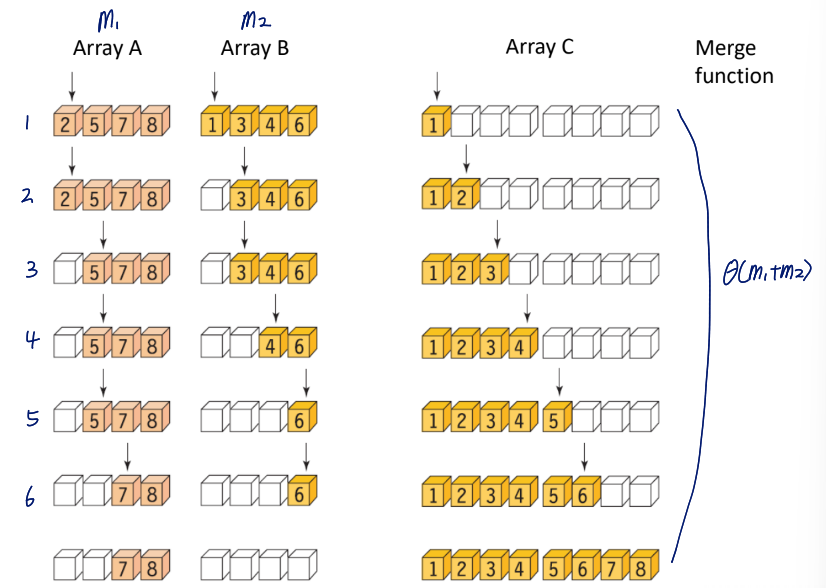
Pseudo code
merge(list, left, mid, right)

i←left;
j←mid+1;
k←left;
while(i<=mid && j<=right) do
	if(list[i] <= list[j])
    	sorted[k]←list[i];
        k++;
        i++;
    else
    	sorted[k] ← list[j]
        k++;
        j++;

copies the remaining elements to 'sorted';
copy 'sorted' to list;
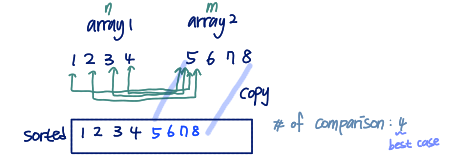
C code
int sorted[MAX_SIZE]

void merge(int list[], int left, int mid, int right){
	int i, j, k, l;
    i = left; j = mid+1; k = left;

    //merge split-sorted arrays
    while(i<=mid && j<=right){
    	if(list[i] <= list[j]){
        	sorted[k++] = list[i++];
        }
        else sorted[k++] = list[j++];
    }

    //right part에 복사 못한 데이터가 남아있는 경우
    if(i>mid){
    	for(l=i; l<=right; l++){
        	sorted[k++] = list[l];
        }
    }
    else{	//left part에 복사 못한 데이터 남아있는 경우
    	for(l=i; l<=mid; l++){
         	sorted[k++] = list[l];
        }
    }

    // sorted를 list에 복사
    for(l=left; l<=right; l++){
    	list[l] = sorted[l];
    }
}

void merge_sort(int list[], int left, int right){
	int mid;
    if(left<right){
    	mid = (left+right)/2;
        merge_sort(list, left, mid);
        merge_sort(list, mid+1, right);
        merge(list, left, mid, right);
    }
}
Time Complexity of Merge Sort
Totally, log₂n recursion
- For each recursion,
- # of comparisons = n
- # of moves = 2n
→ best and worst case : O(nlog₂n) and Ω(nlog₂n) => θ(nlog₂n)
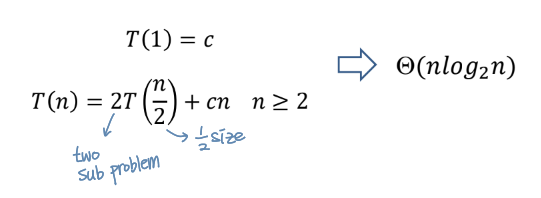
Note
- if the input is implemented using the linked list, the move becomes a simple address updae
- it is a stable sort and is less influenced by the initial order of data
Quick Sort
Property
- In average, the fastest sorting algorithm
- Divide-and-conquer method
- Unstable sort
Method
- divide the array into two sizes using pivot
- call the quick sort recursively
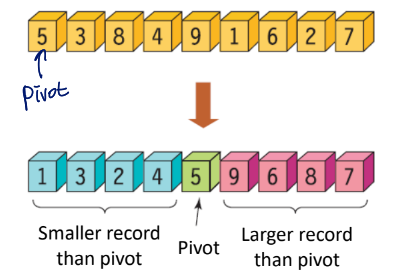
C code
void quick_sort(int list[], int left, int right){
	if(left<right){
    	int q=partition(list, left, right);
        quick_sort(list, left, q-1);
        quick_sort(list, q+1, right);
    }
}- if the size of the segment is greater than 1
- partition into two lists based on pivot.
the 'partiton' function returns the position of the pivot - recursive call from left to right before the pivot (except pivot)
- recursive call from left next the pivot to right (except pivot)
partition function (less efficient one)
int partition(int list[], int left, int right){
	int pivot, temp;
    int low, high;

    low = left+1;
    high = right;
    pivot = list[left];
    while(low<high){
    	while(low<right && list[low]<pivot){
        	low++;
        }
        while(high>left && list[high]>pivot){
        	high--;
        }
        if(low<high) SWAP(list[low], list[high], temp);
    }

    SWAP(list[left], list[high], temp);
    return high;
}
partition function (more efficient one)
int partition(int list[], int left, int right){
	int temp;
	int x = A[right];	//pivot
    int i = left-1;

    for(int j=left; j<right; j++){
    	if(A[j]<=x){
        	i++;
            SWAP(A[i], A[j], temp);
        }
    }
    SWAP(A[i+1], A[right], temp);
    return i+1;
}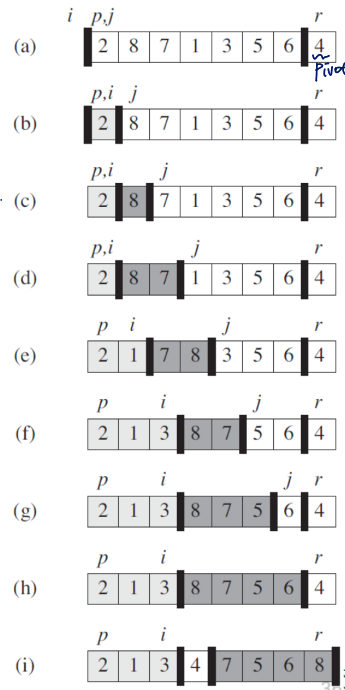
time complexity of this function: θ(n)
Time Complexity of Quick Sort
Best case
- when the array is partitioned almost equally
pivot이 잘 선택된 경우 - # of recursions: _log₂_n
- # of comparisons for each recursion: n
=> θ(nlog₂n)
Worst case
- when the array is partitioned unequally
empty left - # of recursions: n
- # of comparisons for each recursion: n
=> θ(n²)
pivot을 랜덤하게 고르거나 중간값을 고르는 것이 솔루션이 될 수 있음!
.
.
.
+
pivot을 잘 고르면 merge보다 성능이 좋아서 더 많이 사용됨!
Sorting So Far
Comparison based sorting
- selection sort, insert sort, bubble sort, shell sort
- heap sort, merge sort, quick sort
- time complexity: n² or n_log₂_n
Non-comparison sorting is also possible
- counting sort, radix sort
- time complexity: n
Counting Sort
제한조건: 원소 type=integer, 원소 범위 알고 있어야 함
cumulated histogram(=cumulated destiny function=CDF) 사용
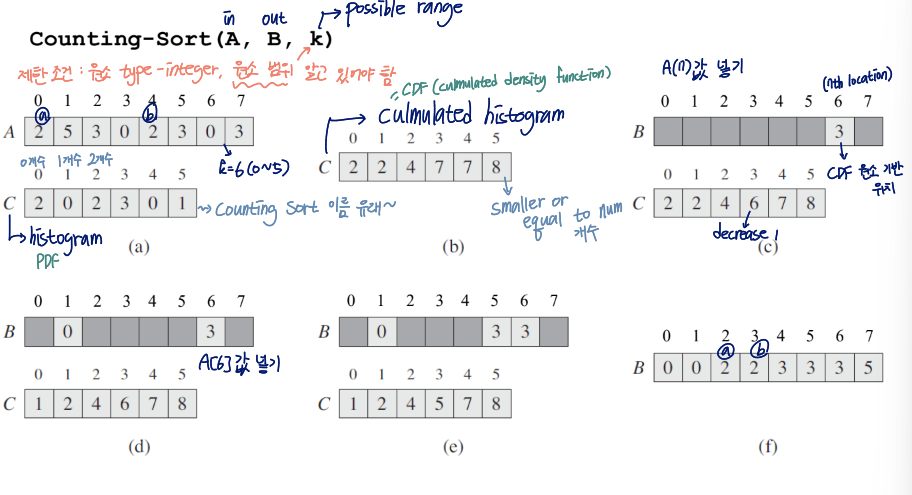
이게,,,어떻게 설명을 해야될지 모르겠네...그냥 코드 보면 이해 되니까 코드 보기로 하잡..
C code
//A: input, B: output, k: possible range(원소 범위)
void counting_sort(A, B, k){
	for(int i=0; i<k; i++){
    	C[i] = 0;
    }
    for(int j=0; j<n; j++){	 //n: size of A
    	C[A[j]] += 1; 		//histogram(=PDF)
    }
    for(int i=1; i<k; i++){
    	C[i] += C[i-1];		//cumulated histogram(CDF)
    }
    for(int j=n-1; j>=0; j++){
    	B[C[A[j]]-1] = A[j];
        C[A[j]] -= 1;
    }
}
for문 중 i를 사용하는 것들:takes O(k) time
for문 중 j를 사용하는 것들:takes O(n) time
Time Complexity of Counting Sort
Total time: O(n+k)
- usually, k=O(n) → k is ignorable
→ counting sort runs in O(n) time - there are no comparisons at all
k가 n보다 much smaller한 경우(ex.n=10000, k=500)에 counting sort에서 advantage를 얻을 수 있음
→ n=3, k=0~20101인 경우는 memory wasting이 심해서 meaningless
this algorithm is stable
numbers with the same value appear in the output array in the same order as in the input array
Radix Sort
k가 큰 경우, counting sort에서의 benefit을 챙기며 sort하고 싶을 때를 위한 아이디어
Key idea
sort the number for each digit
- Sorting order does matter
- Most significant digit(MSD) vs. Least significant digit(LSD)
- Sort the least significant digit(LSD) first
counting sort가 stable sort라서 이것도 statble sort
Example
오른쪽일수록 less significant → 맨오른쪽부터 sort
Time Complexity of Radix Sort
Total compelxity
- for n numbers with d digits, assume each pass ranged 0 to k
- time complexity of each pass: O(n+k)
- total time: O(d(n+k))
- when d is constant and k=O(n), takes O(n) time
Example
sort 1 milion 64-bit numbers
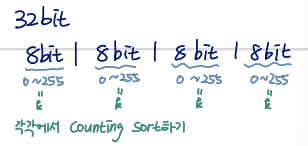
- treat the data as four-digit radix
- each digit ranges 0~2^16-1
→ O(4(n+2^16))
typical comparison-based sort보다 훨씬 빠름
Radix Sort using Queue
Procedure
- set a set of queues for range
- execute 'eunqueue' and 'dequeue'
- iterate 1-2 for each pass(e.g. digit1 -> digit2)
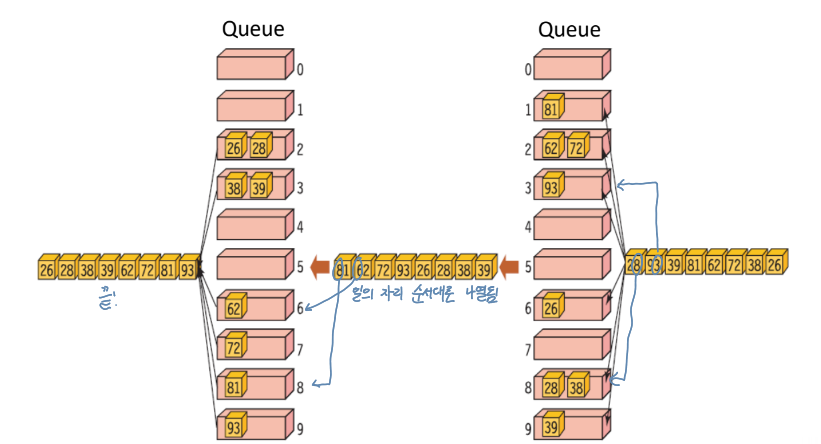
C code
#define BUCKETS 10
#define DIGITS 4

void radix_sort(int list[], int n){
	int i, b, d, factor = 1;
    QueueType queues[BUCKETS];

    for(b=0; b<BUCKETS; b++) init(&queues[b]);

    for(d=0; d<DIGITS; d++){
    	for(i=0; i<n; i++){
        	enqueue(&queues[(list[i]/factor) % BUCKETS], list[i]);
        }
        for(b=i=0; b<BUCKETS; b++){
        	while(!is_empty(&queues[b])){
            	list[i++] = dequeue(&queues[b]);
            }
        }
        factor*=BUCKETS;
    }
}
근데 queue보다 histogram 사용이 메모리를 적게 사용해서 histogram 사용해서 radix sort를 하는 것이 더 좋음
Runtime Measure Example
| Runtime(sec) | |
|---|---|
| Insert sort | 7.438 |
| Selection sort | 10.842 |
| Bubble sort | 22.894 |
| Shell sort | 0.056 |
| Quick sort | 0.014 |
| Heap sort | 0.034 |
| Merge sort | 0.026 |
생각보다 runtime 차이가 엄청나다!
따라서 sort 사용할 때 time complexity 유의하면서 방법 선택하는 게 좋음!
