1. Basic Clustering Methods: Hierarchical Methods
1.1 Why Hierarchical Clustering?
Multiple levels of granularity
- In many real scenarios, data naturally forms groups at different levels
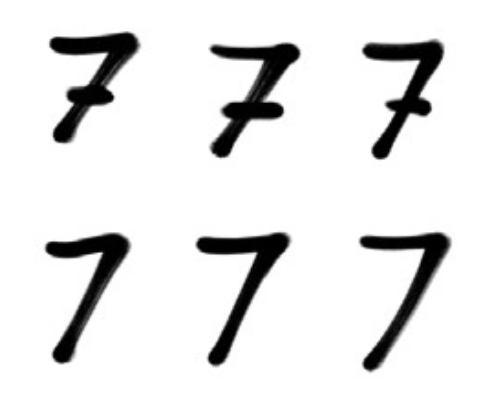
- E.g., organization charts or handwriting styles
Dendrogram
- The result is a tree structure that supports many possible clusterings by "cutting" the tree at different heights
단순히 k개로 나누기가 아니라 덴드로그램이라는 트리 구조를 만든다. 높이에 따라 자르면 다양한 단계의 군집을 얻을 수 있다.
1.2 Two Viewpoints of Hierarchies
1. Representational Tool
- Do not assume the data has an inherent hierarchical structure
- Mainly used to summarize and visualize the data
- E.g., in HR analytics, a hierarchy (executives managers staff) makes it easy to compute summaries like average salary per level
데이터가 원래 그렇게 생겨서가 아니라, 계층적으로 분류해서 보는 것이 유용하기 때문에 계층적 군집화를 쓴다.
2. Underlying Data Structure
- Assume there is an intrinsic hierarchical structure and try to recover it
- E.g.,
- Evolutionary biology: clustering organisms to recover phylogenetic trees
- Strategic games: clustering game configurations to reveal hierarchical strategy patterns
In both cases, the hierarchical representation lets us reason about data at multiple resolutions
2. Agglomerative Hierarchical Clustering
2.1 Agglomerative (bottom-up)
Hierarchical clustering methods differ in how they build the tree: Bottom-up vs. Top-down
- Start with each object as its own cluster
- 데이터가 n개 있다면, 처음에는 n개의 군집이 존재
- Iterative merge clusters until objects are in a single cluster
- Or until some stopping condition is met
- At each step:
- Compute pairwise distances (or similarities) between existing clusters
- Find the two closest clusters
- Merge them into a new cluster
- The final single cluster at the top is the root of the hierachy
- If there are objects, the methods requires at most merges
2.2 Linkage Measures
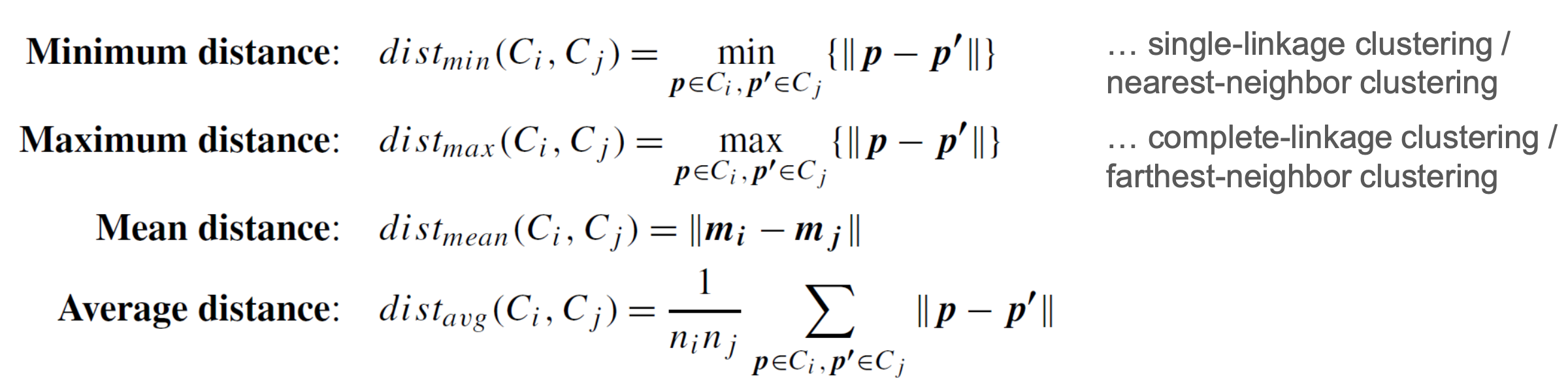
- Suppose and are two clusters, and are objects, is the mean cluster , and is the number of objects in
- The most common linkage measure are the following
Example
- Cluster A: A1 = (1, 1), A2 = (2, 1) / Cluster B: B1 = (5, 1), B2 = (6, 1)
- All pairwise distances
- Single distances = 3
- Complete distances = 5
- Mean distance = 4
- Average distance = 4
2.3 Interpretation
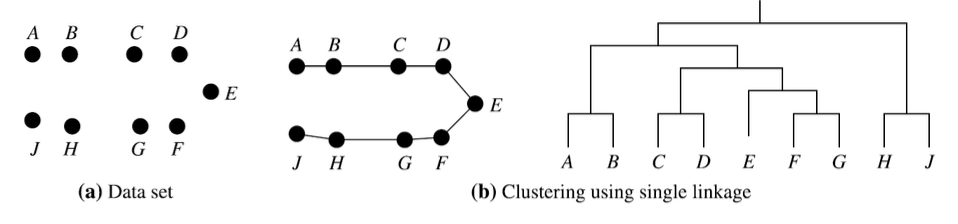
1. Single linkage
- Discover clusters based on local proximity
- May connect objects through a chain of nearby points
- Even when the overall cluster shape is elongated or loose
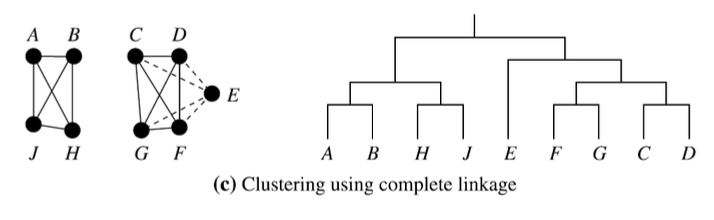
2. Complete linkage
- Discover clusters based on global closeness
- Prefers compact and tight clusters
- Because it penalizes large internal spread
3. Mean distance
- Simple and efficient because it summarizes each cluster with its centroid
- Mainly suitable when cluster means are meaningful and well-defined
- E.g., spherical cluster vs. non-convex or curved cluster
주로 구형 군집에 적합하며 볼록하지 않거나 휘어진 형태에는 취약할 수 있다.
4. Average distance
- Provides a compromise between minimum and maximum linkage
- Relies on all cross-cluster pairwise distances
- It is often more balanced
2.4 Strenthes and Weaknesses
Sensitive to outliers
- In single linkage
- One unusual point may act as a bridge and connect two otherwise separate clusters
- In complete linkage
- One distant outlier can make two otherwise similar clusters appear very far apart
- Mean distance and average distance are often considered more stable compromises
Mean distance vs. Average distance
- Mean distance
- Usually the simplest to compute because it compares only the cluster means
- This makes it computationally attractive when the data are numerical
- Average distance
- More flexible because it does not need a cluster centroid to be defined
- Categorical data or mixed-type data, as long as a distance function
3. Connecting to Partitioning Methods
3.1 Why is there a connection?
Cluster compactness
- Agglomerative hierarchical clustering and partitioning methods may seem different
- But they are related through the idea of cluster compactness
Sum of Squared Errors
- Partitioning methods evaluate a clustering by using the SSE
- Which measures how tightly the objects are grouped around their cluster means
Starting point
- If a dataset contains points, then a partition into clusters means that each point forms its own cluster
- This is exactly the starting point of agglomerative hierarchical clustering, where the algorithm begins with singleton clusters and then repeatedly merges them
Natural heuristic for merging
- Which two clusters should be merged next?
- A natural heuristic is to merge the pair that causes the smallest increase in SSE, because this keeps the clustering as compact as possible
3.2 Ward’s Method
1. Definition
- Measures similarity by asking how much the total within-cluster SSE would increase if two clusters were merged
- Selection rule
- The pair for which the within-cluster SSE increases the least after merging is regarded as the most similar
2. Mathematical Criterion
- 병합 후의 SSE에서 병합 전 군집의 SSE 합을 뺀 값
- 두 군집을 하나로 합쳤을 때 발생하는 SSE의 순수 증가량을 구하는 식
- 두 군집의 크기와 중심점 간의 거리만을 이용하여 동일한 결과를 얻을 수 있도록 유도된 식
- Cluster size distance between centriods
3. Interpretation and Strategy
- Smallest possible increase in within-cluster variance
- As a greedy strategy, it tries to preserve compact and low-variance clusters
- Tend to merge clusters whose centriod are close, while also accouting for their sizes
4. Divisive Hierarchical Clustering
4.1 Divise (top-down)
- Start with all objects in one cluster (the root)
- Iteratively split clusters into smaller subclusters
- Recursively apply splitting to the resulting subclusters
- Stop when:
- Each cluster has just one object, or
- Clusters at the lowest level are sufficiently coherent (objects in each cluster are very similar)