Beyond Spinning Disks
Pros
- Cheapest way to store large amounts of data
Cons
- Slowest component in most computers
- Fragile mechanical components can break
- Disk motor is extremely power hungry
Solid State Drives
NAND flash memory-based drives
- NOR: random access in Byte unit
- HDD
- NAND: Access in Block, Page unit
- ROM
- Non-volatile memory
Props
- More resilient against physical damage
- Disk가 없기 때문에 head를 읽거나 움직일 필요 x
- Reduced power consumption
- No mechanical parts
- Much faster than hard drives
- No penalty for random access
- Each flash cell can be addressed directly
- No need to rotate or seek
- Extremely high throughput
- Although each flash chip is slow, they are RAIDed
- No penalty for random access
Challenges with Flash
Flash memory is written in pages, but erased in blocks
- Pages: 4-16KB, Blocks: 128-256KB
- Thus, flash memory can become fragmented (in block) -> Write amplication
Flash memory can only be written a fixed number of times
- Typically 3000 – 5000 cycles for MLC
- SSDs use wear leveling to evenly distribute writes across all flash cells
지울 때 저항이 발생하기 때문에 횟수 정해짐 -> 수준 맞추기
Write Amplification
- Once all pages have been written, valid pages must be consolidated
- A write triggers garbage collection / compaction
- One or more blocks must be read, erased and rewritten before the write can proceed
Garbage Collection
- Vital for the performance of SSDs
- Many SSDs over-provision to help the GC
- 240 GB SSDs actually have 256 GB
- GC uses 16 GB
- If use the all 240 GB, write on 16 GB and move later
The Ambiguity of Delete
- Goal : SSD wants to perform background GC
- Problem: most file systems don’t actually delete data
- On linux, delete function is unlink() -> delete 표시만
Metadata is overwritten, but the file remains
- File is written to SSD
- File is deleted
- GC executes
- 9 pages look valid to the SSD
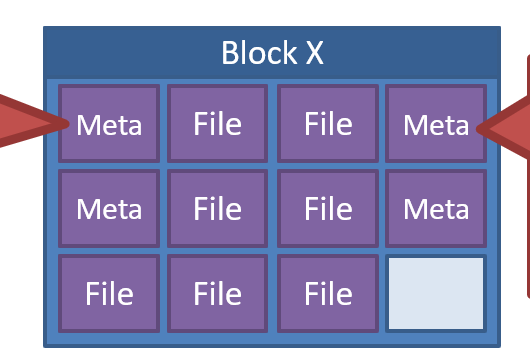
- Lack of explicit delete means the GC wastes effort copying useless pages (7 Files)
- Hard drives are not GCed, so this was never a problem
TRIM
- New SATA command TRIM
- Allow the OS to tell the SSD that specific LBAs are invalid
- Delete function makes files invalid
Wear Leveling
- each flash cell wears out after several thousand writes
- SSDs use wear leveling to spread writes across all cells
-> 메모리 셀들의 마모를 균등하게 분산
Dynamic Wear Leveling
- Wait as long as possible before garbage collecting
- Blocks with pages that are not updated will not be rewritten
- 업데이트 안 되는 블럭은 계속 쓰이지 않음
Static Wear Leveling
- Blocks with long lived data receive less wear
- SSD controller periodically swap long lived data to different blocks
- block write 균형 맞춤
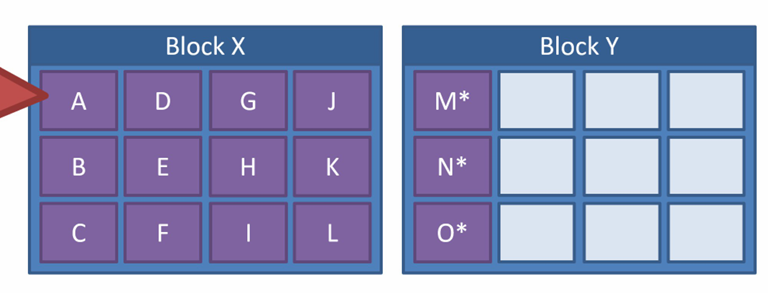
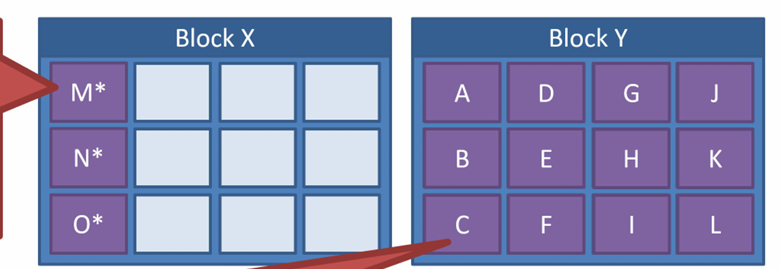
- block write 균형 맞춤
SSD Controllers
- SSDs are extremely complicated internally
- All operations handled by the SSD controller
- Maps LBA to physical page
- Keeps track of free pages, controls the GC
- May implement background GC
- Performs wear leveling
Flavors of NAND Flash Memory
Multi Level Cell
Consumer-grade drives
- Multiple bits per flash cell
- Higher capacity and cheaper than SLC flash
- Lower throughput due to the need for error correction(overhead)
- 3000-5000 write cycles
- Consumes more power
Single Level Cell
Expensive, enterprise drives
- One bit per flash cell
- Lower capacity and more expensive than MLC
- Higher throughput than MLC
- 10000 - 100000 write cycles

갓생호소인