
📌 Problem
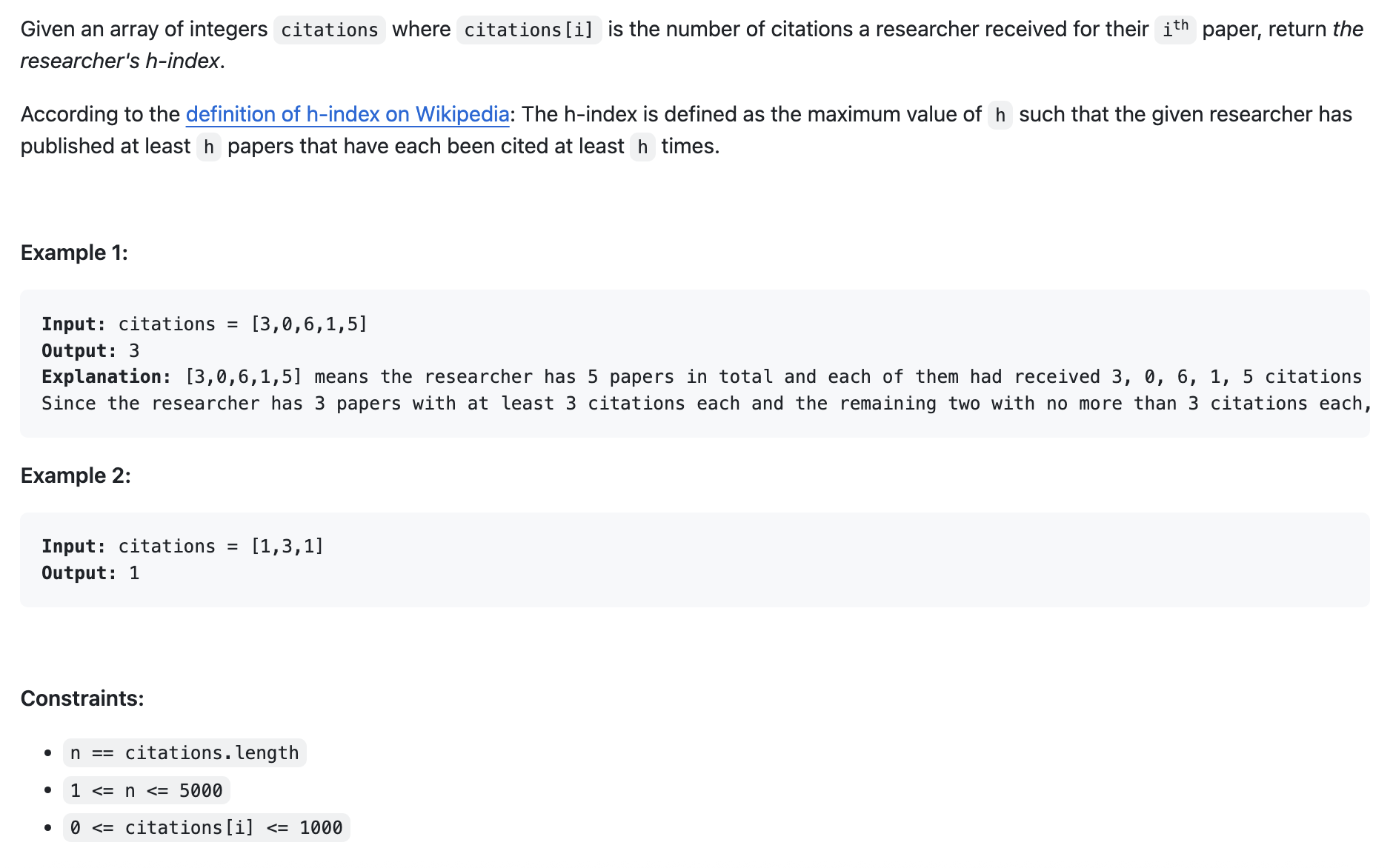
📌 Solution
1. Sorting Approach(1)
Code
class Solution:
    def hIndex(self, citations: List[int]) -> int:
        n = len(citations)
        citations = sorted(citations, reverse=True)

        h_idx = 0
        for i in range(n):
            if citations[i] >= i+1:
                h_idx += 1

        return h_idx
Complexity
- Time Complexity:
- Space Complexity:
2. Sorting Approach(2)
Idea
- Early exit: Return at the first
c<i, avoiding unnecessary scans - In-place sort: Uses
list.sort()instead ofsorted(), reducing extra memory. - Clear & robust:
enumerate(..., start=1)+ immediate return minimizes off-by-one risks
Code
class Solution:
    def hIndex(self, citations: List[int]) -> int:
        citations.sort(reverse=True)
        for i, c in enumerate(citations, start=1):
            if c < i:
                return i - 1
        return len(citations)
Complexity
- Time Complexity:
- Space Complexity:
3. Counting Sort Approach ⭐️
Idea
- Cap all citation counts at n (since h-index ≤ n)
- Build a frequency array of size n+1
- Traverse from n down to 0, keeping a running total of papers
- The first h where papers ≥ h is the h-index
Code
class Solution:
    def hIndex(self, citations: List[int]) -> int:
        n = len(citations)
        count = [0] * (n + 1)

        for c in citations:
            count[min(c, n)] += 1

        papers = 0
        for h in range(n, -1, -1):
            papers += count[h]
            if papers >= h:
                return h
Complexity
- Time Complexity:
- Space Complexity:
For large-scale data or when optimal time complexity is required, the counting sort approach() is the best choice

Where there's a will, there's a way