
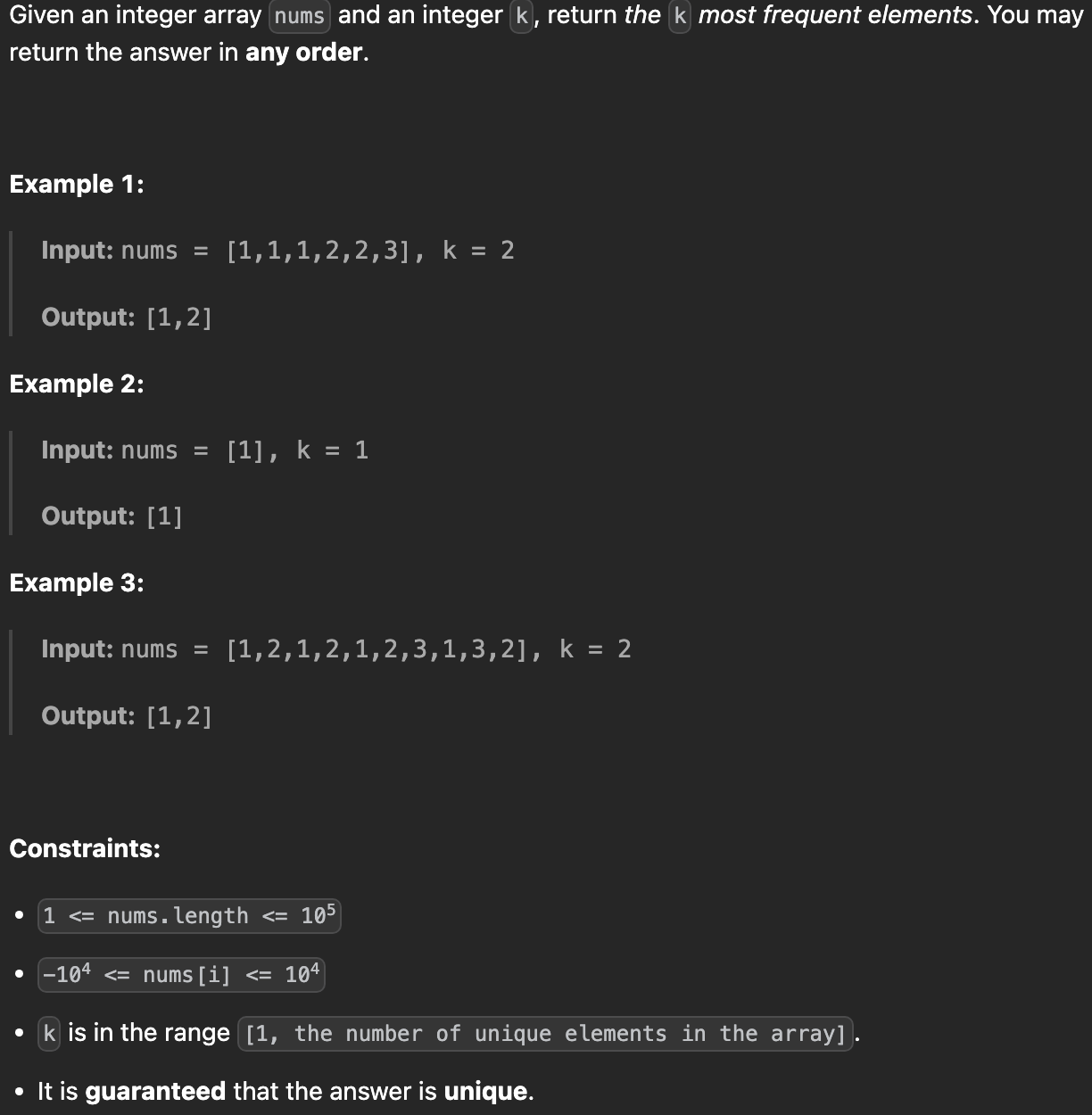
📌 Problem
[LeetCode] 347. Top K Frequent Elements
📌 Solution
Solution 1: Use Counter
Code
class Solution:
    def topKFrequent(self, nums: List[int], k: int) -> List[int]:
        cnt = Counter(nums)
        ans = [num for num, freq in cnt.most_common(k)]
return ans- 코드는 간단함
- but.. 시간복잡도가 넘 큼..
Complexity
-
Time:
(Counting all elements and extracting top-k frequent items) -
Space:
(Frequency map plus output list)
= length of nums, = number of unique elements
Solution 2: Bucket Sort ⭐️
Idea
-
freq[x]= x의 등장 횟수
Count the frequency of each element:freq[x]= number of timesxappears -
buckets[c]= 빈도가 c인 값들
Create buckets by frequency:buckets[c]= elements that appearctimes -
큰 빈도부터 내려오며
k개 모으면 끝
Traverse from the highest frequency down and collectkelements
Code
from typing import List
from collections import Counter

class Solution:
    def topKFrequent(self, nums: List[int], k: int) -> List[int]:
        freq = Counter(nums)  # value -> count

        # buckets[count] = list of values with that count
        buckets = [[] for _ in range(len(nums) + 1)]
        for val, cnt in freq.items():
            buckets[cnt].append(val)

        ans = []
        # 높은 빈도부터 내려오며 채우기
        for cnt in range(len(buckets) - 1, 0, -1):
            for val in buckets[cnt]:
                ans.append(val)
                if len(ans) == k:
                    return ans

        return ans  # (문제 조건상 보통 여기 도달 안 함)
Complexity
- Counting:
- Bucket filling: where is the number of unique elements ()
- Traversing from the end: in the worst case
- Time:
- Space: (Bucket + Counter)
Solution 3: Min-Heap
Idea
- (값, 빈도) 중 빈도만 기준으로 크기 k짜리 최소힙 유지
Maintain a size-k min-heap based on frequency (store (value, freq)) - 힙 크기가 k 초과하면 가장 작은 빈도 제거
If the heap size exceeds k, remove the smallest-frequency element
Code
from typing import List
from collections import Counter
import heapq

class Solution:
    def topKFrequent(self, nums: List[int], k: int) -> List[int]:
        freq = Counter(nums)

        heap = []  # (count, value)
        for val, cnt in freq.items():
            heapq.heappush(heap, (cnt, val))
            if len(heap) > k:
                heapq.heappop(heap)

        return [val for cnt, val in heap]
Complexity
- Time:
where is the number of unique elements - Space:
Where there's a will, there's a way