What Is Cryptolepis Used For? A Clear, Evidence-First Guide
If you've searched "what is cryptolepis used for", you've probably seen two very different stories: one rooted in West African tradition, and another built from modern supplement buzz. This article bridges both without hype. You'll learn what Cryptolepis sanguinolenta is, what it's traditionally used for, what research actually suggests, and what safety and quality signals matter most before you consider a tincture.
Important: Cryptolepis is not a substitute for medical care. For serious infections especially malaria self-treatment can be dangerous. Use this guide to understand the landscape and talk to a qualified clinician.
What is cryptolepis, and why do people talk about it?

Cryptolepis (commonly Cryptolepis sanguinolenta) is a climbing shrub native to parts of West and Central Africa. Its root has a distinctive yellow pigment and has been used both medicinally and as a dye.
It is sometimes called "Ghanaian quinine" (a traditional nickname, not a statement that it is quinine).
What makes cryptolepis biologically interesting?
The plant contains several alkaloids especially cryptolepine that have been studied for activity against microbes and parasites in laboratory settings.
That "activity" is the key word. Lab results are not the same as proven clinical outcomes in humans.
What is cryptolepis used for in traditional practice?
Traditional use does not equal proven efficacy, but it helps explain why researchers started studying the plant.
Across parts of West Africa, cryptolepis root preparations have been used in community herbal practice, especially in relation to fever and malaria-like illness patterns.
Reported ethnomedical uses in the literature include:
-
malaria / febrile illness traditions
-
gastrointestinal complaints such as diarrhea
-
respiratory complaints in traditional contexts
A separate but useful context: traditional and complementary medicine is widely used globally. World Health Organization notes that traditional/complementary medicine is used in many countries and at high population levels in some settings.
What does research say cryptolepis is used for today?
People use cryptolepis in modern supplements for "immune support," "microbial balance," or "travel wellness." The evidence is uneven across these claims, so it helps to sort by strength of evidence.
Evidence map: where cryptolepis has data and where it doesn't
Human clinical research and reviews exist around cryptolepis and malaria-related use, including published clinical efficacy reporting for a tea-bag/aqueous root formulation in uncomplicated malaria settings.
Separately, multiple reviews summarize pharmacology, traditional uses, and toxicology.
Key takeaway: The strongest "real-world" evidence cluster is malaria-context research, but that does not mean a consumer tincture "treats malaria."
Malaria is the big context: what the statistics say
Malaria remains a major global health burden. In the World Malaria Report 2025, the WHO estimates ~282 million cases and ~610,000 deaths in 2024.
What compounds are studied, and what do they do?
The best-described alkaloid is cryptolepine, which has been investigated for:
-
antiparasitic activity (including against malaria parasites in vitro)
-
antibacterial effects in lab studies (e.g., against Staphylococcus aureus)
-
DNA intercalation/genotoxicity signals in some experimental models
Is cryptolepis safe? What the red flags actually are
Safety for botanicals is rarely binary. It's "safe for whom, at what dose, for how long, and in what form?"
Safety considerations that show up in published research
-
Genotoxicity / DNA-interaction concerns (preclinical):\
Cryptolepine is a DNA intercalator and has shown genotoxicity signals in vitro, which is one reason researchers treat it cautiously. -
Reproductive and pregnancy-related caution (animal data):\
There are animal studies suggesting reproductive effects with certain extracts and dosing patterns (e.g., antifertility signals in male rats for leaf ethanolic extract).\
Other experimental work explores embryotoxicity/developmental toxicity concerns in models. -
Product variability risk:\
"Cryptolepis" can mean different plant parts, extraction solvents, concentrations, and alkaloid profiles so safety and effect can vary.
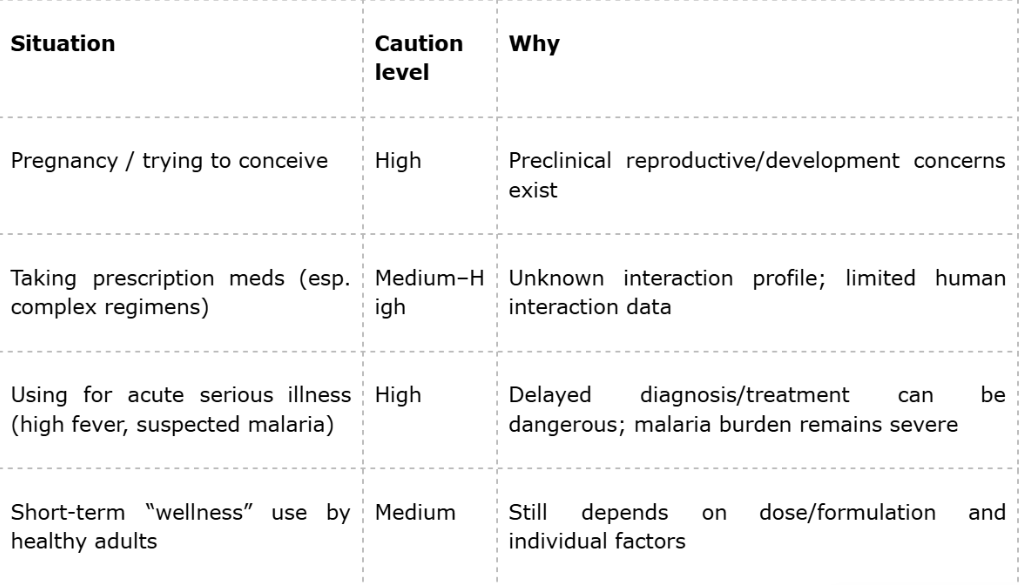
Quick safety table
How do you choose a cryptolepis tincture responsibly?
Here's a beginner-proof checklist that reduces risk and improves the chance you're buying something consistent.
Checklist: what to look for on a cryptolepis label
-
Botanical name shown: Cryptolepis sanguinolenta (not just "cryptolepis")
-
Plant part specified: root vs leaf matters for phytochemistry and research context
-
Extraction details: solvent (e.g., alcohol/water), ratio, and serving size listed
-
Quality signals: batch testing, contaminant screening (microbial, heavy metals)
-
No disease claims: avoid brands promising to "cure," "treat," or "kill" anything
-
Clear cautions: pregnancy, fertility, and medication-use warnings are a good sign of responsible labeling
-
Transparent sourcing: region and supply chain clarity helps reduce adulteration risk
If a product page is making aggressive medical promises, treat that as a quality red flag not a benefit.
Why some claims spread fast (and how to stay skeptical)
Cryptolepis sits at an intersection that tends to amplify claims:
-
a real traditional history
-
compelling lab activity
-
and a global health backdrop where malaria remains common
That combination can create marketing that outruns evidence. The safe approach is to separate:
-
"studied for" (research interest)\
from -
"proven to" (strong clinical evidence, reproducible outcomes, established dosing and safety)
FAQ
1) What is cryptolepis used for?
Traditionally, cryptolepis root has been used in parts of West Africa in malaria and fever-related herbal practice, and it is studied for antiparasitic and antimicrobial activity.
2) Is cryptolepis proven to treat malaria?
Some human studies exist for specific herbal preparations in specific contexts, but malaria is a serious disease that requires medical diagnosis and standard treatment.
3) What is cryptolepine?
Cryptolepine is a major alkaloid found in Cryptolepis sanguinolenta, studied for bioactivity including antiparasitic and antimicrobial effects, with safety questions in some models.
4) Can I take cryptolepis with medications?
Interaction data are limited. If you take prescription meds or have conditions requiring ongoing treatment, consult a qualified clinician before use.
5) Is cryptolepis safe during pregnancy?
Pregnancy is a caution zone. Preclinical data raise reproductive/development concerns in some models, so conservative avoidance is reasonable unless a clinician advises otherwise.
6) Why do cryptolepis products vary so much?
Different plant parts, extraction methods, and batch quality can change alkaloid levels, which can change both effects and tolerability.
Glossary
-
Alkaloid: Nitrogen-containing plant compound often responsible for strong bioactivity (e.g., cryptolepine).
-
Cryptolepine: A major alkaloid in Cryptolepis sanguinolenta studied for antiparasitic/antimicrobial activity and safety signals.
-
Ethnopharmacology: Study of traditional medicinal use and how it relates to pharmacology.
-
In vitro: Lab studies outside a living organism (cells, test tubes).
-
Genotoxicity: Potential to damage genetic material; a safety concern in some preclinical findings.
-
Aqueous extract: Water-based extraction (often closer to traditional decoctions/teas).
-
Quality control (QC): Testing for identity, potency, and contaminants to ensure product consistency.
What is cryptolepis used for? | Closing
Cryptolepis is best understood as a traditionally important West African botanical with meaningful lab research and limited but notable human data in malaria-context preparations plus real safety and quality considerations.
If you're looking for a tincture as part of a cautious wellness routine (not as a disease treatment), choose a brand that avoids medical claims, communicates sourcing, and treats safety seriously. That's the logic behind considering a cryptolepis tincture from Herb-Era.com especially if it emphasizes transparent labeling and responsible, non-disease positioning.
Sources
-
World Health Organization. World malaria report 2025 (2025). hxxps://www.who.int/teams/global-malaria-programme/reports/world-malaria-report-2025
-
World Health Organization. Malaria -- Fact sheet (updated 2025). hxxps://www.who.int/news-room/fact-sheets/detail/malaria
-
Bugyei KA, Boye GL, Addy ME. Clinical efficacy... Cryptolepis sanguinolenta... (2010). hxxps://pmc.ncbi.nlm.nih.gov/articles/PMC2956313/
-
Osafo N, et al. Phytochemical and Pharmacological Review of Cryptolepis sanguinolenta (2017). hxxps://pmc.ncbi.nlm.nih.gov/articles/PMC5661077/
-
Ansah C, et al. In Vitro Genotoxicity... cryptolepine... (2005). hxxps://pubmed.ncbi.nlm.nih.gov/15664441/
-
Gopalan RC, et al. Effects of cryptolepine... DNA damage... (2011). hxxps://www.sciencedirect.com/science/article/abs/pii/S0378427411015293
-
Ajayi AF, Akhigbe RE. Antifertility activity... male rats (2012). hxxps://pmc.ncbi.nlm.nih.gov/articles/PMC3409919/
-
Mensah KB, et al. Cryptolepine... developmental toxicity models (2019). hxxps://pmc.ncbi.nlm.nih.gov/articles/PMC6644280/
-
Zhang Y, et al. Botanical Medicines... Cryptolepis... toxicology considerations (2021). hxxps://www.frontiersin.org/articles/10.3389/fcimb.2021.624745/full
-
WHO. Traditional medicine Q&A / usage survey (2025). hxxps://www.who.int/news-room/questions-and-answers/item/traditional-medicine
