
📝 파이썬 - 알고리즘
📌 알고리즘
✏ 선형검색
- 선형으로 나열되어 있는 데이터를 순차적으로 스캔하면서 원하는 값을 찾는다.
datas = [3,2,5,7,9,1,0,8,6,4]
print(f'datas : {datas}')
print(f'datas length : {len(datas)}')

searchDatas = int(input('찾으려는 숫자 입력 : '))
searchResultIdx = -1

n = 0
while True:

    if n == len(datas):
        searchResultIdx = -1
        break
    elif datas[n] == searchDatas:
        searchResultIdx = n
        break

    n+= 1

print('searchResultIdx : {}'.format(searchResultIdx))
↓
datas : [3, 2, 5, 7, 9, 1, 0, 8, 6, 4]
datas length : 10
찾으려는 숫자 입력 : 9
searchResultIdx : 4
✏ 보초법
- 마지막 인덱스에 찾으려는 값을 추가해서 찾는 과정을 간략화 한다.
datas = [3,2,5,7,9,1,0,8,6,4]
print(f'datas : {datas}')
print(f'datas length : {len(datas)}')

searchData = int(input('찾으려는 숫자 입력 : '))
searchResultIdx = -1
datas.append(searchData)
n = 0
while True:

    if datas[n] == searchData:
        if n != len(datas) - 1:
            searchResultIdx = n
        break

    n+= 1
print(datas)
print('searchResultIdx : {}'.format(searchResultIdx))
↓
datas : [3, 2, 5, 7, 9, 1, 0, 8, 6, 4]
datas length : 10
찾으려는 숫자 입력 : 10
[3, 2, 5, 7, 9, 1, 0, 8, 6, 4, 10]
searchResultIdx : -1- 실습
num = [4,7,10,2,4,7,0,1,7,3,9]

searchNum = 7
num.append(searchNum)
searchNumIdx = -1

n = 0
while True:

    if num[n] == searchNum:
        if n != len(num)-1:
            searchNumIdx = n
        break

    n+=1

print('searchNumIdx : {}'.format(searchNumIdx))
↓
searchNumIdx : 1


searchResultIdxs = []
for i, v in enumerate(num):
    if v == searchNum and i != len(num)-1:
        searchResultIdxs.append(i)

print('searchResultIdxs : {}'.format(searchResultIdxs))
↓
searchResultIdxs : [1, 5, 8]
✏ 이진검색
- 정렬되어 있는 자료구조에서 중앙값과의 크고 작음을 이용해서 데이터를 검색한다.
datas = [1,2,3,4,5,6,7,8,9,10,11]
print('datas : {}'.format(datas))
print('datas length: {}'.format(len(datas)))

searchData = int(input('search data : '))
searchResultIdx = -1

staIdx = 0
endIdx = len(datas) - 1
midIdx = (staIdx + endIdx) // 2
midVal = datas[midIdx]
print(f'midIdx : {midIdx}')
print(f'midVal : {midVal}')

while searchData <= datas[len(datas) - 1] and searchData >= datas[0]:

    if searchData == datas[len(datas) - 1]:
        searchResultIdx = len(datas) - 1
        break

    if searchData > midVal:
        staIdx = midIdx
        midIdx = (staIdx + endIdx) // 2
        midVal = datas[midIdx]
        print(f'midIdx : {midIdx}')
        print(f'midVal : {midVal}')
    elif searchData < midVal:
        endIdx = midIdx
        midIdx = (staIdx + endIdx) // 2
        midVal = datas[midIdx]
        print(f'midIdx : {midIdx}')
        print(f'midVal : {midVal}')

    elif searchData == midVal:
        searchResultIdx = midIdx
        break

print('searchResultIdx : {}'.format(searchResultIdx))
↓
datas : [1, 2, 3, 4, 5, 6, 7, 8, 9, 10, 11]
datas length: 11
search data : 11
midIdx : 5
midVal : 6
searchResultIdx : 10- 이진검색 실습
리스트를 오름차순으로 정렬한 후 '7'을 검색하고 위치(인덱스)를 출력하자.
datas = [4,10,22,5,0,17,7,11,9,61,88]
print(f'datas : {datas}')
print(f'datas length : {len(datas)}')
datas.sort()
print(datas)

searchData = int(input('search data : '))
searchResultIdx = -1
startIdx = 0
endIdx = len(datas) - 1
lastIdx = len(datas) - 1
midIdx = (startIdx + endIdx) // 2
midVal = datas[midIdx]

print(f'midIdx : {midIdx}')
print(f'midVal : {midIdx}')

while searchData <= datas[lastIdx] and searchData >= datas[0]:

    if searchData == datas[lastIdx]:
        searchResultIdx = lastIdx
        break

    if searchData > midVal:
        startIdx = midIdx
        midIdx = (startIdx + endIdx) // 2
        midVal = datas[midIdx]
    elif searchData < midVal:
        endIdx = midIdx
        midIdx = (startIdx + endIdx) // 2
        midVal = datas[midIdx]
    elif searchData == midVal:
        searchResultIdx = midIdx
        break

    if searchData not in datas :
        searchResultIdx= -1
        print('this data is not in datas')
        break

print(f'searchResultIdx : {searchResultIdx}')
↓
datas : [4, 10, 22, 5, 0, 17, 7, 11, 9, 61, 88]
datas length : 11
[0, 4, 5, 7, 9, 10, 11, 17, 22, 61, 88]
search data : 13
midIdx : 5
midVal : 5
this data is not in datas
searchResultIdx : -1


↓
search data : 11
midIdx : 5
midVal : 5
searchResultIdx : 6
✏ 순위
- 수의 크고 작음을 이용해서 수의 순서를 정하는 것을 순위라고 한다.
import random

rdNums = random.sample(range(50,101),20)

ranks = [0 for i in range(20)]
print(rdNums)
print(ranks)

for idx, num1 in enumerate(rdNums):
    for num2 in rdNums:
        if num1 < num2:
            ranks[idx] += 1

for idx, num in enumerate(rdNums):
    print(f'num : {num}, \t rank: {ranks[idx] + 1}')
↓
[60, 84, 53, 69, 72, 66, 55, 83, 95, 59, 63, 92, 56,
78, 75, 50, 98, 51, 94, 65]
[0, 0, 0, 0, 0, 0, 0, 0, 0, 0, 0, 0, 0, 0, 0, 0, 0, 0,
0, 0]
num : 60, 	 rank: 14
num : 84, 	 rank: 5
num : 53, 	 rank: 18
num : 69, 	 rank: 10
num : 72, 	 rank: 9
num : 66, 	 rank: 11
num : 55, 	 rank: 17
num : 83, 	 rank: 6
num : 95, 	 rank: 2
num : 59, 	 rank: 15
num : 63, 	 rank: 13
num : 92, 	 rank: 4
num : 56, 	 rank: 16
num : 78, 	 rank: 7
num : 75, 	 rank: 8
num : 50, 	 rank: 20
num : 98, 	 rank: 1
num : 51, 	 rank: 19
num : 94, 	 rank: 3
num : 65, rank: 12- 순위 실습
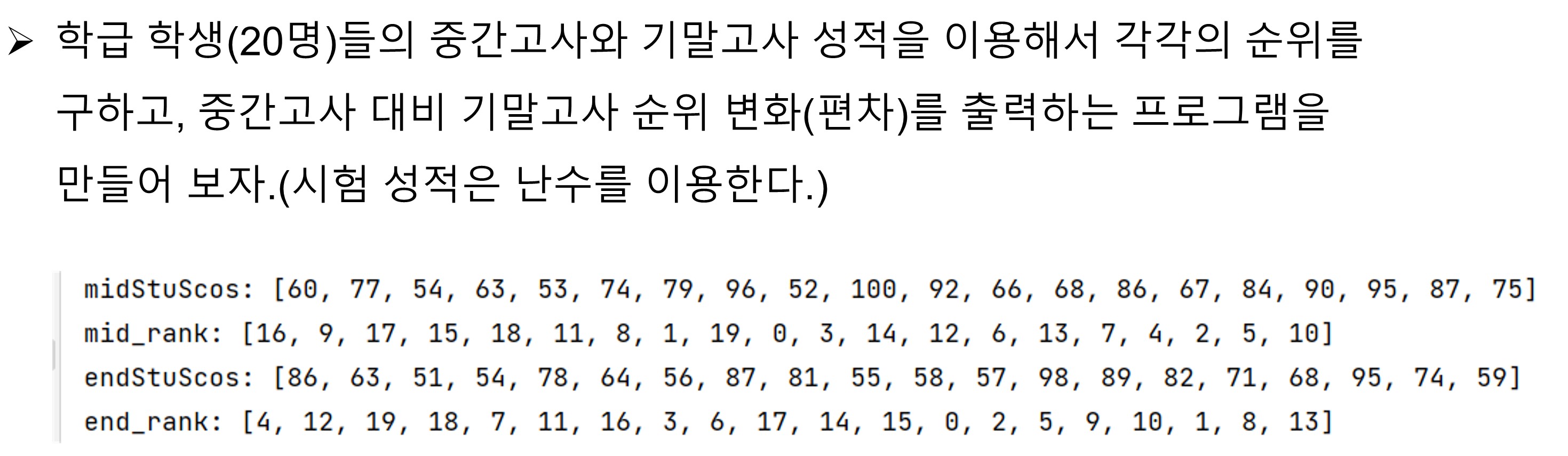
class RankMd:
    def __init__(self, mss, ess):
        self.midStuScos = mss
        self.endStuScos = ess
        self.midRanks = [0 for i in range(len(mss))]
        self.endRanks = [0 for i in range(len(mss))]
        self.rankDiviation = []

    def setRank(self,ss, rs):
        for idx, sco1 in enumerate(ss):
            for sco2 in ss:
                if sco1 < sco2:
                    rs[idx] += 1

    def setMidRank(self):
        self.setRank(self.midStuScos, self.midRanks)

    def setEndRank(self):
        self.setRank(self.endStuScos, self.endRanks)

    def getMidRank(self):
        return self.midRanks

    def getEndRank(self):
        return self.endRanks

    def printRankDeviation(self):

        for idx, mRank in enumerate(self.midRanks):
            deviation = mRank - self.endRanks[idx]

            self.rankDiviation.append(deviation)

            if deviation > 0:
                deviation = '↑' + str(abs(deviation))
            elif deviation == 0:
                deviation = '=' + str(abs(deviation))
            else:
                deviation = '↓' + str(abs(deviation))

            print(f'mid_rank: {mRank} \t end_rank : {self.endRanks[idx]} \t Diviation : {deviation}')


import day23_04 as rk
import random

midStuScos = random.sample(range(50, 101), 20)
endStuScos = random.sample(range(50, 101), 20)

rd = rk.RankMd(midStuScos,endStuScos)
rd.setMidRank()
print(f'midStuScores : {midStuScos}')
print(f'getMidRank : {rd.getMidRank()}')
rd.setEndRank()
print(f'midStuScores : {endStuScos}')
print(f'getMidRank : {rd.getEndRank()}')

rd.printRankDeviation()
↓
midStuScores : [91, 50, 87, 70, 54, 58, 62, 83, 59, 80,
79, 75, 55, 67, 99, 95, 85, 94, 92, 66]
getMidRank : [4, 19, 5, 11, 18, 16, 14, 7, 15, 8, 9,
10, 17, 12, 0, 1, 6, 2, 3, 13]
midStuScores : [81, 76, 60, 59, 97, 78, 73, 72, 87, 51,
92, 62, 99, 91, 66, 95, 96, 79, 83, 80]
getMidRank : [8, 12, 17, 18, 1, 11, 13, 14, 6, 19, 4,
16, 0, 5, 15, 3, 2, 10, 7, 9]
mid_rank: 4 	 end_rank : 8 	 Diviation : ↓4
mid_rank: 19 	 end_rank : 12 	 Diviation : ↑7
mid_rank: 5 	 end_rank : 17 	 Diviation : ↓12
mid_rank: 11 	 end_rank : 18 	 Diviation : ↓7
mid_rank: 18 	 end_rank : 1 	 Diviation : ↑17
mid_rank: 16 	 end_rank : 11 	 Diviation : ↑5
mid_rank: 14 	 end_rank : 13 	 Diviation : ↑1
mid_rank: 7 	 end_rank : 14 	 Diviation : ↓7
mid_rank: 15 	 end_rank : 6 	 Diviation : ↑9
mid_rank: 8 	 end_rank : 19 	 Diviation : ↓11
mid_rank: 9 	 end_rank : 4 	 Diviation : ↑5
mid_rank: 10 	 end_rank : 16 	 Diviation : ↓6
mid_rank: 17 	 end_rank : 0 	 Diviation : ↑17
mid_rank: 12 	 end_rank : 5 	 Diviation : ↑7
mid_rank: 0 	 end_rank : 15 	 Diviation : ↓15
mid_rank: 1 	 end_rank : 3 	 Diviation : ↓2
mid_rank: 6 	 end_rank : 2 	 Diviation : ↑4
mid_rank: 2 	 end_rank : 10 	 Diviation : ↓8
mid_rank: 3 	 end_rank : 7 	 Diviation : ↓4
mid_rank: 13 	 end_rank : 9 	 Diviation : ↑4
✏ 버블정렬
- 처음부터 끝까지 인접하는 인덱스의 값을 순차적으로 비교하면서 큰 숫자를 가장 끝으로 옮기는 알고리즘이다.
nums = [10,2,7,21,0]
print(f'not sorted nums : {nums}')

length = len(nums) -1

for i in range(length):
    for j in range(length-i):
        if nums[j] > nums[j+1] :
            # temp = nums[j]
            # nums[j] = nums[j + 1]
            # nums[j+1] = temp
            nums[j], nums[j+1] = nums[j+1], nums[j]
        print(nums)
print(f'sorted nums : {nums}')
↓
not sorted nums : [10, 2, 7, 21, 0]
[2, 10, 7, 21, 0]
[2, 7, 10, 21, 0]
[2, 7, 10, 21, 0]
[2, 7, 10, 0, 21]
[2, 7, 10, 0, 21]
[2, 7, 10, 0, 21]
[2, 7, 0, 10, 21]
[2, 7, 0, 10, 21]
[2, 0, 7, 10, 21]
[0, 2, 7, 10, 21]
sorted nums : [0, 2, 7, 10, 21]- 버블정렬 실습

import copy

def bubbleSort(ns, deepCopy = True):

    if deepCopy :
        cns = copy.copy(ns)
    else :
        cns = ns

    length = len(cns) - 1

    for i in range(length):
        for j in range(length-i):
            if cns[j] > cns[j+1]:
                cns[j], cns[j + 1] = cns[j + 1], cns[j]

    return cns


import bubbleMod as bm
import random as rd

students = []

for i in range(20):
    students.append(rd.randint(170,185))

print(students)
sortedStudents = bm.bubbleSort(students)
print(students)
print(sortedStudents)
↓
[175, 175, 176, 174, 182, 173, 173, 178, 178, 177, 184,
177, 176, 176, 183, 175, 179, 183, 183, 180]
[173, 173, 174, 175, 175, 175, 176, 176, 176, 177, 177,
178, 178, 179, 180, 182, 183, 183, 183, 184]
✏ 삽입정렬
- 정렬되어 있는 자료 배열과 비교해서, 정렬 위치를 찾는다.
nums = [5,10,2,1,0]

for i1 in range(1, len(nums)):
    i2 = i1 -1
    cNum = nums[i1]

    while nums[i2] > cNum and i2 >= 0:
        nums[i2 + 1] = nums[i2]
        i2 -= 1

    nums[i2+1] = cNum
    print(nums)
↓
[5, 10, 2, 1, 0]
[2, 5, 10, 1, 0]
[1, 2, 5, 10, 0]
[0, 1, 2, 5, 10]- 삽입정렬 실습
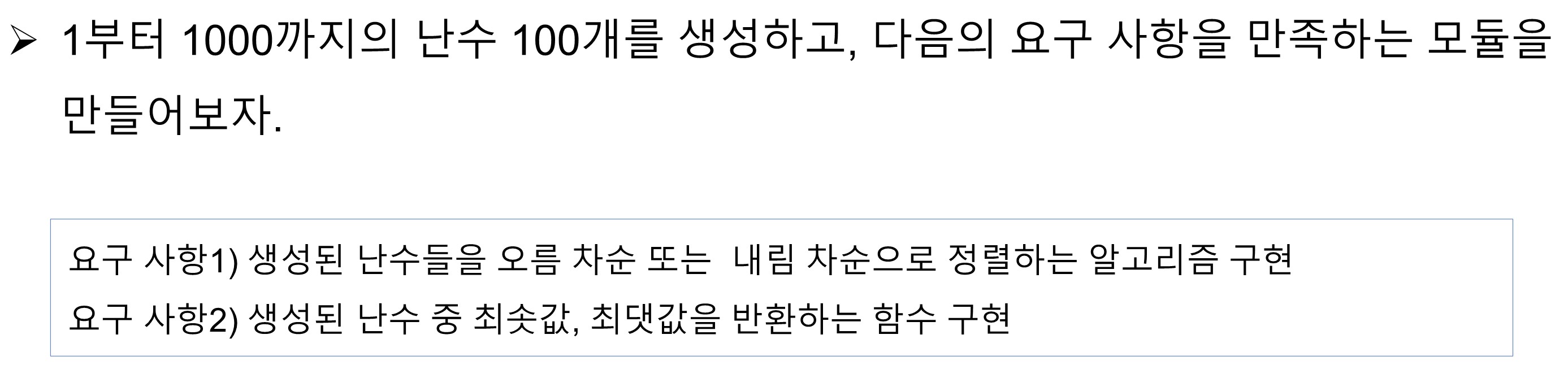
import copy

def getInsert(ns, deepCopy = True, asc=False, desc=False):
    if deepCopy :
        cns = copy.copy(ns)
    else :
        cms = ns

    if asc==True:
        for i1 in range(1, len(cns)):
            i2 = i1 - 1
            cNum = cns[i1]

            while cns[i2] > cNum and i2 >= 0:
                cns[i2+1] = cns[i2]
                i2 -= 1

            cns[i2+1] = cNum

    elif desc==True:
        for i1 in range(1, len(cns)):
            i2 = i1 - 1
            cNum = cns[i1]

            while cns[i2] < cNum and i2 >= 0:
                cns[i2 + 1] = cns[i2]
                i2 -= 1
            cns[i2 + 1] = cNum

    minNum = min(cns)
    maxNum = max(cns)
    print(f'min number : {minNum}')
    print(f'max number : {maxNum}')

    return cns


import insertMod as im
import random as rd

nums = []
for i in range(100):
    nums.append(rd.randint(1, 1000))

print(nums)

resultAsc = im.getInsert(nums, asc=True)
resultDesc = im.getInsert(nums, desc=True)

print(f'sorted number by ASC : {resultAsc}')
print(f'sorted number by DESC : {resultDesc}')
print(f'min number : {min(resultAsc)}')
print(f'max number : {max(resultAsc)}')
↓
[42, 57, 642, 199, 375, 931, 922, 797, 888, 495, 990,
535, 921, 626, 988, 120, 552, 166, 350, 533, 351, 970,
736, 497, 8, 456, 189, 183, 804, 999, 974, 937, 58,
584, 687, 616, 811, 924, 139, 354, 118, 241, 811, 849,
923, 316, 479, 93, 655, 5, 918, 437, 359, 748, 620, 13,
201, 352, 21, 34, 156, 973, 126, 820, 125, 473, 320,
791, 304, 124, 871, 734, 267, 276, 999, 821, 475, 707,
639, 706, 169, 677, 924, 159, 737, 471, 586, 344, 284,
140, 324, 526, 388, 243, 964, 431, 755, 680, 776, 345]
sorted number by ASC : [5, 8, 13, 21, 34, 42, 57, 58,
93, 118, 120, 124, 125, 126, 139, 140, 156, 159, 166,
169, 183, 189, 199, 201, 241, 243, 267, 276, 284, 304,
316, 320, 324, 344, 345, 350, 351, 352, 354, 359, 375,
388, 431, 437, 456, 471, 473, 475, 479, 495, 497, 526,
533, 535, 552, 584, 586, 616, 620, 626, 639, 642, 655,
677, 680, 687, 706, 707, 734, 736, 737, 748, 755, 776,
791, 797, 804, 811, 811, 820, 821, 849, 871, 888, 918,
921, 922, 923, 924, 924, 931, 937, 964, 970, 973, 974,
988, 990, 999, 999]
sorted number by DESC : [999, 999, 990, 988, 974, 973,
970, 964, 937, 931, 924, 924, 923, 922, 921, 918, 888,
871, 849, 821, 820, 811, 811, 804, 797, 791, 776, 755,
748, 737, 736, 734, 707, 706, 687, 680, 677, 655, 642,
639, 626, 620, 616, 586, 584, 552, 535, 533, 526, 497,
495, 479, 475, 473, 471, 456, 437, 431, 388, 375, 359,
354, 352, 351, 350, 345, 344, 324, 320, 316, 304, 284,
276, 267, 243, 241, 201, 199, 189, 183, 169, 166, 159,
156, 140, 139, 126, 125, 124, 120, 118, 93, 58, 57, 42,
34, 21, 13, 8, 5]
min number : 5
max number : 999
✏ 선택정렬
- 주어진 리스트 중에 최소값을 찾아, 그 값을 맨 앞에 위치한 값과 교체하는 방식으로 자료를 정렬하는 알고리즘이다.
nums = [4,2,5,1,3]
print(nums)

for i in range(len(nums) - 1):
    minIdx = i
    for j in range(i+1, len(nums)):
        if nums[minIdx] > nums[j]:
            minIdx = j

    # tempNum = nums[i]
    # nums[i] = nums[minIdx]
    # nums[minIdx] = tempNum

    nums[i],nums[minIdx] = nums[minIdx],nums[i]
    print(nums)
↓
[4, 2, 5, 1, 3]
[1, 2, 5, 4, 3]
[1, 2, 5, 4, 3]
[1, 2, 3, 4, 5]
[1, 2, 3, 4, 5]- 선택정렬 실습

import random

scores = random.sample(range(50, 101),20)
print(f'scores : {scores}')

def printScores(ns,asc=True):

    if asc:
        for i in range(len(ns)-1):
            minIdx = i
            for j in range(i+1,len(ns)):
                if ns[minIdx] > ns[j]:
                    minIdx = j

            ns[i], ns[minIdx] = ns[minIdx], ns[i]
    else:
        for i in range(len(ns) - 1):
            minIdx = i

            for j in range(i + 1, len(ns)):
                if ns[minIdx] < ns[j]:
                    minIdx = j

            ns[i], ns[minIdx] = ns[minIdx], ns[i]

    return ns

printAsc = printScores(scores)
print(f'scores by ASC : {printAsc}')
printDesc = printScores(scores, asc=False)
print(f'scores by Desc : {printDesc}')
↓
scores : [66, 71, 85, 53, 59, 78, 88, 82, 90, 68, 86,
76, 81, 69, 92, 50, 67, 94, 56, 75]
scores by ASC : [50, 53, 56, 59, 66, 67, 68, 69, 71,
75, 76, 78, 81, 82, 85, 86, 88, 90, 92, 94]
scores by Desc : [94, 92, 90, 88, 86, 85, 82, 81, 78,
76, 75, 71, 69, 68, 67, 66, 59, 56, 53, 50]
✏ 최댓값
- 자료구조에서 가장 큰 값을 찾는다.
class Maxalgorithm:

    def __init__(self, ns):
        self.nums = ns
        self.maxNum = 0

    def getMaxNum(self):

        self.maxNum = self.nums[0]

        for n in self.nums:
            if self.maxNum < n:
                self.maxNum = n

        return self.maxNum

nums = [-2,-4,5,7,10,0,8,20,-11]
ma = Maxalgorithm(nums)

result = ma.getMaxNum()
print(nums)
print('maxNum : {}'.format(result))
↓
[-2, -4, 5, 7, 10, 0, 8, 20, -11]
maxNum : 20- 최댓값 실습
class MaxAlgorithm :

    def __init__(self, ns):
        self.chars = ns
        self.maxChar = 0

    def getMaxChar(self):
        self.maxChar = self.chars[0]

        for c in self.chars:
            if ord(self.maxChar) < ord(c):
                self.maxChar = c

        return self.maxChar

chars = ['c','x','Q','A','e','P','p']

ma = MaxAlgorithm(chars)
print('chars : {}'.format(chars))
print('maxChar : {}'.format(ma.getMaxChar()))
↓
char : ['c', 'x', 'Q', 'A', 'e', 'P', 'p']
maxChar : x
✏ 최솟값
- 자료구조에서 가장 작은 값을 찾는다.
class MinAlgorithm:

    def __init__(self, ns):
        self.nums = ns
        self.minNum = 0

    def getMinNum(self):
        self.minNum = self.nums[0]

        for n in self.nums:
            if self.minNum > n:
                self.minNum = n

        return self.minNum

nums = [-2,-4,5,7,10,-100,8,20,-11]

ma = MinAlgorithm(nums)
minNum = ma.getMinNum()
print(f'nums : {nums}')
print(f'minNum : {minNum}')
↓
nums : [-2, -4, 5, 7, 10, -100, 8, 20, -11]
minNum : -100- 최솟값 실습
- 리스트에서 아스키코드가 가장 작은 값을 찾는 알고리즘을 만들어보자.
class MinChar:
    def __init__(self, cs):
        self.chars = cs
        self.minChar = 0

    def getMinChar(self):
        self.minChar = self.chars[0]

        for c in self.chars:
            if ord(self.minChar) > ord(c):
                self.minChar = c

        return self.minChar


chars = ['c','x','Q','A','e','P','p']
mc = MinChar(chars)
minChar = mc.getMinChar()
print(f'chars : {chars}')
print(f'minChar : {minChar}')
↓
chars : ['c', 'x', 'Q', 'A', 'e', 'P', 'p']
minChar : A
✏ 최빈값
- 데이터에서 빈도수가 가장 많은 데이터를 최빈값이라고 한다.
class MAxAlgorithm:

    def __init__(self, ns):
        self.nums = ns
        self.maxNum = 0
        self.maxNumIdx = 0

    def setMaxIdxAndNum(self):
        self.maxNum = self.nums[0]
        self.maxNumIdx = 0

        for i, n in enumerate(self.nums):
            if self.maxNum < n :
                self.maxNum = n
                self.maxNumIdx = i

    def getMaxNum(self):
        return self.maxNum

    def getMaxNumIdx(self):
        return self.maxNumIdx

nums = [1,3,7,6,7,7,7,12,12,17]

ma = MAxAlgorithm(nums)
ma.setMaxIdxAndNum()
maxNum = ma.getMaxNum()
print(f'maxNum : {maxNum}')

indexes = [0 for i in range(maxNum + 1)]
print(f'indexes length : {len(indexes)}')

for n in nums:
    indexes[n] = indexes[n] + 1

print(f'indexes : {indexes}')

maxAlo = MAxAlgorithm(indexes)
maxAlo.setMaxIdxAndNum()
maxNum = maxAlo.getMaxNum()
maxNumIdx = maxAlo.getMaxNumIdx()
print(f'maxNum : {maxNum}')
print(f'maxNumIdx : {maxNumIdx}')

print(f'즉, {maxNumIdx}의 빈도수가 {maxNum}로 가장 높다.')
↓
maxNum : 17
indexes length : 18
indexes : [0, 1, 0, 1, 0, 0, 1, 4, 0, 0, 0, 0, 2, 0, 0, 0, 0, 1]
maxNum : 4
maxNumIdx : 7
즉, 7의 빈도수가 4로 가장 높다.- 최빈값 실습
class MaxAlgorithm:

    def __init__(self, ns):
        self.nums = ns
        self.MaxNum = 0
        self.MaxNumIdx = 0

    def setMaxNumIdxAndNum(self):
        self.MaxNum = self.nums[0]
        self.MaxNumIdx = 0

        for i, n in enumerate(self.nums):
            if self.MaxNum < n :
                self.MaxNum = n
                self.MaxNumIdx = i

    def getMaxNum(self):
        return self.MaxNum

    def getMaxNumIdx(self):
        return self.MaxNumIdx


import random as rd
import lowestMod as lm

scores = []

for i in range(100):
    scores.append(rd.randint(14, 20)*5)

print(f'scores : {scores}')

# 최댓값 알고리즘
maxAlo = lm.MaxAlgorithm(scores)
maxAlo.setMaxNumIdxAndNum()
maxNum = maxAlo.getMaxNum()
print(f'maxNum : {maxNum}')

# 인덱스 리스트 생성
indexes = [0 for i in range(len(scores)+1)]
# 인덱스 리스트 저장
for n in scores:
    indexes[n] = indexes[n] + 1


n = 1
while True :

    maxAlo = lm.MaxAlgorithm(indexes)
    maxAlo.setMaxNumIdxAndNum()
    maxNum = maxAlo.getMaxNum()
    maxNumIdx = maxAlo.getMaxNumIdx()

    if maxNum == 0:
        break

    print(f'{n}. {maxNumIdx} 빈도수 : {maxNum} \t', end='')
    print('+' * maxNum)

    indexes[maxNumIdx] = 0

    n += 1
↓
scores : [100, 90, 90, 85, 100, 85, 80, 95, 100, 90,
75, 80, 100, 100, 95, 75, 75, 100, 100, 80, 100, 75,
70, 85, 80, 70, 75, 75, 85, 80, 90, 75, 75, 75, 75,
100, 75, 70, 90, 75, 90, 100, 95, 85, 90, 85, 75, 75,
95, 70, 90, 80, 70, 90, 70, 70, 100, 95, 70, 70, 85,
80, 100, 75, 75, 75, 85, 70, 85, 100, 75, 70, 75, 100,
90, 70, 95, 85, 85, 80, 75, 100, 70, 90, 85, 80, 70,
95, 95, 90, 80, 85, 95, 80, 80, 95, 95, 70, 85, 85]
maxNum : 100
1. 75 빈도수 : 20 	++++++++++++++++++++
2. 70 빈도수 : 15 	+++++++++++++++
3. 85 빈도수 : 15 	+++++++++++++++
4. 100 빈도수 : 15 +++++++++++++++
5. 80 빈도수 : 12 	++++++++++++
6. 90 빈도수 : 12 	++++++++++++
7. 95 빈도수 : 11 	+++++++++++
✏ 근삿값
- 특정 값(참값)에 가장 가까운 값을 근삿값이라고 한다.
import random

nums = random.sample(range(0, 50), 20)
print(f'nums : {nums}')

inputNum = int(input('input number: '))
print(f'inputNum : {inputNum}')

nearNum = 0
minNum = 50

for n in nums:
    absNum = abs(n - inputNum)
    # print((f'absNum : {absNum}'))

    if absNum < minNum:
        minNum = absNum
        nearNum = n

print(f'nearNum: {nearNum}')
↓
nums : [37, 25, 39, 5, 19, 13, 40, 2, 10, 34, 28, 31, 38, 12, 43, 11, 0, 35, 23, 30]
input number: 44
inputNum : 44
nearNum: 43- 근삿값 실습
def getNearNum(an):
    baseScores = [95, 85, 65, 55]
    nearNum = 0
    minNum = 100

    for n in baseScores:
        absNum = abs(n - an)
        if absNum < minNum:
            minNum = absNum
            nearNum = n

    if nearNum == 95 :
        return 'A'
    elif nearNum == 85 :
        return 'B'
    elif nearNum == 75 :
        return 'C'
    elif nearNum == 65 :
        return 'D'
    elif nearNum <= 55 :
        return 'F'


import near

korScore = int(input('input kor score : '))
engScore = int(input('input eng score : '))
matScore = int(input('input mat score : '))
sciScore = int(input('input sci score : '))
hisScore = int(input('input his score : '))

scores = [korScore,engScore,matScore,sciScore,hisScore]
totalScore = 0
avgScore = 0
for n in scores:
    totalScore += n
    avgScore = totalScore / len(scores)

print(f'totalScore : {totalScore}')
print(f'avgScore : {avgScore}')

grade = near.getNearNum(avgScore)

print(f'grade : {grade}')
↓
input kor score : 77
input eng score : 88
input mat score : 97
input sci score : 88
input his score : 79
totalScore : 429
avgScore : 85.8
grade : B
✏ 평균
- 여러 수나 양의 중간값을 갖는 수를 평균이라고 한다.
import random

nums = random.sample(range(0, 100), 10)
print(nums)

total = 0
for n in nums:
    total += n

avgNum  = total / len(nums)
print(avgNum)
↓
[71, 35, 15, 83, 97, 1, 2, 96, 39, 20]
45.9- 평균 실습
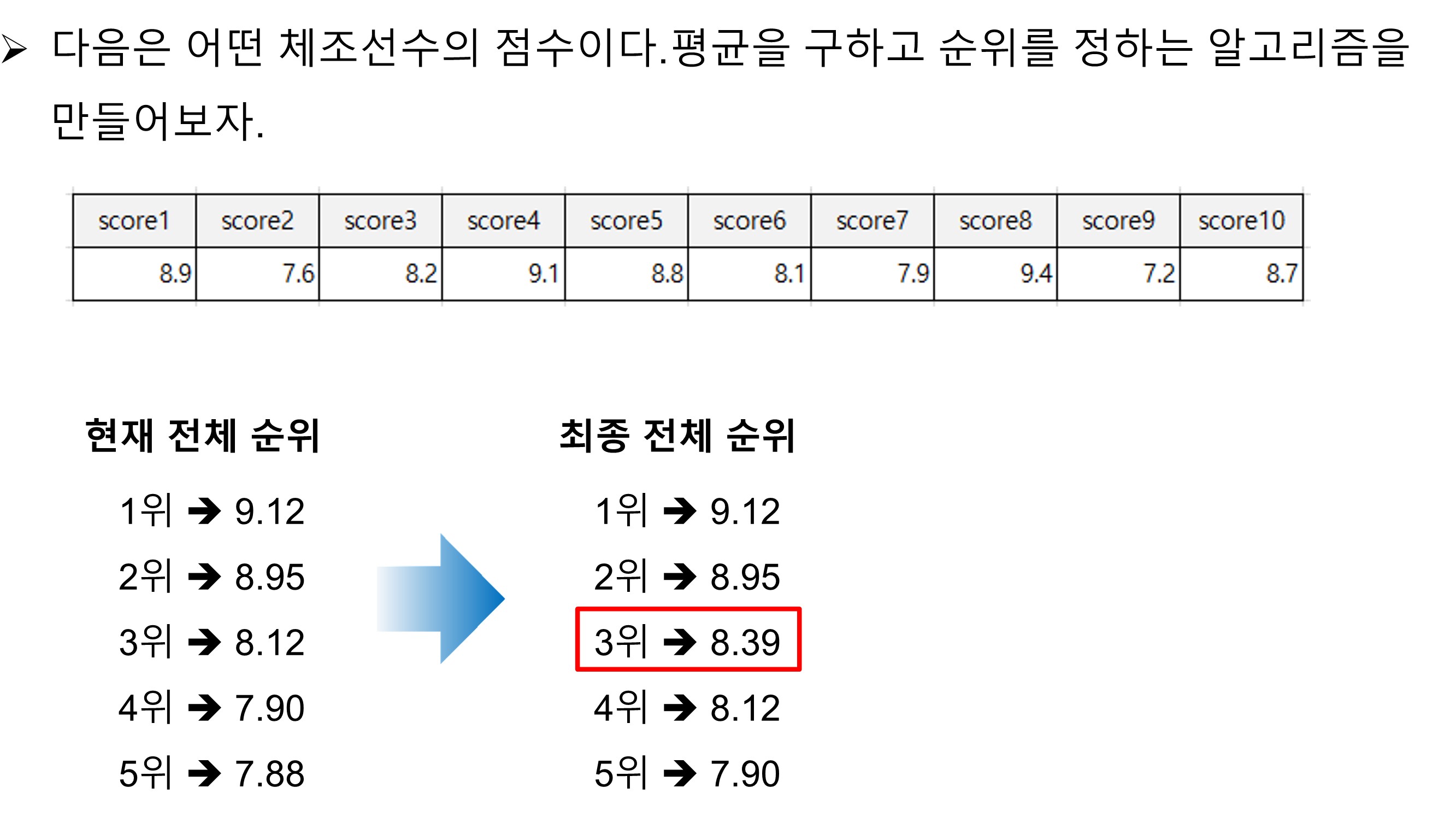
class Top5Players :

    def __init__(self, cs, ns):
        self.currentScores = cs
        self.newScore = ns

    def setAlignScore(self):

        nearIdx = 0
        nearScore = 0
        minNum = 10.0

        for i, s in enumerate(self.currentScores):
            absNum = abs(self.newScore - s)

            if absNum < minNum:
                minNum = absNum
                nearIdx = i
                nearScore = s

        if self.newScore >= self.currentScores[nearIdx]:
            for i in range(len(self.currentScores)-1, nearIdx, -1):
                self.currentScores[i] = self.currentScores[i-1]

            self.currentScores[nearIdx] = self.newScore

        else:
            for i in range(len(self.currentScores)-1, nearIdx+1, -1):
                self.currentScores[i] = self.currentScores[i-1]

            self.currentScores[nearIdx] = self.newScore

    def getFinalTo5Players(self):
        return self.currentScores

import random
import avgNear as nr

scores = [8.9, 7.6, 8.2, 9.1, 8.8, 8.1, 7.9, 9.4, 7.2, 8.7]

total = 0
top5PlayerScores = [9.12, 8.95, 8.12, 7.9, 7.88]

for n in scores:
    total += n

print(total)
avgScore = round(total / len(scores),2)
print(avgScore)

tp = nr.Top5Players(top5PlayerScores, avgScore)
tp.setAlignScore()
top5PlayerScores = tp.getFinalTo5Players()

print(f'top5PlayerScores : {top5PlayerScores}')
↓
83.9
8.39
top5PlayerScores : [9.12, 8.95, 8.39, 8.12, 7.9]
✏ 재귀 알고리즘
- 나 자신을 다시 호출하는 것을 재귀라고 한다.
def recusion(num):

    if num > 0:
        print('*' * num)
        return recusion(num-1)
    else:
        return 1

recusion(10)
↓
**********
*********
********
*******
******
*****
****
***
**
*


def factorial(num):

    if num > 0:
        return num * factorial(num-1)
    else:
        return 1

print(f'factorial(10) : {factorial(10)}')
↓
factorial(10) : 3628800- 재귀 알고리즘 실습
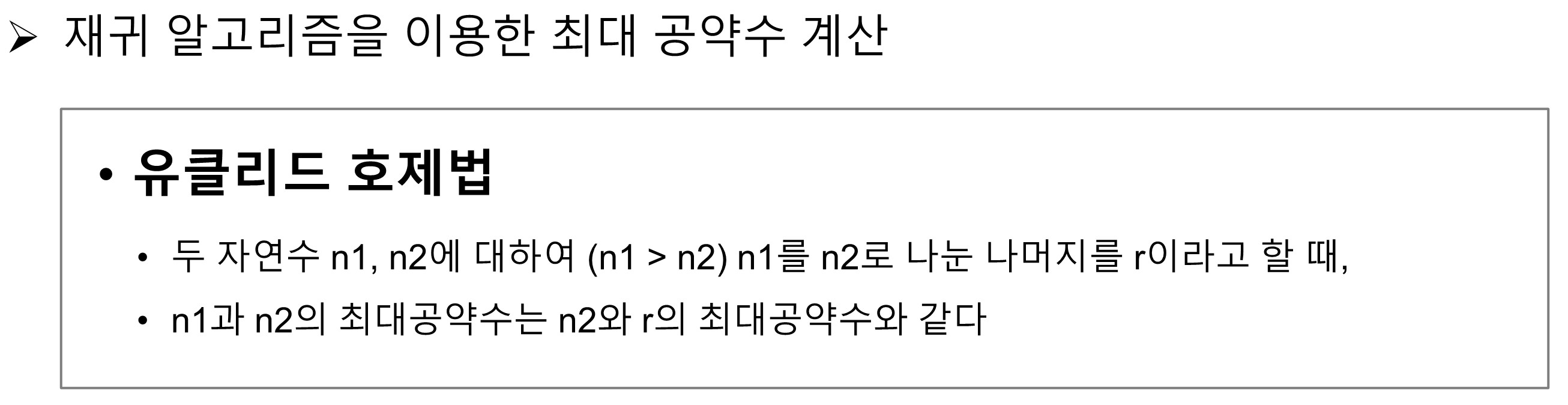
def greatestCommonDevide(n1,n2):

    maxNum = 0
    for i in range(1, (n1+1)):
        if n1 % i == 0and n2 % i == 0:
            maxNum = i

    return maxNum

print(f'maxNum : {greatestCommonDevide(82,32)}')
print(f'maxNum : {greatestCommonDevide(96,40)}')
↓
maxNum : 2
maxNum : 8


def gcd(n1, n2):

    if n1 % n2 == 0:
        return n2
    else:
        return gcd(n2, n1 % n2)

print(f'maxNum : {gcd(82,32)}')
print(f'maxNum : {gcd(96,40)}')
↓
maxNum : 2
maxNum : 8
✏ 하노이의 탑
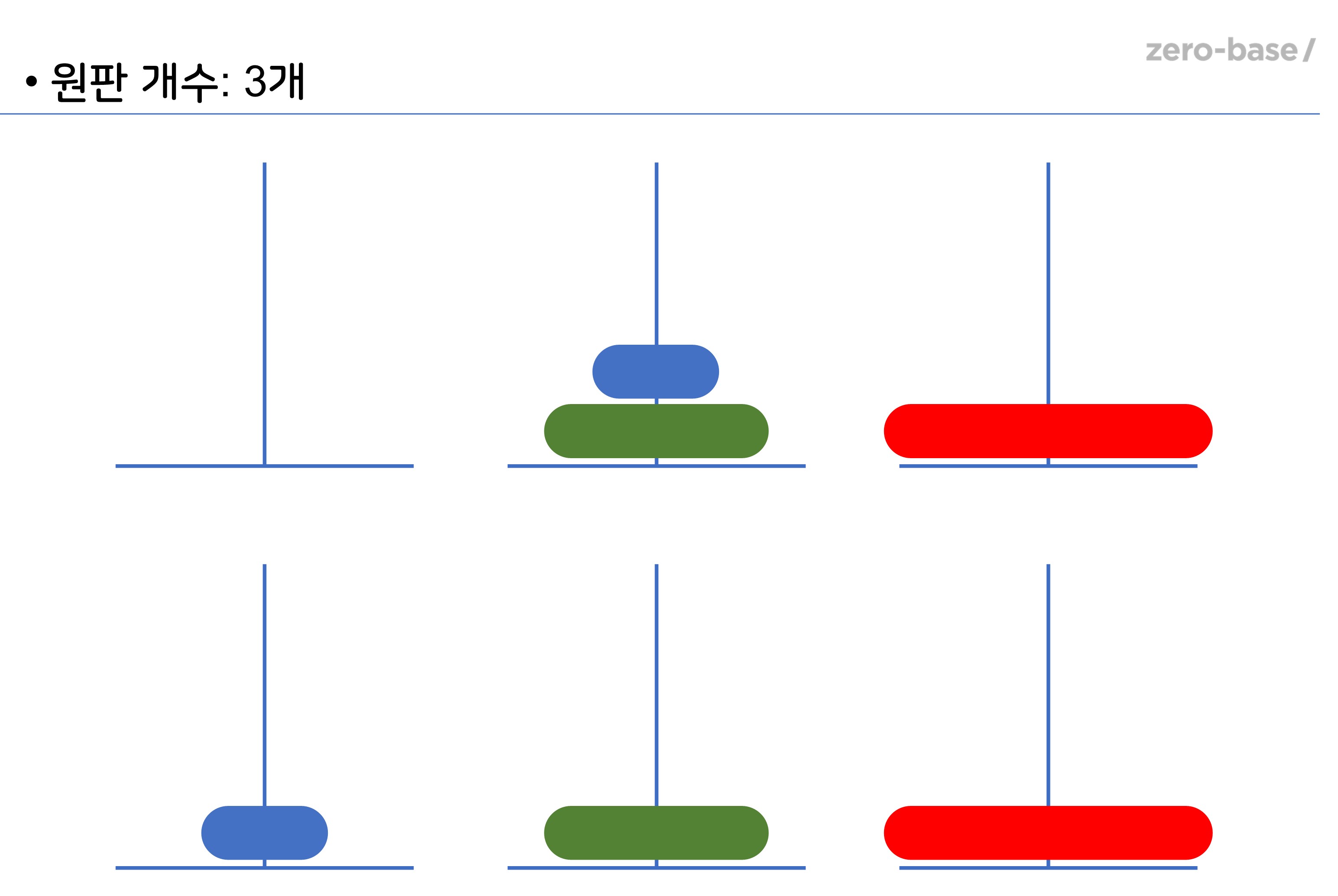
- 퍼즐 게임의 일종으로 세 개의 기둥을 이용해서 원판을 다른 기둥으로 옮기면 되고, 제약 조건은 다음과 같다.
- 한 번에 한개의 원판만 옮길 수 있다.- 큰 원판이 작은 원판 위에 있어서는 안된다.
- 하노이의 탑 실습
          # 원판 개수, 출발 기둥, 도착 기둥, 경유 기둥
def moveDisc(discCnt, fromBar, toBar, viaBar):
        if discCnt == 1:
            print(f'{discCnt}disc를 {fromBar}에서 {toBar}(으)로 이동!')

        else:
            # (discCnt - 1)개들을 경유 기둥으로 이동
            moveDisc(discCnt - 1, fromBar, viaBar, toBar)

            # discCnt를 목적 기둥으로 이동
            print(f'{discCnt}disc를 {fromBar}에서 {toBar}(으)로 이동!')

            # (discCnt-1)개들을 도착 기둥으로 이동
            moveDisc(discCnt-1, viaBar, toBar, fromBar)

moveDisc(3,1,3,2)
↓
1disc를 1에서 3(으)로 이동!
2disc를 1에서 2(으)로 이동!
1disc를 3에서 2(으)로 이동!
3disc를 1에서 3(으)로 이동!
1disc를 2에서 1(으)로 이동!
2disc를 2에서 3(으)로 이동!
1disc를 1에서 3(으)로 이동!
✏ 병합정렬
- 자료구조를 분할하고 각각의 분할된 자료구조를 정렬한 후 다시 병합하여 정렬한다.
def mSort(ns):

    if len(ns) < 2:
        return ns

    midIdx = len(ns) // 2
    leftNums = mSort(ns[0:midIdx])
    rightNums = mSort(ns[midIdx:len(ns)])

    mergeNums = []
    leftIdx = 0; rightIdx = 0
    while leftIdx < len(leftNums) and rightIdx < len(rightNums):

        if leftNums[leftIdx] < rightNums[rightIdx]:
            mergeNums.append(leftNums[leftIdx])
            leftIdx += 1

        else:
            mergeNums.append(rightNums[rightIdx])
            rightIdx += 1

    mergeNums = mergeNums + leftNums[leftIdx:]
    mergeNums = mergeNums + rightNums[rightIdx:]

    return mergeNums

nums = [8, 1, 4, 3, 2, 5, 10, 6]

print(f'mSort : {mSort(nums)}')
↓
mSort : [1, 2, 3, 4, 5, 6, 8, 10]- 병합정렬 실습
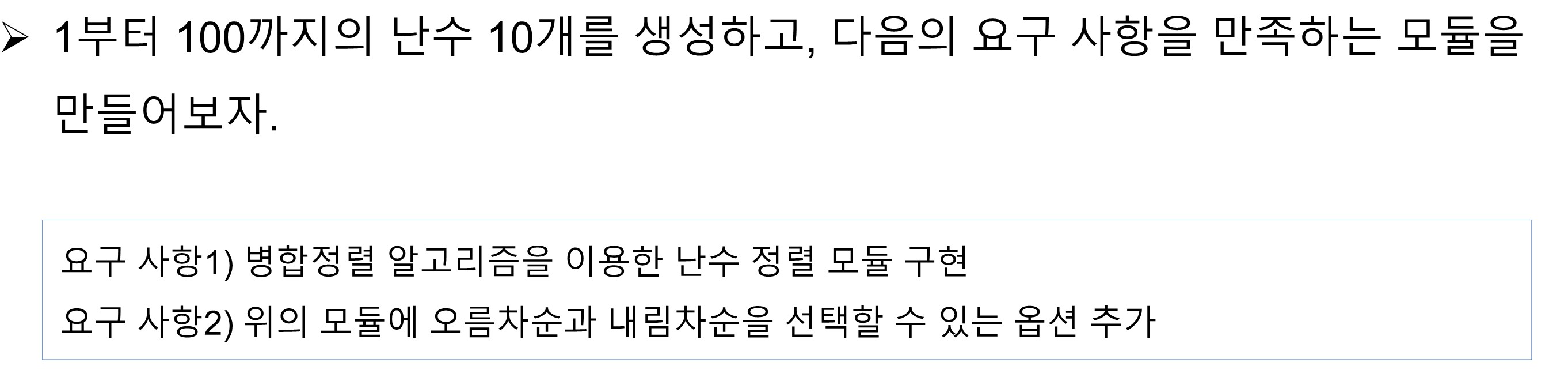
# zero-base

def mSort(ns,asc=True):
    if len(ns) < 2 :
        return ns

    midIdx = len(ns) // 2
    leftNums = mSort(ns[0:midIdx], asc=asc)
    rightNums = mSort(ns[midIdx: len(ns)], asc=asc)

    mergeNums = []

    leftIdx = 0; rightIdx = 0

    while leftIdx < len(leftNums) and rightIdx < len(rightNums):
        if asc:
            if leftNums[leftIdx] < rightNums[rightIdx]:
                mergeNums.append(leftNums[leftIdx])
                leftIdx += 1

            else:
                mergeNums.append(rightNums[rightIdx])
                rightIdx += 1
        else:
            if leftNums[leftIdx] > rightNums[rightIdx]:
                mergeNums.append(leftNums[leftIdx])
                leftIdx += 1

            else:
                mergeNums.append(rightNums[rightIdx])
                rightIdx += 1

    mergeNums += leftNums[leftIdx:]
    mergeNums += rightNums[rightIdx:]

    return mergeNums
↓
not sorted rNums : [14, 56, 50, 59, 33, 65, 93, 13, 6, 77]
sorted rNums : [6, 13, 14, 33, 50, 56, 59, 65, 77, 93]
sorted rNums : [93, 77, 65, 59, 56, 50, 33, 14, 13, 6]


# self

import random

def mSort(ns, sort=True):

    if len(ns) < 2:
        return ns

    midIdx = len(ns) // 2
    leftNums = mSort(ns[0:midIdx])
    rightNums = mSort(ns[midIdx:len(ns)])

    leftIdx = 0; rightIdx = 0

    mergeNums = []

    while leftIdx < len(leftNums) and rightIdx < len(rightNums):

        if leftNums[leftIdx] < rightNums[rightIdx]:
            mergeNums.append(leftNums[leftIdx])
            leftIdx += 1

        else:
            mergeNums.append(rightNums[rightIdx])
            rightIdx += 1

    mergeNums += leftNums[leftIdx:]
    mergeNums += rightNums[rightIdx:]
    if sort:
        return mergeNums
    else:
        mergeNums.sort(reverse=True)
        return mergeNums


nums = random.sample(range(1, 101), 10)
print(f'nums : {nums}')
print(f'mSort : {mSort(nums)}')
print(f'mSort : {mSort(nums, sort=False)}')
↓
not sorted nums : [40, 24, 12, 83, 79, 59, 20, 68, 98, 5]
mSort by ASC : [5, 12, 20, 24, 40, 59, 68, 79, 83, 98]
mSort by DESC : [98, 83, 79, 68, 59, 40, 24, 20, 12, 5]
✏ 퀵정렬
- 기준 값보다 작은 값과 큰 값으로 분리한 후 다시 합친다.
def qSort(ns):

    if len(ns) < 2:
        return ns

    midIdx = len(ns) // 2
    midVal = ns[midIdx]


    smallNums = []; sameNums = []; bigNums = []

    for n in ns :
        if n < midVal:
            smallNums.append(n)
        elif n == midVal:
            sameNums.append(n)
        else:
            bigNums.append(n)

    return qSort(smallNums) + sameNums + qSort(bigNums)

nums = [8, 1, 4, 3, 2, 5, 4, 10, 6, 8]

print(f'not sorted nums : {nums}')
print(f'qSort(nums) : {qSort(nums)}')
↓
not sorted nums : [8, 1, 4, 3, 2, 5, 4, 10, 6, 8]
qSort(nums) : [1, 2, 3, 4, 4, 5, 6, 8, 8, 10]- 퀵 정렬 실습
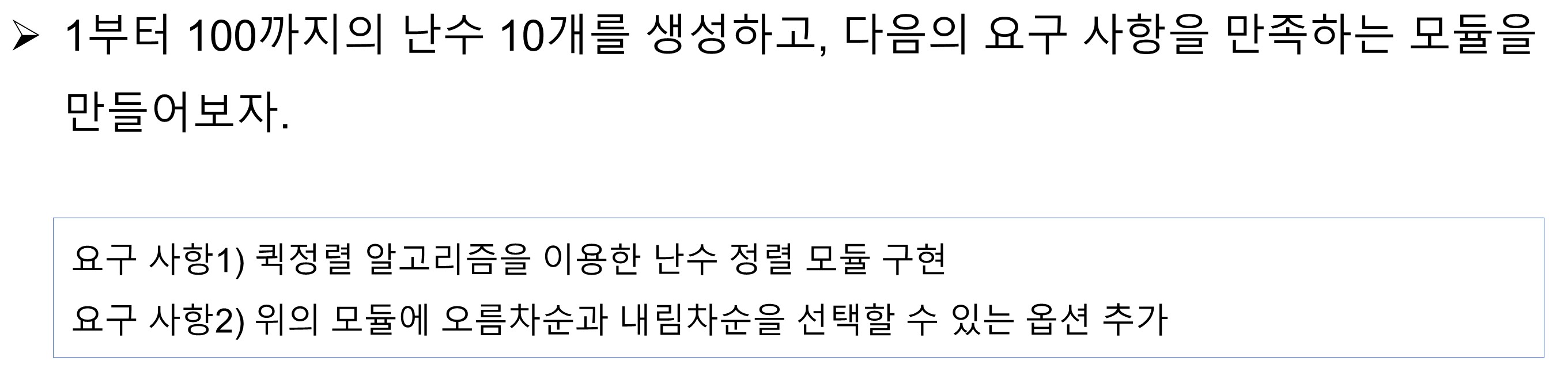
import random as rd
def qSort(ns, asc=True):

    if len(ns) < 2:
        return ns

    midIdx = len(ns) // 2
    midVal = ns[midIdx]

    smallNums = []; sameNums = []; bigNums = []

    for n in ns:

            if n < midVal:
                smallNums.append(n)
            elif n == midVal:
                sameNums.append(n)
            else:
                bigNums.append(n)

    if asc:
        return qSort(smallNums, asc=asc) + sameNums + qSort(bigNums,asc=asc)
    else:
        return qSort(bigNums, asc=asc) + sameNums + qSort(smallNums, asc=asc)


nums = rd.sample(range(1, 101), 10)

print(f'not sorted nums : {nums}')
print(f'sorted nums by ASC : {qSort(nums)}')
print(f'sorted nums by DESC : {qSort(nums, asc=False)}')
↓
not sorted nums : [5, 96, 21, 94, 60, 85, 49, 37, 1, 79]
sorted nums by ASC : [1, 5, 21, 37, 49, 60, 79, 85, 94, 96]
sorted nums by DESC : [96, 94, 85, 79, 60, 49, 37, 21, 5, 1]
개발 스터디 노트