Pang, C., Cao, Y., Zhou, G., Li, H., & Luo, P. (2025). Document-Level Tabular Numerical Cross-Checking: A Coarse-to-Fine Approach. http://arxiv.org/abs/2506.13328
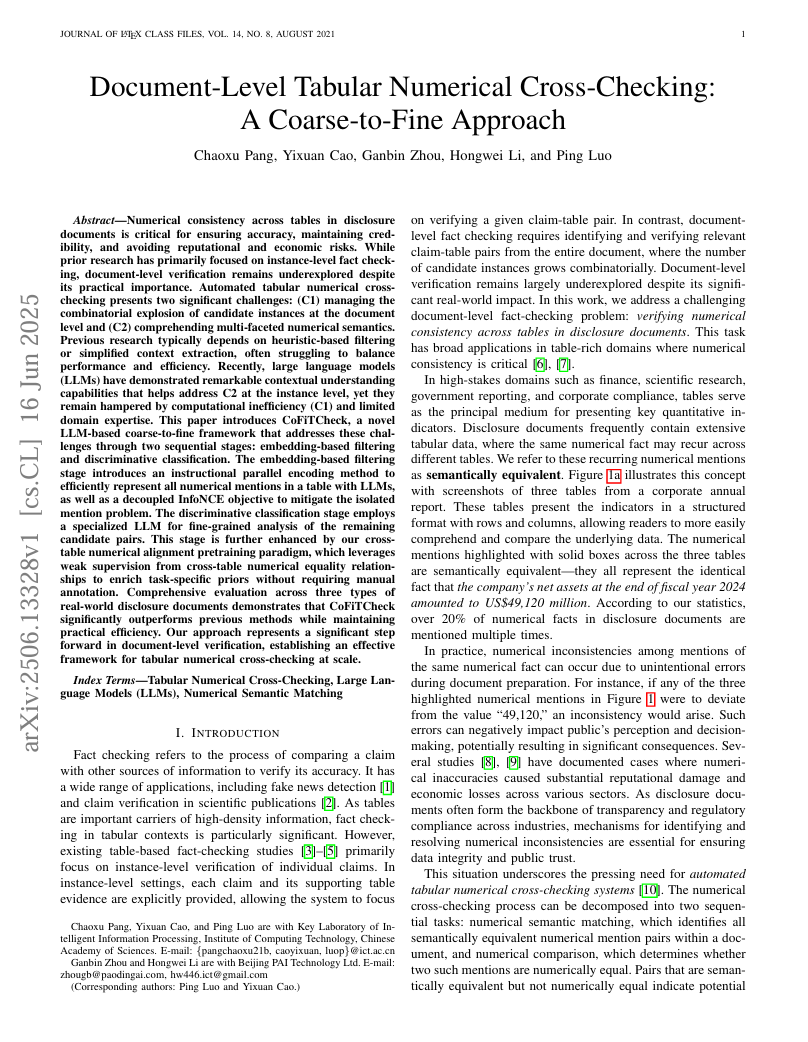
This paper addresses a challenging document-level fact-checking problem: verifying numerical consistency across tables in disclosure documents.
The numerical cross-checking process can be decomposed into two sequential tasks:
- Numerical Semantic Matching: identifies all semantically equivalent numerical mention pairs within a document.
- Numerical Comparison: determines whether two semantically equivalent numerical mentions are numerically equal.
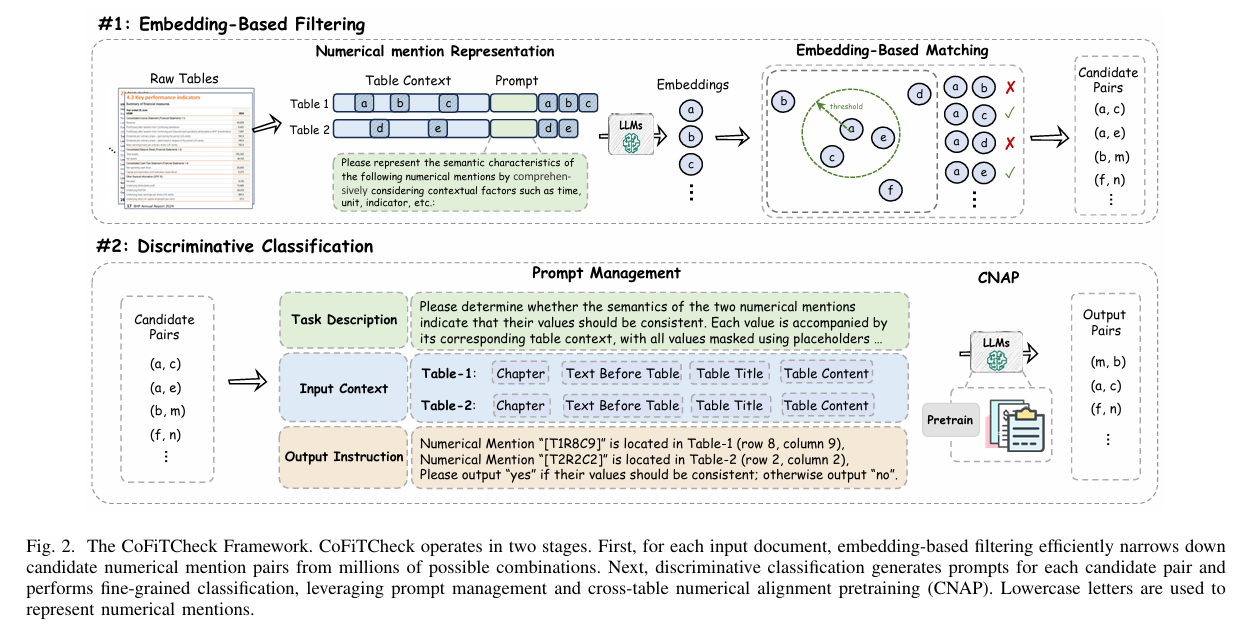
To address this task, the paper propeses CoFiTCheck, a novel Coarse-to-Fine Tabular Numerical Cross-Checking framework, which operates through two sequential stages:
Coarse-to-fine: 복잡한 문제를 해결할 때 넓고 대략적인 단계에서 시작해 점차 좁고 정밀한 단계로 구체화해 나가는 계층적 문제 해결방식
1) Embedding-Based Filtering
Efficiently reduces the large candidate space by encoding numerical mentions as dense embeddings and filtering candidate pairs based on embedding similarity.
2) Discriminative Classification
Performs fine-grained classification on the remaining candidate pairs to determine whether the numerical mentions are semantically equivalent.
[Method]
- To prevent cross-contamination between numerical mentions after the prompt, a specialized attention mask is applied.
여러 숫자 을 한번에 EmbLLM에 넣으면, 뒤에 있는 숫자가 앞 숫자의 정보를 볼 수 있음 → 각 숫자의 embedding이 섞임 → attention mask와 positional encoding으로 해결
- For numerical mention , consisting of tokens , the attention mask is defined as:
> 현재 Numerical mention의 특정 token이 어떤 token들을 볼 수 있는지
>
- This ensures that tokens within a numerical mention can attend only to:
    - the table context $c$
    - the prompt $p_{emb}$
    - preceding tokens within the same numerical mention
- and not to other numerical mentions
- The position indices of numerical mention tokens are reset to start after the end of the prompt regardless of their absolute position in the sequence:
Numerical mention의 Positional index를 Prompt 직후부터 독립적으로 다시 시작하여, mention간 순서정보가 섞이지 않도록 함
- These adjustments preserve contextual understanding while isolating the representations of individual numerical mentions.
Pruning: 딥러닝 인공지능 모델에서 중요도가 낮은 가중치나 뉴런을 제거하여 모델의 크기와 연산량을 줄이는 경량화 기법
- After obtaining embeddings for all numerical mentions , candidate pairs retained only when their embedding similarity exceeds a threshold t:
- To efficiently identify candidate pairs at scale, the authors use the HNSW algorithm implemented in the FAISS library for approximate nearest-neighbor search.
> FAISS의 HNSW(Hierarchical Navigable Small World)
수많은 dense vector 중에서 query vector와 가장 비슷한 vector를 빠르게 찾기 위한 그래프 기반 Approximate Nearest Neighbor (ANN) 알고리즘
> - The computational complexity of constructing : →
- To train EmbLM, the paper proposed a decoupled InfoNCE objective utilizing in-batch negatives.
InfoNCE(Information Noise-Contrastive Estimation): Self-Supervised Learning에서 Positive Sample과 Negative Sample을 비교해 유용한 특징 표현을 학습하도록 돕는 핵심 손실 함수
- For each mention : denotes the set of indices of mentions that are semantically equivalent to , while the remaining mentions are treated as negatives.
- The paper identifies two characteristics that distinguish numerical semantic matching from traditional retrieval:
- Mentions serve as both queries and passages
- Most mentions are isolated without semantic equivalents
- Accordingly:
-
: set of non-isolated numerical mentions
-
: set of isolated numerical mentions
are treated separately.
-
-
- : cosine similarity
- : temperature parameter
- : small constant
-
- encourges semantically equivalent mentions to have similar representations while pushing apart non-equivalent pairs, whereas explicitly enforces dissimilarity between isolated numerical mentions.
- The final training objective is:
※ 앞으로 더 추가 예정!