Poveda-Villalón, M., Fernández-Izquierdo, A., Fernández-López, M., & García-Castro, R. (2022). LOT: An industrial oriented ontology engineering framework. Engineering Applications of Artificial Intelligence, 111, 104755. https://doi.org/10.1016/J.ENGAPPAI.2022.104755
This paper proposes the Linked Open Terms(LOT) methodology, an overall and lightweight methodology for building ontologies based on existing methodologies and oriented to semantic web developments and technologies.
- LOT is the first methodology oriented to the publication of ontologies following semantic web best practices and FAIR(Findable, Accsessible, Interoperable, Reusable) principles including specific recommendations, tips and potential tools that can be helpful to ontology developers.
- The Linked Open Terms (LOT) methodology is a lightweight methodology for developing ontologies and vocabularies on industry projects.
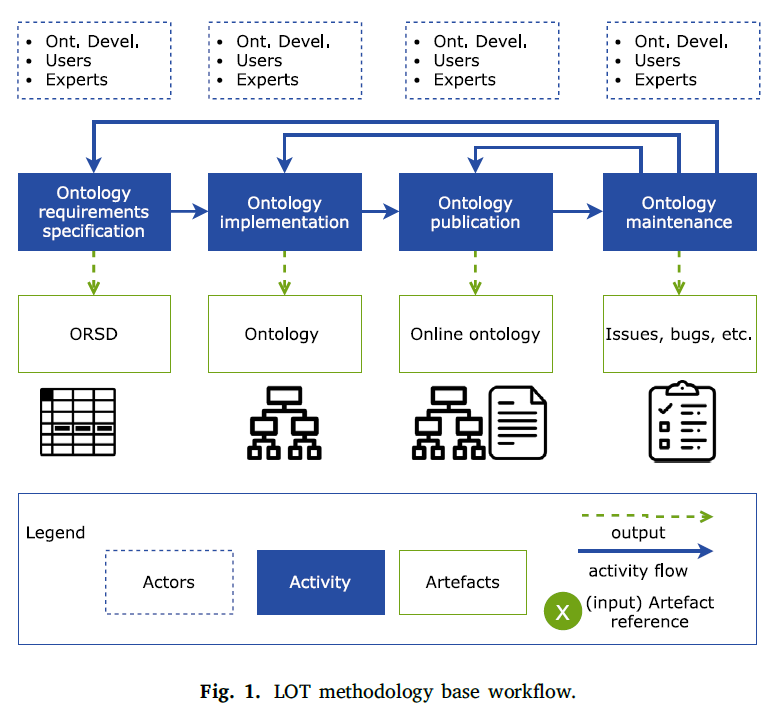
- The LOT methodology defines iterations over a basic workflow composed of the following activities
- Ontological requirements specification
- Ontology implementation
- Ontology publication
- Ontology maintenance
- The main workflow: Requirements elicitation - Implementation - Evaluation
1. Ontology requirements specification
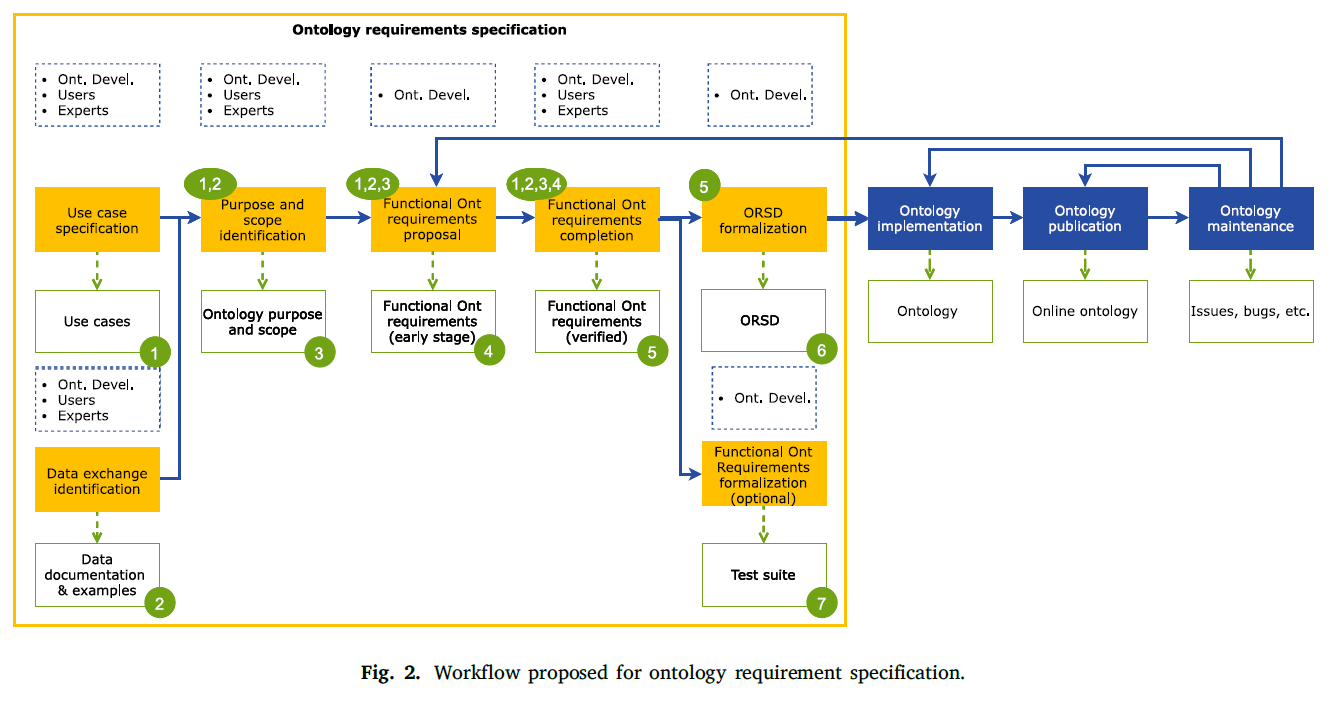
- The activity of collecting the requirements that the ontology should fulfill.
- The goal of the ontology
- The domain that the ontology should model
- Technical details of the ontology
- This activity results the ontology requirements specification document(ORSD)
- the use case specification
- the documentation needed
- the purpose and scope of the ontology
- the requirements proposal
1-1. Use case specification
- The goal of the use case specification activity is to provide a vision on the potential use that the ontology will have.
- The output of this activity is a list of use cases.
- Objective is to guide the obtaining of the requirements.
- Consists of the narration of a scenario in which one or several actors intervene and the necessary interactions to obtain and expected result or benefit.
1-2. Data exchange identification
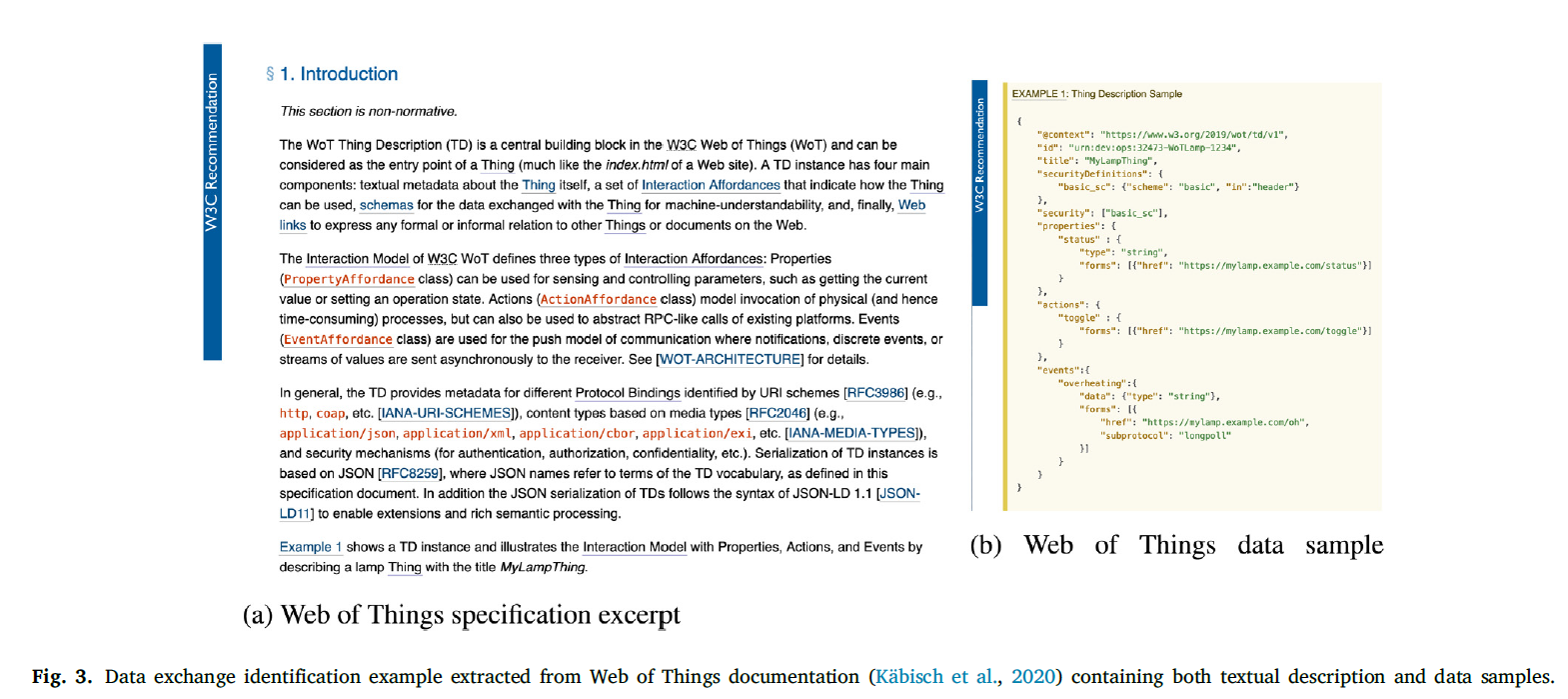
- The goal is to provide the ontology development team with the necessary documentation about the domain to be modeled.
- The output is a set of domain documents and resources.
1-3. Purpose and scope identification
- From use cases and the domain documentation provided in the data exchange identification task, the purpose and scope identification activity is carried out.
- As output of this activity a text document describing the purpose and scope of the ontology is produced.
1-4. Functional ontological requirements proposal
- Competency questions(CQs)
- Suggests to elaborate a set of queries that the ontology to be developed should answer.
- Natural language statements
- The domain to be represented in the ontology is describe by writing affirmative or negative natural language statements.
2. Ontology implementation
- To build the ontology using a formal language, based on the ontological requirements identified by the domain experts and the ontology development team.
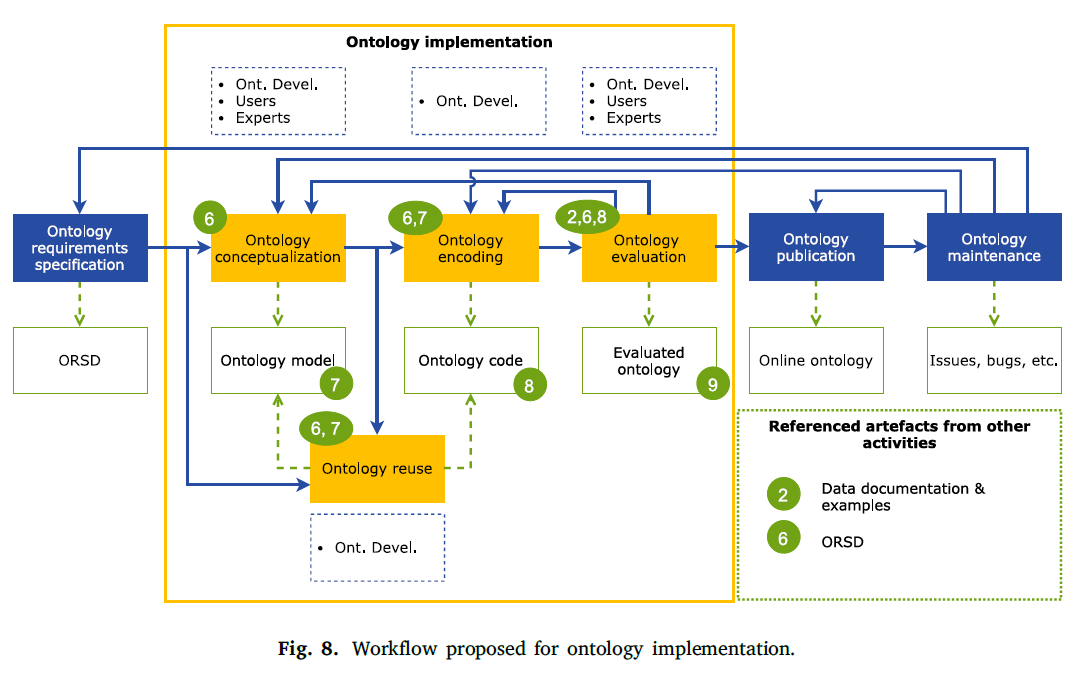
2-1. Ontology conceptualization
- The purpose of the conceptualization sub-activity is to create a model that represents the domain of the ontology.
- The conceptualization could be carried out by stating the concepts and relations in a formal system (or logic language) or could be done by means of diagrams, which is currently a common technique.
- To develop the conceptualization
- Classes (or concepts)
- A class is instantiated by individuals that represent entities that have something in common.
- An individual represents a particular entity of a domain.
- Class hierarchies
- A class A is subclass of another class B if and only if every instance of A is also an instance of B.
- Properties between classes (relationships)
- A binary relationship is instantiated by pairs of individuals that represent facts.
- Properties between classes and datatypes (attributes)
- If the target of a property is a data value, attributes are normally created to indicate that the expected value of the property belongs to a datatype.
- Property hierarchies
- A property r is subproperty of another property t if and only if every time the relation r holds between and individual and another individual or a value the property t also holds.
- Additional Axioms
- Other restrictions could be added to ontology elements, for example: cardinality constraints, property characteristics, universal or existential constraints, etc.
- Classes (or concepts)
2-2. Ontology encoding
- The goal of the encoding activity is to produce an ontology in an implementation language.
- The ontology code resultant from this activity includes in addition to the ontology classes, properties and axioms, metadata, such as creator, title, publisher, license and version of the ontology in addition to metadata for each of the ontology terms.
2-3. Ontology reuse
- Ontology reuse refers to the process of using available ontological resources for solving different problems.
2-4. Ontology evaluation
- Checking the technical quality of an ontology
- Evaluation can be divided into two categories
- Validation
- Compares the meaning of the ontology definitions against the intended model of the world aiming to conceptualize
- Verification
- Compares the ontology against the ontology specification document, ensuring that the ontology is built correctly
- Validation
- I summarized only the aspects related to ontology implementation.

감자애오