[백준][20365] 블로그2
그리디 알고리즘 (Greedy algorithm)
import sys
# sys.setrecursionlimit(10**7)
# sys.stdin = open("sample_input.txt", "r")

n = int(sys.stdin.readline())
text = sys.stdin.readline()

color = {"B": 0, "R": 0}

color[text[0]] += 1

for i in range(1, n):
    if text[i] != text[i-1]:
        color[text[i]] += 1

min_col = min(color["B"], color["R"]) + 1
print(min_col)
[백준][1916] 최소비용 구하기
다익스트라 알고리즘 (Dijkstra's algorithm)
import sys

n = int(sys.stdin.readline())  # 도시의 개수 n
m = int(sys.stdin.readline())  # 버스의 개수 m

graph = {}
for i in range(1, n+1):
    graph[i] = {}

for _ in range(m):
    start, end, cost = map(int, sys.stdin.readline().split())
    if end in graph[start]:
        graph[start][end] = min(graph[start][end], cost)
    else:
        graph[start][end] = cost

city1, city2 = map(int, sys.stdin.readline().split())


def dijkstra(graph, start):
    # 모든 도시까지의 요금을 무한대로 초기화
    costs = {vertex: float('infinity') for vertex in graph}
    # 각 도시를 방문했을 때, 이전에 방문한 도시를 기록
    previous_nodes = {vertex: None for vertex in graph}
    # 시작 도시 요금 0으로 초기화
    costs[start] = 0
    # 아직 방문하지 않은 모든 도시의 목록을 생성
    vertices_to_visit = list(graph.keys())

    # 방문하지 않은 도시가 남아있는 동안 계속 반복
    while vertices_to_visit:
        # 방문하지 않은 도시 중 요금이 가장 낮은 도시 선택
        current_vertex = min(
            vertices_to_visit, key=lambda vertex: costs[vertex])

        # 선택된 도시의 요금이 무한대라면, 나머지 도시는 모두 도달할 수 없는 것이므로 반복 종료
        if costs[current_vertex] == float('infinity'):
            break

        # 선택된 도시에 인접한 모든 도시에 대해 요금 갱신
        for neighbor, weight in graph[current_vertex].items():
            # 선택된 도시를 거쳐 인접한 도시로 이동하는 요금 계산
            alternative_route = costs[current_vertex] + weight
            # 계산된 요금이 현재 알려진 요금보다 저렴하면 갱신
            if alternative_route < costs[neighbor]:
                costs[neighbor] = alternative_route
                previous_nodes[neighbor] = current_vertex

        # 선택된 도시를 방문했으므로 목록 제거
        vertices_to_visit.remove(current_vertex)

    # 모든 도시까지의 최소 요금 정보 반환
    return costs


print(dijkstra(graph, city1)[city2])
[백준][1753] 최단경로
import sys
# sys.setrecursionlimit(10**7)
import heapq
sys.stdin = open("sample_input.txt", "r")

# 정점의 개수 v, 간선의 개수 e
v, e = map(int, sys.stdin.readline().split())
# 시작 정점 k
k = int(sys.stdin.readline())


graph = {}
for i in range(1, v+1):
    graph[i] = {}

for _ in range(e):
    start, end, w = map(int, sys.stdin.readline().split())
    if end in graph[start]:
        graph[start][end] = min(graph[start][end], w)
    else:
        graph[start][end] = w

# 모든 정점까지의 소요시간을 무한대로 초기화
weights = {vertex: float('infinity') for vertex in graph}
heap = []


def dijkstra_heap(graph, start):
    # 시작 정점의 가중치는 0으로 초기화
    weights[start] = 0
    # (가중치, 현재 정점)
    heapq.heappush(heap, (0, start))

    while heap:
        w, n = heapq.heappop(heap)

        # 현재 정점과 연결된 다른 정점 확인
        for i, j in graph[n].items():
            nw = w + j
            if nw < weights[i]:
                weights[i] = nw
                heapq.heappush(heap, (nw, i))
    return weights

weights = dijkstra_heap(graph, k)
for w in weights.values():
    if w == float('infinity'):
        print("INF")
    else:
        print(w)
[백준][14501] 퇴사
DP (동적 프로그래밍)
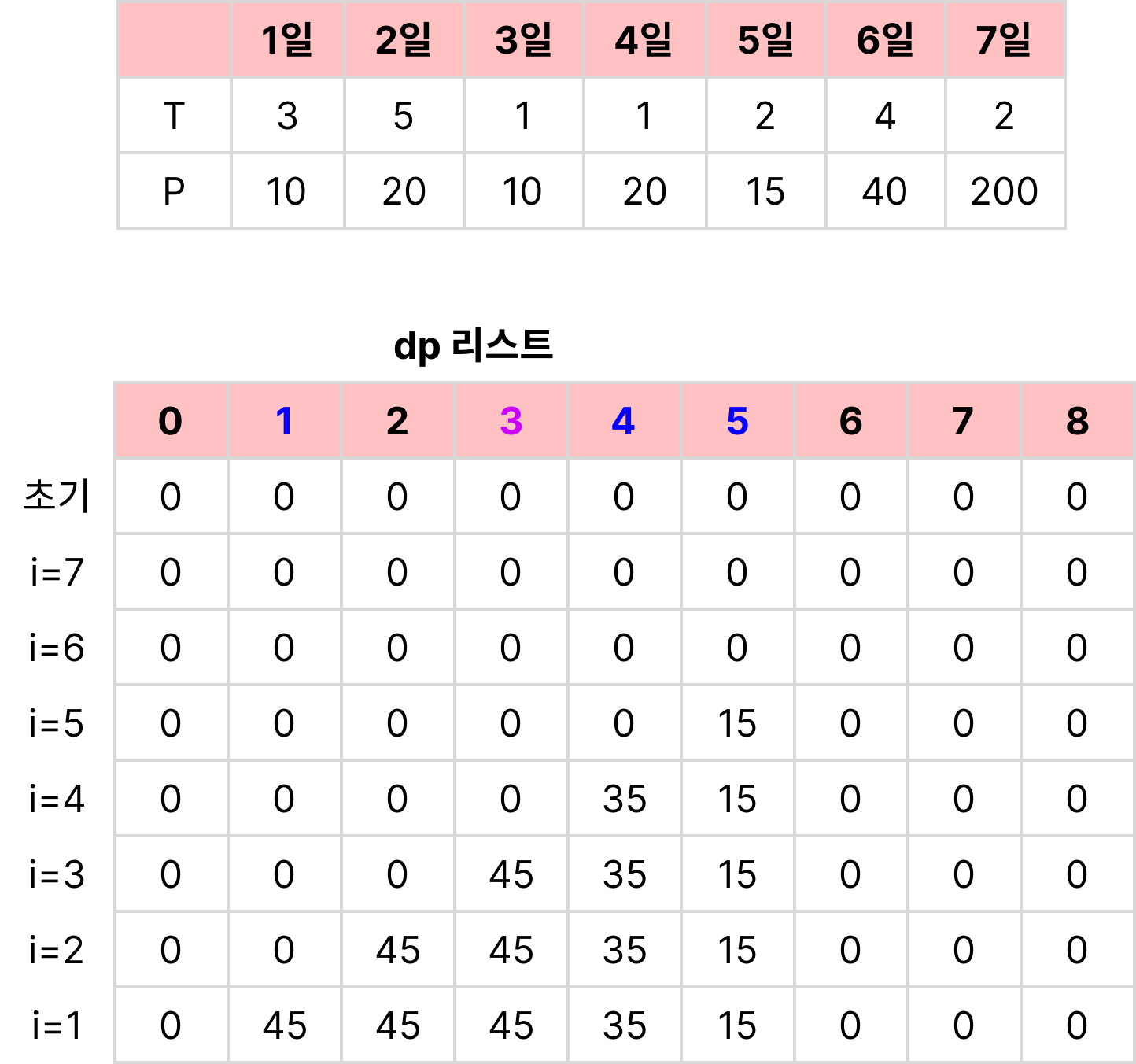
import sys
sys.stdin = open("sample_input.txt", "r")

# 상담이 가능한 기간 n (n+1일에 퇴사)
n = int(sys.stdin.readline())
schedules = [[] for _ in range(n+1)]
for i in range(1, n+1):
    schedules[i] = list(map(int, sys.stdin.readline().split()))
# [[], [3, 10], [5, 20], [1, 10], [1, 20], [2, 15], [4, 40], [2, 200]]
print(schedules)

dp = [0 for i in range(n+2)]

# 거꾸로 접근
for i in range(n, 0, -1):
    if i + schedules[i][0] - 1 > n:  # 퇴사일보다 오래 걸리면
        dp[i] = dp[i+1]
    else:  # 퇴사일보다 짧게 걸리면
        dp[i] = max(schedules[i][1] + dp[i + schedules[i][0]], dp[i+1])
    print(i)
    print(dp)

print(dp[1])
[백준][2309] 일곱 난쟁이
완전 탐색 (Brute Force)
import sys
sys.stdin = open("sample_input.txt", "r")

# 일곱 난쟁이의 키 입력 받기
heights = []
for _ in range(9):
    heights.append(int(sys.stdin.readline()))
# 키 정렬
heights.sort()

found = False
for i in range(9):
    for j in range(i+1, 9):
        if sum(heights) - heights[i] - heights[j] == 100:
            del1, del2 = i, j  # 삭제할 난쟁이 인덱스
            found = True
            break

    if found:
        # 두 난쟁이를 리스트에서 제거
        heights.pop(del2)
        heights.pop(del1)
        break

for height in heights:
    print(height)
[백준][23971] ZOAC 4
이 문제는 for문 돌리면서 완전 탐색처럼 짰더니, 메모리 초과가 떴다.
도저히 해법이 안 보여서 찾아봤더니.. 너무 간단하게 끝났다. 🤯 으악!
import math
import sys
sys.stdin = open("sample_input.txt", "r")

# 행의 개수 h, 열의 개수 w, 세로 n칸, 가로 m칸 이상 비워서 앉기
h, w, n, m = map(int, sys.stdin.readline().split())

print(math.ceil(h/(n+1)) * math.ceil(w/(m+1)))
[백준][2667] 단지번호붙이기
import sys
from collections import deque
sys.stdin = open("sample_input.txt", "r")
n = int(sys.stdin.readline())
graph = list(list(map(int, sys.stdin.readline().strip())) for _ in range(n))

dx = [-1, 1, 0, 0]
dy = [0, 0, -1, 1]

blocks = []

def bfs(x, y):
    queue = deque([(x, y)])
    graph[x][y] = "V"
    count = 1

    while queue:
        x, y = queue.popleft()

        for i in range(4):
            nx, ny = x + dx[i], y + dy[i]
            if 0 <= nx < n and 0 <= ny < n:
                if graph[nx][ny] == 1:
                    graph[nx][ny] = "V"
                    queue.append((nx, ny))
                    count += 1
    return count

for r in range(n):
    for c in range(n):
        if graph[r][c] == 1:
            blocks.append(bfs(r, c))

blocks.sort()
print(len(blocks))
for b in blocks:
    print(b)
[백준][9184] 신나는 함수 실행
DP (동적 프로그래밍)
import sys
sys.stdin = open("sample_input.txt", "r")

dp = [[[0 for _ in range(21)] for _ in range(21)] for _ in range(21)]


def w(a, b, c):
    if a <= 0 or b <= 0 or c <= 0:
        return 1
    if a > 20 or b > 20 or c > 20:
        return w(20, 20, 20)
    if dp[a][b][c]:
        return dp[a][b][c]
    if a < b < c:
        dp[a][b][c] = w(a, b, c-1) + w(a, b-1, c-1) - w(a, b-1, c)
        return dp[a][b][c]
    dp[a][b][c] = w(a-1, b, c) + w(a-1, b-1, c) + \
        w(a-1, b, c-1) - w(a-1, b-1, c-1)
    return dp[a][b][c]


while True:
    a, b, c = map(int, sys.stdin.readline().split())
    if a == -1 and b == -1 and c == -1:
        break
    print(f"w({a}, {b}, {c}) = {w(a, b, c)}")
[백준][2565] 전깃줄
DP - LIS 알고리즘
import sys
sys.stdin = open("sample_input.txt", "r")

n = int(sys.stdin.readline())
wires = []
for _ in range(n):
    wires.append(list(map(int, sys.stdin.readline().split())))
# [[1, 8], [3, 9], [2, 2], [4, 1], [6, 4], [10, 10], [9, 7], [7, 6]]
wires.sort()
# [[1, 8], [2, 2], [3, 9], [4, 1], [6, 4], [7, 6], [9, 7], [10, 10]]

dp = [1] * n

for i in range(1, n):
    for j in range(i):
        if wires[i][1] > wires[j][1]:
            dp[i] = max(dp[i], dp[j] + 1)
        #print("i", i, "j", j, dp)

print(n-max(dp))